

Ringing a Korean Doorbell: What to Say When the Intercom Buzzes
Phase 1: Empathy (Welcome to the Hallway Freeze!)
안녕하세요! 매일한글 에디터입니다. (Hello! I’m your Daily Hangul editor.)
Picture this classic K-Drama scene: You have finally arrived at your Korean friend’s apartment in Mapo-gu for dinner. You stepped out of the elevator into a pin-drop silent corridor. You find unit 804, take a deep breath, and press the sleek digital chime. Ding-dong!
Suddenly, the speaker crackles with static, and a sharp electronic voice asks: “누구세요?” (Who is it?).
Your pulse spikes. Do you state your full name like you are reporting for a job interview? Do you whisper “It’s me”? Do you stand at attention staring into the tiny camera lens, or should you step back?
If you have ever felt paralyzed at a Korean front door, you are certainly not alone. Over ten years of guiding international students and travelers in Seoul, I have watched countless learners master complex grammar in textbooks, only to freeze when a wall-mounted video phone buzzes at them.
Standing on the doormat is where real-life Korean truly begins. In this guide, we will unpack the exact words, vocal tones, and unwritten apartment manners you need so you can announce your arrival like a charming, thoughtful local.
Phase 2: Core Expressions in Depth
Here are the top three arrival expressions every A2 learner should keep in their pocket.
1. 저 왔어요! (Jeo wasseoyo!)
- Pronunciation: Jeo wasseoyo (Sounds like “Juh wah-ssuh-yo”, where jeo rhymes with “law”).
- Meaning: Literal: “I have come / I arrived.” | Real Nuance: “I’m here! / Honey, I’m home!”
- K-Culture Moment: Heard in almost every warm home-cooked meal episode in K-dramas when someone drops by a friend’s housewarming party (집들이 – jipdeuri).
- Editor’s Insight: In English, you might say “I’m here!” using the verb to be. In Korean, however, arrival is expressed as a completed action of moving toward the host: 오다 (to come) -> 왔어요 (came). It signals that your journey is complete and you are right at their doorstep.
- Situation Spectrum: Casual: ✅ (왔어!) | Semi-formal: ✅ (저 왔어요!) | Formal: ⚠️ (도착했습니다)
- 🤔 Think About It: Why does Korean highlight the act of coming rather than static presence? It reflects a mindset focused on the host-guest connection established along the way!
2. 저 [Name]이에요 / 저예요 (Jeo [Name]-ieyo / Jeoyeyo)
- Pronunciation: Jeo [Name]-ieyo / Jeo-ye-yo (Sounds like “Juh-yeh-yo”).
- Meaning: Literal: “I am [Name]” / “It is me.” | Real Nuance: “It’s [Name]! / It’s just me!”
- K-Culture Moment: Speaking right into the intercom screen (월패드 – wallpad) when the host asks “누구세요?”.
- Editor’s Insight: If your host is expecting you, saying 저는 [Name]입니다 sounds like an FBI agent announcing an inspection. Using 저예요 (“It’s me!”) or 저 [Name]이에요 strikes the perfect balance of polite friendliness.
- Situation Spectrum: Casual: ✅ (나야!) | Semi-formal: ✅ (저예요!) | Formal: 🚫 (신원을 명확히 밝혀야 함)
- 🤔 Think About It: Saying “It’s me” requires shared trust. When a Korean host opens the door upon hearing 저예요, you know you have entered their inner social circle.
3. 문 열어 주세요 (Mun yeoreo juseyo)
- Pronunciation: Mun yeoreo juseyo (Sounds like “Moon yuh-ruh joo-seh-yo”).
- Meaning: Literal: “Please open the door.” | Real Nuance: “Could you buzz me in?”
- K-Culture Moment: When you are downstairs at the apartment building’s communal ground floor security gate (공동현관) and need your friend to unlock the glass doors.
- Editor’s Insight: Add a slight melodic lift at the end (주세요~). It softens the imperative command into a cheerful, inviting request.
- Situation Spectrum: Casual: ✅ (문 열어줘) | Semi-formal: ✅ (문 열어 주세요) | Formal: ⚠️ (문 좀 열어 주시겠습니까?)
- 🤔 Think About It: Modern Korean apartments use two layers of digital locks. How does this two-tier intercom culture balance privacy with hospitality?
Phase 3: Textbook Korean vs. Real Korean
Situation 1: Answering the Intercom (“누구세요?”)
- 📖 교과서 한국어 (Textbook): “저는 마이클입니다. 문을 열어 주십시오.” (Jeoneun maikeurimnida. Muneul yeoreo jusipsio. – “I am Michael. Please open the door.”)
- 🗣️ 진짜 한국어 (Real-Life): “민수 씨, 저 마이클이에요! 도착했어요~” (Minsu ssi, jeo maikeurieyo! Dochakhaesseoyo~ – “Minsu, it’s Michael! I’m here~”)
- 💡 왜 다를까?: Traditional textbooks lean heavily on stiff, honorific declarative endings (-십시오). Real-world friends speak with a bright, friendly -요 ending that creates immediate warmth.
Situation 2: Announcing You Are Outside the Front Door
- 📖 교과서 한국어 (Textbook): “계십니까?” (Gyesimnikka? – “Is anyone present?”)
- 🗣️ 진짜 한국어 (Real-Life): (초인종 누른 후) “계세요~? 저 왔어요!” ((Choinjong nureun hu) “Gyeseyo~? Jeo wasseoyo!” – After ringing: “Anyone home~? I’m here!”)
- 💡 왜 다를까?: 계십니까? sounds like a character from a historical drama (사극) or a tax auditor knocking in 1985. A light 계세요~? with rising intonation sounds natural and approachable.
Phase 4: K-Culture Deep Dive & Non-Verbal Manners
4-1. 눈치 (Nunchi) & Intercom Gestures
- The One-Ring Rule: Korean apartment hallways are narrow and echo intensely. Never ring twice in rapid succession (띵동-띵동-띵동!). Press the bell firmly once, step two feet back from the door, and wait at least 15 seconds.
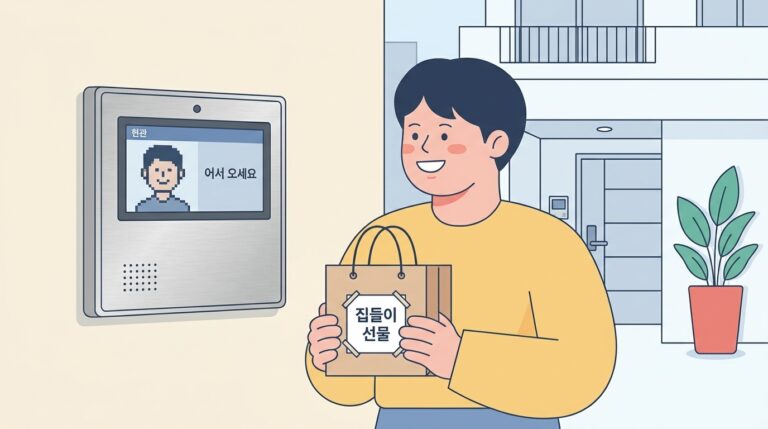
- Screen Positioning: Step back so the wide-angle camera captures your face rather than your forehead or chest. If you brought a small gift or takeout box, hold it slightly up near your shoulder with a gentle smile so the host sees it right away on their living room monitor!
- Threshold Etiquette (현관 매너): Do not cross into the shoe-dropping foyer (현관 – hyeongwan) until the host formally swings the door open and gestures for you to enter.
4-2. Cultural Code: The Housewarming Gift Code (휴지와 세제)
If you are visiting a newly moved home, you never press the doorbell with completely empty hands (빈손). In Korean culture, guests bring toilet paper roll packs (휴지 – hyuji), which symbolize things unraveling smoothly (일이 술술 풀리다), or laundry detergent (세제 – seje), whose bubbles symbolize wealth bubbling up in the new home.
Phase 5: Real-Life Roleplay Scenario
Setting: You (Alex) have taken the elevator to the 8th floor of an apartment complex in Seoul to visit your Korean classmate, Min-ji.
- Alex: (Ding-dong!) [🎭 띵동 누르고 카메라를 보며 살짝 미소를 짓는다]
“계세요? 민지 씨, 저 알렉스예요!”
(Gyeseyo? Minji ssi, jeo allekseuyeyo! / “Anyone home? Minji, it’s Alex!”) - Min-ji: [🎭 인터폰 스피커 너머로 들려오는 반가운 목소리]
“어, 알렉스 왔어? 잠깐만, 문 열어 줄게!”
(Eo, allekseu wasseo? Jamkkanman, mun yeoreo julge! / “Oh, Alex, you’re here? Hold on, I’ll unlock the door!”) - Sound: (Door lock buzzes: 삐리릭- 찰칵!)
- Min-ji: [🎭 문을 활짝 열며 반갑게 맞이한다]
“어서 와! 날씨 추운데 오느라 고생했어.”
(Eoseo wa! Nalssi chuunde oneura gosaenghaesseo. / “Welcome! It’s so cold outside, you must have had a rough trip.”) - Alex: [🎭 고개를 가볍게 숙이며 과일 상자를 건넨다]
“아니에요! 금방 왔어요. 초대해 줘서 고마워요.”
(Anieyo! Geumbang wasseoyo. Chodaehae jwoseo gomawoyo. / “Not at all! I got here quickly. Thanks for having me over.”) - Min-ji: [🎭 양손으로 선물을 받으며 감동한 표정]
“어머, 빈손으로 와도 되는데 뭘 이런 걸 사 왔어! 잘 먹을게.”
(Eomeo, binsoneuro wado doeneunde mwol ireon geol sa wasseo! Jal meogeulge. / “Oh my, you could have come empty-handed, why did you buy this! We’ll enjoy it.”) - Alex: [🎭 현관 타일에서 신발을 가지런히 벗는다]
“작은 선물이에요. 집이 진짜 깨끗하고 예쁘네요!”
(Jageun seonmurieyo. Jibi jinjja kkaekkeuthago yeppeuneyo! / “Just a small gift. Your place is really clean and pretty!”) - Min-ji: [🎭 실내 슬리퍼를 발앞에 놓아주며]
“고마워! 자, 여기 슬리퍼 신어. 편하게 앉아 있어~”
(Gomawo! Ja, yeogi seullipeo sineo. Pyeonhage anja isseo~ / “Thanks! Here, put on these slippers. Relax and make yourself at home~”) - Alex: [🎭 슬리퍼를 신고 거실로 들어가며]
“네, 실례하겠습니다!”
(Ne, sillyehagesseumnida! / “Yes, excuse me for coming in!”)
🔀 Interactive Choice Point
The speaker crackles and Min-ji asks: “누구세요?” (Who is it?). What do you say?
* Option A: “저 알렉스예요! 문 열어 주세요~”
👉 Feedback [BEST]: Perfect! Friendly identification followed by a polite request. Min-ji unlocks the door immediately with a smile.
* Option B: “저는 미국인 알렉스입니다. 문을 열어 주십시오.”
👉 Feedback [BAD]: Far too formal! You sound like a door-to-door sales agent or an officer on official business. It creates instant awkwardness.
* Option C: (Silence, then furiously pressing the doorbell button 3 more times)
👉 Feedback [RISK]: Major social faux pas! Ringing repeatedly without speaking scares whoever is inside and disturbs the quiet hallway neighbors.
Phase 6: 10-Second Emotion Shadowing Drill
Practice these lines out loud with the indicated pausing (/) and emotional tone!
- [😊 Bright & Upbeat / 반갑고 씩씩하게]
“민지 씨, / 저 왔어요! / 문 열어 주세요~”
(Minji ssi, / jeo wasseoyo! / mun yeoreo juseyo~) -
[🥺 Shy yet Polite / 쑥스럽지만 정중하게]
“초대해 주셔서 / 정말 감사해요! / 집이 너무 좋아요.”
(Chodaehae jusyeoseo / jeongmal gamsahaeyo! / jibi neomu joayo.) -
[✨ Considerate & Sweet / 센스 있고 다정하게]
“날씨가 추워서 / 따뜻한 음료수 / 좀 사 왔어요!”
(Nalssiga chuwoseo / ttatteut-han eumryosu / jom sa wasseoyo!)
Phase 7: K-Culture Mini Dictionary
- 초인종 (Choinjong) | Doorbell
Usage: The physical chime button or electronic ringer on outside walls. (초인종을 누르다 = to press the doorbell). - 현관 (Hyeongwan) | Entryway / Foyer
Usage: The dedicated sunken tiled area just inside the door where shoes are taken off and kept separate from wooden flooring. - 실내화 (Silnae-hwa) | Indoor Slippers
Usage: Soft slippers provided by hosts to keep guest feet warm and preserve pristine floorboards. - 집들이 (Jipdeuri) | Housewarming Party
Usage: The beloved Korean social tradition of inviting friends, coworkers, and family over to celebrate moving into a new apartment.
Phase 8: Survival Kit for Travelers
Top 3 Survival Phrases
- 1층 공동현관 번호가 뭐예요? (Il-cheung gongdong-hyeongwan beonhoga mwoyeyo?)
Pro Tip: Many apartment buildings require a pin code or keycard just to enter the elevator lobby on the ground floor. Ask this before you leave! - 경비실에 맡겨 주세요. (Gyeongbisire matgyeo juseyo.)
Pro Tip: Essential when delivery drivers or couriers call you while you are away from your Airbnb. - 지금 엘리베이터 타고 올라가요! (Jigeum ellibeiteo tago ollagayo!)
Pro Tip: Text this to your friend when you pass the first-floor gate so they can unlock the unit door just as you arrive.
Editor’s Travel Note
When visiting a residential high-rise complex (아파트 단지), standard western mapping apps frequently mix up building numbers (동 – Dong) and entryway stairwells. Make sure to download the 네이버 지도 앱 다운로드 before heading out. Also note: On Korean communal keypad consoles, you usually punch in [Unit Number] + [호] + [Bell Button (🔔)] or [*] + [Unit Number] + [*] to ring the room!
Phase 9: “One Step Deeper” (Cultural Essay)
In Korean culture, the front door is not merely a piece of wood or steel—it is the boundary (경계) between the harsh public world (바깥) and the warm inner sanctuary (집안). When you take off your shoes at the 현관 and announce “저 왔어요!”, you are honoring that boundary. By stepping out of street shoes and slipping into indoor slippers, you shed external dirt and stress, signaling to your host: “I enter your home with peace and trust.” This transition is the quiet cornerstone of Korean domestic hospitality.
💬 Your Turn: How do guests announce themselves at the door in your home country? Do you ring the bell and wait quietly, or call ahead on your phone? Share your arrival habits in the comments below!
Phase 10: FAQ & Common Mistakes
Q: Should I call my host on the phone or just press the doorbell?
A: In modern Korea, a quick text message (“저 1층 로비 도착했어요!” – “I arrived at the 1st-floor lobby!”) before buzzing the unit bell is considered extremely courteous because it allows hosts a 60-second window to put their pets away or tidy up the entryway.
Q: What should I do if nobody answers on the first doorbell chime?
A: Wait at least 20 seconds. Apartment floor plans can be large, or your host might be in the kitchen cooking with an extractor fan on. Ring once more gently, and if there is still no answer, send a quick text message rather than repeatedly pressing the chime.
Q: Can I step onto the wooden floor with my socks while taking off my shoes?
A: Never let your clean socks touch the sunken tiled floor where dirty outdoor shoes rest! Step directly from the inside of your shoes straight up onto the elevated wooden floor or directly into slippers.
🚨 Common Mistakes Alert!
- Mistake: Chime Bombing (초인종 연타).
Correct Action: Press once, wait 15 seconds. Respect hallway acoustics. - Mistake: Staring blankly at the door handle instead of the intercom camera.
Correct Action: Look up at the camera lens so the host can clearly identify your smiling face on their wall pad. - Mistake: Saying “누구세요?” yourself when the speaker crackles.
Correct Action: The host asks “누구세요?” (Who is it?); your line is “저 [Name]이에요!” (It’s [Name]!).
Phase 11: Action Mission & Challenge
- 🥉 Bronze Mission (Solo Practice): Look into your phone’s front camera and practice saying: “민지 씨, 저 [Your Name]이에요! 저 왔어요~” with a bright smile 3 times.
- 🥈 Silver Mission (Community Share): Share your favorite K-drama doorbell scene or entryway line on social media and tag
#DailyHangul. - 🥇 Gold Mission (Real-Life Application): The next time you visit a Korean home, Airbnb host, or even a local private dining room, announce yourself using “저 왔어요!” without hesitating!
- 🎮 K-Culture Mission: Watch an episode of a slice-of-life drama like Reply 1988 or Hospital Playlist. Pay attention to how visitors shout “나 왔어!” or “저 왔어요!” as they step inside.
Phase 12: Interactive Quiz Challenge
Test your doorbell instincts!
- Situation Judgment: You just pressed the intercom button at your friend’s apartment. A voice asks “누구세요?”. What is the most natural reply?
- (A) 저는 손님입니다. (Jeoneun sonnimimnida.)
- (B) 저 수잔이에요! 저 왔어요~ (Jeo suzanieyo! Jeo wasseoyo~)
- (C) 누구세요? (Nuguseyo?)
- Fill in the Blank: When asking your host to open the door through the intercom, you say:
- “민수 씨, 문 ( _____ ) 주세요!”
- True or False: It is considered polite to press the doorbell repeatedly 4-5 times to show enthusiasm about visiting your friend.
- [True / False]
👉 Click here to check your answers & explanations!
- Answer: (B)
Explanation: Stating “저 [Name]이에요! 저 왔어요~” is warm, polite, and natural. (A) is unnaturally formal, and (C) means you are asking the host who they are in their own home! - Answer: 열어 (yeoreo)
Explanation: 열다 (to open) combines with -아/어 주세요 to form 열어 주세요 (Please open the door). - Answer: False
Explanation: Rapidly buzzing the chime causes noise pollution in quiet apartment hallways and alarms the resident. One firm press is the golden standard!







