

Pulling an All-Nighter for the Olympics: Scream, Cheer, and Snack Like a Local in Korea
Phase 1: Empathy (Late-Night Glory in Seoul)
안녕하세요! 매일한글 에디터입니다. (Hello! This is your Daily Hangul editor.)
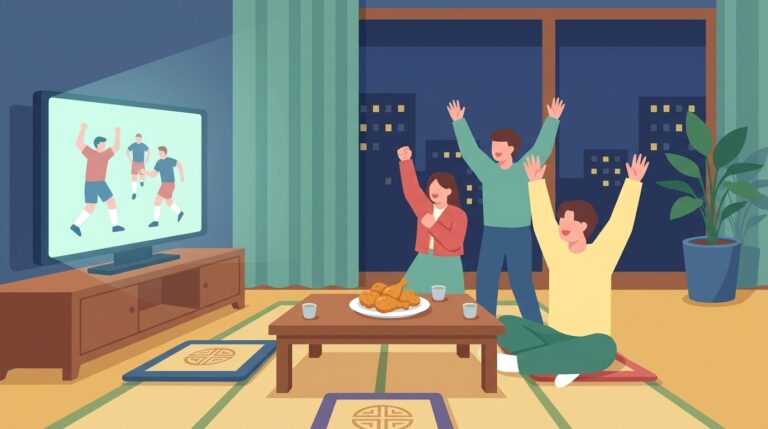
Picture this: It is 3:15 AM on a stifling Tuesday night in Seoul. Outside, the streets are eerily quiet, but if you look up at the towering apartment complexes, hundreds of living room windows glow with a faint, flickering blue light. Inside your friend’s apartment, an open carton of crispy garlic-soy fried chicken sits on the low table alongside empty beer cans and chilled barley tea. The Olympic archery shoot-off or football knockout match is entering sudden death on the screen.
Your Korean friends are clutching sofa pillows with white knuckles, their eyes glued to the display. You want to match their electrifying energy, but your brain blanks out. The only sentence coming to mind from your textbook is: “저는 한국 팀을 응원하고 있습니다” (Jeoneun hanguk timeul eungwonhago itseumnida — “I am supporting the Korean team”). You say it. The room suddenly feels like a formal lecture hall, and your friend gives you an amused, sympathetic pat on the back.
Cheering during late-night international sports events is a sacred, high-octane ritual in South Korea. Because of global time-zone differences, Koreans regularly band together to sacrifice sleep for glory. In this guide, built from years of coaching intermediate learners and countless sleepless nights cheering on Team Korea, you’ll learn the exact slang, expressive reactions, and unspoken social etiquette needed to pull an unforgettable Olympic all-nighter.
Phase 2: Top 3 Core Expressions (Deep Dive)
1. 오늘 밤새워야겠다! (Oneul bamsaewoyagetda!)
- Pronunciation: Oh-neul bam-sae-wo-ya-get-da (Sounds like the English word “bomb” + “say” + “wo” + “ya” + “get-dah”).
- Meaning: Literal: “I should stay up all night today!” | Real Nuance: “There’s no way I’m going to sleep tonight—let’s ride this hype out till sunrise!”
- K-Culture Moment: You will hear this in almost every Korean variety show (like Running Man or I Live Alone) whenever an exciting mission extends past midnight, or during World Cup and Olympic broadcast specials.
- Editor’s Insight: The suffix -겠다 (-getda) implies personal determination and assumption. Saying this signals to everyone in the room that you are fully committed to the match and won’t tap out early.
- Situation Spectrum: Casual (✅) / Semi-formal (⚠️ – with 존댓말: “오늘 밤새워야겠어요”) / Formal (🚫)
- 🤔 Think About It: In many Western cultures, pulling an all-nighter is seen as an exhausting chore. Why do you think Korean youth treat “밤샘 (bamsaem)” as a celebratory badge of shared loyalty?
2. 제발 역전 가자! (Jebal yeokjeon gaja!)
- Pronunciation: Je-bal yeok-jeon ga-ja (Sounds like “Jay-bahl yuck-jun gah-jah”).
- Meaning: Literal: “Please, let’s go for a reversal!” | Real Nuance: “Please, let’s turn the tables! Comeback win, let’s go!”
- K-Culture Moment: Frequently shouted during Olympic short-track speed skating or fencing when a Korean athlete is trailing in second place before the final sprint.
- Editor’s Insight: 역전 (Yeokjeon) means turning a losing game into a victory. Combining it with 가자 (gaja – let’s go) is the ultimate rallying cry when your team is trailing by just one point.
- Situation Spectrum: Casual (✅) / Semi-formal (⚠️ – with 요: “역전 가요!”) / Formal (🚫)
- 🤔 Think About It: Does your native language have a short, punchy phrase specifically dedicated to comeback victories, or do you describe the entire play instead?
3. 아, 완전 아깝다! (A, wanjeon akkaptda!)
- Pronunciation: Ah, wan-jeon ah-kkap-da (“Wan” as in “wander”, “jeon” like “jun”, and “akkap-da” with a crisp double-k stop).
- Meaning: Literal: “Ah, completely wasted/pitiable!” | Real Nuance: “Oh, that was SO close! What a heartbreaker!”
- K-Culture Moment: The standard reaction whenever an archery arrow hits an 8.9 ring or a football strike bounces violently off the crossbar.
- Editor’s Insight: 아깝다 (Akkapda) is one of the most uniquely versatile emotive words in Korean. It denotes the regret of coming tantalizingly close to something good, only to miss it by a hair.
- Situation Spectrum: Casual (✅) / Semi-formal (✅ – “아, 완전 아까워요!”) / Formal (⚠️)
- 🤔 Think About It: How does naming the collective feeling of “wasted effort or close calls” help a group bond through disappointment?
Phase 3: Textbook Korean vs. Real Korean
Situation 1: Cheering passionately for victory
- 📖 교과서 한국어 (Textbook): “한국 선수들이 이기기를 간절히 바랍니다.” (Hanguk seonsudeuri igigireul ganjeolhi baramnida. – “I earnestly desire that the Korean athletes win.”)
- 🗣️ 진짜 한국어 (Real-World): “대한민국 가자! 오늘 끝까지 달린다!” (Daehanminguk gaja! Oneul kkeutkkaji dallinda! – “Let’s go Korea! We are running with this all the way tonight!”)
- 💡 왜 다를까? (Why is it different?): Textbook Korean over-relies on long, descriptive verbs expressing passive wishes. In actual sports viewing, Koreans rely on rhythmic, action-driven verbs (달린다 – we run/charge) to build adrenaline.
Situation 2: Reacting to heart-stopping tension
- 📖 교과서 한국어 (Textbook): “경기가 매우 긴장되고 흥미진진합니다.” (Gyeonggiga maeu ginjangdoego heungmijinjinhamnida. – “The match is very tense and thrilling.”)
- 🗣️ 진짜 한국어 (Real-World): “진짜 심장 쫄깃해 미치겠다!” (Jinjja simjang jjolgit-hae michigetda! – “My heart is literally in my throat, this is insane!”)
- 💡 왜 다를까? (Why is it different?): Koreans frequently express physiological anxiety with culinary textures! 쫄깃하다 (Jjolgit-hada) literally means chewy or taut (like fresh rice cakes). Describing your heart as chewy vividly captures that clenched, breathless feeling.
Phase 4: K-Culture Deep Dive & Non-Verbal Manners
4-1. Nunchi & The Late-Night Apartment Dilemma (층간소음)
Over 60% of South Koreans live in multi-unit apartment complexes (아파트). Sound travels effortlessly through concrete floors and walls. When Korea scores an equalizer at 3:45 AM, screaming at the top of your lungs will immediately get you reported by the apartment security guard (경비원 아저씨).
* The Muffled Pillow Scream: When something thrilling happens, grab a couch cushion, bury your face into it, and unleash your cheer.
* The Silent High-Five & Knee Slap: Koreans master the art of wide-eyed, silent victory dances. Instead of stomping, slap your own knees or exchange frantic, air-cushioned high-fives.
* The Legendary Clap Rhythm: Every Korean child is born knowing the rhythm: “Dae~han-min-guk!” followed by five rapid claps: Clap-Clap, Clap, Clap-Clap (👏-👏, 👏, 👏-👏). Master this tempo to instantly earn respect.
4-2. The Cultural Fuel: Late-Night Yasik (야식) & Chicken Warfare
Watching Olympic matches without 야식 (late-night snacks) is unimaginable in Korea. Chimaek (치맥 – Chicken + Maekju/Beer) is king. However, during major Olympic matches, delivery applications crash from overload 30 minutes before kickoff. The pro-tip used by locals is to pre-order your chicken at 10 PM with a designated scheduled delivery time.
Phase 5: Real-World Roleplay Scenario
Setting: It is 2:50 AM in Seoul. You are sitting on the rug in Minjun’s living room. The Olympic football quarterfinal is tied 1-1, heading into 5 minutes of extra stoppage time.
- 민준 (Minjun): “야, 추가 시간 5분 줬어! 치킨 식기 전에 얼른 더 먹어!”
(Ya, chuga sigan obun jwosseo! Chikin sikgi jeone eolleun deo meogeo!)
[🎭 Biting his fingernails while staring intently at the TV]
“Hey, they gave 5 minutes of added time! Eat some more chicken before it gets cold!” -
나 (You): “치킨이 목에 안 넘어가. 나 지금 심장 쫄깃해 죽겠어.”
(Chikini moge an neomeoga. Na jigeum simjang jjolgit-hae jukgesseo.)
[🎭 Clutching a small sofa pillow to your chest]
“I can’t even swallow chicken. My heart is pounding like crazy right now.” -
민준 (Minjun): “맞아, 여기서 한 골 먹히면 바로 끝이야. 제발 한 번만 막자!”
(Maja, yeogiseo han gol meokhymyeon baro kkeuchiya. Jebal han beonman makja!)
[🎭 Leaning forward, his hands clasped together as if praying]
“Right, if we concede a goal here, it’s over. Please, let’s just defend this once!” -
나 (You): “아, 완전 아깝다! 방금 슈팅 봤어? 골대 맞았어!”
(A, wanjeon akkaptda! Banggeum syuting bwasseo? Goldae majasseo!)
[🎭 Gasping silently and slapping both your knees]
“Ah, that was so close! Did you see that shot? It hit the post!” -
민준 (Minjun): “진짜 미치겠다! 1분 남았어. 오늘 우리 밤새워야겠다, 승부차기 갈 것 같아.”
(Jinjja michigetda! Ilbun namasseo. Oneul uri bamsaewoyagetda, seungbuchagi gal geot gata.)
[🎭 Running both hands through his hair in frantic excitement]
“Seriously driving me crazy! 1 minute left. We definitely have to pull an all-nighter, looks like penalty shootouts.” -
나 (You): “아직 안 끝났어! 마지막 코너킥이야. 제발 역전 가자!”
(Ajik an kkeutnasseo! Majimak koneokikiya. Jebal yeokjeon gaja!)
[🎭 Pointing your index finger firmly toward the screen]
“It’s not over yet! Final corner kick. Please, let’s get the comeback goal!” -
민준 (Minjun): “골이다!! 들어갔다!! 야! …읍! 소리 지르지 마, 베개에 대고 질러!”
(Gorida!! Deureogatda!! Ya! …Eup! Sori jireuji ma, begaee daego jilleo!)
[🎭 Jumping up on the sofa, then instantly covering his mouth, gesturing wildly]
“Goal!! It went in!! Hey! …Oof! Don’t scream out loud, scream into the pillow!” -
나 (You): “대박! 역전골 미쳤다! 오늘 잠 다 잤네!”
(Daebak! Yeokjeongol michyetda! Oneul jam da janne!)
[🎭 Punching the pillow repeatedly with a massive grin]
“Incredible! That comeback goal was insane! No sleeping tonight!”
🔀 Interactive Decision Point
Korea scores the winning goal at 3:15 AM! What is your next move?
- Option A: Throw open the apartment sliding window and shout “대한민국 만세!” out into the courtyard at top volume.
Feedback: [BAD] 🚨 You will trigger an avalanche of angry complaints on the apartment intercom, and the security guard will visit within 5 minutes. - Option B: Exchange frantic silent high-fives with Minjun, bury your face into a cushion, and whisper loudly: “대박, 진짜 미쳤다!”
Feedback: [BEST] 🏆 Perfect balance of Korean nunchi (apartment etiquette) and high-level camaraderie! - Option C: Stand up formally, bow at a 90-degree angle, and say “한국 팀의 승리를 진심으로 축하드립니다.”
Feedback: [RISK] ⚠️ While grammatically immaculate, you’ll instantly deflate the late-night adrenaline rush and make your friend laugh at your robotic tone.
Phase 6: 10-Second Emotional Shadowing Drill
Practice these lines out loud. Focus on the pitch accents indicated by the slashes (/).
[🔥 비장하고 간절하게 - Resolute and Earnest]
“제발 / 한 골만 더 넣자! / 역전 가자!”
(Jebal / han golman deo neotja! / Yeokjeon gaja! — “Please / just one more goal! / Let’s turn the tables!”)-
[😱 심장이 조여오는 긴장감 - Heart-Throbbing Tension]
“진짜 / 심장 쫄깃해서 / 못 보겠어!”
(Jinjja / simjang jjolgit-haeseo / mot bogesseo! — “Honestly / my heart is so clenched / I can’t even watch!”) -
[🥳 환호하며 흥분된 톤 - Jubilant and Ecstatic]
“대박! / 오늘 우리 / 완전 밤새워야겠다!”
(Daebak! / Oneul uri / wanjeon bamsaewoyagetda! — “Incredible! / Tonight we / definitely have to pull an all-nighter!”)
Phase 7: K-Culture Mini Dictionary
-
야식 (Yasik)
Translation: Late-night meal / midnight snack.
Usage: Distinct from standard dinner. It refers to calorie-heavy treats like fried chicken, tteokbokki, or bossam ordered specifically after 10 PM while drinking or studying. -
역전패 vs. 역전승 (Yeokjeonpae vs. Yeokjeonseung)
Translation: Comeback loss vs. Comeback victory.
Usage: Essential sports commentary vocabulary. If you win from behind, it’s an exhilarating 역전승; if you blow a lead, it’s a bitter 역전패. -
심장 쫄깃하다 (Simjang jjolgit-hada)
Translation: To feel heart-clenching suspense.
Usage: Used not just for sports, but whenever you watch suspenseful K-dramas (like Squid Game) or wait for exam results. -
현생 복귀 (Hyeonsaeng bokgwi)
Translation: Returning to real life (reality).
Usage: The bitter moment at 7:00 AM after an all-nighter when you have to shower, put on a suit, and head to work or class after celebrating the match.
Phase 8: Traveler’s Survival Kit
Survival Expressions TOP 3
- “배달 얼마나 걸려요?” (Baedal eolmana geollyeoyo?)
Translation: “How long will delivery take?”
Pro Tip: Use this when calling a local chicken joint or messaging customer support during peak Olympic match days. - “아직 안 끝났어! 끝까지 봐!” (Ajik an kkeutnasseo! Kkeutkkaji bwa!)
Translation: “It’s not over yet! Watch till the very end!”
Pro Tip: Perfect cheer to encourage your Korean buddies when morale dips. - “내일 출근 어떡하지?” (Naeil chulgeun eotteokhaji?)
Translation: “What am I going to do about work tomorrow morning?”
Pro Tip: The universal bonding phrase shared by all Korean adults between 3:00 and 5:00 AM.
Editor’s Travel Note
- Ordering Yasik: If you are staying at a hotel or Airbnb without a local phone number, check out our [Baedal Minjok English delivery ordering guide] for step-by-step app navigation.
- 24-Hour Hangouts: If your accommodation has strict quiet hours, head to a 24-hour sports pub in Hongdae or a cozy 24-hour PC bang (internet café), where you can stream matches with high-speed internet while ordering ramen directly to your desk.
- Early Morning Transit: Subway lines close around midnight. If you stay out until 4:30 AM, you can catch the first train (첫차) near 5:20 AM, or hail an early ride using the [Kakao T taxi booking app guide].
Phase 9: “One Step Deeper” (Reflective Question)
In South Korea, international sports are rarely viewed as merely individual games; they are emotional catharsis for the collective “우리” (Uri — “We / Our”). Having endured rapid modern transformation, economic crises, and intense daily competition, the collective triumph of an athlete on the world stage feels like a personal victory for every citizen staying awake in their living room. Sharing an all-nighter over chicken and beer isn’t just about watching sports—it’s an unspoken affirmation that no matter how stressful daily life is, everyone in the room shares the same heartbeat.
💬 Your Turn: How does late-night sports watching bring people together in your home country? Have you ever sacrificed an entire night of sleep just to watch a match with friends? Drop your story in the comments below!
Phase 10: FAQ & Avoiding Misunderstandings
Q: Can I use “화이팅 (Hwaiting)” during Olympic matches?
A: Absolutely! 화이팅 (or 파이팅) is universally loved. However, using it alone makes your Korean sound elementary. Elevate it by combining it with action verbs, such as: “대한민국 파이팅! 끝까지 밀어붙이자!” (Daehanminguk paiting! Kkeutkkaji mireobuchija! — “Go Korea! Let’s push through to the end!”).
Q: What is the difference between “밤새우다” and “밤새다”?
A: 밤새우다 (bamsaeuda) is transitive—meaning you actively stay awake through the night on purpose. 밤새다 (bamsaeda) indicates the night passing by itself. In casual speech, natives frequently say “오늘 밤새야겠다” or “오늘 밤새워야겠다” interchangeably.
Q: Is it rude to celebrate loudly if Korea beats my home country?
A: Koreans appreciate sportsmanship. Friendly banter (장난) is welcomed, but boastful or gloating celebrations in public Korean venues can lead to genuine tension. Stick to mutual respect: praise both sides with “양 팀 다 진짜 잘 싸웠다” (Both teams fought really well).
🚨 Common Mistakes Warning Board
- Mistake: Shouting formal honorifics during a fast-break play (e.g., “패스해 주십시오!”).
Correction: Drop honorifics during split-second action: “패스!”, “슛!”, or “달려!”. - Mistake: Confusing “아쉽다 (aswipda)” and “아깝다 (akkapda)”.
Correction: Use 아쉽다 when you feel a lingering sense of melancholy or missing something pleasant. Use 아깝다 when you missed an immediate victory or goal by a hair’s breadth. - Mistake: High-fiving a senior colleague or older host with one wild hand.
Correction: Even in exciting moments, support your right elbow with your left hand when high-fiving someone older to show polite enthusiasm.
Phase 11: Action Missions
- 🥉 Bronze Mission (Solo Practice): Stand in front of your mirror and practice the phrase “진짜 심장 쫄깃해!” 3 times with expressive facial tension.
- 🥈 Silver Mission (Social Share): The next time an international match takes place, post an Instagram story of your snacks or screen captioned: “오늘 밤새워야겠다! ⚽🔥”.
- 🥇 Gold Mission (Real-World Execution): Join a group of Korean friends or visit a Korean pub during a game and shout “아, 완전 아깝다!” within 2 seconds of a missed score.
- 🎮 K-Culture Mission: Watch a highlight clip of the Korean Olympic archery team on YouTube and spot how many times the commentators say “아깝습니다” or “10점 갑니다!”.
Phase 12: Interactive Quiz Challenge
Test your knowledge before the next big match kicks off!
- Situational Judgment: It is the 89th minute, and Korea is losing 0-1. Suddenly, Korea gets a penalty kick. What should you shout?
- A) 오늘 일찍 자야겠다!
- B) 제발 역전 가자!
- C) 식사 맛있게 하세요.
- Fill in the Blank: When your heart is pounding with anxiety and excitement during a penalty shootout, you say:
“경기가 너무 치열해서 심장이 _________.”- A) 딱딱하다 (ttakttakhada)
- B) 쫄깃하다 (jjolgit-hada)
- C) 매콤하다 (maekomhada)
- True or False Cultural Trivia: When celebrating a late-night goal in a Seoul apartment at 3 AM, stomping loudly on the floor is considered standard camaraderie.
- [ ] True
- [ ] False
👉 Click here for answers and explanations!
-
Answer: B (제발 역전 가자!)
Explanation: When you need a turnaround, shouting for a reversal (역전) is the natural reaction. Option A means “I should sleep early,” and C means “Enjoy your meal.” -
Answer: B (쫄깃하다)
Explanation: 심장 쫄깃하다 is the iconic idiom for extreme match tension. 딱딱하다 means stiff/hard, and 매콤하다 means spicy! -
Answer: False
Explanation: Inter-floor noise (층간소음) is a major social issue in Korea. True locals celebrate by stifling screams into cushions or doing silent victory dances!







