

Phase 1: Empathy (Immersive Story Opening)
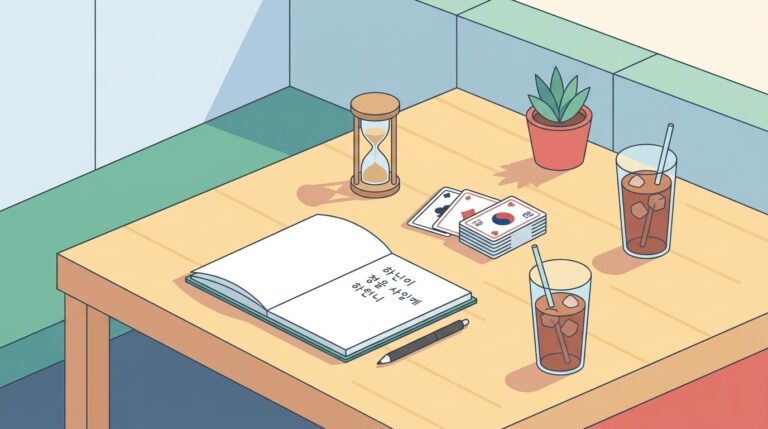
안녕하세요! 매일한글 에디터입니다. Have you ever sat around a wooden table in a bustling Hongdae board game cafe, surrounded by your Korean friends, only to feel a sudden chill run down your spine as someone points a finger at you and shouts, “야, 너 눈빛 흔들린다? (Ya, neo nunbit heundeullinda? – Hey, your eyes are wavering!)”
Playing the Mafia game (마피아 게임) in Korea is not just a casual pastime; it is an electric, high-stakes psychological battlefield. It tests your mastery of social intuition, split-second bluffing, and group dynamics. Countless advanced learners tell us that despite passing TOPIK Level 5 or 6, they freeze when the group enters a rapid-fire interrogation. The textbook phrase “저는 결백합니다 (I am innocent)” sounds so stiff that it immediately gets you voted out on turn one. Real Korean psychological warfare relies on subtle shifts in tone, micro-deflections, and high-context persuasion. This guide is crafted from authentic social sessions to elevate your Korean from grammatically precise to psychologically devastating.
Phase 2: Deep Dive into 3 Core Psychological Expressions
1. 몰아가다 (Mol-agada) / 몰아가지 마세요 (Mol-agaji maseyo)
- Pronunciation: [Mol-ah-gah-dah] (Sounds like mole-ah-gah-da – imagine burrowing a “mole” into a tight corner)
- Meaning: Literally “to herd/drive into a corner”; figuratively “to frame someone collectively” or “to gang up on someone without proof.”
- K-Culture Moment: Frequently heard on variety shows like Going Seventeen or Running Man when members coordinate a rapid witch hunt against an unsuspecting guest.
- Editor’s Insight: At a C1 level, notice the transitive particle. When you say “사람 하나 바보로 몰아가지 마세요 (Don’t gang up and make me look like a fool),” you expose the group’s cognitive bias rather than simply pleading innocence.
- Situation Spectrum: Casual: ✅ | Semi-formal: ✅ | Formal: ⚠️
- 🤔 Think About It: Why does Korean have a specific single verb for collective scapegoating (몰아가기)? How does it reflect the cultural power of collective consensus over individual assertion?
2. 넌지시 떠보다 (Neonjisi tteoboda)
- Pronunciation: [Neon-jee-shee tteo-boh-dah] (Sounds like nun-gee-see tuh-boh-dah – smooth, dipping a spoon lightly to taste soup)
- Meaning: Literally “to lightly scoop up”; figuratively “to probe slyly” or “to test the waters to see someone’s reaction.”
- K-Culture Moment: In psychological survival reality shows like The Genius or Bloody Game, a player subtly asks about a card rule just to observe their rival’s micro-expressions.
- Editor’s Insight: This is calculated reconnaissance. Saying “나 떠보지 마 (Stop fishing for a reaction)” establishes sharp interpersonal boundaries.
- Situation Spectrum: Casual: ✅ | Semi-formal: ✅ | Formal: 🚫
- 🤔 Think About It: In high-context languages, probing is rarely done through direct interrogation. Does your native tongue have a word that blends subtlety (넌지시) with speculative probing (떠보다)?
3. 딱 잡아떼다 (Ttak jabat-tteda)
- Pronunciation: [Ttak jah-bat-tteh-dah] (Snappy Ttak sound, like an abrupt snap of fingers)
- Meaning: Literally “to pull off cleanly”; figuratively “to feign total ignorance with a poker face” or “to flatly deny despite obvious guilt.”
- K-Culture Moment: Classic K-Drama courthouse or boardroom confrontations where a villain refuses to concede an inch until hard physical evidence slams onto the table.
- Editor’s Insight: Use this to call someone’s bluff: “끝까지 딱 잡아떼네? (You’re really going to deny it to the bitter end, huh?)”
- Situation Spectrum: Casual: ✅ | Semi-formal: ⚠️ | Formal: 🚫
- 🤔 Think About It: What does the crisp onomatopoeia 딱 (ttak) add to the psychology of flat denial?
Phase 3: Textbook Korean vs. Real Korean
Situation 1: Defending yourself when universally suspected
- 📖 교과서 한국어: 저는 마피아가 아니며, 시민입니다. (Jeoneun mapiaga animyeo, siminimnida. / “I am not the mafia; I am a citizen.”)
- 🗣️ 진짜 한국어: 내 목을 걸게. 나 지금 죽이면 시민 팀 판 바로 터져. (Nae mog-eul geolge. Na jigeum jugimyeon simin tim pan baro teojyeo. / “I bet my neck on it. If you execute me right now, the citizen team collapses instantly.”)
- 💡 왜 다를까? In real Korean games, claiming passive innocence sounds evasive. C1 speakers offer collateral (내 목을 건다) and frame their survival as an existential requirement for the group.
Situation 2: Spotting an inconsistency in someone’s alibi
- 📖 교과서 한국어: 당신의 진술에는 논리적 모순이 있습니다. (Dangsin-ui jinsureneun nollijeok mosuni itseumnida. / “There is a logical contradiction in your statement.”)
- 🗣️ 진짜 한국어: 말에 뼈가 있네? 지금 앞뒤 안 맞고 눈동자 흔들려. (Mare ppyeoga inne? Jigeum apdwi an matgo nundongja heundeullyeo. / “There’s hidden venom in your words. Your story doesn’t add up and your pupils are darting.”)
- 💡 왜 다를까? Intellectual jargon alienates party game participants. Colloquial metaphors like 말에 뼈가 있다 (pointed subtext) and somatic cues like 눈동자가 흔들린다 hit much harder.
Phase 4: K-Culture Deep Dive & Non-verbal Manners
4-1. 눈치 (Nunchi) & Micro-Gestures
During Korean deduction games, your body speaks louder than your vocabulary. Direct, aggressive staring (노려보기) is considered unsophisticated. Instead, observe through 곁눈질 (side-eye scans).
* When bluffed: Keep your palms open and flat against the table. Folding your arms or touching your collarbone screams defensiveness.
* When interrogating: Maintain a relaxed half-smile, tilt your head slightly (약 15도), and tap your index finger on the table in steady cadences. This relaxed posture projects complete psychological dominance.
4-2. Culture Code: MT (Membership Training) & Variety Show DNA
In Korea, Mafia is not merely a tabletop exercise; it is an institutional bonding ritual practiced during university MTs (엠티), corporate workshops, and military downtimes. Popularized by legendary variety shows like SBS’s X-Man (the foundational “Dang-yeon-haji” psychological duel) and modern cult hits like The Genius (더 지니어스), winning is secondary to crafting an entertaining narrative. If you play with cold clinical logic and zero emotion, you will often be executed simply for being “노잼 (boring/unfun)”. Showmanship and dramatic conviction are mandatory.
Phase 5: Real Role-play Scenario
Setting: A trendy board game cafe in Hongdae on a Friday night. Turn 3 of Mafia. Min-woo (analytical, calculating) and Ji-soo (high-energy instigator) corner you.
- 민우: 너 아까부터 말이 너무 없는데? 평소랑 텐션이 달라. (Neo kkabuteo mari neomu eonneunde? Pyeongsorang tensyeoni dalla.)
🎭 Leans chin on interlaced hands, eyes locked on you. - 나 (You): 조용히 판세를 읽고 있었을 뿐이야. 근거 없이 짚지 마. (Joyonghi panse-reul ilkgo isseosseul ppuniya. Geon-geo eopsi jipji ma.)
🎭 Casually takes a slow sip of iced Americano without blinking. - 지수: 판세를 읽어? 지난 턴에 민우 살리자고 한 거 너잖아! (Panse-reul ilgeo? Jinan teone Min-u salrijago han geo neojanha!)
🎭 Slaps the table playfully, pointing dramatically with both index fingers. - 민우: 지수 말이 맞아. 내가 의사라고 확신도 못 하면서 왜 쉴드 쳤어? (Jisu mari maja. Naega uisarago hwaksindo mot hamyeonseo wae swildeu chyeosseo?)
🎭 Raises one eyebrow, voice lowering to a confident murmur. - 나 (You): 쉴드가 아니라, 마피아가 짠 프레임에 안 낚인 거지. (Swildeuga anira, mapiaga jjan peureime an nakkin geoji.)
🎭 Chuckles softly, shaking your head in gentle disbelief. - 지수: 와, 이 사람 봐라? 말 돌리면서 또 우리 갈라치기 하네! (Wa, i saram bwara? Mal dollimyeonseo tto uri gallachigi hane!)
🎭 Turns her head to rally the other three players at the table. - 민우: 시간 30초 남았어. 시민이면 확실하게 스탠스 밝혀. (Sigan samsip-cho namasseo. Siminimyeon hwaksilhage seutaenseu balkhyeo.)
🎭 Taps his wristwatch with a composed, skeptical smirk. - 나 (You): 내가 마피아면 여기서 굳이 지수랑 각을 세웠겠어? 흑막은 따로 있어. (Naega mapiamyeon yeogiseo gudi Jisurang gag-eul se-wotgesseo? Heungmag-eun ttaro isseo.)
🎭 Spreads arms wide in open, unflinching clarity.
🔀 Interactive Branching Point
Min-woo raises his voting token. How do you deliver the knockout counter?
* Option A: “지수가 지나치게 과열된 거 안 보여? 지금 진짜 마피아는 뒤에서 웃고 있어.” (Best: Diverts attention to the agitator and questions group clarity)
* Option B: “아 진짜 아니라고 몇 번을 말해! 짜증 나게 왜 나만 괴롭혀!” (Bad: Emotional venting that confirms guilt under pressure)
* Option C: “그럼 그냥 나 죽여. 대신 다음 턴에 둘 다 책임져.” (Risk: High stakes; might provoke spite votes if tone isn’t charismatic)
Phase 6: 10-Second Emotional Shadowing Drill
Read these lines aloud using the indicated rhythm marks (/) and visceral emotional targets:
[😏 여유만만하고 도발적으로 / Relaxed and Provocative]
“그렇게 몰아가면, / 본인 정체 드러나는 건 / 시간문제일 텐데?”
(Geureoke mol-agamyeon, / bonin jeongche deureonaneun geon / siganmunje-il tende?)-
[😰 억울함을 논리로 승화하며 / Channeling Frustration into Sharp Logic]
“내 패 다 깔 테니까, / 나 죽고 나서 / 감당할 자신 있으면 투표해.”
(Nae pae da kkal tenikka, / na jukgo naseo / gamdanghal jasin isseumyeon tupyo-hae.) -
[🕵️ 날카롭게 핵심을 찌르며 / Piercing Deduction]
“눈동자 흔들렸어. / 방금 그 발언, / 마피아가 아니면 절대 나올 수 없지.”
(Nundongja heundeullyeosseo. / Banggeum geu bal-eon, / mapiaga animyeon jeoldae naol su eopji.)
Phase 7: K-Culture Mini Dictionary
- 심리전 (Simrijeon): Psychological warfare. Applied not only to gaming but to real-life negotiations, corporate salary reviews, and subtle dating tensions (밀당).
- 눈치싸움 (Nunchi-ssaum): A fierce battle of wits and non-verbal perception. Used widely when competing for seats during subway rush hours or timing ticket purchases.
- 흑막 (Heungmak): The puppet master or mastermind pulling the strings behind the scenes; borrowed heavily in political editorials and drama critiques.
- 빌드업 (Bil-deu-eop): A deliberate strategic setup over time (from football tactics). In conversation, crafting subtle clues across multiple turns before executing an ambush.
Phase 8: Traveler’s Survival Kit
Survival Expressions TOP 3
- “설명서 한 번만 다시 짚어주실래요?” (Seolmyeongseo han beonman dasi jipeojusillaeyo? / “Could the staff clarify this rulebook mechanic one more time?”)
Pro Tip: Board game cafe staff (알바생) love customers who clarify edge rules early. - “추리나 블러핑 위주 게임 추천해 주세요.” (Churina beulleoping wiju geim chucheonhae juseyo? / “Could you recommend games focused on deduction and bluffing?”)
Pro Tip: Ideal for finding hidden gems like *Avalon, Coup, or Salem beyond basic Mafia.* - “여기 1인 1음료 주문 필수인가요?” (Yeogi irin ireumnyo jumun pilsu-ingayo? / “Is ordering one drink per person mandatory here?”)
Pro Tip: Almost 99% of Korean board game cafes require this in addition to hourly table fees.
Editor’s Travel Note
When hunting for board game hubs, install the [Naver Map application for local Korean place searches]. Search for 보드게임카페 around major student hubs like Sinchon, Hyehwa, or Gangnam. Top chains include Red Button (레드버튼) and Boardgame Holic, which feature iPad video rulebooks and private booth seating.
Phase 9: One Step Deeper
In Korean society, the tension between individual dissent and collective solidarity is razor-thin. When playing games of deception, Koreans rarely rely purely on binary Western logic or formal debate structures. Instead, victory belongs to whoever can orchestrate collective mood and social validation. Accusing someone isn’t just about showing factual contradictions; it is about building a compelling emotional consensus that makes others feel safe following you.
💬 Your Turn: How does deception or bluffing change in your culture? Is it viewed as an intellectual puzzle or an interpersonal test? Share your thoughts below!
Phase 10: FAQ & Common Mistakes
Q: What should I do if my accent makes me an easy target for “몰아가기”?
A: Lean into it strategically! Say: “발음 핑계로 마피아 몰아가는 거 너무 날로 먹는 거 아니에요? (Isn’t blaming my accent a bit too lazy of a scapegoat?)” Humor immediately diffuses suspicion.
Q: Can I use 존댓말 (Honorifics) during an intense Mafia match?
A: Absolutely. In fact, keeping strict 존댓말 while ruthlessly destroying someone’s logic (known as 우아한 저격) makes your psychological presence infinitely more terrifying.
Q: What is the difference between “발뺌하다” and “잡아떼다”?
A: 발뺌하다 implies finding excuses and weaseling out through escape routes, whereas 잡아떼다 is a brazen, poker-faced denial without moving an inch.
🚨 Common Mistakes Warning Board
- Calling someone “거짓말쟁이 (Liar)” directly: Too childish and insulting. Instead, use “말에 모순이 있다 (Your statement has contradictions)” or “블러핑이 심하네 (Your bluff is showing)”.
- Remaining completely silent: Silence is viewed as a sign of defeat or resignation. If trapped, actively counter-attack.
- Using textbook formal markers like “저는 결백함을 주장합니다”: Sounds like a pre-written press release. Replace with conversational anchors like “진짜 억울해 (This is genuine injustice)”.
Phase 11: Action Missions
- 🥉 Bronze Mission: Practice shadowing Drill #1 five times in the mirror until your eyebrow raise matches the vocal cadence.
- 🥈 Silver Mission: Write a mock counter-argument using 몰아가다 in the comments below.
- 🥇 Gold Mission: Visit a Korean board game cafe or an online gaming lobby (like Among Us Korean server) and survive two rounds as the Mafia using today’s deflection phrases.
- 🎮 K-Culture Mission: Watch Episode 36 of Going Seventeen (“Don’t Lie” series) and spot three moments where players shout “몰아가지 마!”
Phase 12: Interactive Quiz Challenge
1. Situational Judgment
When three people point at you calling you the Mafia, which response projects C1 level psychological mastery?
* A) 죄송하지만 저는 시민이 틀림없습니다.
* B) 지금 여론몰이하는 사람이 진짜 마피아인 거 나만 보여?
* C) 그냥 죽이세요. 저 이제 말 안 할래요.
2. Fill in the Blank
“아무리 증거가 나와도 그는 끝까지 잘못이 없다고 딱 ______.” (Hint: Flatly denying with a poker face)
3. Cultural True or False
In Korean group games, keeping stone-cold silence with zero emotional interaction is considered the most respected strategy. (T/F)
🔍 Click here to reveal Answers & Explanations
- Answer: B – Identifying 여론몰이 (public opinion framing) and flipping the question back to the group displays top-tier social intuition and rhetorical power.
- Answer: 잡아뗐다 (잡아떼다) – Conjugated past tense: 딱 잡아뗐다 (brazenly denied to the end).
- Answer: False – Remaining utterly detached violates the shared entertainment value (노잼 factor) and usually gets you voted off out of sheer boredom!







