

Phase 1: Empathy & Story-Driven Opening
안녕하세요! 매일한글 에디터입니다. (Hello! I’m your Daily Hangul editor.)
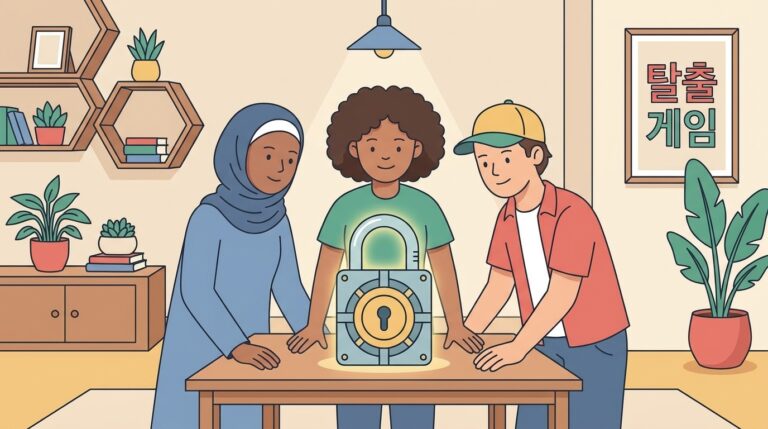
Imagine this: You are standing inside a dimly lit, 1980s detective-themed escape room in Hongdae, Seoul. A digital timer on the wall is glowing red with only 10 minutes left on the clock. You and your friends have cracked the math puzzle written on the old chalkboard, deciphered the secret notebook, and found a heavy metallic directional padlock (방향키 자물쇠) guarding the final exit door.
Your heart is pounding. You frantically push the buttons—Up, Up, Down, Left. Nothing happens. The metal shackle won’t budge. You try to tell your Korean teammate that the lock feels jammed, but your mind goes completely blank. Do you say “I can’t open this”? Do you say “Break it”? In the heat of the moment, English fails, and guessing random Korean words from a translation app just eats away your precious seconds.
Escape rooms (방탈출 카페) are one of the most vibrant, addictive parts of modern youth culture in Korea. But when you are locked in, textbook grammar like “Please open this door” will not save you. Based on real feedback from international learners who panicked in Seoul escape rooms, this guide gives you the exact, bite-sized A2 Korean phrases you need to communicate under pressure, crack tricky locks, and celebrate an epic victory together!
Phase 2: Top 3 Core Expressions Deep Dive
1. 안 열려요! (An yeollyeoyo!)
- Pronunciation: [An yeol-lyeo-yo] (Sounds like ahn + y’all-ryuh-yo)
- Meaning: Literal: “It does not open!” | Real Nuance: “It’s stuck! / It won’t open!”
- K-Culture Moment: You will hear this constantly in popular Korean game variety shows like tvN’s Great Escape (대탈출) whenever cast members frantically pull at locked chests with seconds remaining.
- Editor’s Insight: Notice that Koreans don’t say “I can’t open it” (못 열어요). Instead, they use the passive verb 열리다 (to be opened) and say 안 열려요 (It won’t open). It puts the blame on the stubborn lock, not your muscle power!
- Situation Spectrum:
- Casual (Friends): 안 열려! (An yeollyeo!) ✅
- Semi-formal (Polite / Mixed group): 안 열려요! (An yeollyeoyo!) ✅
- Formal (Official report): 안 열립니다. (An yeollimnida.) ⚠️
- 🤔 Think About It: Why do you think Korean phrasing highlights the state of the padlock rather than the person trying to pull it?
2. 비밀번호 뭐예요? (Bimilbeonho mwoyeyo?)
- Pronunciation: [Bi-mil-beon-ho mwo-ye-yo] (Sounds like bee-meal-bun-ho mwoh-ye-yo)
- Meaning: Literal: “What is the secret number?” | Real Nuance: “What’s the passcode / lock code?”
- K-Culture Moment: Seen in thrilling K-drama detective scenes where detectives shout over their shoulders while rifling through suspect files.
- Editor’s Insight: In fast-paced, real-life escape rooms, locals often shorten 비밀번호 (passcode) to 비번 (bi-beon)! So “비번 뭐야?” is what you will hear 90% of the time among peers.
- Situation Spectrum:
- Casual: 비번 뭐야? (Bibeon mwoya?) ✅
- Semi-formal: 비밀번호 뭐예요? (Bimilbeonho mwoyeyo?) ✅
- Formal: 비밀번호가 무엇입니까? (Bimilbeonhoga mueosimnikka?) 🚫 (Too robotic for an escape game!)
- 🤔 Think About It: How does combining ‘secret’ (비밀) and ‘number’ (번호) reflect the thrill of mystery culture in Korea?
3. 다시 해볼게요 (Dasi haebolgeyo)
- Pronunciation: [Da-si hae-bol-ge-yo] (Sounds like dah-shee hae-bol-geh-yo)
- Meaning: Literal: “I will try doing it again.” | Real Nuance: “Let me try one more time / Resetting!”
- K-Culture Moment: In gaming videos and reality shows, when a player realizes they turned a dial the wrong way and needs a fresh reset.
- Editor’s Insight: The ending -ㄹ게요 (-lgeyo) indicates a gentle promise or self-intention. It tells your teammates, “Don’t worry, step aside for two seconds while I give this another shot.”
- Situation Spectrum:
- Casual: 다시 해볼게 (Dasi haebolge) ✅
- Semi-formal: 다시 해볼게요 (Dasi haebolgeyo) ✅
- Formal: 다시 시도하겠습니다 (Dasi sidohagetseumnida) ⚠️
- 🤔 Think About It: Notice how adding ‘-해보다’ (to try doing) softens your actions, preventing you from sounding bossy to your teammates.
Phase 3: Textbook Korean vs. Real Korean
Situation 1: Resetting a stuck padlock
- 📖 Textbook Korean: 이 자물쇠를 초기화해 주십시오. (I jamulsoe-reul chogihwahae jusipsio. / Please initialize this padlock.)
- 🗣️ Real Korean: 이거 리셋 어떻게 해요? (Igeo riset eotteoke haeyo? / How do you reset this?)
- 💡 Why the difference? The textbook phrase sounds like an industrial safety manual. Native players simply use the loanword 리셋 (reset) with simple question markers.
Situation 2: The moment the padlock clicks open!
- 📖 Textbook Korean: 성공적으로 열렸습니다. (Seonggongjeogeuro yeollyeotseumnida. / It has opened successfully.)
- 🗣️ Real Korean: 열렸다! (Yeollyeotda! / It’s open!)
- 💡 Why the difference? In moments of pure adrenaline, Koreans instantly switch to the plain exclamation form (-았다/었다) to scream their relief to the room.
Phase 4: K-Culture Deep Dive & Non-Verbal Manners
4-1. 눈치 (Nunchi) & Gestures at the Padlock
- The Reset Click: When dealing with directional or push-button locks, repeatedly pushing down the top shackle produces two audible clicks. Showing your friends you are resetting it by tapping the shackle twice signals good nunchi—it tells everyone, “Starting from zero, don’t shout new numbers yet!”
- Passing the Clue: Never hoard the clue paper. In Korean group games, holding a clue sheet with both hands and tilting it toward the center of the group shows you are playing as a collective team (우리), not trying to be a solo hero.
4-2. The Korean Room Escape Craze (방탈출 문화)
Escape rooms in Korea aren’t just weekend pastimes; they are high-tech narrative experiences. Many venues feature automated sensors, movie-set quality props, and intricate storylines designed by former TV scriptwriters. Korean youth celebrate team chemistry (팀 케미) inside these rooms, treating escape success as a benchmark of friendship and dating compatibility!
Phase 5: Live Roleplay Scenario
Setting: A dimly lit detective office in Sinchon. You and your Korean teammate Minji are staring at a locked wooden desk drawer with 8 minutes left.
- Minji: 저기 자물쇠 찾았어! (Jeogi jamulsoe chajasseo!)
“I found the padlock over there!”
🎭 Points flashlight excitedly at the desk drawer. -
You: 비밀번호 뭐예요? (Bimilbeonho mwoyeyo?)
“What is the passcode?”
🎭 Crouches down beside the drawer and inspects the dials. -
Minji: 쪽지에 적힌 숫자가 1-9-8-4야. (Jjokjie jeokhin sutjaga il-gu-pal-sa-ya.)
“The numbers written on the memo are 1-9-8-4.”
🎭 Shines the beam directly onto the handwritten note. -
You: 1-9-8-4… 어? 안 열려요! (Il-gu-pal-sa… eo? An yeollyeoyo!)
“1-9-8-4… Huh? It’s not opening!”
🎭 Tugs on the metal lock shackle with both hands. -
Minji: 기준선에 숫자 맞췄어? (Gijunseone sutja matchwosseo?)
“Did you line up the numbers to the guideline?”
🎭 Peers closely over your shoulder. -
You: 아, 기준선이요? 다시 해볼게요. (A, gijunseon-iyo? Dasi haebolgeyo.)
“Ah, the guideline? Let me try again.”
🎭 Carefully spins the dials to center line markers. -
Minji: 위아래 두 번 당겨서 리셋해야 돼! (Wiarae du beon danggyeoseo risethaeya dwae!)
“You have to pull it up and down twice to reset first!”
🎭 Demonstrates the clicking motion with her fingers. -
You: 와, 열렸다! 서랍 열려요! (Wa, yeollyeotda! Seorap yeollyeoyo!)
“Wow, it’s open! The drawer opens!”
🎭 Grins broadly as the latch pops open with a satisfying snap.
🔀 Interactive Decision Point
The next box has a directional keypad (상하좌우), but you are totally stuck on the riddle. Time is ticking down to 4 minutes! What do you say?
- Choice A: “힌트 쓸까요?” (Hinteu sseulkkayo? / Shall we use a hint?)
👉 [Best Choice!] Perfect team etiquette. Escape rooms give limited hints (usually 3 to 5), so politely asking before using the hint phone keeps the team happy and preserves precious minutes. - Choice B: “몰라요, 포기해요.” (Mollayo, pogihaeyo. / I don’t know, let’s give up.)
👉 [Bad Choice!] Total mood killer! Korean escape room culture values fighting until the final second (존버 정신). - Choice C: “내가 힘으로 부술게!” (Naega himeuro busulge! / I’ll break it with force!)
👉 [Risk Warning!] Dangerous! Escape rooms explicitly make players sign waivers against using brute force (물리력 금지). You could be fined for prop damages!
Phase 6: 10-Second Emotion Shadowing Drill
Speak aloud along with the pause markers (/) and adopt the indicated emotion:
[😰 Anxious & Rushed]
시간 없어요 / 빨리 열어봐요!
(Sigan eopseoyo / ppalli yeoreobwayo!)
“We have no time / try opening it quickly!”-
[🧐 Focused & Calm]
천천히 / 번호 다시 돌려보자.
(Cheoncheonhi / beonho dasi dollyeoboja.)
“Slowly / let’s turn the numbers again.” -
[🎉 Victorious & Hyped]
대박! / 드디어 열렸다!
(Daebak! / deudieo yeollyeotda!)
“Jackpot! / It finally opened!”
Phase 7: K-Culture Mini Dictionary
- 자물쇠 (Jamulsoe) | Padlock
Used for physical dial, directional, and alphabet locks. Escape rooms categorize themes by their padlock-to-device ratio (자물쇠 비율). - 힌트폰 (Hinteu-pon) | Hint Device / Smartphone
A dedicated smartphone or walkie-talkie provided before entering, used to scan NFC tags or type clue numbers to receive tips. - 탈출 (Talchul) | Escape / Successful breakout
The ultimate goal! If you escape within 60 minutes, staff often take commemorative polaroid photos and give you chalkboards to decorate. - 방린이 (Bang-rini) | Escape Room Beginner
A trendy portmanteau of 방탈출 (room escape) + 어린이 (child). Use this to introduce yourself: “저 방린이에요!” (I’m an escape room newbie!).
Phase 8: Traveler’s Survival Kit
Top 3 Survival Expressions
- 힌트 코드 어디 있어요? (Hinteu kodeu eodi isseoyo?)
Where is the hint code?
💡 Pro Tip: Clues usually have a tiny sticker with a 4-digit code to type into your hint phone. - 무전기 안 들려요. (Mujeongi an deullyeoyo.)
I cannot hear the walkie-talkie.
💡 Pro Tip: If the staff uses radio transmitters and the audio crackles, use this immediately. - 불 켜주세요. (Bul kyeojuseyo.)
Please turn on the light.
💡 Pro Tip: If horror themes get too overwhelming or pitch-black, staff can adjust room lighting.
Editor’s Travel Note
- Booking: Search popular spots in Hongdae, Gangnam, or Hyehwa using the Naver Map app download. Keywords to search:
방탈출 카페(Escape Room Cafe). - Lockers & Shoes: Most venues require you to lock all phones, smartwatches, and jackets in outdoor lockers, and swap your shoes for comfortable indoor slippers before entering.
Phase 9: A Step Deeper (Reflection Essay)
In many Western cultures, puzzle solving in games is often an individual showcase of intellect. In Korea, however, escape rooms are deeply rooted in the concept of ‘우리’ (Woori – Us/We). No single person is expected to solve everything alone.
Admitting you are stuck by saying “안 열려요” (It won’t open) or “다시 해볼게요” (I’ll try again) isn’t seen as a failure; it is an active invitation for your teammates to lean in, check your angles, and share the eureka moment. It’s a miniature playground for Korean communal bonding.
💬 Your Turn: Have you ever played an escape room in your country or in Korea? Which padlock type is the hardest for you—numbers, letters, or directional arrows? Share your story in the comments below!
Phase 10: FAQ & Common Mistakes
Q: Can non-Korean speakers enjoy Korean escape rooms?
A: Absolutely! Many popular escape room chains in Hongdae and Gangnam offer themes with English subtitles for clues and digital hint tablets translated into English.
Q: What is the difference between a lock (자물쇠) and a gimmick (장치)?
A: Korean room escapes distinguish between 자물쇠 (traditional padlocks) and 장치 (electronic mechanisms, like lasers, RFID sensors, and magnetic doors). Beginners usually prefer a good 50:50 balance!
Q: What happens if we run out of time?
A: If you don’t escape in 60 minutes, the staff will knock, open the door, and kindly explain the remaining puzzle steps so you leave with closure!
🚨 Common Mistakes Alert (Top 3)
- Forcing a stiff lock: Padlocks in escape rooms open smoothly when the code is right. Pulling with extreme force can bend the shackle and trigger a penalty.
Correct Action: Say “안 열려요, 비번 맞아요?” and re-check the combination. - Ignoring the alignment line (기준선): Dial locks have tiny red or engraved indicator lines. If your numbers are one millimeter above the line, it won’t open!
Correct Action: Center each digit precisely on the line. - Forgetting directional reset: Directional padlocks (방향키) require pushing the top shackle down twice before typing a new arrow sequence. If you don’t reset, your previous inputs stay saved!
Phase 11: Action Missions
- Bronze Mission (Solo Practice): Practice saying “안 열려요!” and “비밀번호 뭐예요?” in front of your mirror with expressive hand gestures 5 times.
- Silver Mission (Social Engagement): Leave a comment below using the word 자물쇠 (padlock) in a simple Korean sentence.
- Gold Mission (Real Life Action): Book an escape room in Seoul with friends (or try a virtual escape game) and shout “열렸다!” the moment your first padlock pops open!
- 🎮 K-Culture Mission: Watch a clip of tvN’s Great Escape (대탈출) on YouTube and spot how many times the members shout “열렸다!” when unlocking props.
Phase 12: Interactive Quiz Challenge
Test what you’ve learned before your escape room adventure!
1. Situational Judgment:
You put in the numbers 3-5-2-1, but the padlock won’t budge. What is the most natural, polite Korean phrase to tell your teammate?
(a) 너 틀렸어. (You are wrong.)
(b) 안 열려요! 다시 해볼게요. (It won’t open! Let me try again.)
(c) 자물쇠를 파괴하세요. (Destroy the lock.)
2. Fill in the Blank:
“이 자물쇠 _______ 뭐예요? 쪽지 좀 보여줘요.” (What is this lock’s passcode? Show me the note.)
Hint: It means secret number!
3. True or False:
In Korean escape room culture, it is considered rude to ask your team before using a hint. (True / False)
👉 Click here to reveal answers & explanations!
-
Answer: (b)
Explanation: “안 열려요! 다시 해볼게요” politely explains that the lock isn’t popping open and shows cooperative willingness to re-attempt. -
Answer: 비밀번호 (or 비번)
Explanation: 비밀번호 (passcode) or its short slang form 비번 fits naturally. -
Answer: False
Explanation: It is actually great manners (눈치) to ask your team “힌트 쓸까요?” before consuming one of your limited hints!







