

Surviving Christmas in Korea: Essential Phrases & Surprising Holiday Culture for Beginners
Phase 1: Empathy & Real-World Scene
안녕하세요! 매일한글 에디터입니다.
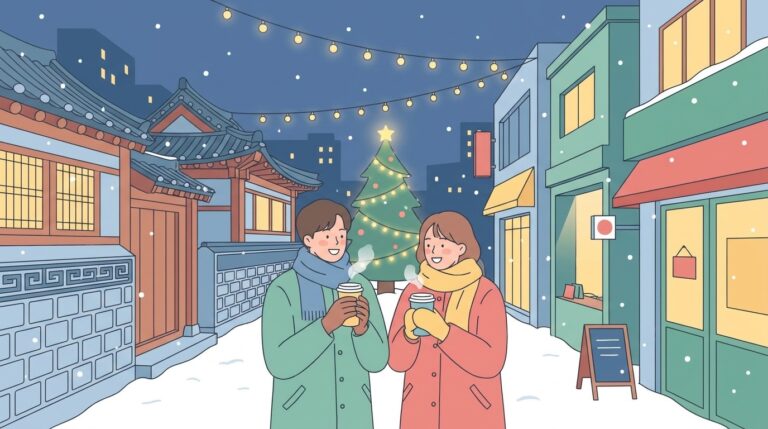
Picture this: It is December 24th, 7:00 PM, and you are walking down the dazzling streets of Myeongdong in Seoul. Soft snow flurries brush your cheeks, giant LED Christmas trees sparkle against department store facades, and sweet holiday melodies drift from every cafe. But as you look around, you suddenly realize something unexpected: almost everyone walking past is in matching couple long-padding coats, clutching strawberry sponge cakes and heart-shaped flower boxes. If you were expecting quiet family dinners with roast turkey like back home, Korea’s Christmas energy might catch you completely off guard!
Every year, dozens of our beginner learners tell us: “I wanted to wish my Korean colleagues and cafe baristas a happy holiday, but I froze. Do Koreans even celebrate Christmas? Do I say an English phrase or is there a formal Korean word?”
Don’t worry! Christmas in Korea is a national public holiday, but with a fascinating twist: it is celebrated primarily as a romantic, festive couple’s holiday and a fun day out with best friends. In this guide, tailored specifically for A1 beginners, we will equip you with 3 foolproof holiday phrases, unpack the unique Korean holiday etiquette, and give you the confidence to greet anyone naturally—from friendly convenience store clerks to your favorite Korean friends.
Phase 2: 3 Core Expressions In-Depth Analysis
1. 메리 크리스마스! (Meri keuriseumaseu!)
- Pronunciation: meh-ree keu-ree-seu-mah-seu (Think of the English “Merry Christmas”, but pronounced with Korean’s rhythmic, even vowel beats: no rolled “r”, and ending cleanly with a soft “seu”).
- Meaning:
- Literal: Merry Christmas.
- Real Nuance: Exactly like the English greeting, but fully localized into everyday Korean. It is universally understood, lively, and warm.
- K-Culture Moment: You will hear this everywhere in K-dramas during winter special episodes, shouted happily when characters pop champagne or exchange cute gift bags.
- Editor’s Insight: English loanwords are extremely natural in Korea! You never have to worry about sounding “too Westernized” when saying this—Koreans of all ages love saying “메리 크리스마스!”
- Situation Spectrum:
- Casual (Friends, Coworkers): ✅
- Semi-formal (Service staff, Cafe baristas): ✅
- Formal (Elderly in-laws, Formal business emails): ⚠️ (Use 따뜻한 성탄절 보내세요 instead)
- 🤔 Think About It: Why do you think modern Korean embraces loanwords like 메리 크리스마스 rather than enforcing strict classical terminology in casual life?
2. 크리스마스에 뭐 해요? (Keuriseumaseu-e mwo haeyo?)
- Pronunciation: keu-ree-seu-mah-seu-eh mwo hae-yo (Flow smoothly from mwo [sounds like “mwah” without the “ah”, like “muh”] to haeyo [hey-yo]).
- Meaning:
- Literal: Christmas-at what do-you?
- Real Nuance: “What are you doing for Christmas?” / “Got any holiday plans?”
- K-Culture Moment: In romance K-dramas, the male or female lead casually drops this question around mid-December to nervously figure out if their crush is single or free on December 25th!
- Editor’s Insight: Because Christmas is a major romantic date holiday in Korea, asking this to a close friend is standard small talk, but asking it with intense eye contact might make someone’s heart flutter!
- Situation Spectrum:
- Casual (Friends, classmates): ✅
- Semi-formal (Polite acquaintances, coworkers): ✅
- Formal (High-ranking bosses): ⚠️ (A bit too personal for formal hierarchy)
- 🤔 Think About It: In your country, is asking about holiday plans considered personal, family-oriented, or romantic?
3. 즐거운 크리스마스 보내세요! (Jeulgeoun keuriseumaseu bonaeseyo!)
- Pronunciation: jeul-guh-woon keu-ree-seu-mah-seu boh-nae-seh-yo (Jeul rhymes with “bull”, geoun rhymes with “sun”).
- Meaning:
- Literal: Joyful Christmas send/spend please!
- Real Nuance: “Have a wonderful and joyful Christmas!”
- K-Culture Moment: Used by warm store owners handing you your festive cake box, or as the closing line in a holiday group chat message.
- Editor’s Insight: Adding the polite verb ending 보내세요 (bonaeseyo – please spend/have) turns a simple greeting into a deeply respectful, heartfelt wish. It is safe for almost every polite interaction.
- Situation Spectrum:
- Casual: ⚠️ (A bit too long for close friends; just say 메리 크리스마스!)
- Semi-formal (Neighbors, colleagues, teachers): ✅
- Formal (Store greetings, seasonal emails): ✅
- 🤔 Think About It: Notice how Korean polite wishes focus on “spending time well” (보내다 – to spend time). What does this reveal about Korean social caring?
Phase 3: Textbook Korean vs Real Korean
Situation 1: Wishing Someone a Happy Christmas
- 📖 교과서 한국어 (Textbook): 성탄절을 축하합니다. (Seongtanjeoreul chukhahamnida. – “Congratulations on Holy Birth Day.”)
- 🗣️ 진짜 한국어 (Real-Life): 메리 크리스마스! 즐겁게 보내세요! (Meri keuriseumaseu! Jeulgeopge bonaeseyo! – “Merry Christmas! Have a great one!”)
- 💡 왜 다를까? (Why is it different?): Textbook Korean often translates Christmas as 성탄절 (Seongtanjeol), which carries formal or church-related connotations. While accurate, everyday Koreans on the street almost exclusively shout 메리 크리스마스! for that cheerful, pop-culture holiday feeling.
Situation 2: Explaining That You Are Staying Home Alone
- 📖 교과서 한국어 (Textbook): 저는 휴일에 집에서 휴식을 취할 것입니다. (Jeoneun hyu-ire jib-eseo hyusigeul chwihal geosimnida. – “I will take rest at home during the holiday.”)
- 🗣️ 진짜 한국어 (Real-Life): 저 집에서 뒹굴뒹굴 쉴 거예요! (Jeo jib-eseo dwing-gul-dwing-gul swil geoyeyo! – “I’m just gonna chill and roll around at home!”)
- 💡 왜 다를까? (Why is it different?): Casual Korean thrives on expressive mimetic words (의태어). 뒹굴뒹굴 (dwing-gul-dwing-gul) adorably depicts relaxing lazily in your warm heated floor (ondol room), watching K-dramas and eating mandarins.
Phase 4: K-Culture Deep Dive & Non-Verbal Manners
4-1. 눈치 (Nunchi) & Polite Holiday Body Language
- Two-Handed Cake Delivery: If you buy or give a holiday gift, seasonal coffee, or Christmas card, always present it using both hands (or support your right wrist/forearm with your left hand). It conveys genuine sincerity.
- Respecting the Couple Crowds: Christmas Eve (크리스마스 이브) is the peak date night of the year in Seoul. Hip neighborhoods like Seongsu-dong, Ikseon-dong, and Gangnam will be overflowing with couples. Don’t be surprised if restaurants require pre-set multi-course couple menus or have massive waitlists!
4-2. Cultural Codes: The Great Christmas Cake Craze
In Korea, Christmas is synonymous with Christmas Cake (크리스마스 케이크). Bakeries from local Paris Baguette franchises to luxury five-star hotels (like Shilla or Signiel) design extravagant themed cakes months in advance. Families and couples consider blowing out candles on a Christmas cake an absolute must-do ritual on December 24th or 25th.
Furthermore, visiting department store holiday light displays—especially the legendary Shinsegae Department Store Main Branch Media Façade in Myeongdong—is a national winter pilgrimage. Bundle up in a warm coat, grab a warm roasted sweet potato (gun-goguma), and enjoy the dazzling winter lights!
Phase 5: Real-Life Roleplay Scenario
Setting: A cozy boutique cafe in Hongdae on the afternoon of December 24th. Soft jazz carols are playing. You approach the counter to order a warm winter latte and a strawberry cake slice.
Characters:
* You (An excited traveler/student in Seoul)
* 민지 (Minji) (A friendly cafe barista wearing a Santa hat)
8-Turn Dialogue:
- 민지 (Minji): 안녕하세요! 주문 도와드릴까요?
(Annyeonghaseyo! Jumun dowadeurilkkayo?)
“Hello! May I take your order?”
🎭 Smiling brightly behind the register with hands lightly folded. -
You: 네! 따뜻한 라떼 한 잔이랑 딸기 케이크 하나 주세요.
(Ne! Ttatteut-han rate hana-rang ttalgi keikeu hana juseyo.)
“Yes! One warm latte and one strawberry cake, please.”
🎭 Pointing gently at the display case with an open hand. -
민지 (Minji): 네, 드시고 가시나요, 아니면 포장이세요?
(Ne, deusigo gasinayo, animyeon pojang-iseyo?)
“Okay, for here or to go?”
🎭 Tapping the screen promptly. -
You: 먹고 갈게요! 오늘 카페가 정말 예뻐요.
(Meokgo galgeyo! Oneul kapega jeongmal yeppeoyo.)
“For here! The cafe is really pretty today.”
🎭 Looking around at the festive garlands with an appreciative smile. -
민지 (Minji): 감사해요! 오늘 크리스마스 이브라서 트리 장식했어요.
(Gamsahaeyo! Oneul keuriseumaseu ibeoraseo teuri jangsinghaesseoyo.)
“Thank you! Since it’s Christmas Eve today, we decorated the tree.”
🎭 Giggles happily and gestures toward the glowing corner tree. -
You: 정말 멋져요. 크리스마스에 바쁘시겠어요!
(Jeongmal meotjyeoyo. Keuriseumaseu-e bappeusigesseoyo!)
“It looks awesome. You must be super busy on Christmas!”
🎭 Nodding empathetically. -
민지 (Minji): 네, 손님이 많지만 그래도 즐거워요! 진동벨 드릴게요.
(Ne, sonnimei manchiman geuraedo jeulgeowoyo! Jindongbel deurilgeyo.)
“Yes, lots of customers, but it’s still fun! Here is your buzzer.”
🎭 Hands over the buzzer with both hands. -
You: 감사합니다. 메리 크리스마스!
(Gamsahamnida. Meri keuriseumaseu!)
“Thank you. Merry Christmas!”
🎭 Bowing head lightly at a 15-degree angle.
🔀 Interactive Choice Point
Minji hands you your freshly prepared tray. How do you respond as you step away?
- Option A: “즐거운 크리스마스 보내세요! 감사합니다!” (Jeulgeoun keuriseumaseu bonaeseyo! Gamsahamnida!)
👉 Feedback [BEST]: 100% natural, polite, and warmly touches the hard-working barista’s heart. You will definitely receive a huge smile back! - Option B: “야, 너 오늘 크리스마스 파티 가?” (Ya, neo oneul keuriseumaseu pati ga? – “Hey, you going to a party today?”)
👉 Feedback [BAD]: Way too informal (반말). Using 야 (Hey) with a cafe staff member sounds rude and startling. - Option C: “성탄절 예배에 참석하십니까?” (Seongtanjeol yebae-e chamseokhasimnikka? – “Are you attending Christmas worship service?”)
👉 Feedback [RISK]: Overly personal and strictly religious for a casual cafe setting. Best to stick to general holiday cheer.
Phase 6: 10-Second Emotion Shadowing Drill
Practice reading these lines aloud with the indicated pause (/) and emotional tone!
[😊 Cheerful & Bright]
메리 크리스마스! / 즐거운 연말 보내세요!
(Meri keuriseumaseu! / Jeulgeoun yeonmal bonaeseyo!)
“Merry Christmas! / Have a wonderful year-end!”-
[☕ Cozy & Polite]
따뜻한 라떼 한 잔 / 부탁드려요.
(Ttatteut-han rate han jan / butakdeuryeoyo.)
“One warm latte / please.” -
[🥺 Playful & Teasing]
크리스마스에 / 약속 있어요?
(Keuriseumaseu-e / yaksok isseoyo?)
“On Christmas / do you have plans?”
Phase 7: K-Culture Mini Dictionary (4 Key Terms)
-
성탄절 (Seongtanjeol)
Meaning: Holy Birth Day (Christmas).
Usage: The formal and calendar name for Christmas Day (December 25th), seen on calendar apps and in news broadcasts. -
솔크 (Sol-keu)
Meaning: Solo Christmas.
Usage: Slang abbreviation of “Solo” + “Christmas”. Used playfully by singles spending Christmas without a romantic partner (e.g., “나 이번에도 솔크야!” – “I’m spending another Christmas solo!”). -
케이크 예약 (Keikeu Yeyak)
Meaning: Cake Reservation / Pre-order.
Usage: An essential seasonal phrase in Korea during late November and December when bakeries require pre-ordering signature holiday cakes. -
크리스마스 이브 (Keuriseumaseu Ibeu)
Meaning: Christmas Eve (December 24th).
Usage: In Korea, Christmas Eve is often celebrated with even more energy and romantic dinner dates than Christmas Day itself.
Phase 8: Survival Kit for Travelers
Top 3 Survival Phrases:
-
사진 한 장 찍어 주실 수 있나요? (Sajin han jang jjigeo jusil su innayo?)
Meaning: “Could you please take a photo of me/us?”
Pro Tip: Perfect when you are standing in front of the giant Christmas tree at Seoul Plaza or Shinsegae Department store! -
크리스마스 포장 되나요? (Keuriseumaseu pojang doenayo?)
Meaning: “Do you have Christmas gift wrapping?”
Pro Tip: Use at Olive Young or bookstore gift sections when purchasing winter souvenirs. -
날씨가 진짜 춥네요! (Nalssiga jinjja chumneyo!)
Meaning: “The weather is really cold!”
Pro Tip: The ultimate winter icebreaker with taxi drivers and shopkeepers while rubbing your hands together.
Editor’s Travel Note:
- Subway & Navigation: Seoul subways run packed on Christmas Eve. To avoid getting stuck in freezing wind, use the official Naver Map route search app to track real-time subway arrival times and indoor underground walking paths.
- Restaurant Reservations: If you want a nice dinner on December 24th or 25th, walk-ins are notoriously difficult. Use the Catch Table restaurant reservation app at least 2–3 weeks in advance.
Phase 9: “One Step Deeper” (Reflective Thought)
In many Western cultures, Christmas is fundamentally family-centric—a quiet, nostalgic gathering around home-cooked meals, while New Year’s Eve belongs to parties with friends. In Korea, this dynamic is fascinatingly reversed. Christmas belongs to lovers, friends, and youthful nightlife, while family reunions and ancestral reverence are saved for Seollal (Lunar New Year) and Chuseok (Harvest Festival). By observing how modern Korea reinvented Christmas as a festival of romance and luminous urban spectacle, we see how culture adapts global holidays to fit its own community rhythm.
💬 Your Turn: How does your home country’s Christmas vibe compare to Korea’s romantic couple culture? Drop your thoughts in the comments below!
Phase 10: FAQ & Avoiding Misunderstandings
Q: Is Christmas an official public holiday with days off in Korea?
A: Yes! December 25th is an official national holiday in South Korea. Banks, government offices, and schools are closed, but most cafes, restaurants, movie theaters, and shopping malls remain wide open and bustling.
Q: Can I wish older Koreans ‘메리 크리스마스’?
A: Yes, it is completely acceptable! However, to show even deeper respect to elderly neighbors, teachers, or your partner’s parents, saying “따뜻하고 즐거운 성탄절 보내세요” (Ttatteut-hago jeulgeoun seongtanjeol bonaeseyo – “Please have a warm and joyful Christmas”) sounds extra thoughtful.
Q: Do Koreans exchange big Christmas presents under a tree?
A: Typically, gift exchange is focused on romantic partners (perfume, jewelry, warm scarves) or small children who still believe in 산타 할아버지 (Santa Grandfather). Large family gift exchanges under a home tree are not standard Korean tradition.
🚨 흔한 실수 (Common Mistakes) Warning Board:
- Mistake 1: Assuming Christmas is a quiet day where all shops close.
Correct Action: Don’t stay cooped up expecting ghost towns! Downtown Seoul comes alive with bustling festivals and pop-up markets. - Mistake 2: Calling December 25th a “family-only” holiday.
Correct Action: If your Korean friend has a partner, do not expect them to hang out with you all day; December 24th and 25th are prime dating days! - Mistake 3: Pronouncing English words with native English intonation when speaking Korean.
Correct Action: Pronounce 메리 크리스마스 with flat, distinct syllables (Me-ri Keu-ri-seu-ma-seu) so native listeners catch it immediately.
Phase 11: Action Mission & Engagement
Take action today with our 3-step challenge:
* 🥉 Bronze Mission (Solo): Look in the mirror and practice saying: “메리 크리스마스! 즐거운 성탄절 보내세요!” 5 times with a bright, welcoming smile.
* 🥈 Silver Mission (Social): Write a festive comment under a Korean friend’s or your favorite K-pop idol’s Instagram post using the phrase: “행복한 크리스마스 보내세요! 🎄”
* 🥇 Gold Mission (Real Life): When you visit a Korean cafe or convenience store this winter, greet the clerk with “메리 크리스마스!” as you pay.
🎮 K-Culture Mission: Watch any winter episode of your favorite K-drama (like Crash Landing on You or Weightlifting Fairy Kim Bok-joo) and spot how characters react to first snow (첫눈) and holiday plans!
Phase 12: Interactive Quiz Challenge
1. Situation Judgment
You run into your Korean language teacher on December 23rd after class. Which greeting is the most natural and polite?
* A) 야! 파티 가자!
* B) 선생님, 즐거운 성탄절 보내세요!
* C) 솔크 축하해요!
2. Fill-in-the-Blank
Complete the natural Korean phrase:
“크리스마스에 뭐 ________?” (What are you doing on Christmas?)
* A) 자요 (jayo)
* B) 해요 (haeyo)
* C) 가요 (gayo)
3. True or False
True or False: In Korea, Christmas is predominantly celebrated as a quiet holiday spent cooking at home with grandparents and extended family.
👉 Click here for answers and explanations!
-
Answer: B (선생님, 즐거운 성탄절 보내세요!)
Explanation: Addressing your teacher with their title (선생님) combined with the polite greeting 즐거운 성탄절 보내세요 is the most respectful and natural choice. Option A is rude slang, and Option C pokes fun at being single! -
Answer: B (해요)
Explanation: 크리스마스에 뭐 해요? (Keuriseumaseu-e mwo haeyo?) literally means “What do you do on Christmas?” and is the classic way to ask about holiday plans. -
Answer: False
Explanation: Unlike Western traditions, Christmas in Korea is celebrated mainly by couples on romantic dates and young people hanging out with friends. Family home gatherings are traditionally reserved for Seollal and Chuseok!







