

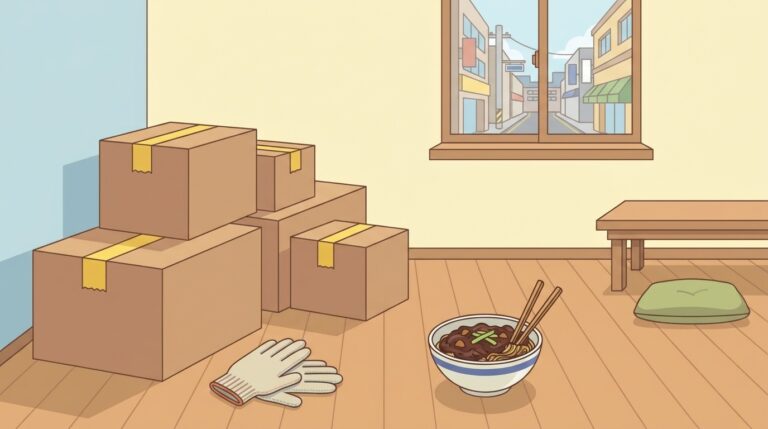
Moving Day in Korea: How to Ask Friends to Help You Pack Without Feeling Awkward
Phase 1: Empathy (Story-Immersive Opening)
안녕하세요! 매일한글 에디터입니다. (Hello! I’m your Daily Hangul editor.)
Picture this: You are sitting on the floor of your cozy Seoul 원룸 (wonrum, studio apartment), surrounded by half-assembled cardboard boxes, stray packing tape, and piles of clothing that seem to have magically multiplied overnight. Your lease ends this Saturday. You glance at your watch, wipe the sweat from your forehead, and feel a wave of panic wash over you. In your home country, asking a buddy to come over, pack boxes, and lift heavy furniture might feel like a straightforward favor—or perhaps an intrusion on their weekend. But here in Korea, stepping into someone’s personal living space and asking for manual moving help comes with a unique set of social etiquette, unspoken debts of gratitude, and one sacred ritual: the moving-day delivery feast.
Over the past decade of guiding foreign residents through the ups and downs of Korean life, I have heard so many learners say, “I was drowning in moving boxes, but I didn’t know how to ask my Korean coworkers or university friends without sounding burdensome or rude!” Don’t worry. In Korean culture, helping friends move is actually an ancient communal tradition called 품앗이 (pumasi). When asked with the right tone, the right softening words, and the customary promise of a delicious meal, your Korean friends won’t just say yes—they will show up with extra work gloves and scissors ready to pitch in. Let’s master the exact phrases, cultural nuances, and conversational finesse you need to pack up your home smoothly and deepen your friendships along the way.
Phase 2: Core 3 Expressions Deep-Dive
1. 이사 짐 싸는 것 좀 도와줄 수 있어? (Isa jim ssaneun geot jom dowajul su isseo?)
- Pronunciation: [Isa jim ssaneun geot jom dowajul su isseo?] (Ee-sah jeem ssah-neun geot johm doh-wah-jool soo ee-ssuh? Think of the English word “jam” spoken crisply as jim, and “some” softened to jom).
- Meaning: Literal: “Can you help a little with the thing of packing moving luggage?” / Real Nuance: “Could you lend me a hand packing my things for the move?”
- K-Culture Moment: You see this in relatable youth K-dramas like Fight for My Way or Age of Youth, where housemates and neighborhood friends gather on bare laminate floors to seal up carton boxes while exchanging playful banter.
- Editor’s Insight: Notice the magical syllable 좀 (jom). While it literally translates to “a little,” Koreans use it as an essential conversational shock absorber. Even if you have thirty giant boxes waiting, inserting 좀 softens the burden of the request and instantly makes you sound humble and polite rather than demanding.
- Situation Spectrum: Casual: ✅ | Semi-formal: ⚠️ (Use 도와주실 수 있어요?) | Formal: 🚫
- 🤔 Think About It: In English, we often say “Could you do me a favor?” Why do you think Korean uses diminutive words like “a little (좀)” to show respect when requesting physical labor?
2. 내가 맛있는 밥 살 테니까 잠깐만 도와줘! (Naega masinneun bap sal tenikka jamkkanman dowajwo!)
- Pronunciation: [Naega masinneun bap sal tenikka jamkkanman dowajwo!] (Neh-gah mah-sheen-neun bap sahl teh-nee-kkah jahm-kkahn-mahn doh-wah-jwoh!)
- Meaning: Literal: “Because I will buy delicious food, please help for just a moment!” / Real Nuance: “Dinner’s on me if you help me out for a bit!”
- K-Culture Moment: In almost every Korean moving scene, after hours of taped boxes and flying dust, friends sit cross-legged on flattened cardboard eating steaming hot Jajangmyeon and crispy Sweet and Sour Pork.
- Editor’s Insight: The grammar pattern -(으)ㄹ 테니까 expresses the speaker’s strong promise of reciprocity before asking for an action. By stating upfront that you will provide a hearty meal, you frame the moving session not as unpaid labor, but as a fun, shared social event.
- Situation Spectrum: Casual: ✅ | Semi-formal: ⚠️ (Use 제가 맛있는 식사 대접할 테니까…) | Formal: 🚫
- 🤔 Think About It: Why is sharing a hot meal considered far more sincere and comforting in Korean relationships than offering a small amount of cash?
3. 무거운 것만 같이 날라줄래? (Mugeoun geonman gachi nallajullae?)
- Pronunciation: [Mugeoun geonman gachi nallajullae?] (Moo-guh-oon gun-mahn gah-chee nahl-lah-jool-leh?)
- Meaning: Literal: “Will you carry only the heavy things together?” / Real Nuance: “Could you just help me carry the heavy stuff?”
- K-Culture Moment: In reality shows like I Live Alone (나 혼자 산다), celebrity friends are often called in specifically to help maneuver bulky mattresses or heavy desktop setups down narrow villa staircases.
- Editor’s Insight: The particle -만 (man, only) is your best friend when negotiating favors. By narrowing down the request to “only the heavy items,” your friend knows they won’t be trapped organizing your socks or wiping dusty shelves all afternoon.
- Situation Spectrum: Casual: ✅ | Semi-formal: ⚠️ (Use 같이 날라주실래요?) | Formal: 🚫
- 🤔 Think About It: How does setting clear boundaries on a favor protect friendships across different cultures?
Phase 3: Textbook Korean vs. Real-World Korean
Situation 1: Checking if a friend is free to help this weekend
- 📖 교과서 한국어 (Textbook): 이번 주말에 제 이사를 도와주실 수 있습니까? (Ibeon jumare je isareul dowajusil su isseumnikka? / “Are you able to assist with my relocation this weekend?”)
- 🗣️ 진짜 한국어 (Real-World): 이번 주말에 혹시 시간 돼? 짐 싸는 것 좀 부탁하려고! (Ibeon jumare hoksi sigan dwae? Jim ssaneun geot jom butak-haryeogo! / “By any chance, do you have time this weekend? I was hoping to ask for a favor with packing!”)
- 💡 왜 다를까? (Why is it different?): The textbook phrasing sounds like an official corporate memo. Real Koreans prepend 혹시 (hoksi, by any chance) and ask about availability first. This creates a comfortable exit cushion so your friend doesn’t feel cornered if they already have plans.
Situation 2: Promising moving-day food
- 📖 교과서 한국어 (Textbook): 감사의 표시로 제가 식사를 대접하겠습니다. (Gamsaui pyosiro jega siksareul daejeop-hagetseumnida. / “As a token of gratitude, I shall treat you to a meal.”)
- 🗣️ 진짜 한국어 (Real-World): 짐 다 싸고 내가 짜장면 시원하게 쏠게! (Jim da ssago naega jjajangmyeon siwon-hage ssolge! / “Once we’re done packing, Jajangmyeon is completely on me!”)
- 💡 왜 다를까? (Why is it different?): The verb 대접하다 is overly ceremonious among peers. Native speakers love the colloquial verb 쏘다 (ssoda, literally ‘to shoot’, idiomatically ‘to treat/pick up the tab’), which sounds lively, generous, and exciting.
Phase 4: K-Culture Deep Dive & Non-Verbal Manners
4-1. 눈치 (Nunchi) & Body Language Checklist
When asking for moving help in Korea, your posture speaks before your mouth does:
* The Two-Handed Supplication: When asking for a favor, bring both hands together gently at chest level and tilt your head slightly. This non-verbal gesture shows modesty and signals, “I know I am taking up your precious rest time.”
* Appreciative Eye Contact: Avoid staring intensely into their eyes while waiting for an answer. Glance down momentarily with a sheepish, apologetic smile (멋쩍은 미소) so they don’t feel pressured.
* Prep Before They Arrive: Real Korean Nunchi means having your personal, private, and fragile items (undergarments, documents, jewelry) packed and hidden away before your friend arrives. Never make a friend sort through intimate personal clutter.
4-2. Culture Code: The Moving Day Jajangmyeon Ritual (이사 날엔 짜장면)
In Korea, eating black bean sauce noodles (짜장면) and sweet and sour pork (탕수육) on moving day is an ironclad cultural tradition. But why? Historically, when moving into a new house, your kitchen gas wasn’t hooked up yet, and all bowls and pots were packed deep inside boxes. Chinese restaurants in Korea were the fastest delivery services that provided free reusable plastic bowls and wooden chopsticks. Even in today’s era of hyper-fast app deliveries, sitting on unfolded newspaper sheets or flattened moving boxes to slurp Jajangmyeon together remains the ultimate bonding ritual after sweat and heavy lifting.
Phase 5: Real-World Roleplay Scenario
Setting: You are inside your studio apartment in Sinchon. Cardboard boxes are stacked unevenly. Your close Korean university friend, Minwoo, is visiting for a cup of coffee.
- You: 🎭 (Scratching the back of your neck sheepishly) 민우야, 이번 주 토요일에 혹시 바빠? (Minu-ya, ibeon ju toyoire hoksi bappa? / Minwoo, are you busy this Saturday by any chance?)
- Minwoo: 🎭 (Taking a sip of iced Americano, checking his phone calendar) 토요일 오후에는 별일 없는데, 왜? 무슨 일 있어? (Toyoil ohue-neun byeoril eomneunde, wae? Museun il isseo? / Nothing much in the afternoon, why? What’s going on?)
- You: 🎭 (Clasping hands together, smiling apologetically) 실은 내가 이번 주말에 이사하거든. 짐 싸는 것 좀 도와줄 수 있어? (Sireun naega ibeon jumare isahageodeun. Jim ssaneun geot jom dowajul su isseo? / Actually, I’m moving this weekend. Could you help me pack up some stuff?)
- Minwoo: 🎭 (Teasing with a wide grin) 아이고, 짐이 얼마나 많은데? 설마 아직 하나도 안 쌌어? (Aigo, jimi eolmana maneunde? Seolma ajik hanado an ssasseo? / Oh boy, how much stuff do you have? Don’t tell me you haven’t packed anything yet?)
- You: 🎭 (Pointing to the taped boxes in the corner) 옷이랑 작은 짐은 거의 다 쌌는데, 책이랑 무거운 것만 같이 날라줄래? (Osirang jageun jimeun geoui da ssanneunde, chaegirang mugeoun geonman gachi nallajullae? / I already packed my clothes and small things, but could you help me carry the books and heavy items?)
- Minwoo: 🎭 (Nodding enthusiastically) 그래, 그 정도야 뭐! 혼자 들기엔 위험하니까. 몇 시까지 오면 돼? (Geurae, geu jeongdoya mwo! Honja deulgien wiheomhanikka. Myeot sikkaji omyeon dwae? / Sure, that’s no problem! It’s dangerous to lift those alone. What time should I come?)
- You: 🎭 (Beaming with gratitude, giving a high five) 오후 2시쯤! 끝나고 내가 맛있는 짜장면이랑 탕수육 쏠 테니까 기대해! (Ohu dusi-jjeum! Kkeun-nago naega masinneun jjajangmyeon-irang tangsuyuk ssol tenikka gidaehae! / Around 2 PM! I’ll buy us delicious Jajangmyeon and Tangsuyuk afterward, so get ready!)
- Minwoo: 🎭 (Patting his stomach with a laugh) 좋아! 탕수육 ‘대(大)’ 자로 시켜줘. 토요일에 보자! (Joa! Tangsuyuk dae-jaro sikyeojwo. Toyoire boja! / Deal! Make sure it’s a large Tangsuyuk. See you on Saturday!)
🔀 Interactive Branching Moment
If Minwoo had hesitated, what would have been your best response?
* Choice A: “토요일에 무조건 와야 돼. 나 힘들어!” (Toyoire mujogeon waya dwae. Na himdeureo! / You must come on Saturday without fail. I’m exhausted!)
* Feedback: 🚫 Bad: Too demanding. Even between close friends, moving is heavy labor. Demanding it as an entitlement damages the relationship.
* Choice B: “혹시 바쁘면 무리 안 해도 돼! 시간 되는 다른 날에 밥이나 먹자.” (Hoksi bappeumyeon muri an haedo dwae! Sigan doeneun dareun nare babina meokja! / If you’re busy, please don’t overextend yourself! Let’s just grab food another day when you’re free.)
* Feedback: 🌟 Best: Shows mature Nunchi. Giving your friend an easy out protects their dignity and preserves your friendship.
* Choice C: “이사 도와주면 내가 현금으로 2만 원 줄게.” (Isa dowajumyeon naega hyeongeumeuro iman-won julge. / If you help me move, I’ll give you 20,000 KRW in cash.)
* Feedback: ⚠️ Risk: Awkward. In Korean friendship culture, offering a meager cash amount degrades personal loyalty into cheap labor. Offer a generous meal or coffee gift card instead!
Phase 6: 10-Second Emotional Shadowing Drill
Practice reading these rhythm lines out loud. Notice the pauses marked by / and channel the specified emotions:
[🥺 미안하고 간절하게 / Apologetic and earnest]- 이번 주말에 / 혹시 시간 괜찮으면 / 짐 싸는 것 좀 / 도와줄 수 있어?
- (Ibeon jumare / hoksi sigan gwaenchaneumyeon / jim ssaneun geot jom / dowajul su isseo?)
[💪 씩씩하고 믿음직스럽게 / Energetic and promising]- 무거운 것만 / 같이 날라주면 돼! / 끝나고 내가 / 짜장면 쏠게!
- (Mugeoun geonman / gachi nallajumyeon dwae! / Kkeun-nago naega / jjajangmyeon ssolge!)
[🙏 따뜻하고 진심 어린 감사 / Warm and heartfelt gratitude]- 바쁠 텐데 / 와줘서 진짜 고마워. / 오늘 진짜 / 든든하다!
- (Bappeul tende / wajwoseo jinjja gomawo. / Oneul jinjja / deundeunhada!)
Phase 7: K-Culture Mini Dictionary
- 원룸 (Wonrum): Studio apartment. Derived from “one room,” this is the standard first home for university students, expats, and young working singles in Korean cities.
- 용달 (Yongdal): Small cargo truck moving service. Rather than hiring an expensive full-service moving team (포장이사), most young people hire a 1-ton Yongdal driver to transport packed boxes while moving the boxes themselves with friends.
- 품앗이 (Pumasi): The traditional Korean communal system of shared cooperative labor. Historically applied to planting rice, today it survives in helping friends paint rooms, pack boxes, or assemble flat-pack furniture.
- 집들이 (Jipdeuri): Housewarming party. Once you finish unpacking and setting up your new place, inviting the friends who helped you move for home-cooked food or drinks is an essential courtesy.
Phase 8: Survival Kit for Expats & Travelers
Top 3 Survival Phrases
- 박스 테이프 어디에 있어요? (Bakseu teipeu eodie isseoyo?)
- Where is the packing tape? Pro Tip: Buy heavy-duty brown box tape at your local Daiso or convenience store beforehand!
- 이건 깨지기 쉬우니까 조심해 줘! (Igeon kkaejigi swiunikka josimhae jwo!)
- This is fragile, so please be careful! Pro Tip: Write “취급주의 (Fragile)” in big red letters on the box.
- 잠깐 쉬었다가 하자! (Jamkkan swieottaga haja!)
- Let’s take a short break! Pro Tip: Prepare cold drinks or iced barley tea (보리차) in advance.
Editor’s Expat Note: Essential Apps for Moving in Korea
- If you need heavy-duty moving boxes or second-hand furniture, download the 당근마켓 앱 다운로드 to buy cheap moving supplies or request neighborhood hauling help.
- To estimate moving truck costs without haggling over the phone, use the 짐싸 앱 다운로드 to compare small-move quotes across your neighborhood.
- Remember: You cannot simply leave discarded mattresses or desks on the curb! You must purchase a local district oversized waste sticker (대형폐기물 스티커) from the community center (주민센터) or convenience store.
Phase 9: “A Step Deeper” (Reflective Mini-Essay)
In many individualistic Western cultures, asking an acquaintance to spend four hours carrying dirty boxes up three flights of stairs can feel like a boundary violation. We are conditioned to hire professionals so as not to impose on others. In Korea, however, relationships (인간관계) thrive precisely on mutual indebtedness and the concept of 정 (Jeong, relational warmth). Allowing someone to see your chaotic, half-packed room and sweating alongside them creates a deep, unspoken bond. By letting someone help you, you are inviting them into your inner circle and offering them the opportunity to participate in communal reciprocity (품앗이). Just remember the golden rule: when they move in six months, you better show up with your sneakers laced and ready to tape boxes!
💬 Your Turn: Have you ever asked a friend for help moving in your home country, or helped someone else? How does the etiquette compare to Korea? Share your story in the comments below!
Phase 10: FAQ & Avoiding Misunderstandings
Q: Should I offer money to my Korean friend for helping me pack?
A: In general, no. Handing a friend cash for helping you pack feels cold and transactional, as if you are treating them as hired labor. The best etiquette is to treat them to a generous meal (Jajangmyeon with Tangsuyuk, or Korean BBQ with beer) and follow up later with an iced coffee coupon via KakaoTalk Gift (카카오톡 선물하기).
Q: What if my friend says they are busy when I ask?
A: Always accept their first “no” with grace! Say: “아, 약속 있구나! 괜찮아, 혼자 해볼게! (Oh, you have plans! No worries at all, I’ll manage!)” Koreans dislike feeling forced. Pushing a second time will make them feel uncomfortable.
Q: What should I prepare before my friend arrives at my apartment?
A: Prepare thick fabric work gloves with rubber grips (목장갑), multiple box cutters, heavy-duty tape, and plenty of cold drinks. Most importantly, pack your dirty laundry, private papers, and intimate personal items ahead of time so your friend only handles general household goods.
🚨 Common Mistakes Warning Board
| Common Mistake | Why It Causes Awkwardness | Correct Action |
|---|---|---|
| 1. Asking on moving day morning | Sounds disorganized and disregards the friend’s weekend schedule. | Ask at least 5 to 7 days in advance using 혹시 시간 돼? |
| 2. Leaving everything completely unpacked | Friend arrives thinking they will lift boxes, but ends up sorting your trash. | Pack clothes and knick-knacks yourself; ask help for heavy lifting. |
| 3. Not providing food or drinks | Violates the sacred moving-day hospitality code. | Order delivery Jajangmyeon or provide high-protein meals immediately afterward. |
Phase 11: Action Mission & Engagement
- 🥉 Bronze Mission (Solo Shadowing): Stand in front of a mirror and recite: “이사 짐 싸는 것 좀 도와줄 수 있어? 끝나고 맛있는 밥 살게!” 3 times with a polite, smiling expression.
- 🥈 Silver Mission (Social Connection): Send a message to a Korean friend using the softening word 혹시 (hoksi) to ask about their weekend schedule.
- 🥇 Gold Mission (Real-Life Mastery): The next time you move or tackle a spring cleaning project, invite a friend over using the exact phrases learned today and treat them to Jajangmyeon on the floor!
🎮 K-Culture Mission: Watch an episode of the variety show I Live Alone (나 혼자 산다) or a lifestyle K-drama. Spot how many times characters order takeout during a room renovation or move!
Phase 12: Interactive Quiz Challenge
Test your moving-day Korean skills! Click the toggles below to check your answers.
Q1. Situational Judgment: Which sentence is the most natural and polite way to ask a peer for moving assistance?
- A) 내일 와서 내 짐 다 싸라.
- B) 이번 주말에 혹시 시간 돼? 짐 싸는 것 좀 도와줄 수 있어?
- C) 돈 줄 테니까 우리 집에 와서 일해.
👉 Click to reveal Answer & Explanation
Correct Answer: B
Explanation: Option B uses 혹시 (by any chance) to check availability and softens the request with 좀 (a little). Option A is an impolite command, while Option C is offensively transactional.
Q2. Fill-in-the-Blank: Complete the classic moving-day reward phrase.
- “짐 다 싸고 내가 맛있는 짜장면 ________! (After we pack, I’ll treat you to delicious Jajangmyeon!)”
- Hint: Think of the colloquial verb meaning “to shoot/treat” with the future intention ending.
👉 Click to reveal Answer & Explanation
Correct Answer: 쏠게! (ssolge!)
Explanation: 쏘다 means to treat or pick up the tab among close friends. Combined with -(으)ㄹ게, it forms 쏠게 (I’ll treat/buy)!
Q3. Cultural True or False: In Korea, it is considered rude to feed your helpers while sitting on cardboard boxes on the floor.
👉 Click to reveal Answer & Explanation
Correct Answer: False!
Explanation: Eating delivery Jajangmyeon and Tangsuyuk cross-legged on flattened boxes or newspapers is the ultimate beloved moving-day tradition in Korea. It is the hallmark of genuine friendship and shared hard work!







