

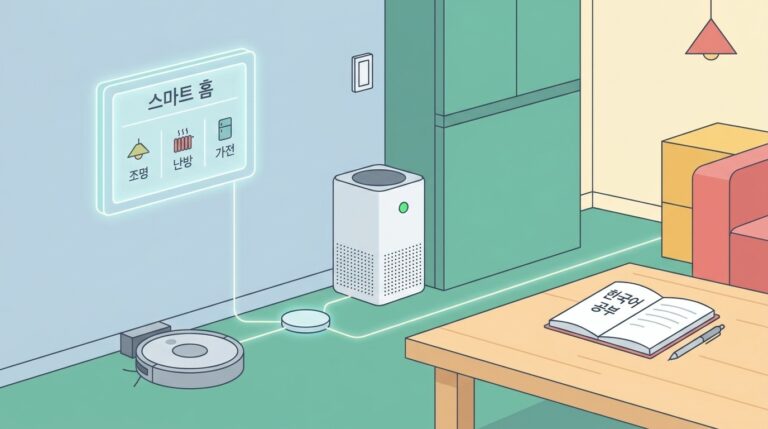
Mastering Korean Smart Home and IoT Troubleshooting Like a Seoul Tech Insider
Phase 1: Empathy (Welcome & Real-World Opening)
안녕하세요! 매일한글 에디터입니다. Imagine moving into a gleaming, state-of-the-art officetel in Mapo or Gangnam. You unpack your belongings, ready to enjoy the seamless futuristic lifestyle promised in every contemporary K-drama. You pull out your smartphone, open Samsung SmartThings or LG ThinQ, and tap into your apartment’s integrated central wall pad (월패드). But suddenly, your robotic vacuum won’t connect, your air conditioner refuses to register on the home network, and your phone flashes an ominous error: “기기를 찾을 수 없습니다.” You call the apartment maintenance office (관리사무소), but explaining Wi-Fi frequency mismatches or device sync failure in textbook Korean feels like trying to run an app on dial-up internet.
Smart home automation is deeply woven into Korean urban living. Knowing how to articulate specific technical issues transforms you from an overwhelmed tenant into a confident, technologically fluent resident. This guide is crafted from authentic feedback from expats and advanced learners who needed more than standard grammar to conquer Seoul’s ultra-connected apartments.
Phase 2: Core Expressions Deep Dive
1. 기기 연동이 자꾸 끊겨요 (Gigi yeondong-i jakku kkeunkyeoyo)
- Pronunciation: [Gi-gi yeon-dong-i jak-ku kkeun-kyeo-yo] (Think of ‘yeon-dong’ like ‘yawn’ + ‘dome’, and ‘kkeun’ as a sharp snap of a guitar string)
- Meaning: Literal: “The appliance linkage keeps severing.” | Real Nuance: “The device keeps disconnecting / failing to stay paired.”
- K-Culture Moment: Seen in home-makeover shows and modern K-dramas where a character tries to automate mood lighting before a romantic dinner, only for the smart bulbs to randomly go offline.
- Editor’s Insight: 연동 (yeondong) is the gold-standard term for IoT integration or inter-device linking. Using 자꾸 (jakku) captures recurrent annoyance without sounding aggressive.
- Situation Spectrum: Casual: ✅ | Semi-formal: ✅ | Formal: ⚠️ (In formal reports, prefer ‘연동 장애가 빈번히 발생합니다’)
- 🤔 Think About It: Notice how Korean uses 끊기다 (to be severed/snapped) for wireless digital signals. What does conceptualizing a wireless connection as a physical thread reveal about spatial intuition in Korean?
2. 네트워크 대역폭을 2.4GHz로 재설정해야 인식이 돼요 (Neteuwokeu daeyeokpogeul i-jeom-sa gigahereucheuro jaeseoljeonghaeya insigi dwaeyo)
- Pronunciation: [Ne-teu-wo-keu dae-yeok-po-geul i-jeom-sa gi-ga-he-reu-cheu-ro jae-seol-jeong-hae-ya in-si-gi dwae-yo]
- Meaning: Literal: “Only when re-establishing network bandwidth to 2.4GHz does recognition occur.” | Real Nuance: “It only registers if you switch the Wi-Fi band to 2.4GHz.”
- K-Culture Moment: A classic tech-savvy young neighbor coming to troubleshoot a confused protagonist’s smart rice cooker on a trendy web drama.
- Editor’s Insight: Most Korean smart appliances exclusively support 2.4GHz Wi-Fi due to wall-penetration requirements. 인식되다 (to be recognized/detected) is the quintessential verb for sensor and device pairing.
- Situation Spectrum: Casual: ⚠️ | Semi-formal: ✅ | Formal: ✅
- 🤔 Think About It: 인식 (cognition/recognition) anthropomorphizes devices. How does giving ‘perception’ to hardware change how you interact with technology?
3. 홈넷 계정이 동기화되지 않아서 충돌이 나네요 (Homnet gyejeong-i dong-gihwadoeji anaseo chungdori naneyo)
- Pronunciation: [Hom-net gye-jeong-i dong-gi-hwa-doe-ji a-na-seo chung-do-ri na-ne-yo]
- Meaning: Literal: “Because the home-network account is unsynchronized, a collision is occurring.” | Real Nuance: “The home network accounts aren’t synced, so there’s a system conflict.”
- K-Culture Moment: An apartment security officer or IT consultant inspecting an integrated touch screen wall pad in a high-end luxury apartment complex.
- Editor’s Insight: 홈넷 (homenet) refers to the central apartment IoT ecosystem. 충돌이 나다 (a crash/conflict occurs) is natural slang used by developers and tech-savvy locals alike.
- Situation Spectrum: Casual: ✅ | Semi-formal: ✅ | Formal: ✅
- 🤔 Think About It: In Korea, individual apartment devices are linked to the whole building’s server. What balance does this strike between collective efficiency and personal privacy?
Phase 3: Textbook Korean vs. Real Korean
Situation 1: Asking someone to pair the appliance to the central system
- 📖 교과서 한국어: 스마트 기기를 벽면 단말기에 연결해 주십시오. (Seumateu gigireul byeongmyeon danmalgie yeongyeolhae jusipsio.) — “Please connect the smart device to the wall terminal.”
- 🗣️ 진짜 한국어: 이거 월패드에 연동 좀 물려주시겠어요? (Igeo wolpaedeue yeondong jom mullyeojusigesseoyo?) — “Could you hook this up to the wall pad for me?”
- 💡 왜 다를까?: Real residents call the unit a 월패드 (wall pad), not 벽면 단말기. Native speakers use the expressive verb 물리다 (to catch/bite onto; idiomatically, to link up into a network) rather than basic 연결하다.
Situation 2: Suggesting a firmware reset when an appliance bugs out
- 📖 교과서 한국어: 기기의 소프트웨어를 초기화하여 다시 시작하세요. (Gigieui sopeuteuwe-eoreul chogihwahayeo dasi sijakhaseyo.) — “Initialize the software of the device and start over.”
- 🗣️ 진짜 한국어: 펌웨어 한번 싹 밀고 다시 페어링해 보세요. (Peom-we-eo hanbeon ssak milgo dasi peeoringhae boseyo.) — “Wipe the firmware clean and re-pair it from scratch.”
- 💡 왜 다를까?: Advanced tech Korean frequently adopts loan words like 펌웨어 (firmware) and 페어링 (pairing), paired with visceral verbs like 싹 밀다 (to scrape/wipe clean).
Phase 4: K-Culture Deep Dive & Non-Verbal Manners
4-1. Nunchi & Gestures with Tech Support
When requesting help from the building maintenance technician (관리사무소 기사님), avoid tapping aggressively on the screen to show an error. Instead, hold your smartphone with both hands, tilting the screen slightly toward their line of sight at chest height. Use cushion words (쿠션어) like “바쁘실 텐데 번거롭게 해드려 죄송하지만…” (I know you are busy, so I’m sorry to trouble you, but…) before pointing out the pairing failure. This demonstrates deep cultural awareness and prompts far faster, friendlier assistance.
4-2. The Korean Apartment Ecosystem Culture
In South Korea, an apartment is not just an individual living box; it is an integrated smart ecosystem. Through the ubiquitous 월패드, your refrigerator, elevator call button, smart door lock, and parking location tracker communicate in harmony. If an IoT link fails, it often involves communal protocols (such as building-wide energy saving cutoffs or shared Wi-Fi mesh nodes). Understanding this collective architecture prevents unnecessary equipment replacement.
Phase 5: Real-Life Roleplay Scenario
Setting: Alex’s newly leased high-rise studio in Yeouido. Alex is troubleshooting a smart air conditioner and automated blinds that refuse to respond to the central console. The building technician, 기사님 (Gisanim) Park, has just stepped in.
- Alex: 기사님, 바쁘실 텐데 와주셔서 감사합니다. 스마트홈 연동에 계속 오류가 떠서요. (Gisanim, bappeusil tende wajusyeoseo gamsahamnida. Seumateuhom yeondong-e gyesok oryoga tteoseoyo.) 🎭 Bows at a 30-degree angle, gesturing politely toward the wall pad.
- Technician Park: 네, 어떤 기기가 말썽인가요? 에어컨인가요, 아니면 조명 제어 쪽인가요? (Ne, eotteon gigiga malsseong-ingayo? E-eokeon-ingayo, animyeon jomyeong jeeo jjokingayo?) 🎭 Unzips his tool pouch while examining the wall panel interface.
- Alex: 에어컨이랑 블라인드 둘 다 월패드에서 오프라인으로 잡혀요. (E-eokeon-irang beullaindeu dul da wolpaedeueseo opeuraineuro japhyeoyo.) 🎭 Points gently to the grayed-out icons on the tablet display.
- Technician Park: 아, 최근에 통신사 공유기를 교체하셨나요? IP 할당 대역이 바뀌면 연동이 풀릴 수 있거든요. (A, choegeune tongsinsa gong-yugireul gyochehasyeonnayo? IP haldang daeyeogi bakkwimyeon yeondongi pullil su itgeodeunyo.) 🎭 Checks the router cables beside the entrance console.
- Alex: 아, 어제 5GHz 와이파이로 바꿨는데 그것 때문에 충돌이 났을까요? (A, eoje o-gigahereucheu wa-i-pa-i-ro bakkwonneunde geugeot ttaemune chungdori nasseulkkayo?) 🎭 Tilt head thoughtfully, showing realization.
- Technician Park: 빙고! 가전 연동 칩셋은 보통 2.4GHz 단독 대역만 지원해요. 제가 공유기 세팅에서 듀얼 밴드 분리해 드릴게요. (Binggo! Gajeon yeondong chipseseun botong i-jeom-sa gigahereucheu dandok daeyeokman jiwonhaeyo. Jega gong-yugi setting-eseo dyueol baendeu bunrihae deurilgeyo.) 🎭 Taps his tablet to access router admin settings.
- Alex: 감사해요! 그럼 기기 초기화 버튼 누르고 재인식시키면 될까요? (Gamsahaeyo! Geureom gigi chogihwa beoteun nureugo jae-insiksikimyeon doelkkayo?) 🎭 Prepares the remote control to reset the AC unit.
- Technician Park: 네, 3초 동안 꾹 누르시면 삐 소리와 함께 연동 모드로 들어갈 겁니다. (Ne, samcho dongan kkuk nureusimyeon ppi soriwa hamkke yeondong modeuro deureogal geomnida.) 🎭 Smiles encouragingly as the status LED begins to blink blue.
🔀 Interactive Choice Point
The technician asks you to verify the connection on your smartphone app. What do you say?
* Choice A: “네, 앱에서 새 기기 추가 누르니까 바로 신호 감지되네요!” (Yes, when I press ‘Add New Device’ in the app, the signal gets detected immediately!)
* Choice B: “당연히 기사님이 만졌으니까 이제 돼야죠.” (Of course it should work now since you touched it.)
* Choice C: “벽을 다 뜯어서 전선을 확인해 주세요.” (Please tear down the wall to check the electric cables.)
Feedback:
* Choice A (Best): Polite, technically precise, and acknowledges progress gracefully.
* Choice B (Bad): Overly transactional and borderline rude to a senior technician in Korean culture.
* Choice C (Risk): Absurd overreaction that will create awkward confusion over an everyday wireless routing glitch.
Phase 6: 10-Second Emotion Shadowing Drill
[😮 Frustrated & Puzzled]기기 등록 버튼을 눌러도 / 계속 연결 대기 중만 뜨고 / 안 넘어가요. (Gigi deungnok beoteuneul nulleodo / gyesok yeongyeol daegi jungman tteugo / an neomeogayo.) — “Even when I press register, it stays stuck on ‘waiting for connection’ and won’t advance.”[💡 Realization & Relief]아, 듀얼 밴드 주파수가 달라서 / 연동이 튕겼던 거군요! (A, dyueol baendeu jupasuga dallaseo / yeondong-i twing-gyeotdeon geogunyo!) — “Ah, the connection kept bouncing off because the dual-band frequencies were different!”[🤝 Professional Gratitude]덕분에 월패드 제어권이 정상 복구되었습니다 / 정말 감사드려요. (Deokbune wolpaedeu jeeogwoni jeongsang bokgudoeeotseumnida / jeongmal gamsadeuryeoyo.) — “Thanks to you, control via the wall pad has been fully restored. Thank you so much.”
Phase 7: K-Culture Mini Dictionary
- 월패드 (Wolpaedeu – Wall Pad): The centralized touchscreen terminal installed near the entryway of modern Korean homes that operates intercoms, door locks, heating, and IoT pairings.
- 스마트홈 허브 (Seumateuhom Heobeu – Smart Home Hub): A bridging hardware unit (or smart speaker like Kakao Mini / GiGA Genie) that coordinates third-party appliances.
- 펌웨어 충돌 (Peom-we-eo Chungdol – Firmware Conflict): A mismatch between newly updated operating software in an appliance and legacy building automation.
- 관리사무소 (Gwallisamuso – Building Management Office): The nerve center of Korean apartment life, handling physical maintenance, security, and smart network discrepancies.
Phase 8: Expat Survival Kit
TOP 3 Survival Phrases
- 초기화 버튼이 어디에 숨어 있나요? (Chogihwa beoteuni eodie sumeo innayo?) — “Where is the reset button hidden?” [Pro Tip: Pin-hole reset buttons on Korean appliances are often marked as ‘리셋’ or ‘초기화’ near the filter compartment.]
- 스마트폰이랑 가전이랑 블루투스 싱크가 안 맞아요. (Seumateupon-irang gajeon-irang beullutuseu singkeuga an majayo.) — “The Bluetooth sync between my phone and appliance isn’t catching.”
- 관리실 연결해서 원격 점검 부탁드릴게요. (Gwallisil yeongyeolhaeseo won-gyeok jeomgeom butakdeurilgeyo.) — “Please connect to the maintenance room and request a remote diagnostic.”
Editor’s Tech & Travel Note
When configuring appliances in Korea, avoid using third-party global apps. Download the domestic version via the [국내 가전 제어용 스마트싱스 앱 다운로드] or LG ThinQ app to unlock region-specific protocols. If an appliance network error persists, you can search for authorized repair centers near your apartment using [네이버 지도 앱을 통한 고객센터 검색] for instant on-site bookings.
Phase 9: One Step Deeper (Cultural Reflection)
South Korea boasts one of the highest fiber-optic and IoT density rates in the world. Living in an apartment complex means participating in a micro-society where your front door, air purification, and parcel notifications are interconnected. While this delivers unmatched convenience, it requires navigating shared server protocols and collective etiquette—such as avoiding late-night automated robotic vacuum sweeps that cause floor vibrations (층간소음). Mastering the language of IoT is not merely about managing technology; it reflects how you harmonize with modern Korean community living.
💬 Your Turn: Have you ever experienced a hilarious or baffling tech failure while traveling or living abroad? How do you say “pairing failed” in your home language? Drop your experience in the comments below!
Phase 10: FAQ & Avoiding Misunderstandings
Q: Why does my Korean appliance reject my 5GHz home Wi-Fi network?
A: Most smart home appliances sold in Korea (air cleaners, humidifiers, robotic vacuums) are equipped with 2.4GHz wireless chips to minimize interference across thick reinforced concrete apartment walls. You should split your router into two dedicated SSIDs (2.4GHz and 5GHz) and connect your smart home devices exclusively to the 2.4GHz band.
Q: What is the difference between ‘연결’ (yeongyeol) and ‘연동’ (yeondong)?
A: ‘연결’ refers broadly to physical or digital connection (e.g., plugging in an HDMI cord or connecting to Wi-Fi). ‘연동’ implies functional inter-operation and synchronized control between two smart systems (e.g., an air conditioner turning on automatically when the wall sensor detects heat).
Q: Can I control my officetel’s pre-installed heating with my international Google Home?
A: In most instances, no. Korean residential complexes utilize proprietary protocol standards governed by domestic telcos (KT, SKT, LGU+) or dedicated system manufacturers (Commax, KoCom, Hyundai HT). To link them, you must bridge through the building’s localized wall pad system.
🚨 Common Mistakes Alert Board
- ❌ Mistake 1: Saying “기계가 죽었어요” (The machine died).
👉 Correct Action: Say “기기 전원이 안 들어오거나 응답이 없어요” (The device won’t power up or is unresponsive). - ❌ Mistake 2: Using “합치다” (to combine physically) for syncing data.
👉 Correct Action: Use “동기화하다” (to synchronize) or “연동하다” (to link/pair). - ❌ Mistake 3: Shouting at smart speakers using English syntax.
👉 Correct Action: State the target appliance first, followed by the action: “거실 조명 꺼 줘” (Living room light, turn off please).
Phase 11: Action Missions
- 🥉 Bronze Mission: Change your smartphone’s companion app (Samsung SmartThings, LG ThinQ, or Apple Home) language setting to Korean for 24 hours.
- 🥈 Silver Mission: Write an Instagram Story or social post describing your home setup using at least two advanced terms: 월패드 and 기기 연동.
- 🥇 Gold Mission: Call your building office or talk to a Korean-speaking friend to simulate troubleshooting an IoT device using the sentence pattern: “~대역폭 문제로 연동이 자꾸 끊겨요.”
- 🎮 K-Culture Mission: Watch an episode of a modern Korean slice-of-life drama (like Start-Up or Crash Course in Romance) and listen for scenes featuring automated smart locks (도어락) or wall pad doorbells!
Phase 12: Interactive Quiz Challenge
Q1. [Context Judgment] You want to tell an officetel maintenance technician that your robotic vacuum cleaner fails to sync with the central wall terminal. Which sentence is most natural for an advanced (C1) speaker?
1. 청소기가 벽에 붙지 않아요.
2. 로봇청소기가 월패드에 연동이 안 되고 자꾸 튕기네요.
3. 스마트 기기 소프트웨어가 슬픕니다.
👉 Click for Answer & Explanation
Answer: 2
Explanation: ‘월패드에 연동이 안 되고 자꾸 튕기다’ naturally captures both the technical setting and native conversational nuance (튕기다 = to get bounced/disconnected).
Q2. [Fill in the Blank] 네트워크 ________을 2.4GHz로 재설정해야 가전 기기가 올바르게 인식됩니다.
(Hint: Bandwidth)
👉 Click for Answer & Explanation
Answer: 대역폭 (daeyeokpok)
Explanation: ‘대역폭’ is the technical Korean term for bandwidth/frequency spectrum.
Q3. [True / False Cultural Check] In typical Korean apartments, the ‘월패드’ only controls the doorbell and intercom, without any ability to operate appliances or call elevators.
👉 Click for Answer & Explanation
Answer: False
Explanation: Modern Korean wall pads serve as an all-in-one IoT hub controlling heating, lighting, air ventilation, elevator dispatch, and even vehicle parking locations.







