

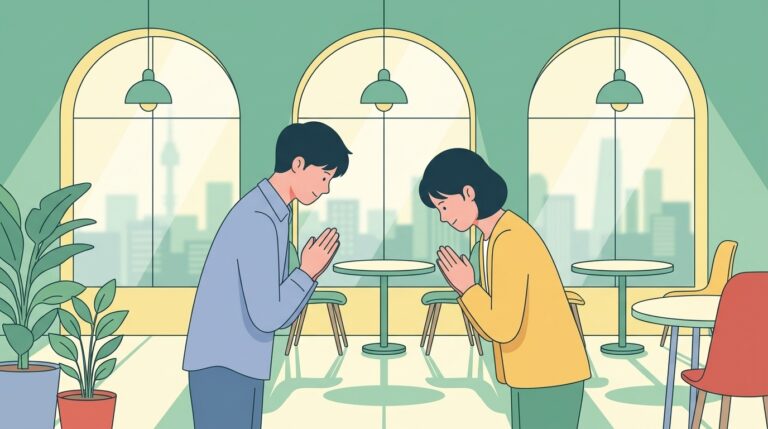
How to Bow in Korea: Master Korean Greeting Etiquette Without the Awkwardness
Phase 1: Empathy & Storytelling Hook
안녕하세요! 매일한글 에디터입니다. (Hello! I’m your Daily Hangul editor.)
Picture this: You just touched down in Incheon, took the AREX train into Seoul, and walked into a charming little bakery in Hongdae. The aroma of freshly baked salt bread fills the air. The friendly cashier smiles and says, “어서오세요!” (Eoseo-oseyo! / Welcome!).
Suddenly, your brain freezes. Do I wave? Do I offer a handshake? Or do I bow right here? If I bow, how low do I go? 90 degrees? What if I look like I’m auditioning for a historical K-Drama?
Panic sets in, so you execute an awkward 90-degree military bend while maintaining intense eye contact. The poor barista blinks in shock, frantically bows 90 degrees back, and both of you stand there in stunned silence.
Take a deep breath! You are not alone. Almost every single Korean learner goes through the “Bowing Dilemma.” Bowing in Korea isn’t a stiff ritual meant to stress you out; it is simply a physical handshake of the heart. Based on real feedback from hundreds of our beginner students, this guide breaks down the angles, expressions, and social rhythm so you can greet anyone in Korea with natural charm and total confidence.
Phase 2: 3 Core Expressions for Bowing
1. 안녕하세요 (Annyeonghaseyo)
- Pronunciation: [An-nyeong-ha-se-yo] (Think: “Ahn-young-ha-say-yo”, smooth and flowing)
- Meaning: Literal: “Are you in peace?” | Real Nuance: “Hello! / Good day / Nice to see you.”
- K-Culture Moment: Every K-Drama ever filmed! Notice how characters gently drop their heads at a 30-degree angle when entering an office or greeting elders.
- Editor’s Insight: This is Korea’s ultimate universal key. You don’t need distinct phrases for “good morning” or “good afternoon.” Just match this phrase with a gentle nod, and you are immediately welcomed.
- Situation Spectrum: Casual ⚠️ | Semi-formal ✅ | Formal ✅
- 🤔 Think About It: In English, we ask “How are you?” without expecting a medical report. In Korean, wishing “peace” (안녕, Annyeong) reflects centuries of valuing communal safety. How does your culture express everyday peace?
2. 감사합니다 (Gamsahamnida)
- Pronunciation: [Gam-sa-ham-ni-da] (Note: The ㅂ in 합 sounds like ‘m’: “Gahm-sah-hahm-nee-dah”)
- Meaning: Literal: “I do gratitude.” | Real Nuance: “Thank you very much.”
- K-Culture Moment: When your favorite K-Pop idol receives a music show trophy, clutches the mic, bows repeatedly, and says this phrase from the bottom of their heart.
- Editor’s Insight: While 고마워요 (Gomawoyo) also means thank you, 감사합니다 (Gamsahamnida) is safer and shows higher respect to service staff, taxi drivers, and new acquaintances.
- Situation Spectrum: Casual ⚠️ | Semi-formal ✅ | Formal ✅
- 🤔 Think About It: Koreans almost always pair verbal thanks with a physical nod. Have you ever noticed yourself bowing slightly while thanking someone on the phone?
3. 안녕히 계세요 (Annyeonghi gyeseyo)
- Pronunciation: [An-nyeong-hi gye-se-yo] (Think: “Gye-say-yo” – rhyme ‘gye’ with ‘get’ + ‘ye’)
- Meaning: Literal: “Please stay in peace.” | Real Nuance: “Goodbye (to someone who is staying).”
- K-Culture Moment: Leaving a restaurant or cafe after paying the bill, bowing lightly towards the counter.
- Editor’s Insight: Remember the secret trick: 계세요 (Gyeseyo) has a G, like Guests leaving the host who stays! If the other person is also leaving, you say 안녕히 가세요 (Annyeonghi gaseyo – “Go in peace”).
- Situation Spectrum: Casual 🚫 | Semi-formal ✅ | Formal ✅
- 🤔 Think About It: Korean divides “goodbye” based on who moves and who stays behind. Why do you think relational positioning matters so much in Korean communication?
Phase 3: Textbook Korean vs. Real Korean
Situation 1: Leaving a Convenience Store or Small Shop
- 📖 교과서 한국어 (Textbook): 안녕히 계세요. (Annyeonghi gyeseyo. / Goodbye.)
- 🗣️ 진짜 한국어 (Real-life): 수고하세요~ (Sugo-haseyo~ / Keep up the good work!)
- 💡 왜 다를까? (Why the difference?): While “안녕히 계세요” is 100% correct, native Koreans almost instinctively say “수고하세요~” with a light 15-degree nod when exiting shops. It acknowledges the worker’s effort with warm solidarity.
Situation 2: Greeting an Acquaintance in a Hallway or Elevator
- 📖 교과서 한국어 (Textbook): 처음 뵙겠습니다. 만나서 반갑습니다. (Cheo-eum boepgesseumnida. Mannaseo bangapsumnida. / It is the first time meeting you. Nice to meet you.)
- 🗣️ 진짜 한국어 (Real-life): 안녕하세요~! (Annyeonghaseyo~! / Hello!)
- 💡 왜 다를까? (Why the difference?): Long formal textbook greetings can feel stiff in casual passing encounters. A bright, musical “안녕하세요~!” accompanied by a brief head nod is what locals actually use.
Phase 4: K-Culture Deep Dive & Non-Verbal Manners
4-1. 눈치 (Nunchi) & The Physical Bow
Bowing is an art of angles and eye coordination. Here is the golden rule:
1. The 15° Nod (목례, Mok-rye): Used for passing someone in the hallway, entering a convenience store, or saying a quick thanks to an elevator neighbor. Just tilt your head and upper neck down smoothly for one second.
2. The 30° to 45° Standard Bow (보통 인사, Botong Insa): Used for meeting elders, teachers, bosses, or introducing yourself. Bend from the waist, keep your back straight, and keep your hands neatly at your sides or clasped in front.
3. Where do my eyes look? Never stare directly into their eyes while bending! That is perceived as a glare or challenge. Lower your gaze naturally toward the floor near their shoes, then lift your head back up and make soft eye contact.
4-2. The 90-Degree Folder Bow (폴더 인사)
In K-Pop culture, rookie idols are famous for their “Folder Bow” (폴더 인사, Pol-deo Insa)—literally folding their torso in half at a 90-degree angle to show extreme humility and respect to seniors. While admirable on television, you rarely need a 90-degree bow in daily life! Doing this at a coffee shop might make the staff feel pressured or flustered. Stick to a pleasant 15° to 30° bow.
Phase 5: Real-life Roleplay Scenario
Setting: A trendy cafe in Yeonnam-dong. You approach the counter to order and pay for a drink.
NPC Character: Minji (A friendly 24-year-old barista with a warm smile).
- Turn 1 (Minji): 안녕하세요! 주문 도와드릴까요? (Annyeonghaseyo! Jumun dowadeurilkkayo? / Hello! May I help you order?)
- 🎭 Minji smiles warmly and tilts her head at 15 degrees.
- Turn 2 (You): 안녕하세요! 아이스 아메리카노 한 잔 주세요. (Annyeonghaseyo! A-i-seu a-me-ri-ka-no han jan juseyo. / Hello! One iced Americano, please.)
- 🎭 You give a polite 15-degree nod as you speak.
- Turn 3 (Minji): 네, 4,500원입니다. 카드를 꽂아주세요. (Ne, sa-cheon-o-baek-won-imnida. Ka-deu-reul kkoja-juseyo. / Sure, that’s 4,500 won. Please insert your card.)
- Turn 4 (You): 네, 여기요. (Ne, yeogi-yo. / Yes, here you go.)
- 🎭 You hand the card over using two hands as a polite gesture.
- Turn 5 (Minji): 영수증 필요하세요? (Yeongsujeung piryohaseyo? / Do you need a receipt?)
- Turn 6 (You): 아니요, 괜찮아요. 감사합니다. (Aniyo, gwaenchanayo. Gamsahamnida. / No, it’s fine. Thank you.)
- 🎭 A crisp, polite tone accompanied by a brief head bow.
- Turn 7 (Minji): 음료 나오면 진동벨로 알려드릴게요. (Eumryo naomyeon jindongbelleo allyeodeurilgeyo. / We’ll alert you with the buzzer when your drink is ready.)
- Turn 8 (You): 감사합니다! (Gamsahamnida! / Thank you!)
- 🎭 You take the buzzer and take two steps back before turning around.
🔀 Interactive Choice Point
You pick up your coffee at the pick-up counter. What do you do as you leave?
- Option A: Bow deeply at a stiff 90-degree angle for 5 seconds without saying a word.
- Feedback (Risk): The barista will be startled and might wonder if something is wrong!
- Option B: Make a light 15-degree nod, smile, and say: “감사합니다, 수고하세요!” (Gamsahamnida, sugo-haseyo!)
- Feedback (Best!): Perfect 100 points! Natural, warm, and shows impeccable everyday manners.
- Option C: Hold up your hand for a high five.
- Feedback (Bad): While funny, Korean service staff will likely freeze in confusion!
Phase 6: 10-Second Emotion Shadowing Drill
Practice reading these out loud, observing the / breath pauses and matching the emotional cues!
[😊 Warm, bright, and welcoming]- 안녕하세요! / 반갑습니다! (Annyeonghaseyo! / Bangapsumnida!)
- “Hello! / Nice to meet you!”
[🙏 Heartfelt and appreciative]- 도와주셔서 / 정말 감사합니다. (Dowajusyeoseo / jeongmal gamsahamnida.)
- “Thank you / so much for helping me.”
[👋 Polite and breezy departure]- 감사합니다! / 안녕히 계세요~ (Gamsahamnida! / Annyeonghi gyeseyo~)
- “Thank you! / Goodbye~”
Phase 7: K-Culture Mini Dictionary
- 목례 (Mok-rye / Eye & Head Nod Bow): The effortless head nod (10°–15°) used in tight spaces like elevators, hallways, or when making brief eye contact with neighbors.
- 폴더 인사 (Folder Insa / 90-Degree Fold Bow): Folding yourself like a flip phone. Reserved for formal apologies, major ceremonies, or K-Pop stars greeting massive crowds.
- 배꼽 인사 (Baekkop Insa / Belly-Button Bow): Placing both hands over your navel before bowing. Taught to Korean kindergarteners and standard among flight attendants.
- 눈치 (Nunchi / Social Intuition): The subtle superpower of reading the room and gauging others’ emotions to adjust your posture, speech, and bow angle accordingly.
Phase 8: Survival Kit for Travelers
Top 3 Survival Expressions for Daily Courtesy
- 저기요 (Jeogiyo)
- Pronunciation: [Jeo-gi-yo]
- Pro Tip: Use this to get someone’s attention (like a waiter or passerby). Raise your hand slightly, nod, and say it clearly.
- 죄송합니다 (Joesonghamnida)
- Pronunciation: [Joe-song-ham-ni-da]
- Pro Tip: If you accidentally bump into someone on the bustling Seoul subway, give a quick 15° bow and say this phrase.
- 잠시만요 (Jamsimanyo)
- Pronunciation: [Jam-si-man-yo]
- Pro Tip: Means “Excuse me / Just a moment.” Crucial when squeezing past people off a crowded subway car.
Editor’s Travel Note: Subway & Transit Etiquette
- In Korea, bowing isn’t the only etiquette rule: when riding the subway, keep your voice down, avoid phone calls on speaker, and leave the pink seats reserved for pregnant passengers open.
- For flawless navigation through Seoul’s streets and transit systems, make sure you download Naver Map app instead of relying on foreign map tools, which often lack updated walking routes in Korea.
Phase 9: “One Step Deeper” (Reflective Essay)
In Western cultures, looking someone straight in the eye while giving a firm, bone-crushing handshake signals confidence, equality, and trustworthiness. In Korean culture, however, lowering your posture and casting your gaze downward communicates something different: “I lower my ego to elevate your presence.”
Bowing is not about subservience; it is a shared social rhythm that keeps a dense, fast-paced society compassionate and smooth.
💬 Your Turn: In your home culture, what physical gestures express genuine respect? Have you ever bowed by accident outside of Korea after watching too many K-Dramas? Tell us in the comments below!
Phase 10: FAQ & Avoiding Misunderstandings
Q: Do Koreans shake hands, or do they only bow?
A: Both! In modern business and formal settings, men and women frequently shake hands, but it is almost always paired with a polite head nod. To show extra respect, support your right forearm or wrist lightly with your left hand during the handshake.
Q: Should I bow to cashiers, bus drivers, and servers?
A: Yes! A quick head nod (목례, Mok-rye) at 15 degrees while saying “감사합니다” (Gamsahamnida) is appreciated everywhere. It brightens someone’s workday.
Q: Do I need to bow to people younger than me or children?
A: You don’t need to bow to young children; a warm smile or wave is standard. However, when meeting younger adult acquaintances for the first time, a mutual polite bow shows good character.
🚨 Common Mistakes TOP 3
- Locking Eyes While Bending (The Stare-Down):
- Wrong: Bending your back while maintaining intense eye contact like a martial arts fighter.
- Correct Action: Let your gaze fall naturally toward the ground about 1–2 meters ahead, then raise your head back to meet their eyes.
- Bowing While Sitting Down:
- Wrong: Slouching forward in your chair to greet a senior who just walked into the room.
- Correct Action: Stand up first, straighten your posture, and execute your bow.
- Overdoing the 90-Degree Bow:
- Wrong: Folding in half at a street food cart when buying tteokbokki.
- Correct Action: Keep it casual with a light 15-degree head tilt and a sincere smile.
Phase 11: Action Mission & Engagement
- 🥉 Bronze Mission (Solo Practice): Stand before a mirror. Practice the 15° nod and the 30° standard bow 3 times each. Keep your hands resting neatly at your sides!
- 🥈 Silver Mission (Social Share): Film a 5-second video practicing your bow while saying “안녕하세요!” (Annyeonghaseyo!) and share it with your language partner or tag us on Instagram.
- 🥇 Gold Mission (Real Life / Immersion): Next time you enter a Korean restaurant or grocery mart, give the staff a gentle 15° bow and say: “안녕하세요!” (Annyeonghaseyo!).
- 🎮 K-Culture Spotting Mission: Watch one episode of any workplace K-Drama (like Misaeng or King the Land). Count how many different types of bows you can identify in the office!
Phase 12: Interactive Quiz Challenge
1. Situation Challenge: You accidentally brush shoulders with a commuter on the Seoul Subway Line 2. What is the most appropriate reaction?
* A) Perform a 90-degree folder bow and apologize loudly.
* B) Smile, give a quick 15-degree head nod, and say “죄송합니다” (Joesonghamnida).
* C) Give them a firm two-handed handshake.
2. Fill in the Blank: When leaving a coffee shop where the barista stays behind, you should say:
* “안녕히 ________” (gyeseyo / gaseyo)
3. True or False: In Korea, you must maintain intense, unbroken eye contact while bowing downward to show honesty.
* [True / False]
👉 Click here to reveal the answers and explanations!
- Answer: B – A quick 15-degree nod with “죄송합니다” (Joesonghamnida) is the polite, natural reflex for public transit hiccups.
- Answer: 계세요 (Gyeseyo) – Use 계세요 because the barista is staying inside the shop!
- Answer: False – Staring into someone’s eyes while bending is considered aggressive or unnatural. Lower your gaze smoothly toward the floor.







