

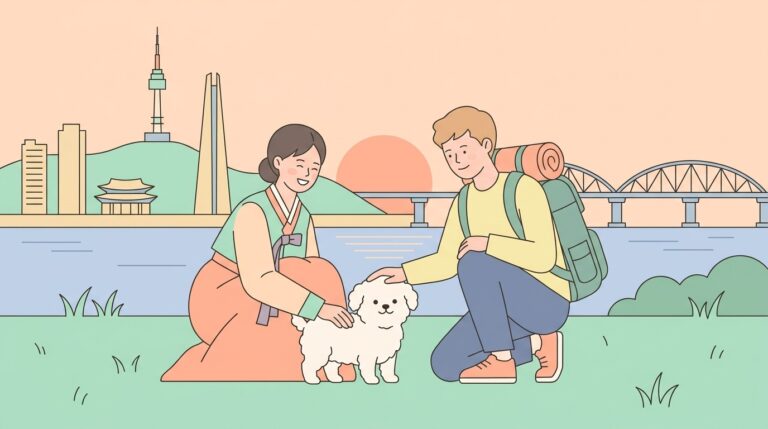
Phase 1: 공감 (Story-Driven Opening)
안녕하세요! 매일한글 에디터입니다.
Picture this: You are taking a leisurely sunset stroll along the Han River in Seoul. The breeze is gentle, the smell of ramen drifts from a nearby convenience store, and suddenly, the most angelic, cloud-like Bichon Frise trotting in a tiny yellow raincoat waddles right past your sneakers. Your heart melts. You eagerly pull out your phone to show the owner a photo of your own beloved cat back home, but your mind completely blanks. You search your textbook memory bank and remember the rigid sentence: “I possess a domestic animal.”
Stop right there! If you translate word-for-word from English, you might end up sounding like a 19th-century zoology professor. In South Korea, pets aren’t just considered animals you “own”—they are deeply cherished family members (가족, gajok), treated as the baby of the house or even an adorable little sibling (동생, dongsaeng). Over my 10 years of coaching global K-culture fans and travelers, I’ve seen so many beginners miss out on heartwarming park conversations simply because they lacked the right natural phrases. This guide is built directly from real student experiences and local Seoulite interactions. By the end of this lesson, you’ll be able to introduce your furry buddy with genuine warmth, charm pet owners, and make instant Korean friends effortlessly!
Phase 2: 핵심 표현 3선 심층 분석 (Top 3 Key Expressions)
1. 강아지 키워요. (Gangaji kiwoyo.)
- Pronunciation: [Gahn-gah-jee kee-woh-yoh] (Think of ‘gang’ like the fruit ‘guava’ start + ‘gee’ as in ‘geek’, and ‘kiwo’ rhymes with ‘key-glow’ without the l)
- Meaning: Literal: “I raise a puppy/dog.” | Real Nuance: “I have a dog!”
- K-Culture Moment: In reality shows like I Live Alone (나 혼자 산다), when idol guests introduce their homes, they always point to their four-legged roomie and happily beam, “저 강아지 키워요!”
- Editor’s Insight: Notice that Korean speakers rarely say “I have a dog” (개가 있어요). Instead, they use the verb 키우다 (kiwuda), meaning “to nurture, raise, or grow.” It reflects the mindset that a pet is someone you nurture with love, just like a child.
- Situation Spectrum: Casual: ✅ | Semi-formal: ✅ | Formal: ⚠️ (In ultra-formal job interviews, use 반려동물을 기르고 있습니다)
- 🤔 Think About It: In English, we simply “have” a pet. Why do you think Korean emphasizes the act of “raising/nurturing” (키우다) over mere possession?
2. 우리 집 막내예요. (Uri jip mangnaeyeyo.)
- Pronunciation: [Oo-ree jeep mahng-neh-yeh-yoh] (Sound analogy: ‘oo-ree’ like ‘ooh-reed’ minus the d, ‘mangnae’ sounds like ‘mung-neh’)
- Meaning: Literal: “(It) is our house’s youngest child.” | Real Nuance: “This is the baby of our family!”
- K-Culture Moment: When BTS’s V talks about his famous Pomeranian Yeontan, he doesn’t call him a pet; he introduces him with proud parental affection as the cherished little one of the family.
- Editor’s Insight: Koreans use 우리 (uri – our) rather than 내 (nae – my) even when talking about their own household. Calling your pet 막내 (mangnae – the youngest child) instantly conveys that this animal has official family status, complete with all the spoiling that comes with it!
- Situation Spectrum: Casual: ✅ | Semi-formal: ✅ | Formal: 🚫
- 🤔 Think About It: Why does Korean culture default to collective ownership (“our house”) even when an individual is speaking? What does this say about belonging?
3. 몇 살이에요? (Myeot sarieyo?)
- Pronunciation: [Myut sah-ree-eh-yoh] (Sound analogy: ‘myut’ rhymes with ‘hut’ with an initial m-y sound, followed by ‘sah-ree-eh-yo’)
- Meaning: Literal: “How many years/ages is it?” | Real Nuance: “How old is he/she?”
- K-Culture Moment: The golden icebreaker at every Seoul dog cafe or neighborhood park bench. Whenever two dogs sniff each other’s noses, owners immediately bow slightly and ask this exact sentence.
- Editor’s Insight: While asking human adults their age right away can sometimes feel blunt in Western cultures, in Korea, asking a pet’s age is the highest form of polite interest! It shows you care about their life journey.
- Situation Spectrum: Casual: ⚠️ (Use 몇 살이야? with close friends) | Semi-formal: ✅ | Formal: ✅
- 🤔 Think About It: Age establishes hierarchy and care etiquette in Korea. Could knowing a pet’s age help owners adjust how gently they approach them?
Phase 3: 교과서 한국어 vs 진짜 한국어 (Textbook vs. Real-Life Korean)
Situation 1: Saying you own a pet
- 📖 교과서 한국어 (Textbook): 저는 개가 있습니다. (Jeoneun gaega itseumnida.) — “I possess a canine.”
- 🗣️ 진짜 한국어 (Real-Life): 저 강아지 키워요! (Jeo gangaji kiwoyo!) — “I raise a doggie!”
- 💡 왜 다를까? (Why the difference?): In everyday speech, Koreans use 강아지 (gangaji – puppy/dog) regardless of whether the dog is 3 months old or a 10-year-old gentle giant. The word 개 (gae) on its own can sound slightly sterile or occasionally harsh in colloquial slang.
Situation 2: Bragging about how gentle your pet is
- 📖 교과서 한국어 (Textbook): 제 애완동물은 온순합니다. (Je aewandongmureun onsunhamnida.) — “My pet animal is docile.”
- 🗣️ 진짜 한국어 (Real-Life): 우리 애 진짜 순해요. (Uri ae jinjja sunhaeyo.) — “Our baby is super gentle!”
- 💡 왜 다를까? (Why the difference?): Real pet parents refer to their furry companions as 우리 애 (uri ae – our kid/baby). Replacing legalistic terms like “온순하다” with warm colloquial words like 순하다 (sunhada – sweet/tame) marks you instantly as a natural speaker.
Phase 4: K-Culture 딥다이브 & 비언어적 매너 (Cultural Deep-Dive & Etiquette)
4-1. 눈치 (Nunchi) & Body Language
When meeting someone’s pet on the streets of Seoul, eye contact and hand positions matter tremendously:
* The “Palm Sniff” Approach: Never reach straight over a dog’s head. Squat down slightly to bring your eye line lower, make polite eye contact with the owner first, and extend the back of your hand gently for the dog to sniff.
* The Golden Question First: Before touching, always ask permission: 만져봐도 돼요? (Manjyeobwado dwaeyo? – May I pet them?). Korean dog parents are very protective of their pet’s stress levels. Asking first is peak 눈치 (nunchi – social awareness)!
4-2. The Rise of the “Petfam” Tribe (펫팸족)
In modern Korea, a fascinating cultural phenomenon has emerged: the 펫팸족 (Petfam Tribe)—a portmanteau of “Pet” and “Family.” With many young Koreans living in single-person households (1인 가구), pets have stepped into the role of primary emotional companions. Walk down the trendy alleys of Yeonnam-dong or Seongsu-dong, and you will see 개모차 (gaemocha – pet strollers) outnumbering baby strollers on weekend afternoons! Bakeries sell specialized gluten-free pup-cakes, and pet boutiques stock traditional Hanbok for Lunar New Year doggie celebrations. Treating pets with deep personhood isn’t just an option here; it is the cultural standard.
Phase 5: 실전 롤플레이 시나리오 (Real-Life Interactive Roleplay)
Setting: Yeouido Hangang Park at golden hour. You are sitting on a bench enjoying a drink. A friendly local named Minji sits on the next bench with a fluffy, cloud-white Bichon wearing a stylish striped harness.
- Turn 1 (Minji): 안녕하세요! 날씨 정말 좋죠? (Annyeonghaseyo! Nalssi jeongmal jotjyo?)
🎭 Smiles warmly as her dog wags its tail toward your shoes.
“Hello! The weather is so nice, right?” -
Turn 2 (You): 네, 안녕하세요! 강아지가 너무 귀여워요. (Ne, annyeonghaseyo! Gangajiga neomu gwiyeowoyo.)
🎭 Leans forward gently, hands resting on your knees.
“Yes, hello! Your dog is so cute.” -
Turn 3 (Minji): 감사해요! 만져보셔도 돼요. 사람 진짜 좋아해요. (Gamsahaeyo! Manjyeobosyeodo dwaeyo. Saram jinjja joahaeyo.)
🎭 Loosens the leash slightly, encouraging the pup.
“Thank you! You can pet him. He really loves people.” -
Turn 4 (You): 혹시 몇 살이에요? (Hoksi myeot sarieyo?)
🎭 Offers the back of your hand gently for a polite sniff.
“By any chance, how old is he?” -
Turn 5 (Minji): 이제 세 살이에요. 혹시 집에서 동물 키우세요? (Ije se sarieyo. Hoksi jibeseo dongmul kiuseyo?)
🎭 Looks up curiously with a welcoming tilt of the head.
“He just turned three. Do you raise any animals at home by any chance?” -
Turn 6 (You): 네! 저 고양이 키워요. 우리 집 막내예요. (Ne! Jeo goyangi kiwoyo. Uri jip mangnaeyeyo.)
🎭 Pulls out phone with a proud smile to show a photo.
“Yes! I raise a cat. He’s the baby of our home.” -
Turn 7 (Minji): 어머, 진짜요? 사진 보니까 완전 미묘네요! (Eomeo, jinjjayo? Sajin bonikka wanjeon mimyoneyo!)
🎭 Claps hands together quietly in genuine delight.
“Oh my goodness, really? Looking at the picture, he is an absolute stunner of a cat!” -
Turn 8 (You): 감사합니다! 이름은 코코예요. (Gamsahamnida! Ireumeun Kokoyeyo.)
🎭 Smiles brightly as Minji admires your cat’s photo.
“Thank you! His name is Coco.”
🔀 Interactive Decision Point: Minji asks to see another photo!
How do you respond to keep the friendly vibe rolling?
- Choice A: 저 동물 싫어해요. 저리 가세요. (Jeo dongmul sileohaeyo. Jeori gaseyo.)
- Choice B: 여기 사진 더 있어요! 진짜 귀엽죠? (Yeogi sajin deo isseoyo! Jinjja gwiyeopjyo?)
- Choice C: 개는 고양이보다 시끄럽습니다. (Gaeneun goyangiboda sikkeureopseumnida.)
Detailed Feedback:
* Choice A (🚨 Bad): This means “I hate animals. Go away.” You initiated the chat, so saying this is socially disastrous and needlessly hostile!
* Choice B (🌟 Best): Perfect natural communication! It translates to “Here are more photos! Super cute, right?” This invites enthusiasm and deepens the bonding moment.
* Choice C (⚠️ Risk): Means “Dogs are noisier than cats.” Even if factual, criticizing someone’s pet choice right in front of their beloved pup creates major awkwardness (갑분싸 – sudden mood kill).
Phase 6: 10초 감정 섀도잉 드릴 (10-Second Emotion Shadowing Drill)
Practice these lines out loud! Use the emotional tags and rhythm slashes (/) to mimic natural native cadence.
[😊 Proud and beaming]
저 / 강아지 키워요! / 우리 집 / 막내예요!
(Jeo / gangaji kiwoyo! / Uri jip / mangnaeyeyo!)
Break rhythm: Short pause after ‘저’, smooth flow through ‘강아지 키워요’, proud emphasis on ‘막내예요!’-
[🥺 Tender and polite curiosity]
혹시 / 만져봐도 / 돼요? / 진짜 / 순하네요!
(Hoksi / manjyeobwado / dwaeyo? / Jinjja / sunhaneyo!)
Break rhythm: Soft rising pitch on ‘돼요?’, warm breathy delivery on ‘순하네요!’
Phase 7: K-Culture 미니 사전 (Mini Culture Dictionary)
-
댕댕이 (Daengdaengi)
Translation: Pooch / Doggie / Pupper.
Context: A famous piece of Korean internet wordplay (야민정음). Because the visual shape of the Hangul letters in ‘댕댕’ closely resembles ‘멍멍’ (the barking sound meong-meong), netizens lovingly call all cute dogs 댕댕이. -
랜선 집사 (Raenseon Jipsa)
Translation: Cyber Butler / Virtual Cat Guardian.
Context: In Korea, cat owners are humble “butlers” (집사) who serve their feline royalty. If your apartment lease bans pets and you only follow cats on Instagram or YouTube, you are an official 랜선 집사! -
개모차 (Gaemocha)
Translation: Pet Stroller.
Context: A blend of 개 (gae – dog) and 유모차 (yumocha – baby stroller). Used constantly in Seoul parks, pet expos, and department stores. -
멍뭉미 (Meongmungmi)
Translation: Puppy-like Charm.
Context: Used in K-dramas and K-pop fandoms to describe an adorable, cheerful person or idol who behaves like a bouncy, loving golden retriever (e.g., actor Park Bo-gum).
Phase 8: 여행자를 위한 생존 키트 (Traveler’s Survival Kit)
TOP 3 Survival Phrases
-
만져봐도 돼요? (Manjyeobwado dwaeyo?)
Romanization: Man-jyeo-bwa-do dwae-yo?
Pro Tip: The ultimate polite key before reaching out toward any dog in Korea. -
이름이 뭐예요? (Ireumi mwoyeyo?)
Romanization: Ee-reum-ee mwo-yeh-yo?
Pro Tip: Ask this while looking at the pet, then repeat their name softly with an appreciative smile. -
사진 찍어도 돼요? (Sajin jjigeodo dwaeyo?)
Romanization: Sah-jin jjee-geo-do dwae-yo?
Pro Tip: Essential when you visit Seoul’s famous animal cafes or spot an exceptionally well-dressed pup on the street.
Editor’s Travel Note
- Pet-Friendly Transit Rules: On the Seoul Metro and city buses, small pets are permitted only if they are enclosed in an approved pet carrier or pet stroller where they cannot poke their heads out.
- Seoul Navigation Tip: To easily find pet-friendly cafes and dog runs (애견 동반 카페), do not use foreign map services which often lack local indoor information. Instead, check out our guide on how to complete the 네이버 지도 앱 다운로드 to search the verified tag #반려동물동반 with ease!
Phase 9: “한 발 더 깊이” (Cultural Essay)
Notice how language reflects the evolution of the human heart. Decades ago in Korea, animals kept in households were widely termed 애완동물 (aewandongmul), which translates literally to “plaything animal” or “toy creature.” Today, this term has been almost entirely replaced in public broadcasting, government paperwork, and daily speech by 반려동물 (ballyeodongmul)—meaning “companion life-partner animal.” The root word 반려 (ballyeo) is the very same sacred root used in 반려자 (life partner / spouse). In an ultra-fast-paced, hyper-digitalized society where human relationships can sometimes feel fleeting, our pets offer unconditional sanctuary. When you call your pet 우리 집 막내 (the baby of our house), you aren’t just practicing a language point; you are stepping into a profound cultural declaration that love, not genetics alone, defines a family.
💬 Your Turn: What pet do you have at home, or what animal do you dream of adopting? Introduce them in the comments below using today’s sentence: 저 [동물 이름] 키워요!
Phase 10: FAQ & 오해 방지 (FAQ Schema)
Q: What is the difference between 개 (gae) and 강아지 (gangaji)?
A: Technically, 개 means an adult dog and 강아지 means a puppy. However, in modern spoken Korean, referring to someone’s pet as 개 can sound slightly cold or unrefined. Koreans warmly call dogs of all ages and sizes—even a 40kg Siberian Husky—강아지 or the affectionate slang 댕댕이.
Q: Can I use “키워요” for plants or siblings too?
A: Yes for plants, absolutely no for human siblings! You can say 식물 키워요 (I grow plants). However, if you say you 키우다 your human brother, it means you raised him as his guardian or parent, which sounds very weird if you’re just his peer!
Q: Why do people refer to themselves as ‘Mom’ (엄마) or ‘Dad’ (아빠) to animals?
A: Just like in English-speaking pet culture, Korean pet parents frequently say to their pets: “엄마한테 와! (Come to Mom!)” or “아빠 손! (Give Dad your paw!)”. It is considered totally normal, loving, and cute.
🚨 흔한 실수 (Common Mistakes) 경고판
| Foreign Learner Mistake | Why It Sounds Off | Correct Action |
|---|---|---|
| 제 개를 소유해요. | Literal robotic translation of “I own my dog.” Pets are not legal assets in social speech! | Use 강아지 키워요. |
| 만져도 됩니까? | Overly stiff military-style formality with a friendly stranger in a park. | Say softly: 만져봐도 돼요? |
| 이 동물이 늙었어요. | Saying an animal is “old/aged” (늙었다) sounds harsh and blunt. | Ask gently: 몇 살이에요? or say 나이가 좀 있어요. |
Phase 11: 액션 미션 & 참여 유도 (Action Missions)
- 🥉 Bronze Mission (Solo Practice): Stand in front of your mirror or pet. Say out loud 3 times: “우리 집 막내예요!” with a broad, beaming smile.
- 🥈 Silver Mission (Social Media): Post a photo of your pet (or your favorite animal) on Instagram or Weverse with the Korean caption: “우리 집 막내 [Pet’s Name]예요! 🐾 #매일한글”.
- 🥇 Gold Mission (Real-world Challenge): Next time you see a Korean dog owner at a park or visit a pet cafe, make eye contact, bow gently, and ask: “혹시 몇 살이에요?”
🎮 K-Culture Mission: Watch an episode of the popular Korean variety show Dogs Are Incredible (개는 훌륭하다) or search the hashtag #댕댕이 on Instagram. Count how many times you hear or read the word 우리 애!
Phase 12: 인터랙티브 퀴즈 챌린지 (Interactive Quiz)
Test your knowledge before you hit the parks!
1. Situation Judgment: You see an adorable dog walking toward you in Mangwon Hangang Park. What is the most polite and natural first step?
* (A) Pick up the dog immediately and hug it.
* (B) Look at the owner, smile, and say: 만져봐도 돼요?
* (C) Shout: 개가 큽니다!
2. Fill-in-the-blank: Complete the natural introduction sentence below:
* “저 집에서 귀여운 고양이 __________.” (Hint: Verb meaning ‘to raise’)
3. True or False: Calling a 9-year-old adult dog 강아지 is an offensive grammar error in conversational Korean.
* True / False
👉 Click here to reveal the answers and explanations!
1. Correct Answer: (B)
Explanation: Always ask permission from the owner first with 만져봐도 돼요? to practice good 눈치 (nunchi) and pet safety.
2. Correct Answer: 키워요 (kiwoyo)
Explanation: 고양이 키워요 is the natural, native way to state that you have a cat.
3. Correct Answer: False
Explanation: In conversational Korean, pet dogs of all ages are affectionately called 강아지 (or 댕댕이). It expresses warmth, not factual infancy!







