

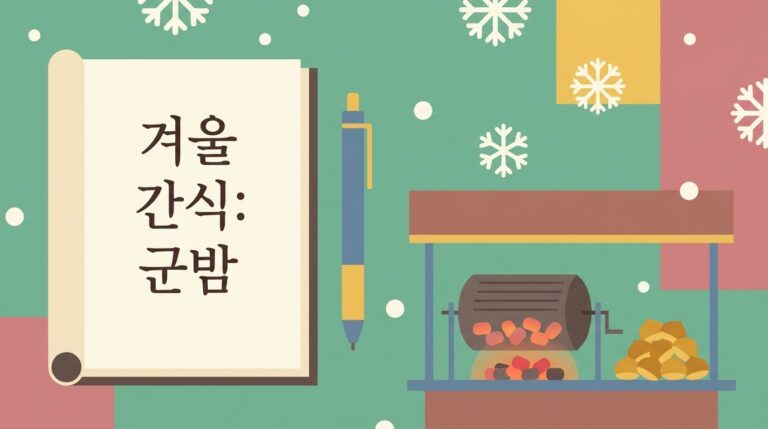
Warm Up Your Winter: How to Order Roasted Chestnuts (Gunbam) Like a Local
Phase 1: Empathy
안녕하세요! 매일한글 에디터입니다. (Hello! I am your Daily Hangul editor.)
Imagine walking down a breezy street in Seoul in the middle of January. Your breath forms little white clouds, the wind bites your cheeks, and suddenly, a rich, nutty, caramelized aroma hits your nose. You follow your senses and spot a cozy street cart where a metal cylinder is spinning over glowing coals, tumbling golden roasted chestnuts inside. You desperately want a paper bag of those steaming hot treasures to warm your freezing fingers, but your mind goes blank: How do I order? Do they take cards? What if I say the wrong thing?
Don’t worry at all! Every single Korean learner has felt that momentary freeze in front of a street cart. Buying gunbam (roasted chestnuts) is actually one of the simplest, warmest cultural interactions you can have in Korea. Today, based on real street tests and beginner feedback, I will teach you the exact, bite-sized survival lines to get your hands on a bag of hot chestnuts in under thirty seconds—even if this is day one of your Korean journey!
Phase 2: Core Expressions Deep Dive
1. 군밤 주세요 (Gunbam juseyo)
- Pronunciation: [Gun-bam ju-se-yo] (Sounds like: Goon-bahm joo-seh-yoh)
- Meaning: Literal: “Roasted chestnut, give please.” / Real Nuance: “A bag of roasted chestnuts, please!”
- K-Culture Moment: In winter scenes of dramas like Reply 1988 or Weightlifting Fairy Kim Bok-joo, characters stroll under snowfall while sharing paper bags of gunbam.
- Editor’s Insight: Juseyo (주세요) is your golden magic wand in Korea. Attach it to any noun, and you instantly have a polite, natural order.
- Situation Spectrum: Casual ⚠️ | Semi-formal ✅ | Formal ✅
- 🤔 Think About It: In English, we say “Could I please have…”. Korean gets straight to the point with just “Noun + 주세요”, yet it remains completely warm and respectful. How does this simplify your speaking anxiety?
2. 얼마예요? (Eolmayeyo?)
- Pronunciation: [Eol-ma-ye-yo] (Sounds like: Uhl-mah-yeh-yoh)
- Meaning: Literal: “How much is it?” / Real Nuance: “How much for one bag?”
- K-Culture Moment: When tourists or locals approach traditional pojangmacha (street stalls) where prices aren’t printed on flashy digital screens.
- Editor’s Insight: Keep your pitch gentle at the end. Raising the tone slightly makes you sound friendly rather than demanding.
- Situation Spectrum: Casual ⚠️ | Semi-formal ✅ | Formal ✅
- 🤔 Think About It: In many Western cultures, asking price directly can feel blunt without extra padding. In Korean street markets, directness is prized because it keeps the line moving!
3. 하나 주세요 (Hana juseyo)
- Pronunciation: [Ha-na ju-se-yo] (Sounds like: Hah-nah joo-seh-yoh)
- Meaning: Literal: “One, please give.” / Real Nuance: “Just one bag, please.”
- K-Culture Moment: Street food stalls sell chestnuts pre-measured in paper bags. Saying hana (one) automatically means “one paper bag.”
- Editor’s Insight: If you want two bags for you and a friend, swap hana (하나) for dul (둘) to say 둘 주세요 (Dul juseyo)!
- Situation Spectrum: Casual ⚠️ | Semi-formal ✅ | Formal ✅
- 🤔 Think About It: Notice how Korean doesn’t require words like “bag” or “packet” here? Context does all the heavy lifting.
Phase 3: Textbook Korean vs. Real Korean
Situation 1: Placing the order at the cart
- 📖 교과서 한국어 (Textbook): 저는 군밤을 사고 싶습니다. (Jeoneun gunbameul sago sipseumnida. – “I wish to purchase roasted chestnuts.”)
- 🗣️ 진짜 한국어 (Real Street): 군밤 하나 주세요! (Gunbam hana juseyo! – “One bag of roasted chestnuts, please!”)
- 💡 왜 다를까? (Why is it different?): Textbook phrases sound like an official business contract. Real street vendors appreciate fast, friendly, and practical speech.
Situation 2: Asking if you can pay with cash or transfer
- 📖 교과서 한국어 (Textbook): 신용카드로 결제할 수 있습니까? (Sinyongkadeuro gyeoljehal su isseumnikka? – “Is it possible to settle payment via credit card?”)
- 🗣️ 진짜 한국어 (Real Street): 현금만 돼요? (Hyeongeumman dwaeyo? – “Is it cash only?”)
- 💡 왜 다를까? (Why is it different?): Street carts rarely have card swipe terminals. Asking directly if cash is required saves both you and the seller awkward card rejections.
Phase 4: K-Culture Deep Dive & Non-Verbal Manners
4-1. 눈치 (Nunchi) & Gestures
- The Two-Hand Rule: When the cart owner (often an elderly halmeoni or harabeoji) hands you that steaming hot paper bag, receive it with both hands or hold your elbow with your left hand. It shows deep, instinctive respect.
- Watch the Steam: Never blow the steam directly toward the vendor. Step one step aside, inhale the smoky aroma, and take your first bite with an appreciative nod.
4-2. Cultural Code Analysis: The Winter Romance of Gunbam
In Korea, winter street food is not just junk food; it is emotional nostalgia called chueok (추억). Street roasted chestnuts are cooked in specialized rotating drums that peel the tough outer shell and scorch the inner yellow meat to sweet perfection. Historically, street carts provided affordable, hearty warmth for workers heading home. Today, stopping by a gunbam stand on a chilly date night is a classic romantic staple seen in countless K-Dramas.
Phase 5: Real-Life Roleplay Scenario
Setting: A chilly Friday night near Jongno 3-ga. Grandfather vendor (Harabeoji) stands beside a glowing, rotating chestnut roaster.
- Turn 1 (Learner): 안녕하세요! 군밤 얼마예요? (Annyeonghaseyo! Gunbam eolmayeyo?)
🎭 [Smiling warmly, pointing gently at the warm bag]
Translation: Hello! How much are the roasted chestnuts? - Turn 2 (Vendor): 한 봉지에 오천 원이에요! (Han bongjie ocheon-wonieyo!)
🎭 [Shaking a freshly roasted bag to show the steam]
Translation: It’s 5,000 won per bag! - Turn 3 (Learner): 와, 맛있겠네요! 하나 주세요. (Wa, masitgenneyo! Hana juseyo.)
🎭 [Nodding with eager eyes, holding up one finger]
Translation: Wow, looks delicious! One bag, please. - Turn 4 (Vendor): 방금 구워서 엄청 뜨거워요. 조심해요! (Banggeum guwoseo eomcheong tteugeowoyo. Josimhaeyo!)
🎭 [Handing over the bag carefully using paper tongs]
Translation: They were just roasted so they’re super hot. Be careful! - Turn 5 (Learner): 네, 감사합니다! 혹시 계좌이체 돼요? (Ne, gamsahamnida! Hoksi gyejwa-iche dwaeyo?)
🎭 [Looking around the cart for an account number sign]
Translation: Yes, thank you! By any chance, can I do a bank transfer? - Turn 6 (Vendor): 저기 앞에 계좌번호 적혀 있어요. (Jeogi ape gyejwabeonho jeokhyeo isseoyo.)
🎭 [Pointing a gloved finger at a handwritten piece of cardboard]
Translation: The account number is written right there in front. - Turn 7 (Learner): 오천 원 보냈어요! 확인해 보세요. (Ocheon-won bonaesseoyo! Hwaginhae boseyo.)
🎭 [Showing the payment confirmation screen on your phone]
Translation: I sent 5,000 won! Please check. - Turn 8 (Vendor): 아이고, 고마워요! 맛있게 먹어요! (Aigo, gomawoyo! Masitge meogeoyo!)
🎭 [Waving warmly with a broad smile]
Translation: Oh, thank you! Enjoy your snack!
🔀 Interactive Decision Point
The vendor hands you the bag. What do you do?
* Option A: Grab it with one hand while walking away looking at your phone.
Feedback: [Bad] Street stall grandmas and grandpas value human connection. Taking it with one hand while distracted comes across as cold.
* Option B: Receive the bag using both hands, make eye contact, and say “감사합니다! (Gamsahamnida!)”
Feedback: [Best] You nailed street etiquette! You will likely get a big smile or even an extra chestnut (deom) next time.
* Option C: Shout “카드로 할게요! (Kadeuro halgeyo! – I will pay by card!)” before asking if they accept it.
Feedback: [Risk] Street vendors usually do not carry wireless POS machines. You will cause unnecessary awkwardness.
Phase 6: 10-Second Emotional Shadowing Drill
Read these out loud with rhythm and feeling! Slashes (/) indicate brief breath pauses:
[🥶 Freezing cold, full of anticipation]
군밤 / 하나 주세요! (Gunbam / hana juseyo!)-
[😊 Inquisitive and polite]
사장님, / 얼마예요? (Sajangnim, / eolmayeyo?) -
[🙏 Heartfelt and cozy]
따뜻해요, / 감사합니다! (Ttatteuthaeyo, / gamsahamnida!)
Phase 7: K-Culture Mini Dictionary
- 군밤 (Gunbam): Roasted chestnuts. Gun comes from gupda (to bake/roast), and bam means chestnut.
- 현금 (Hyeongeum): Cash. Critical word when shopping at open-air food stalls and subway kiosks.
- 포장 (Pojang): Takeout / packaging. While chestnuts come bagged already, saying “포장해 주세요” (Pojanghae juseyo) works everywhere in Korea for to-go orders.
- 덤 (Deom): The beloved Korean concept of an extra freebie given out of generosity. If a vendor drops two extra chestnuts in your bag, that is deom!
Phase 8: Traveler’s Survival Kit
Top 3 Survival Phrases
- 얼마예요? (Eolmayeyo?) – How much is it?
Pro Tip: Use this at any market stall before pulling out money. - 현금 있어요. (Hyeongeum isseoyo.) – I have cash.
Pro Tip: Instantly brings relief to elderly stall owners. - 뜨거워요? (Tteugeowoyo?) – Is it hot?
Pro Tip: Good check to ensure you are getting fresh, piping-hot chestnuts rather than pre-bagged cold ones.
Editor’s Travel Note
- Most street carts do not take foreign credit cards. Always keep a crisp 5,000 KRW or 10,000 KRW note in your phone case!
- To easily find popular street food alleys in Insadong or Myeongdong, check the official Naver Map navigation guide to avoid getting lost in subway labyrinth exits.
Phase 9: A Step Deeper (Reflection)
In Korea, food shared in the freezing cold is bound by the concept of Jeong (정)—an unspoken bond of collective warmth and compassion. When a vendor roasts chestnuts in sub-zero winds, they aren’t just running a business transaction; they are extending physical warmth to strangers hurrying home. In a world dominated by instant deliveries and self-checkout kiosks, these interactions remind us of the beauty of human presence.
💬 Your Turn: What is the go-to winter street comfort food in your home country? Have you ever tried roasted chestnuts before? Tell us in the comments below!
Phase 10: FAQ & Avoiding Misunderstandings
Q: Can I pay with an Apple Pay or an international Visa card at chestnut stalls?
A: No, 95% of traditional outdoor street carts do not support international cards or Apple Pay. They accept Korean cash, or Korean domestic bank transfers via QR code.
Q: How much does a bag of roasted chestnuts typically cost in Seoul?
A: A standard bag usually ranges between 3,000 KRW and 5,000 KRW depending on the neighborhood and portion size.
Q: Do I need to peel them myself?
A: Good news! The vendor’s machine splits the shells open during roasting, so the skin pops off effortlessly with your thumb and index finger.
🚨 Common Mistakes Warning Board
- Mistake: Calling the vendor Ajumma or Harabeoji directly to get their attention.
Correct Action: Call them politely by saying 사장님 (Sajangnim – “Boss/Proprietor”). It is flattering and universally polite! - Mistake: Handing money with just one hand while looking away.
Correct Action: Always hand cash over with two hands or right hand supported by your left forearm. - Mistake: Tossing the empty chestnut shells on the street.
Correct Action: Hold on to the paper bag; toss shells back into the paper bag, and discard it in a subway station trash bin.
Phase 11: Action Missions & Community Engagement
- 🥉 Bronze Mission: Stand in front of your mirror and repeat “군밤 하나 주세요! (Gunbam hana juseyo!)” three times out loud.
- 🥈 Silver Mission: Snap a picture of your favorite warm snack today and share it on Instagram tagging
@DailyHangulwith the caption “군밤 주세요”. - 🥇 Gold Mission: Walk up to a street cart in Korea, successfully order a bag using only Korean, and say “감사합니다! (Gamsahamnida!)” with a respectful nod.
- 🎮 K-Culture Mission: Watch an episode of a winter-set drama like Goblin or When the Weather is Fine and spot the street food stalls!
Phase 12: Interactive Quiz Challenge
Test your street skills before heading out into the cold!
- Situational Check: You want to buy ONE bag of chestnuts. What is the most natural phrase?
- A) 군밤 먹자 (Gunbam meokja)
- B) 군밤 하나 주세요 (Gunbam hana juseyo)
- C) 군밤을 계산합시다 (Gunbameul gyesanhapssida)
- Fill-in-the-blank: When asking “How much is it?”, you say:
- [ ______ ] 예요?
- True or False: You should always address the vendor as “Hey you” to match the casual street vibe.
Click here to reveal answers & explanations!
- Answer: B (군밤 하나 주세요 is the gold standard for polite, natural ordering).
- Answer: 얼마 (Eolma) -> 얼마예요? (Eolmayeyo? = How much is it?).
- Answer: False! Always use 사장님 (Sajangnim) to show respect and get the best service!







