

The Ultimate Korean Unboxing Guide: Film Your Haul and Review Like a Native Creator
Phase 1: 공감 (Story-Driven Opening)
안녕하세요! 매일한글 에디터입니다.
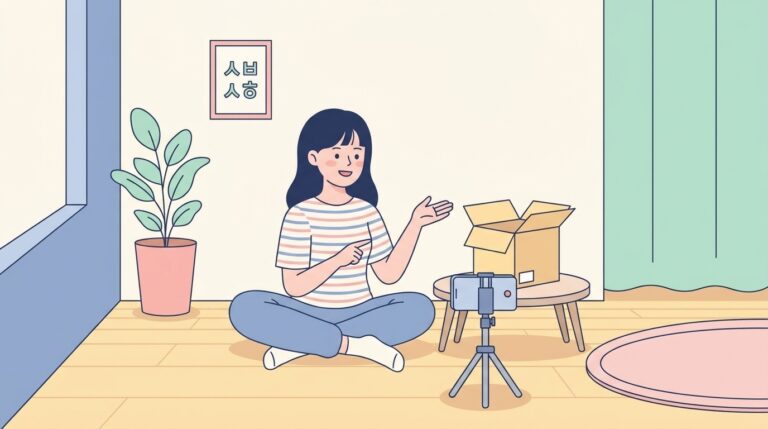
Picture this: You are sitting on your living room floor in Seoul, surrounded by three sleek Coupang Rocket delivery boxes and an iconic olive-green shopping bag from Olive Young. You set up your tripod, adjust your ring light, hit record, and crack open that fresh bubble wrap. You want to share your latest K-beauty, stationery, or K-pop album haul with the world—or perhaps post a quick Instagram story review for your Korean followers.
Then, the dreaded vocabulary block hits. You smile awkwardly at the lens and repeatedly stammer: “이거… 정말 예뻐요. 진짜 좋아요. (Igeo… jeongmal yeppeoyo. Jinjja joeunyo. / This is… really pretty. It’s really good.)”
Deep down, you know your real thoughts are far more nuanced. You want to say that the stitching on this oversized hoodie feels indestructible, that the cushion foundation has a featherlight dewy finish, or that while the aesthetic is pure perfection, the packaging feels slightly flimsy for the price tag.
Intermediate learners (CEFR B2) often get trapped in the “좋아요 (It’s good)” kindergarten cycle when trying to give casual reviews. In Korean internet culture, unboxing (언박싱) is practically an art form backed by hyper-specific slang, sensory adjectives, and balanced evaluations. Based on coaching hundreds of international content creators and K-culture enthusiasts at Daily Hangul, we curated this comprehensive guide to bridge that exact gap. By the end of this lesson, you won’t just describe what came out of the box; you’ll sound like an authentic Seoul influencer dissecting a haul with wit, tact, and flair.
Phase 2: 핵심 표현 3선 심층 분석 (Core Expressions Deep Dive)
Let’s upgrade your review vocabulary from generic praise to B2-level precision with three indispensable phrases.
1. 내돈내산 솔직 후기예요
- Pronunciation: [Nae-don-nae-san sol-jik hu-gi-ye-yo] (Sound analogy: Think “Nay-dawn-nay-sahn sole-jeek who-ghee-yeh-yo”)
- Meaning: Literal: “My money, my purchase, honest review.” | Real Nuance: “100% unsponsored, paid with my own hard-earned cash, totally unbiased review.”
- K-Culture Moment: Every top Korean YouTuber places this in their video thumbnail or opening 5 seconds to build instant trust with viewers skeptical of hidden advertisements (뒷광고).
- Editor’s Insight: This compound abbreviation (내 돈 주고 내가 산 것) became cultural law after major sponsorship scandals shook the Korean creator sphere. Using this immediately establishes authenticity.
- Situation Spectrum: Casual (✅) / Semi-formal (✅) / Formal (⚠️ – In formal journalism, use 자비 부담 솔직 후기 instead)
- 🤔 Think About It: Why does Korean online shopping culture value knowing who funded the purchase so aggressively compared to Western review platforms?
2. 뜯어보니까 생각보다 퀄리티가 훨씬 짱짱해요
- Pronunciation: [Tteu-deo-bo-ni-kka saeng-gak-bo-da kwol-li-ti-ga hwol-ssin jjang-jjang-hae-yo] (Sound analogy: “Tteu-duh-bo-nee-kkah sang-gahk-boh-dah kwol-lee-tee-gah hwool-sheen jjahng-jjahng-heh-yoh”)
- Meaning: Literal: “Now that I opened it, compared to my thoughts, the quality is much tighter.” | Real Nuance: “Having unboxed it, the build quality and sturdiness totally blew away my expectations.”
- K-Culture Moment: Essential when reviewing knitwear, bags, phone cases, or plushies on TikTok or YouTube shorts.
- Editor’s Insight: 짱짱하다 originally describes something tight, resilient, or firmly woven (like high-grade elastic). In modern slang, it means robust, durable, and remarkably high quality.
- Situation Spectrum: Casual (✅) / Semi-formal (✅) / Formal (🚫 – Stick to 내구성이 뛰어납니다)
- 🤔 Think About It: English speakers say “solid build” or “feels premium.” Notice how Korean anchors quality into tactile tension (짱짱하다).
3. 가성비는 괜찮은데, 마감이 살짝 아쉬워요
- Pronunciation: [Ga-seong-bi-neun gwaen-chan-eun-de, ma-gam-i sal-jjak a-swi-wo-yo] (Sound analogy: “Gah-sung-bee-noon gwen-chahn-oon-deh, mah-gahm-ee sahl-jjahk ah-shee-woh-yoh”)
- Meaning: Literal: “Price-to-performance ratio is decent, but the finish is slightly regretful.” | Real Nuance: “It’s great value for money, but the finishing touches/stitching leave a little to be desired.”
- K-Culture Moment: A hallmark of authentic Korean product critique. Praising a product blindly sounds fake; pointing out subtle details like loose threads or brittle seams makes you a respected reviewer.
- Editor’s Insight: 마감 (finishing/seams/edges) and 아쉽다 (to feel a slight lack/disappointment without harsh anger) are the ultimate dynamic duo for diplomatic intermediate critiques.
- Situation Spectrum: Casual (✅) / Semi-formal (✅) / Formal (✅)
- 🤔 Think About It: Why does Korean use emotional words like 아쉽다 (lingering longing/disappointment) rather than aggressive words like “bad” or “defective” when offering constructive feedback?
Phase 3: 교과서 한국어 vs 진짜 한국어 (Textbook vs. Real-Life Korean)
Situation 1: Opening the delivery box on camera
- 📖 교과서 한국어: 지금부터 택배 상자를 개봉해 보도록 하겠습니다. (Jigeumbuteo taekbae sangjareul gaebonghae bodorok hagesseumnida. / I will now open the delivery box.)
- 🗣️ 진짜 한국어: 드디어 도착했는데요, 현기증 나니까 바로 뜯어볼게요! (Deudieo dochakhaenneunde-yo, hyeongijeung nanikka baro tteudeobolge-yo! / It’s finally here! I’m dizzy with anticipation, so let’s rip it open right now!)
- 💡 왜 다를까?: While 개봉하다 is an accurate dictionary term for opening a box or premiering a movie, content creators prefer punchy verbs like 뜯다 (to tear/rip open) and dramatic hyperbole like 현기증 나다 (to feel dizzy from waiting) to inject high energy.
Situation 2: Praising an item’s visual appeal
- 📖 교과서 한국어: 이 상품은 색상이 대단히 아름답습니다. (I sangpumeun saeksangi daedanhi areumdapsumnida. / This product’s color is exceedingly beautiful.)
- 🗣️ 진짜 한국어: 화면보다 실물이 훨씬 영롱하고, 완전 실물 깡패예요! (Hwamyeonboda silmuri hwolssin yeonglonghago, wanjeon silmul kkangpae-ye-yo! / In real life, it’s way more luminous than on screen; the physical item is an absolute showstopper!)
- 💡 왜 다를까?: Calling things 아름답다 sounds like a 19th-century poem. Trend-savvy shoppers use 영롱하다 (iridescent/sparkling) and 실물 깡패 (slang: something that looks so insanely good in person that it bullies the photos) for maximum punch.
Phase 4: K-Culture 딥다이브 & 비언어적 매너 (Deep Dive & Non-Verbal Nuance)
4-1. Nunchi & Creator Body Language
- The Focus Palm Flirt: When filming tiny items (lip tints, photocards, jewelry), never just wave it around. Hold your open palm directly behind the item so the camera lens locks its auto-focus onto the product. Korean netizens expect this gesture instantly!
- The Delivery Label Cover-Up: Korean privacy standards are strict. Never flash the white shipping slip (운송장) on your box. Either black out your phone number and address beforehand or peel the label off before hitting record.
- The Subtle Fingertip Tap (Tteok-tteok): Before opening hard packaging, lightly tap your index fingernail against the surface 2-3 times. This satisfies the viewer’s tactile curiosity and pays homage to Korea’s massive unboxing ASMR subculture.
4-2. Cultural Code: The Culture of Honest Critiques (솔직 후기)
Korea boasts the fastest delivery infrastructure in the world—from Coupang’s Dawn Delivery (새벽배송) to Olive Young’s 3-hour “Today Dream” (오늘드림). Because getting items is effortless, the true currency of the Korean internet is curation integrity. Viewers will unfollow a creator in seconds if they suspect sponsored bias (뒷광고). To gain clout, Korean reviewers intentionally spotlight tiny flaws (e.g., 가루 날림이 조금 있어요 – “there’s a bit of powder fallout”). High praise means nothing unless accompanied by meticulous, objective scrutiny.
Phase 5: 실전 롤플레이 시나리오 (Interactive Roleplay)
Setting: You are filming a collaborative unboxing video in a cozy creator studio in Yeonnam-dong with Minji (민지), an experienced K-lifestyle video creator.
- 턴 1 (Minji): 자, 여러분! 오늘 드디어 기다리던 택배가 도착했는데요, 바로 언박싱 시작해 볼까요?
(Ja, yeoreobun! Oneul deudieo gidarideon taekbaega dochakhaenneunde-yo, baro eonbaksing sijakhae bolkkayo?)
“Alright, everyone! The package we’ve been dying for has finally arrived. Shall we jump straight into unboxing?”
🎭 Claps both hands together excitedly and pushes a yellow box toward the camera. -
턴 2 (Learner): 완전 기대돼요! 협찬 아니고 우리 둘 다 내돈내산으로 산 거 맞죠?
(Wanjeon gidaedwae-yo! Hyeopchan anigo uri dul da naedonnaesaneuro san geo matjyo?)
“I’m so excited! Just to be clear, this isn’t sponsored—we bought this with our own cash, right?”
🎭 Points directly at the camera with a playful, confident wink. -
턴 3 (Minji): 당연하죠! 칼로 테이프 뜯을 때 손 다치지 않게 조심하시고요. 오픈해 보세요!
(Dang-yeonhajyo! Kallo teipeu tteudeul ttae son dachiji anke josimhasigoyo. Opeunhae bose-yo!)
“Of course! Be super careful with your hands when cutting the tape with the utility knife. Go ahead and open it!”
🎭 Hands over a pastel unboxing craft cutter. -
턴 4 (Learner): 우와, 화면으로 봤던 것보다 실물이 훨씬 영롱한데요?
(Uwa, hwamyeoneuro bwatdeon geotboda silmuri hwolssin yeonglonghande-yo?)
“Whoa, seeing it in person is so much more luminous than it looked on screen!”
🎭 Lifts the product gently, placing a hand behind it for camera focus. -
턴 5 (Minji): 대박, 진짜 실물 깡패네요! 소재 만져보니까 느낌은 어때요?
(Daebak, jinjja silmul kkangpaene-yo! Sojae manjeobonikka neukkimeun eottae-yo?)
“No way, it really is a total showstopper! How does the texture feel now that you’re touching the fabric?”
🎭 Leans in close to inspect the seams. -
턴 6 (Learner): 생각보다 퀄리티가 훨씬 짱짱해요. 박음질도 탄탄하고요.
(Saenggakboda kwollitiga hwolssin jjangjjanghae-yo. Bageumjildo tantanhagoyo.)
“The quality is much sturdier than expected. Even the stitching is solidly reinforced.”
🎭 Gently tugs the edge of the material to demonstrate durability. -
턴 7 (Minji): 그러게요! 가격 생각하면 이 정도 마감은 진짜 갓성비라고 봐도 되겠어요.
(Geureoge-yo! Gagyeok saenggakhamyeon i jeongdo magameun jinjja gatseongbirago bwado doegesseo-yo.)
“Totally agree! Considering the price tag, this level of finishing qualifies as god-tier value.”
🎭 Nods vigorously in agreement, flashing thumbs up. -
턴 8 (Learner): 맞아요. 마감 처리가 깔끔해서 이번 쇼핑은 대성공인 것 같아요!
(Majayo. Magam cheoriga kkal-kkeumhaeseo ibeon syoping-eun daeseonggong-in geot gatayo!)
“Exactly. The clean finish makes this haul an absolute home run!”
🎭 Holds the item side-by-side with Minji, beaming at the viewer.
🔀 인터랙티브 분기점 (Interactive Choice)
Imagine Minji discovers a minor flaw: a loose thread hanging from the zipper pull. How do you respond on camera?
- Option A: “어? 여기 불량이에요! 이 브랜드 진짜 최악이네요. 환불할래요.”
(Eo? Yeogi bullyang-i-e-yo! I beuraendeu jinjja choe-ag-i-ne-yo. Hwanbulhallae-yo. / Huh? This is defective! This brand is the absolute worst. I want a refund.) - Option B: “가성비는 최고인데, 지퍼 쪽 마감이 살짝 아쉬워요. 그래도 가위로 정리하면 괜찮을 것 같아요!”
(Gaseongbi-neun choego-inde, jipeo jjok magam-i saljjak aswiwo-yo. Geuraedo gawi-ro jeongnihamyeon gwaenchanheul geot gatayo! / The cost performance is top-notch, though the finish around the zipper is slightly disappointing. Still, snip it with scissors and it’ll be totally fine!) - Option C: “아무 문제 없어요! 다 완벽해요! 무조건 사세요 여러분!”
(Amu munje eopseoyo! Da wanbyeokhaeyo! Mujogeon sase-yo yeoreobun! / No problem at all! Everything is perfect! Buy it unconditionally, everyone!)
Feedback:
* Option A (Bad): Far too aggressive for a tiny loose thread. In Korean review culture, overreacting like this gets labeled as an unreasonable customer (진상 고객) unless the product is genuinely unusable.
* Option B (Best): Perfect B2 nuance! You acknowledge the strong value (가성비), diplomatically address the flaw (마감이 살짝 아쉽다), and suggest a practical fix. Netizens will trust you instantly.
* Option C (Risk): Suspiciously defensive. Viewers can see the loose thread on high-definition video; dismissing obvious flaws makes you sound like a covert brand sponsor (뒷광고 의혹).
Phase 6: 10초 감정 섀도잉 드릴 (Shadowing Drill)
Practice reading these with realistic creator intonations. Slash marks (/) indicate breath pauses and emphasis peaks.
[🤩 완전 감탄하며 / Eyes wide with genuine awe]
“와… / 화면으로 볼 때보다 / 실물이 훨씬 영롱한데요?”
(Wa… / hwamyeoneuro bol ttaeboda / silmuri hwolssin yeonglonghande-yo?)-
[🧐 꼼꼼하게 따져보며 / Narrowing eyes like an analytical critic]
“가성비는 진짜 갓성비인데, / 지퍼 쪽 마감이 / 살짝 아쉬워요.”
(Gaseongbi-neun jinjja gatseongbi-inde, / jipeo jjok magam-i / saljjak aswiwo-yo.) -
[💸 통장을 보며 씁쓸하고 유쾌하게 / Self-deprecating laugh holding up wallet]
“이번 달 통장은 텅장이 됐지만… / 후회 없는 내돈내산입니다!”
(Ibeon dal tongjangeun teongjang-i dwaetjiman… / huhoe eomneun naedonnaesanimnida!)
Phase 7: K-Culture 미니 사전 (Key Vocabulary)
- 내돈내산 (Nae-don-nae-san): “My money, my purchase.” Shorthand for authentic, unsponsored shopping hauls and reviews.
- 실물 깡패 (Sil-mul kkang-pae): Literally “real-life gangster.” Refers to a product, fashion piece, or celebrity that looks astronomically better in person than through promotional photos.
- 갓성비 (Gat-seong-bi): A blend of the English word “God” (갓) and 가성비 (cost-effectiveness). Used when an item gives outrageously high quality for a surprisingly low price.
- 텅장 (Teong-jang): A mashup of 텅 비다 (empty) and 통장 (bank account). The universal feeling when you indulge in a glorious online shopping binge and drain your balance.
Phase 8: 여행자를 위한 생존 키트 (Traveler’s Survival Kit)
Top 3 Survival Phrases for Haulers & Shoppers in Korea
- “혹시 새 상품으로 꺼내주실 수 있나요?”
(Hoksi sae sangpumeuro kkeonaejusil su innayo?)
Pro Tip: At Olive Young or Dongdaemun, display models take a beating. Ask politely if they can fetch a fresh, sealed box from inventory. - “파손되지 않게 뽁뽁이로 꼼꼼히 포장해 주세요.”
(Pason-doeji anke bbok-bbok-i-ro kkom-kkom-hi pojanghae juse-yo.)
Pro Tip: 뽁뽁이 is the charming onomatopoeia for bubble wrap. Essential if you are flying fragile skincare ampoules or albums home! - “택배 상자에 송장 번호가 잘 안 보이는데 다시 확인해 주실 수 있나요?”
(Taekbae sangja-e songjang beonhoga jal an boineunde dasi hwaginhae jusil su innayo?)
Pro Tip: Use this if your hotel concierge or Airbnb host received a package for you and the tracking number (송장 번호) is blurred.
Editor’s Travel Note
- Track Like a Local: If you order online to your Airbnb, download the [CJ대한통운 배송조회 앱 다운로드] to track parcels to the exact delivery minute.
- Fast Skincare Delivery: Can’t wait for standard shipping? Jump on the Olive Young app and choose 오늘드림 (Today Dream) service—a bike courier will drop off your beauty haul at your hotel doorstep in under three hours.
Phase 9: “한 발 더 깊이” (Cultural Essay)
In many Western cultures, consumers consider a product transaction purely bilateral: you pay money, you receive an item. But in Korea’s hyper-connected digital landscape, unboxing is a communal ritual. Korean consumers view themselves as part of a collective watchdog culture. When you announce 내돈내산 (my own purchase), you aren’t just boasting independence; you are accepting responsibility for protecting fellow shoppers from deceptive marketing. Reviewing an item with phrases like 마감이 살짝 아쉽다 shows you respect your peer community enough to deliver fair, unvarnished truths. It reflects a society where collective trust (신뢰) is preserved through shared vigilance.
💬 Your Turn: What was your last “텅장” purchase where the item turned out to be an absolute “실물 깡패”? Tell us your unboxing story in the comments below using at least one Korean phrase!
Phase 10: FAQ & 오해 방지 (FAQ & Common Mistakes)
Q: Can I use the slang term “실물 깡패” in a formal store when speaking to a clerk?
A: It’s better not to! 깡패 (gangster) is playful internet slang best reserved for video content, friends, or social media captions. In front of store staff or elders, say “실물이 훨씬 고급스럽고 예쁘네요 (It looks much more luxurious and pretty in person).”
Q: What is the real difference between “가성비” and “갓성비”?
A: 가성비 (Price-performance ratio) is neutral and analytical—it means you got fair utility for your money. 갓성비 adds the honorary prefix “God” and expresses emotional delight when something is absurdly cheap for its extraordinary quality.
Q: Is it considered rude to give negative feedback on a Korean brand online?
A: Not at all, provided it is constructive! Koreans value objective critique. Rather than saying “이거 쓰레기예요 (This is trash)”, soften your feedback like a pro using intermediate diplomatic phrasing: “~한 점은 살짝 아쉽지만, ~한 부분은 만족스러워요 (While X is slightly disappointing, Y is satisfying).”
🚨 Common Mistakes (흔한 실수 TOP 3)
- Mistake: Using 개봉하겠습니다 on casual social media.
- Correction: Sounds like an official press conference. Use “뜯어볼게요!” or “오픈해 볼게요!”.
- Mistake: Confusing 짱짱하다 (sturdy/resilient) with 짱이다 (awesome/the best).
- Correction: While both are slang, use 짱짱하다 specifically when physical materials, stitching, or battery stamina are tough and durable.
- Mistake: Calling everything 예뻐요 regardless of product category.
- Correction: Diversify your descriptors! Use 영롱하다 for shimmery/glowy items, 마감이 깔끔하다 for clean craftsmanship, and 퀄리티가 좋다 for material excellence.
Phase 11: 액션 미션 (Action Missions)
- 🥉 Bronze Mission (Solo Practice): Pick up one object on your desk right now. Look at your phone camera and practice saying: “생각보다 퀄리티가 훨씬 짱짱해요!” three times with crisp diction.
- 🥈 Silver Mission (Social Share): Snap a photo of a recent Korean purchase (food, cosmetic, or merch), post it to your Instagram story, and caption it with: #내돈내산 솔직 후기: 완전 실물 깡패! Tag
@DailyHangul! - 🥇 Gold Mission (Real World Delivery): Next time you order K-merch or receive a delivery in Korea, film a 15-second TikTok/Reels clip using our Shadowing Drill expressions to describe both a positive highlight and a mild flaw (마감이 살짝 아쉽다).
🎮 K-Culture Mission: Watch an unboxing vlog by your favorite K-pop idol or Korean beauty creator this week. Count how many times they use the words 영롱하다, 뜯어보다, or check the product’s seams (마감)!
Phase 12: 인터랙티브 퀴즈 챌린지 (Interactive Quiz)
1. Situation Judgment: You bought a pair of shoes for 20,000 KRW (very cheap), and while the design is gorgeous, some glue is visibly leaking along the sole. Which sentence strikes the perfect balance for a video review?
* A) 너무 싸구려라서 최악이에요. 절대 사지 마세요.
* B) 갓성비 디자인이지만 접착제 마감이 살짝 아쉬워요.
* C) 아무 문제 없고 전 세계에서 제일 짱짱해요!
2. Fill in the Blank: When you spent all your monthly salary on an impulsive K-pop merchandise haul, your bank account (통장) is now humorously called a ( ______ ).
3. True or False: It is completely safe and normal etiquette in Korean unboxing videos to show the delivery address and barcode on the parcel label to prove your city of residence.
👉 Click here to check the Answers & Explanations!
-
Answer: B
Explanation: Option B highlights the unbeatable price-to-design ratio while diplomatically noting the messy glue finish (마감이 살짝 아쉽다), cementing your credibility as an objective creator. -
Answer: 텅장 (Teong-jang)
Explanation: From 텅 비어버린 통장 (a completely empty bank account). A beloved meme term among avid shoppers. -
Answer: False
Explanation: Korean creators strictly blur or slice off shipping labels (운송장) to protect personal data and privacy before filming!







