

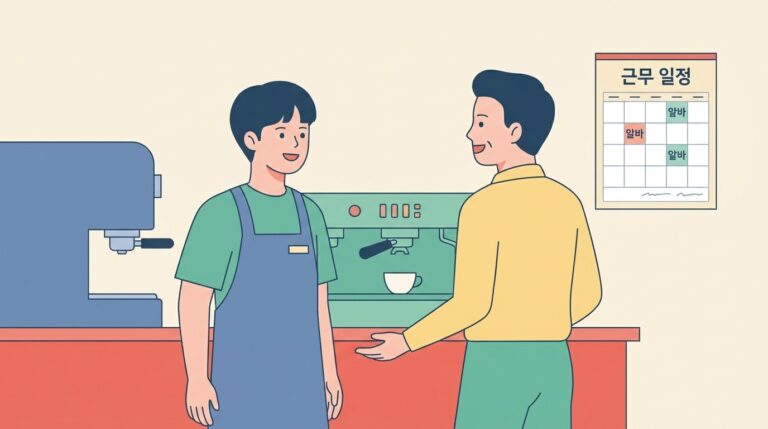
Phase 1: Empathy (Story-Immersive Opening)
안녕하세요! 매일한글 에디터입니다.
Imagine this: You have just landed your dream part-time job at a cozy cafe near Hongdae. The espresso smells incredible, K-indie tracks are playing softly in the background, and you’re finally feeling like a true Seoul local. But then, your university professor drops a bombshell—a mid-term exam is rescheduled right during your Friday afternoon shift. Panic sets in. Your heart beats fast as you stare at your phone screen. How do you text your boss (사장님 – Sajangnim) without sounding rude, irresponsible, or unprofessional? In Korea, asking to change a work shift isn’t just about trading hours; it is a delicate dance of politeness, social harmony, and nunchi (눈치 – situational tact).
If you have ever stared blankly at KakaoTalk, terrified of making a bad impression, take a deep breath. You are not alone! Over the past decade of coaching international students and working holiday travelers, shift adjustment is consistently ranked as the #1 most stressful workplace interaction for beginners. Today, we are breaking down simple, polite, A1-level Korean phrases that will help you adjust your schedule smoothly while actually earning respect from your Korean boss and coworkers.
Phase 2: 3 Key Expressions Deep Dive
1. 시간 바꿀 수 있어요? (Sigan bakkul su isseoyo?)
- Pronunciation: [See-gahn bah-kool soo ee-ssuh-yo?] (Rhymes smoothly like saying “sea gone?” followed by “back cool”).
- Meaning: Literal: “Can [we] change time?” | Actual Nuance: “Could I possibly adjust my shift/time?”
- K-Culture Moment: Seen in campus romance dramas like Weightlifting Fairy Kim Bok-joo, when students frantically trade cafe shifts before sports matches or unexpected exams.
- Editor’s Insight: The word 시간 (sigan) simply means “time,” but at work, it naturally refers to your work hours or shift. Adding
~수 있어요?(~su isseoyo?) turns a raw demand into a gentle request: “Is it possible?” - Situation Spectrum: Casual: ⚠️ (too formal for close peers) | Semi-formal: ✅ (perfect for coworkers & boss) | Formal: ⚠️ (acceptable, but polite ending isseulkkayo is softer)
- 🤔 Think About It: In English, we often ask “Can I swap my Friday shift?” In Korean, the subject “I” is intentionally dropped to keep the conversation humble and focused on mutual flexibility. How does removing “I” change how polite you feel?
2. 이번 주 금요일에 일할 수 있어요? (Ibeon ju geumyoir-e ilhal su isseoyo?)
- Pronunciation: [Ee-beon joo geum-yoh-ee-reh eel-hahl soo ee-ssuh-yo?] (Sounds like: “E-pun-jew” + “Geum-yo-il-eh”).
- Meaning: Literal: “Can [you] work this Friday?” | Actual Nuance: “Would you be free to cover/work this Friday?”
- K-Culture Moment: The classic text message sent in group chats (dantokbang) when a coworker is trying to attend an unexpected K-Pop concert or family gathering.
- Editor’s Insight: You can replace 금요일 (geumyoil – Friday) with any day of the week! Just add the time marker 에 (-e) right after the day. It is straightforward, crystal-clear, and safe for beginners.
- Situation Spectrum: Casual: ✅ (with casual ending isseo?) | Semi-formal: ✅ (ideal for colleagues) | Formal: ⚠️
- 🤔 Think About It: Notice how dates are structured from large to small: 이번 주 (this week) + 금요일 (Friday). Korean logic always moves from the big picture to the specific detail.
3. 죄송하지만, 부탁드려요. (Joesonghajiman, butakdeuryeoyo.)
- Pronunciation: [Jweh-song-hah-jee-mahn, boo-tahk-deu-ryuh-yo.] (Think: “Jwe-song” + “haji-man”, then “Boo-talk-drew-yo”).
- Meaning: Literal: “I am sorry, but I ask of you [a favor].” | Actual Nuance: “I am really sorry to trouble you, but I truly appreciate your help.”
- K-Culture Moment: You hear this in every slice-of-life K-Drama workplace, such as Misaeng, whenever someone needs a favor that inconveniences others.
- Editor’s Insight: This is the golden safety cushion of Korean communication. Even if your grammar is simple, saying this phrase proves that you understand Korean manners.
- Situation Spectrum: Casual: 🚫 | Semi-formal: ✅ | Formal: ✅
- 🤔 Think About It: Why apologize before asking? In Korea, asking someone to cover your shift disrupts their rest time. Apologizing first shows you respect their personal life.
Phase 3: Textbook Korean vs. Real Korean
Situation 1: Asking your boss to change your shift
- 📖 Textbook Korean: 제 근무 일정을 변경해 주실 수 있습니까? (Je geunmu iljeong-eul byeongyeonghae jusil su itseumnikka?)
- 🗣️ Real Korean: 사장님, 저 이번 주 시간 좀 바꿀 수 있을까요? (Sajangnim, jeo ibeon ju sigan jom bakkul su isseulkkayo?)
- 💡 Why is it different? The textbook phrase sounds like an official legal contract or military report. Real Koreans use the word 좀 (jom – a little) to soften requests, making them sound modest and gentle.
Situation 2: Telling your boss you have an exam
- 📖 Textbook Korean: 시험이 있어서 결근하겠습니다. (Siheomi isseoseo gyeolgeunhagetseumnida. – “I have an exam, so I will be absent from work.”)
- 🗣️ Real Korean: 사장님, 그날 시험이 있어서요… (Sajangnim, geunal siheomi isseoseoyo… – “Boss, I have an exam on that day, so…”)
- 💡 Why is it different? Dropping an assertive announcement like “I will be absent” sounds cold. Trailing off softly with
~서요...(~seoyo…) allows the listener to naturally understand your unfortunate dilemma.
Phase 4: K-Culture Deep Dive & Non-Verbal Manners
4-1. 눈치 (Nunchi) & Workplace Body Language
- The Two-Hand Phone Grip: When texting your boss on KakaoTalk or handing over your written availability schedule, always hold your phone or note with both hands. It instantly signals deep respect.
- The Head Tilt of Apology: When asking in person, tilt your head slightly (around 15 degrees) with a soft, apologetic smile. Do not stare straight into their eyes unblinkingly; soften your gaze to show humility.
- Advance Notice (The Golden Rule): Never ask on the day of the shift unless it is a genuine hospital emergency. Asking at least 3 to 5 days in advance demonstrates good nunchi.
4-2. The Alba Culture & Group Chats (Dantok)
In Korea, part-time jobs are called 알바 (Alba), short for the German word Arbeit. Korean workplaces heavily rely on KakaoTalk group chats (dantok). Shift changes are rarely done behind closed doors; usually, employees arrange coverage among themselves first, and then present the completed solution to the boss: “Boss, Minho agreed to cover my Friday, and I will take his Sunday!” Bosses love this because it solves the problem before it reaches their desk.
Phase 5: Real-World Roleplay Scenario
Setting: “Cafe Haru” in Sinchon. You need to attend a surprise university orientation on Wednesday.
Character: Mr. Park (박 사장님 – Park Sajangnim), a warm but busy cafe owner who appreciates proactive staff.
- Turn 1 (You): 저… 사장님, 잠깐 이야기할 수 있어요? (Jeo… sajangnim, jamkkan iyagihal su isseoyo?) 🎭
Fidgeting with your apron respectfully, speaking in a polite tone.(Excuse me, boss… could we talk for a moment?) - Turn 2 (Boss): 응, 민우 씨. 무슨 일 있어요? (Eung, Minwoo-ssi. Museun il isseoyo?) 🎭
Wiping an espresso portafilter and looking up with a friendly smile.(Yes, Minwoo. What is going on?) - Turn 3 (You): 이번 주 수요일에 학교 행사가 있어서요… (Ibeon ju suyoire hakgyo haengsaga isseoseoyo…) 🎭
Holding your hands together in front of you, looking apologetic.(I have a school event this Wednesday, so…) - Turn 4 (Boss): 아, 그래요? 그럼 수요일에 못 나와요? (Ah, geuraeyo? Geureom suyoire mot nawwayo?) 🎭
Pausing to check the weekly wall calendar.(Ah, really? So you can’t come in on Wednesday?) - Turn 5 (You): 네, 죄송합니다. 혹시 시간 바꿀 수 있어요? (Ne, joesonghamnida. Hoksi sigan bakkul su isseoyo?) 🎭
Bowing head slightly, speaking with sincerity.(Yes, I’m very sorry. Could I possibly swap my shift?) - Turn 6 (Boss): 흠… 다른 사람이랑 이야기해 봤어요? (Heum… dareun saram-irang iyagihae bwasseoyo?) 🎭
Tapping the schedule sheet thoughtfully.(Hmm… have you spoken with anyone else?) - Turn 7 (You): 네! 지수 씨가 수요일에 일할 수 있다고 했어요. (Ne! Jisu-ssi-ga suyoire ilhal su itdago haesseoyo.) 🎭
Eyes brightening up while showing your KakaoTalk message.(Yes! Jisu said she can work on Wednesday.) - Turn 8 (Boss): 그래요? 그럼 수요일은 지수가 하고, 민우 씨는 목요일에 나와요. (Geuraeyo? Geureom suyoireun Jisuga hago, Minwoo-ssineun mogyoire nawayo.) 🎭
Nodding with a satisfied smile and writing on the board.(Is that so? Then Jisu will do Wednesday, and Minwoo, you come in on Thursday.)
🔀 Interactive Branch Point: What do you say next?
- Choice A: “네, 감사해요! 목요일에 뵐게요!” (Ne, gamsahaeyo! Mogyoire boelgeyo!)
- Outcome (BEST): Perfect! Cheerful, polite, and confirms your rescheduled day immediately. Sajangnim thinks: “What a reliable worker!”
- Choice B: “오케이! 그럼 수요일에 쉴게요!” (Okei! Geureom suyoire swilgeyo!)
- Outcome (BAD): Too casual! Saying “OK! I’ll rest on Wednesday!” sounds like you only care about getting a day off, forgetting the extra burden on the team.
- Choice C: “지수한테 고마워하세요.” (Jisuhante gomawohaseyo.)
- Outcome (RISK): Telling the boss to “Thank Jisu” sounds awkwardly commanding and disrespectful. Always thank the boss first for approving the swap!
Phase 6: 10-Second Emotional Shadowing Drill
Practice these with rhythm! The slash (/) marks a natural breath pause.
[🥺 조심스럽고 공손하게 - Cautious & Polite]- 저… 사장님, / 시간 좀 바꿀 수 있을까요? (Jeo… sajangnim, / sigan jom bakkul su isseulkkayo?)
[🙏 미안하고 간절하게 - Apologetic & Sincere]- 죄송하지만, / 이번 한 번만 / 부탁드려요. (Joesonghajiman, / ibeon han beonman / butakdeuryeoyo.)
[😊 감사하며 안도하듯 - Relieved & Grateful]- 정말 감사합니다! / 다음엔 제가 / 꼭 도와드릴게요! (Jeongmal gamsahamnida! / Daeumen jega / kkok dowadeurilgeyo!)
Phase 7: K-Culture Mini Dictionary
- 알바 (Alba): Short for 아르바이트 (areubaiteu). Refers to any part-time employment, whether in convenience stores, boba shops, or tutoring.
- 사장님 (Sajangnim): Literally “company president,” but used universally to address shop owners, restaurant managers, and taxi drivers.
- 대타 (Daeta): A substitute worker or shift cover. Example: “오늘 대타 구해?” (Are you looking for a shift cover today?)
- 칼퇴 (Kaltwoe): Leaving work precisely the second your shift ends (literally “knife-sharp leaving”). Highly cherished by young Korean workers!
Phase 8: Survival Kit for Travelers & Working Holiday Expats
TOP 3 Survival Expressions
- 혹시 대타 가능해요? (Hoksi daeta ganeunghaeyo?)
- Pro Tip: Use this text when messaging a coworker to ask if they can cover for you.
- 일정 확인해 볼게요. (Iljeong hwaginhae bolgeyo.)
- Pro Tip: Use this when someone asks you to swap shifts and you need to check your planner first.
- 다음엔 제가 대신 일할게요! (Daeumen jega daesin ilhalgeyo!)
- Pro Tip: Say this to build good karma with the colleague who helped you out.
Editor’s Travel & Living Note
Managing shifts in Korea requires real-time organization. Most team leaders communicate schedule updates via KakaoTalk notice boards or shared mobile calendars. Download the Naver Calendar app to keep your classes and part-time shifts visually synced, and make sure your Kakao notifications are turned on so you never miss a shift announcement!
Phase 9: “One Step Deeper” (Reflective Mini-Essay)
In many Western cultures, a work contract defines your hours strictly as an individual transaction between you and the employer. If you cannot work, management finds a replacement. In Korea, however, a workplace functions like a micro-community bound by 정 (Jeong)—a warm, invisible bond of mutual emotional responsibility. When you step away from a shift, your team members physically shoulder your workload. This is why expressing genuine apology and offering reciprocal help (“I’ll take your weekend shift next week!”) is not just good manners; it is the glue that maintains harmony in Korean workplace culture.
💬 Your Turn: In your home country, how do you usually ask your boss for a shift change? Do you ask a coworker first or go straight to the boss? Tell us in the comments below!
Phase 10: FAQ & Avoiding Misunderstandings
Q: Can I use “미안해요 (Mianhaeyo)” when asking my boss for a schedule change?
A: Avoid it! “미안해요” is only for casual friends or younger acquaintances. With your boss or senior coworkers, always use 죄송합니다 (Joesonghamnida) or 죄송해요 (Joesonghaeyo).
Q: Is it rude to text my boss instead of calling or speaking in person?
A: In modern Korea, KakaoTalk is very common for routine scheduling! However, sending a message during sleeping hours (after 10 PM or before 8 AM) is considered impolite. Send it during business hours.
Q: How many days in advance should I ask to swap shifts?
A: Aim for at least 3 to 7 days ahead. Asking on the day of the shift (당일 변경 – dang-il byeongyeong) without a medical note can seriously hurt your relationship with your employer.
🚨 Common Mistakes Warning Board
- Mistake: Texting only: “나 오늘 못 가” (Na oneul mot ga – “I can’t go today”).
- Correct Action: Use polite speech: “사장님, 오늘 몸이 많이 아파서 출근이 어려울 것 같습니다. 죄송합니다.” (Sajangnim, oneul momi mani apaseo chulgeuni eoryeoul geot gatseumnida. Joesonghamnida.)
- Mistake: Arranging a swap with a coworker and not telling the boss.
- Correct Action: Always inform the boss after agreeing on a swap: “사장님, 지수 씨와 시간을 바꾸기로 했습니다.” (Sajangnim, Jisu-ssi-wa siganeul bakkugiro haesseumnida.)
- Mistake: Forgetting to thank the colleague who substituted for you.
- Correct Action: Buy them a small coffee or convenience store drink (like a banana milk) as a gesture of gratitude!
Phase 11: Action Mission & Community Challenge
- 🥉 Bronze Mission (Solo): Stand in front of your mirror and practice saying: “사장님, 시간 바꿀 수 있어요?” 3 times with polite body language.
- 🥈 Silver Mission (Social): Leave a comment below introducing your favorite day of the week in Korean using the formula:
[Day] + 에 일할 수 있어요!(e.g., 토요일에 일할 수 있어요!). - 🥇 Gold Mission (Real Life): The next time you visit a cafe or store in Korea, listen closely to how the part-time clerks greet and communicate with each other.
- 🎮 K-Culture Mission: Watch an episode of a workplace drama like Work Later, Drink Now or Clean with Passion for Now and spot the word 대타 (Daeta) when shifts are discussed!
Phase 12: Interactive Quiz Challenge
1. Situational Judgment
You need to swap shifts because of a family dinner. Which message is the most polite and natural to send to your boss?
* A. 사장님, 나 내일 안 갈래. (Sajangnim, na naeil an gallae.)
* B. 사장님, 죄송하지만 내일 시간 좀 바꿀 수 있을까요? (Sajangnim, joesonghajiman naeil sigan jom bakkul su isseulkkayo?)
* C. 사장님, 내일 바빠서 안 됩니다. (Sajangnim, naeil bbappaseo an doemnida.)
2. Fill-in-the-Blank
Complete the sentence to ask your coworker if they can work on Friday:
“이번 주 금요일에 일할 ______ 있어요?”
3. True or False Cultural Quiz
- (T/F): In Korea, it is polite to bring a small iced coffee or treat to a coworker who worked a substitute shift (daeta) for you.
👉 Click here to reveal the answers and explanations!
- Answer: B – Option B uses joesonghajiman (I’m sorry, but…) and softens the question with jom (a little) and isseulkkayo?, making it the gold standard of politeness.
- Answer: 수 (su) – The pattern
~할 수 있어요(~hal su isseoyo) means “can do / is able to do.” - Answer: TRUE – Gifting a 2,000 KRW iced Americano or sweet snack expresses warm jeong and ensures they will happily help you again in the future!







