

Phase 1: Empathy (Story-Driven Opening)
안녕하세요! 매일한글 에디터입니다. (Hello! This is your Daily Hangul editor.)
Picture this: you are walking through the neon-soaked alleys of Hongdae after enjoying delicious street food. You reach into your jacket pocket to pull out your transit card, but your fingers touch empty air. Your heart sinks. Your wallet—holding your cards, cash, and ID—is gone. Did it slip out while you were browsing, or was it swiped in the dense crowd? In a country famously known through K-dramas and viral travel clips where people leave laptops unattended in cafes for hours, finding your wallet missing can induce instant shock and disorientation.
Panicking in a foreign language is scary, especially when your Korean level is beginner (A2). But don’t worry! Drawing from hundreds of real learner experiences and local police consultation guidelines, this lesson gives you the exact, stress-free phrases you need to walk into a local police box (지구대 – jigudae) or talk to a subway attendant with total confidence. Let’s master these emergency survival tools together so you can handle any situation like a seasoned Seoul resident!
Phase 2: Deep Dive into 3 Core Expressions
1. 지갑을 소매치기당했어요. (Jigabeul somaechigidanghaesseoyo.)
- Pronunciation: [Ji-ga-beul so-mae-chi-gi-dang-hae-sseo-yo] (Think: “jee-gah-beul” + “so” like sewing + “mae” like May + “chee-gee” like cheeky + “dahng-hae-ssuh-yo”)
- Meaning: Literal: “I suffered pickpocketing of my wallet.” / Natural: “My wallet was pickpocketed.”
- K-Culture Moment: You hear this in police procedural K-dramas like Live or Signal when a distressed victim rushes into a neighborhood police booth to file a report.
- Editor’s Insight: The word 당하다 (danghada) means to suffer or undergo an adverse event against your will. Using 소매치기당했어요 (somaechigidanghaesseoyo) clearly shows that someone deliberately stole it from your body or bag, rather than you simply misplacing it.
- Situation Spectrum: Casual: ⚠️ (Sounds too formal for close friends) | Semi-formal: ✅ | Formal: ✅
- 🤔 Think About It: In English, we often say “Someone stole my wallet” (focusing on the thief), but Korean often frames this passively as “I suffered theft” (당했어요). What does this tell you about how Korean grammar handles victim perspectives?
2. 지갑을 잃어버렸어요. (Jigabeul ireobeoryeosseoyo.)
- Pronunciation: [Ji-ga-beul i-reo-beo-ryeo-sseo-yo] (Think: “jee-gah-beul” + “ee-ruh-buh-ryuh-ssuh-yo”)
- Meaning: Literal: “I lost and dumped away my wallet.” / Natural: “I lost my wallet.”
- K-Culture Moment: Seen in romantic comedies when the flustered lead searches frantic pockets at a convenience store counter before a kind stranger steps in.
- Editor’s Insight: If you are not 100% certain someone stole your wallet, use this phrase! Because South Korea has an exceptionally high recovery rate for lost items, telling officers you “lost” it prompts them to check the centralized Lost & Found network immediately.
- Situation Spectrum: Casual: ⚠️ | Semi-formal: ✅ | Formal: ✅
- 🤔 Think About It: The ending -beoryeoyo (버려요) comes from the verb “to discard.” Why do you think Korean expresses accidental loss with an auxiliary verb meaning “to throw away”?
3. 근처에 경찰서가 어디예요? (Geuncheoe gyeongchalseoga eodiyeyo?)
- Pronunciation: [Geun-cheo-e gyeong-chal-seo-ga eo-di-ye-yo?] (Think: “geun-chuh-eh” + “gyung-chahl-suh-gah” + “uh-dee-yay-yo?”)
- Meaning: Literal: “In the vicinity, police station where is it?” / Natural: “Where is the nearest police station?”
- K-Culture Moment: A classic line uttered by tourists or newcomers asking convenience store clerks for immediate directions during an emergency.
- Editor’s Insight: Koreans frequently distinguish between a large central police department (경찰서 – gyeongchalseo) and a neighborhood police substation (지구대 – jigudae or 파출소 – pachulso). If you need instant local help, asking for a 지구대 will often get you to a police desk right around the block.
- Situation Spectrum: Casual: 🚫 | Semi-formal: ✅ | Formal: ✅
- 🤔 Think About It: How does asking for a specific public building reflect community dependence in urban Korean neighborhoods compared to calling an emergency hotline in your home country?
Phase 3: Textbook Korean vs. Real-World Korean
Situation 1: Describing the stolen property under distress
- 📖 교과서 한국어 (Textbook Korean): 제 지갑을 도난당하였습니다. (Je jigabeul donandanghayeotseumnida. – “I have suffered theft of my wallet.”)
- 🗣️ 진짜 한국어 (Real-World Korean): 지갑을 소매치기당했어요! 도와주세요! (Jigabeul somaechigidanghaesseoyo! Dowajuseyo! – “My wallet was pickpocketed! Please help me!”)
- 💡 왜 다를까? (Why is it different?): Textbook forms with -seumnida sound like a written affidavit. In real life, combining the conversational -eo-yo ending with an urgent plea (도와주세요!) signals genuine emergency without sounding robotic.
Situation 2: Asking if an item was turned in at a station or desk
- 📖 교과서 한국어 (Textbook Korean): 혹시 습득된 분실물이 있습니까? (Hoksi seupdeukdoen bunsilmuri itsseumnikka? – “Perchance, is there an acquired lost article?”)
- 🗣️ 진짜 한국어 (Real-World Korean): 혹시 지갑 들어온 거 있어요? (Hoksi jigap deureoon geo isseoyo? – “By any chance, did a wallet come in?”)
- 💡 왜 다를까? (Why is it different?): Ordinary desk clerks or staff don’t speak like official legal bulletins. The phrase 들어온 거 있어요? (“Did anything come in?”) is the everyday colloquial standard across Korea.
Phase 4: K-Culture Deep Dive & Non-Verbal Manners
4-1. 눈치 (Nunchi) & Gestures in Emergencies
When approaching a Korean police officer (경찰관님 – gyeongchalgwannim) or a subway information booth:
1. Two-handed physical indication: Gently pat your empty pocket or point toward your open bag with both hands open, palms upward. Avoid wildly pointing fingers, which can be interpreted as aggressive or accusatory.
2. Eye Contact & Modest Bow: Start with a light head nod (목례 – mongnye) before speaking. Even in an urgent moment, showing basic respect instantly triggers the listener’s nunchi (situational awareness) and deepens their desire to help you swiftly.
3. Tone of Voice: Keep your pitch clear and slightly lowered rather than screaming loudly. Clear, steady pronunciation works far better than fast, panicked English.
4-2. The “Safe Korea” Paradox and CCTV Culture
Foreigners visiting Korea are often stunned by the “cafe culture” where smartphones and MacBooks are left unguarded on cafe tables while patrons visit the restroom. Because South Korea has millions of high-definition CCTVs (폐쇄회로 TV) and dashboard cameras (블랙박스 – black boxes) recording 24/7, street pickpocketing is exceptionally rare. However, in crowded festival zones or bustling transit hubs (like Myeongdong or Hongdae), accidental losses or rare opportunistic thefts still occur. When you report a stolen wallet, police will immediately pull up CCTV logs. Knowing this will give you immense peace of mind: you are not alone, and there is almost certainly video evidence nearby!
Phase 5: Real-World Roleplay Scenario
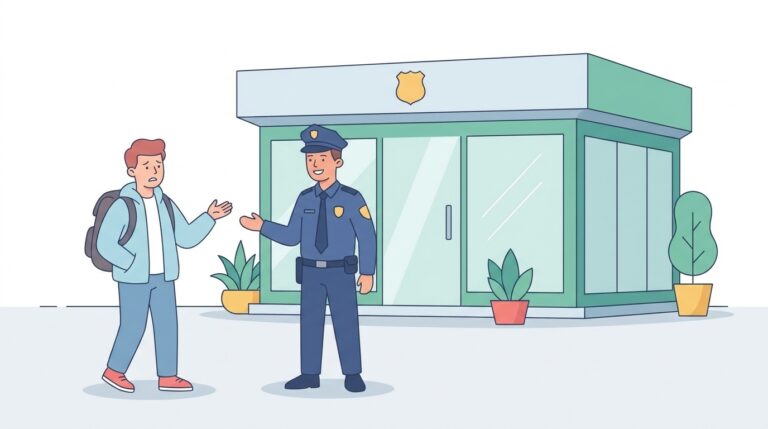
Setting: A brightly lit neighborhood police substation (지구대) near Hongik University Station on a rainy Friday night. Officer Park (박 순경), a warm and professional officer, is sitting at the counter typing on a computer.
- You: 저기요… 도와주세요! (Jeogiyo… dowajuseyo!) [🎭 Approaching desk with hands clasped anxiously] (Excuse me… please help me!)
- Officer Park: 네, 무슨 일이세요? 진정하시고 앉으세요. (Ne, museun iriseyo? Jinjeonghasigo anjeuseyo.) [🎭 Gesturing toward the visitor chair with a calm smile] (Yes, what happened? Please calm down and take a seat.)
- You: 지갑을 소매치기당했어요. (Jigabeul somaechigidanghaesseoyo.) [🎭 Pointing to an empty open coat pocket] (My wallet was pickpocketed.)
- Officer Park: 아이고, 언제 어디서 그러셨어요? (Aigo, eonje eodiseo geureosyeosseoyo?) [🎭 Opening a blank report form on the monitor] (Oh no, when and where did that happen?)
- You: 10분 전에 홍대역 9번 출구 근처에서요. (Sip-bun jeone Hongdaeyeok gubeon chulgu geuncheoeseoyo.) [🎭 Checking wrist watch nervously] (About 10 minutes ago, near Hongik University Station Exit 9.)
- Officer Park: 지갑 색깔이랑 안에 뭐가 있었는지 기억나세요? (Jigap saekkkalirang ane mwoga isseotneunji gieongnaseyo?) [🎭 Readying pen to take notes] (Do you remember the color of the wallet and what was inside?)
- You: 검은색 가죽 지갑이에요. 현금이랑 신용카드가 있어요. (Geomeunsaek gajuk jigabieyo. Hyeongeumirang sinyongkadeuga isseoyo.) [🎭 Gesturing size with hands] (It’s a black leather wallet. It has cash and credit cards inside.)
- Officer Park: 알겠습니다. 바로 카드 정지부터 하시고, CCTV 확인해 드릴게요. (Algetseumnida. Baro kadeu jeongjibuteo hasigo, CCTV hwaginhae deurilgeyo.) [🎭 Handing over a landline phone and stepping toward camera console] (Understood. Let’s suspend your cards first, and I will check the CCTVs for you.)
🔀 Interactive Branch Point: How do you respond to Officer Park?
- Choice A: “신용카드 회사 전화번호를 몰라요. 도와주실 수 있나요?” (Sin-yongkadeu hoesa jeonhwabeonhoreul mollayo. Dowajusil su innayo? – “I don’t know my card company’s phone number. Can you help me?”)
- Choice B: “CCTV 지금 당장 보여주세요!” (CCTV jigeum dangjang boyeojuseyo! – “Show me the CCTV right this instant!”)
- Choice C: “그냥 갈게요.” (Geunyang galgeyo. – “I’ll just leave.”)
-
Branch Feedback:
- Choice A (Best): Superb choice! Korean police officers routinely assist international travelers with dialing international hotlines or card center English desks.
- Choice B (Bad): Demanding to see CCTV footage immediately violates personal privacy laws in Korea (개인정보보호법). Only authorized officers can inspect footage.
- Choice C (Risk): Very risky! If someone attempts unauthorized transactions with your credit or debit cards, failing to file an official initial report impairs your ability to receive fraud reimbursement.
Phase 6: 10-Second Emotion Shadowing Drill
Read aloud following the pause markers (/) and embody the indicated emotion:
[😨 당황하며 / Panicked & Breathless]
저기요… / 지갑을 / 소매치기당했어요! (Jeogiyo… / jigabeul / somaechigidanghaesseoyo!)[🙏 간절하게 / Pleading & Urgent]
카드 정지해야 해요 / 도와주세요! (Kadeu jeongjihaeya haeyo / dowajuseyo!)[🥺 침착하게 설명하며 / Calmly Explaining Detail]
검은색 가죽 지갑이고, / 홍대역 근처였어요. (Geomeunsaek gajuk jigabigo, / Hongdaeyeok geuncheoyeosseoyo.)
Phase 7: K-Culture Mini Dictionary
- 지갑 (Jigap) | Wallet / Purse
Essential noun for any shopping or everyday situation. For coin purses or small pouches, Koreans often say 동전 지갑 (dongjeon jigap). - 소매치기 (Somaechigi) | Pickpocket / Pickpocketing
Compound word from 소매 (sleeve) and 치기 (striking/snatching). Refers exclusively to clandestine theft from someone’s person. - 지구대 (Jigudae) | Neighborhood Police Substation
The foundational community policing unit in Korea, smaller than a central police station (경찰서) but staffed 24/7 with active patrol squads. - 분실물 (Bunsilmul) | Lost Property / Lost-and-Found Items
The formal term used across transit systems, airports, and department stores. You will frequently see signs reading 분실물 센터 (Bunsilmul Senteo – Lost and Found Center).
Phase 8: Traveler’s Survival Kit
TOP 3 Emergency Survival Phrases
- 분실물 센터가 어디예요? (Bunsilmul senteoga eodiyeyo?)
Pro Tip: Use this at subway hubs (like Seoul Station or Express Bus Terminal) if you leave something behind on a train. - 외국인 통역 서비스 연결해 주세요. (Oegugin tong-yeok seobiseu yeongyeolhae juseyo.)
Meaning: “Please connect me to an interpretation service for foreigners.”
Pro Tip: In Korea, calling 1330 (Korea Travel Helpline) provides free 24/7 three-way interpretation. - 도난 신고서 작성하고 싶어요. (Donan singoseo jakseonghago sipeoyo.)
Meaning: “I want to fill out a theft report form.”
Pro Tip: Essential for claiming travel insurance benefits once you return to your home country.
Editor’s Travel Note
If you lose personal property anywhere in Korea, before assuming it is permanently gone, check the 경찰청 유실물 통합포털 LOST112 웹사이트 확인하기. Every recovered item logged by police stations, subways, and taxi fleets across the nation is photographed and uploaded there within hours! For subway losses specifically, head to the station master’s office (역무실 – yeongmusil) and tell them your train car number (printed on the subway platform doors).
Phase 9: “한 발 더 깊이” (A Deeper Look)
In South Korea, high social cohesion and mutual accountability create an implicit covenant: unattended items are generally safe, and returning lost belongings is viewed as standard civic duty. When a wallet disappears, locals usually ask “어디 흘렸나?” (Did I drop it somewhere?) rather than immediately suspecting criminal activity. This distinction changes how you communicate: approaching people with the assumption that your wallet was dropped or misplaced rather than accusing bystanders fosters immediate warmth, empathy, and active cooperation from everyone around you.
💬 Your Turn: Have you ever lost an essential item while traveling abroad? How did you manage to get help, and how would you apply these Korean phrases if it happened in Seoul? Share your thoughts in the comments below!
Phase 10: FAQ & Mistake Prevention
Q: Can I dial 112 if I don’t speak fluent Korean?
A: Yes! When you dial 112 (police emergency) or 119 (fire/medical), you can simply say “English, please” or “외국인 통역 (Oegugin tong-yeok)”. The dispatch center immediately loops in a professional simultaneous interpreter to handle your call.
Q: What is the difference between 경찰서 (Gyeongchalseo) and 지구대 (Jigudae)?
A: 경찰서 is a large municipal police headquarters handling investigations, forensics, and administration. A 지구대 (or 파출소) is a localized street-level substation scattered throughout neighborhoods. For on-the-spot lost wallet reports, visit the nearest 지구대.
Q: Will the police charge any fee for filing a lost item or theft report?
A: Absolutely not. Filing reports (분실 신고 or 도난 신고) and receiving an official report certificate (도난/분실 확인서) for your travel insurance provider is completely free.
🚨 흔한 실수 (Common Mistakes) Notice Board
- ❌ Saying “도둑 맞았어요” in an inappropriate context: 도둑 (doduk) means burglar/thief. Saying 도둑 맞았어요 is acceptable colloquial Korean, but using 소매치기당했어요 is far more specific and helpful when reporting pickpocketing on public transit.
- ❌ Forgetting the subway car number: When leaving an item on the Seoul Metro, saying only “I lost it on Line 2” makes tracking nearly impossible. Always check the platform number or train car number on the doors!
- ❌ Not requesting a certificate for travel insurance: If your wallet is permanently gone, verbal statements won’t suffice for claims. Always politely request: 도난 확인증 발급해 주세요 (Donan hwaginjeung balgeuphae juseyo – Please issue a theft confirmation certificate).
Phase 11: Action Missions & Engagement
- 🥉 Bronze Mission (Solo Drill): Stand in front of your mirror and practice saying: “저기요, 지갑을 소매치기당했어요. 도와주세요!” three times with expressive hand gestures.
- 🥈 Silver Mission (Community Share): Leave a comment below translating your wallet’s color into Korean (e.g., 파란색 지갑 for blue wallet, 갈색 지갑 for brown wallet).
- 🥇 Gold Mission (Real-world Scouting): Next time you walk through a Korean neighborhood or browse KakaoMap/Naver Map, locate the nearest 지구대 (police substation) and save it to your bookmarks!
- 🎮 K-Culture Mission: Watch an episode of a Korean police drama (such as tvN’s Live or Netflix’s Signal) and spot whether the officers wear the dark blue 지구대 patrol uniforms!
Phase 12: Interactive Quiz Challenge
1. Situation Decision: You discover your wallet missing on a crowded bus, but you aren’t sure if it fell out of your tote bag or if someone took it. Which phrase is best to tell the driver or station attendant?
* (A) 경찰을 체포하세요! (Gyeongchareul chepohaseyo!)
* (B) 지갑을 잃어버렸어요. 혹시 들어온 거 있나요? (Jigabeul ireobeoryeosseoyo. Hoksi deureoon geo innayo?)
* (C) 돈을 내놓으세요! (Doneul naenoh-useyo!)
2. Fill in the Blank: Complete the phrase meaning “My wallet was pickpocketed!”:
“지갑을 ____________당했어요!”
3. True or False: In Korea, you must pay a processing fee to police stations to review street CCTV footage for your lost item.
* True / False
👉 Click here to reveal answers & explanations!
- Answer: (B)
Explanation: When uncertain, 잃어버렸어요 (I lost it) is the most polite and natural way to ask if anyone handed it in. (A) mistakenly says “Arrest the police!”, and (C) says “Hand over the money!”. - Answer: 소매치기 (somaechigi)
Explanation: 소매치기 specifically means pickpocketing, forming the compound phrase 소매치기당했어요. - Answer: False
Explanation: Filing reports and police investigation through public CCTV footage is a free public service provided by the Korean National Police Agency.







