

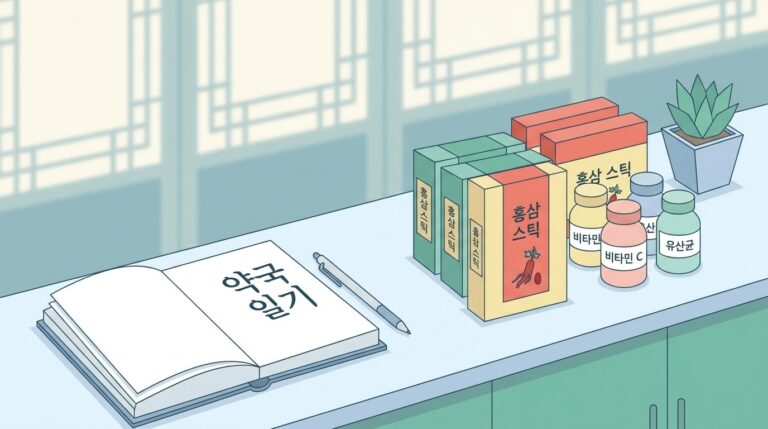
안녕하세요! 매일한글 에디터입니다.
Have you ever watched a high-stakes K-Drama where an exhausted corporate manager or a sleep-deprived law student reaches into their desk drawer, pulls out a slim red pouch, tears it open with their teeth, and downs it in one swift gulp? That iconic stick is hongsam (홍삼 – red ginseng extract), and in Korea, it is practically liquid life support.
Now, imagine stepping off the plane in Seoul, feeling that brutal mix of 14-hour jet lag and seasonal chills. You walk into an Olive Young in Myeongdong or a spotless local yakguk (약국, pharmacy) in Gangnam. You are greeted by gleaming shelves lined with glossy boxes: myeon-yeongnyeok (면역력, immunity), piro haeso (피로 해소, fatigue relief), milk thistle (밀크씨슬), and probiotics in pastel tubs. You try to speak, but your mind draws a blank. Textbook phrases like “배가 아파요” (Bae-ga apayo / My stomach hurts) do not help when you simply want high-potency Vitamin B or something to soothe an empty stomach without caffeine jitters.
Don’t worry, my friend! You are not alone. Our Daily Hangul intermediate learners constantly tell us: “I know how to say I’m sick, but I have no idea how to ask the pharmacist which supplement Koreans actually swear by for daily burnout!” Today, we are going beyond robotic textbook vocabulary. At the B2 level, you will master the art of natural consultation, decode Korea’s functional wellness culture, and shop for health supplements just like a savvy local.
Phase 2: Core 3 Expressions Deep Dive
1. 피로 해소에 뭐가 제일 잘 나가요? (Piro haesoe mwo-ga jeil jal nagayo?)
- Pronunciation: [Pee-ro hae-so-eh mwo-ga jay-il jal na-ga-yo?] (Think of ‘Pee-ro’ like a speedy ‘hero’ with a P, and ‘jal nagayo’ like asking what is literally ‘walking out’ the door fastest).
- Meaning: Literally: “For fatigue relief, what goes out the best?” | Natural nuance: “What is your top-selling supplement for burnout and chronic fatigue?”
- K-Culture Moment: Seen frequently in workplace slice-of-life dramas like Misaeng. An exhausted junior associate ducks into the ground-floor pharmacy during lunch break to buy a quick tonic and asks the pharmacist what everyone in the building is buying to survive overtime.
- Editor’s Insight: Instead of asking “What is effective?” (Hyogwaga itnayo?), native Koreans ask what sells the best (jal nagayo). In Korea’s fast-moving consumer culture, high sales directly correlate with social proof and proven efficacy.
- Situation Spectrum:
- Casual (Friends): 피로 푸는 데 뭐가 제일 잘 나가? (⚠️ Only with close friends)
- Semi-formal (Pharmacy/Olive Young clerk): 피로 해소에 뭐가 제일 잘 나가요? (✅ Perfect balance)
- Formal (Consultation counter): 만성 피로 개선에 가장 인기 있는 제품이 무엇인가요? (✅ High-formality business/clinical tone)
- 🤔 Think About It: In your home country, do you ask pharmacists for their best-selling product, or do you rely strictly on personal doctor prescriptions? How does collective consensus shape health choices in Korea?
2. 속 쓰림 없는 걸로 추천해 주실 수 있나요? (Sok sseurim eomneun geollo chucheonhae jusil su innayo?)
- Pronunciation: [Sok sseu-reem eom-neun geol-lo choo-cheon-hae joo-shil soo in-na-yo?] (Pronounce ‘Sseurim’ with a tight, squeezed double ‘ss’ sound, mimicking the feeling of an irritated, stinging stomach).
- Meaning: Literally: “Could you recommend something without stomach burning?” | Natural nuance: “Can you recommend something gentle on the stomach / that won’t cause acid reflux?”
- K-Culture Moment: Many high-dosage Vitamin C and multivitamin tablets in Korea can irritate an empty stomach, especially when paired with daily iced Americanos (Ah-Ah). Office workers routinely ask this when buying daily multivitamins.
- Editor’s Insight: Sok (속) literally means ‘inside’, but culturally refers to your digestive tract, stomach, or inner chest. Sok sseurim specifically captures that acidic, burning sensation. Asking for something eomneun geol (without that trait) shows sophisticated intermediate sentence tailoring.
- Situation Spectrum:
- Casual: 속 안 쓰린 걸로 줘. (🚫 Disrespectful to pharmacists)
- Semi-formal: 속 쓰림 없는 걸로 추천해 주실 수 있나요? (✅ Highly natural and polite)
- Formal: 위장에 부담이 적은 제형으로 권해주실 수 있습니까? (✅ Formal clinical consultation)
- 🤔 Think About It: Notice how Korean uses physical sensations (sok sseurim – burning interior) as standalone noun phrases rather than technical medical jargon (gastric distress). What does this say about communicative focus in Korean medicine?
3. 꾸준히 챙겨 먹으면 면역력에 도움이 될까요? (Kkujunhi chaenggyeo meogeumyeon myeon-yeongnyeoge doumi doelkkayo?)
- Pronunciation: [Kkoo-joon-hee chaeng-gyeo meo-geu-myeon myeon-yeong-nyeo-ge do-oom-ee doel-kka-yo?] (The double ‘kk’ in ‘kkujunhi’ should sound crisp and punchy, like popping a bubble).
- Meaning: Literally: “If I make sure to eat it steadily, will it be helpful to immune strength?” | Natural nuance: “If I take this consistently every day, will it boost my immunity?”
- K-Culture Moment: When buying red ginseng or functional cordyceps sets for parents during Chuseok or Seollal, shoppers consult the pharmacist or gift-hall attendant with this exact phrase to confirm preventive benefits.
- Editor’s Insight: The magic compound verb here is 챙겨 먹다 (chaenggyeo meokda). It implies taking care, making an intentional effort, and not forgetting your daily doses. In Korea, taking supplements is considered an act of self-care and diligence.
- Situation Spectrum:
- Casual: 꾸준히 챙겨 먹으면 면역력 좀 좋아질까? (✅ Between gym buddies or friends)
- Semi-formal: 꾸준히 챙겨 먹으면 면역력에 도움이 될까요? (✅ The standard courteous inquiry)
- Formal: 지속적으로 복용할 경우 면역력 증진에 효과가 있습니까? (✅ Academic or pharmaceutical review level)
- 🤔 Think About It: Why does Korean use “챙겨 먹다” (take care to eat) for vitamins instead of just “먹다” (eat)? How does intentionality reflect modern Korean wellness philosophy?
Phase 3: Textbook Korean vs. Real Korean
Situation 1: Inquiring about a supplement’s actual daily effects
- 📖 Textbook Korean: 이 비타민 제품의 효능은 무엇입니까? (I bitamin jepum-ui hyoneung-eun mueos-imnikka? / What are the medicinal efficacies of this vitamin product?)
- 🗣️ Real Korean: 이거 먹으면 아침에 일어날 때 피로 좀 덜해요? (Igeo meogeumyeon achime ireonal ttae piro jom deol-haeyo? / If I take this, will it be easier to wake up without feeling as exhausted?)
- 💡 Why the difference? Textbook phrasing sounds like a biology professor interrogating a lab tech. Real Koreans describe concrete daily wellness benchmarks—specifically, whether it makes waking up on Monday morning less painful!
Situation 2: Asking for the exact intake schedule
- 📖 Textbook Korean: 이 약품을 언제 복용해야 합니까? (I yakpumeul eonje bogyonghaeya hamnikka? / When must one administer this pharmaceutical item?)
- 🗣️ Real Korean: 이거 식전에 먹어요, 아니면 밥 먹고 바로 챙겨 먹어야 돼요? (Igeo sikjeone meogeoyo, animyeon bap meokgo baro chaenggyeo meogeoya dwaeyo? / Do I take this before meals, or right after eating?)
- 💡 Why the difference? Bogyonghada (복용하다) is stiff clinical language found on back-label warning stickers. In real life, asking around bap (meal context: before vs. after food) ensures clear dosage timing without sounding archaic.
Phase 4: K-Culture Deep Dive & Non-Verbal Manners
4-1. 눈치 (Nunchi) & Counter Etiquette in Korean Pharmacies
When you step into a neighborhood pharmacy in Korea, you are stepping into a community health hub. Unlike large Western chain drugstores where you wander aisles unattended, Korean yakguk feature high counters where pharmacists (yaksa-nim) actively evaluate what you need.
- The Two-Handed Handover: When handing over a box of supplements or your credit card, hold it with both hands or support your right forearm with your left hand. It signals immediate respect for the pharmacist’s clinical guidance.
- Personal Consultation Zone: If another customer is speaking quietly with the pharmacist at the register, maintain a two-step distance (nunchi). Korean patients frequently discuss sensitive ailments like digestion issues or hangover nausea, so giving them acoustic privacy is essential.
- The Direct Symptom Nod: Keep gentle eye contact while describing your fatigue. Do not just say “Give me vitamins.” State your daily rhythm: “I work late on screens” or “My stomach gets acidic easily.” Pharmacists appreciate contextual clues!
4-2. Cultural Code: The Survival Tonic Culture
Why is the functional health food market (geon-gang gineung sikpum) so massive in South Korea?
It ties directly into Korea’s famous 빨리빨리 (Pali-pali / Fast-paced) culture. Koreans work hard, play hard, and study late. Rather than slowing down, people look for concentrated, bioavailable stamina boosters. This has birthed the ubiquitous culture of portable “stick packs” (스틱형 영양제) that fit neatly into laptop sleeves and purses. Giving a colleague a pouch of red ginseng or a bottle of ssanghwatang (쌍화탕 – traditional herbal restorative drink) is one of the highest forms of workplace affection and solidarity.
Phase 5: Real-life Roleplay Scenario
Setting: Gangnam Station Exit 4, inside Bareun Yakguk (바른 약국). Warm lighting, rows of neatly organized immune tonics, and the subtle earthy aroma of herbal teas.
Character: Pharmacist Park Min-ji (박민지 약사), wearing a crisp white coat over a navy sweater, sharp-eyed yet warm and attentive.
[1] You (손님): 안녕하세요! 요즘 야근이 많아서 너무 피곤한데, 피로 해소에 뭐가 제일 잘 나가요?
(Annyeonghaseyo! Yojeum yageuni manaseo neomu pigonhande, piro haesoe mwo-ga jeil jal nagayo?)
"Hello! I've been doing a lot of overtime lately and feeling exhausted. What sells best for fatigue relief?"
🎭 [Action: Massaging the back of your neck with an apologetic, tired smile]

[2] Pharmacist Park: 아, 요즘 야근하시는 직장인분들 정말 많죠. 혹시 평소에 비타민 B군 챙겨 드시는 거 있으세요?
(A, yojeum yageunhasineun jikjang-inbundeul jeongmal matjyo. Hoksi pyeongsoe bitamin B-gun chaenggyeo deusineun geo isseuseyo?)
"Ah, so many office workers are working overtime these days. Are you currently taking any Vitamin B complexes?"
🎭 [Action: Steps out from behind the counter to point out two high-potency supplement lines]

[3] You (손님): 아니요, 따로 챙겨 먹는 건 없어요. 근데 제가 위가 좀 약해서요. 속 쓰림 없는 걸로 추천해 주실 수 있나요?
(Aniyo, ttaro chaenggyeo meongneun geon eopseoyo. Geunde jega wiga jom yakaeseoyo. Sok sseurim eomneun geollo chucheonhae jusil su innayo?)
"No, I don't take anything regularly right now. But I have a rather sensitive stomach. Could you recommend one that won't upset my stomach?"
🎭 [Action: Lightly resting a hand on your upper stomach to indicate sensitivity]

[4] Pharmacist Park: 그럼 활성형 비타민으로 된 이 제품이 좋겠네요. 위장 장애가 덜해서 빈속에만 안 드시면 편안해요.
(Geureom hwalseonghyeong bitamin-euro doen i jepumi jokesseonneyo. Wijang jang-aega deolhaeseo binsog-eman an deusimyeon pyeon-anhaeyo.)
"In that case, this active vitamin formula would be ideal. It minimizes stomach irritation, so as long as you don't take it on an empty stomach, it's very gentle."
🎭 [Action: Holding up a gold box and showing the dosage label]

[5] You (손님): 다행이네요! 꾸준히 챙겨 먹으면 면역력에도 도움이 될까요?
(Dahaeng-ineyoyo! Kkujunhi chaenggyeo meogeumyeon myeon-yeongnyeogedo doumi doelkkayo?)
"That's a relief! If I take this consistently, will it also help my immune system?"
🎭 [Action: Leaning in with curiosity, eyes brightening]

[6] Pharmacist Park: 네, 아연이랑 비타민 D도 복합되어 있어서 면역력 유지에도 꽤 효과 보실 거예요.
(Ne, ayeon-irang bitamin D-do bokhap-doeeo isseoseo myeon-yeongnyeok yujiedo kkwae hyogwa bosil geoyeyo.)
"Yes, it's compounded with zinc and Vitamin D, so you'll definitely see good results for maintaining immunity as well."
🎭 [Action: Confidently tapping the ingredient breakdown on the box]

[7] You (손님): 좋아요, 이걸로 할게요. 하루에 몇 알씩 챙겨 먹어야 돼요?
(Joayo, igeollo halkeyo. Harue myeot alssik chaenggyeo meogeoya dwaeyo?)
"Great, I'll take this one. How many pills should I take a day?"
🎭 [Action: Reaching into your coat pocket to take out your payment card with both hands]

[8] Pharmacist Park: 하루 한 번, 아침 식사하시고 물 한 컵이랑 드시면 됩니다. 피로 푸세요!
(Haru han beon, achim siksa-hasigo mul han keob-irang deusimyeon doemnida. Piro puseyo!)
"Just once a day, take it after breakfast with a full glass of water. Hope you shake off that fatigue!"
🎭 [Action: Placing the box into a neat small paper bag and bowing politely]
🔀 Interactive Choice Point
The pharmacist hands you the bag. Before paying, you notice a row of liquid herbal ampoules next to the cash register and decide you need immediate relief for this afternoon. How do you ask?
- Option A: “지금 당장 마실 수 있는 마시는 피로회복제도 하나 같이 주시겠어요?” (Jigeum dangjang masil su inneun masineun piro-hoebokjedo hana gachi jusigesseoyo?)
- Option B: “야, 저거 마시면 바로 힘나는 물약이냐? 같이 줘.” (Ya, jeogeo masimyeon baro himnaneun mulyag-inya? Gachi jwo.)
- Option C: “이 약국에서 가장 비싼 걸로 아무거나 하나 더 추가해 주세요.” (I yakgug-eseo gajang bissan geollo amugeona hana deo chugahae juseyo.)
Feedback on Your Choice:
- If you chose Option A (BEST! 🌟): Flawless natural Korean! Asking for a “마시는 피로회복제” (drinkable fatigue restorative) is the quintessential Korean pharmacy experience. The pharmacist will likely pop open an ampoule with a Vitamin B drink on the spot for you to drink right away.
- If you chose Option B (BAD! 🚨): Using informal panmal (Ya, jwo) with a healthcare professional will shock everyone within earshot. This sounds aggressively rude and will ruin the warm rapport you just established.
- If you chose Option C (RISK! ⚠️): While polite grammatically, asking blindly for “the most expensive thing” makes you sound like a reckless spender or an easy target. Pharmacists prefer tailoring products to specific needs (e.g., muscle stiffness vs. mental grogginess).
Phase 6: 10-Second Emotional Shadowing Drill
Practice reading these out loud with the rhythm breaks (/) and emotional tone cues:
[😮💨 Deep sigh, completely drained]
요즘 / 야근을 너무 많이 해서 / 만성 피로가 온 것 같아요.
(Yojeum / yageuneul neomu mani haeseo / manseong piroga on geot gatayo.)
“Lately / because I worked so much overtime / I think chronic fatigue has set in.”-
[💡 Curious, hopeful tone]
혹시 / 위장 부담 없이 / 가볍게 챙겨 먹을 만한 거 / 있을까요?
(Hoksi / wijang budam eopsi / gabyeopge chaenggyeo meogeul manhan geo / isseulkkayo?)
“By any chance / without burdening my stomach / something light I can take regularly / is there anything?” -
[✨ Energized and deeply thankful]
설명 감사합니다! / 오늘부터 / 식후에 꼭 / 챙겨 먹어 볼게요!
(Seolmyeong gamsahamnida! / Oneulbuteo / sik-hue kkok / chaenggyeo meogeo bolkeyo!)
“Thank you for the explanation! / Starting today / definitely after meals / I will make sure to take it!”
Phase 7: K-Culture Mini Dictionary
-
챙겨 먹다 (Chaenggyeo meokda)
- Meaning: To take (medicine/supplements) proactively and without missing doses; to look after one’s nutritional intake.
- Daily Usage: Used across personal life and business lunches. A boss might tell an intern: “건강이 최고니까 영양제 꼭 챙겨 먹어요” (Health comes first, so make sure to take your supplements).
- 건강기능식품 (Geon-gang gineung sikpum)
- Meaning: Functional Health Foods (certified dietary supplements).
- Daily Usage: Often abbreviated as “건기식” in corporate settings and media. Look for this exact badge on boxes at Olive Young or department stores to ensure the product is officially certified by the Korean Ministry of Food and Drug Safety.
- 피로 해소 (Piro haeso)
- Meaning: Fatigue relief / exhaustion recovery.
- Daily Usage: The gold standard phrase on Korean tonic drinks. Unlike simply “resting” (hyusik), piro haeso describes chemically discharging accumulated physical burnout.
- 당 떨어지다 (Dang tteoreojida)
- Meaning: Blood sugar dropping; feeling suddenly depleted of energy.
- Daily Usage: In offices, whenever someone feels sluggish around 3:30 PM, they will sigh: “아, 당 떨어진다… 홍삼이나 초콜릿 먹어야겠어” (Ah, my sugar is crashing… I need to take some red ginseng or chocolate).
Phase 8: Traveler’s Survival Kit
Survival TOP 3 Phrases
- “액상형으로 된 거 있어요?” (Aeksanghyeong-euro doen geo isseoyo?)
- Pronunciation: [Aek-sang-hyeong-eu-ro doen geo is-seo-yo?]
- Pro Tip: Liquid ampoules (aeksanghyeong) absorb faster than big tablets. Use this if you need an instant booster before a big hike up Bukhansan or a long walking tour of Bukchon.
- “선물용으로 포장된 홍삼 세트 추천해 주세요.” (Seonmulyong-euro pojangdoen hongsam seteuchucheonhae juseyo.)
- Pronunciation: [Seon-mool-yong-eu-ro po-jang-doen hong-sam seh-teu choo-cheon-hae joo-seh-yo.]
- Pro Tip: Use this at duty-free shops or department stores to find elegantly boxed ginseng gift sets perfect for family back home.
- “빈속에 먹어도 괜찮아요?” (Binsog-e meogeodo gwaenchannayo?)
- Pronunciation: [Bin-sog-eh meo-geo-do gwaen-chan-na-yo?]
- Pro Tip: Crucial question if you plan on taking your vitamins first thing in the morning before breakfast.
Editor’s Travel Note
- Finding Pharmacies Fast: Skip foreign mapping tools which often have outdated pharmacy hours in Seoul. Always search via the Naver Map application mobile download using the keyword 약국 (pharmacy). Look for spots tagged 심야약국 (night-owl pharmacies) if you have an emergency after 9:00 PM.
- Olive Young vs. Pharmacy: Head to the Olive Young online flagship locator for trendy beauty inner-care products (collagen jelly, glutathione film strips, kombucha packets). For concentrated therapeutic doses (high-potency Vitamin B complexes, liver protection milk thistle, medicinal ginseng), head to a traditional street-level pharmacy (yakguk).
- Tax-Free Perks: Remember that branded functional health foods purchased at major drugstores or department stores are eligible for immediate tax refunds upon showing your physical foreign passport at checkout!
Phase 9: “한 발 더 깊이” (One Step Deeper)
In Western cultures, wellness is often framed as an individualistic, private routine—your personal gym membership, your quiet meditation, your private medicine cabinet. In Korea, however, health supplements occupy a deeply communal, relational space. When a Korean asks you, “영양제 챙겨 먹고 있어요?” (Are you taking your supplements?), they are not prying into your medical records. It is an evolved, modern equivalent of the traditional greeting “밥 먹었어요?” (Have you eaten?).
Handing someone an immune-boosting drink before a difficult meeting is an unspoken social pact: I see how hard you are running, and I want you to survive alongside me. Consuming supplements in contemporary Korea is not merely a biological necessity; it is a ritual of mutual empathy in an ultra-fast society.
💬 Your Turn: Does your culture treat dietary supplements as private medicine or as everyday gifts of care? Share your thoughts and experiences in the comments below!
Phase 10: FAQ & Avoiding Misunderstandings
Q: Can I buy red ginseng extract at regular convenience stores like CU or GS25?
A: Yes, but with an important distinction! Convenience stores carry lighter, beverage-grade ginseng drinks formulated with honey and high water content for casual refreshment. If you want concentrated, therapeutic-grade red ginseng (with specified ginsenoside content), visit an official CheongKwanJang (정관장) boutique, a reputable department store wellness floor, or a certified pharmacy.
Q: Do I need a doctor’s prescription (처방전) to buy vitamins and hangover cures at a pharmacy?
A: Not at all. High-potency vitamins, milk thistle, probiotics, and hangover relief tonics (sukchwi haesoje) are classified as Over-The-Counter (일반의약품) or functional foods. You can walk straight up to the pharmacist counter and purchase them immediately without any paperwork.
Q: What is the difference between a “피로회복제” and an energy drink like Red Bull?
A: While energy drinks rely heavily on high caffeine doses and carbonated sugar for a temporary spike, Korean pharmacy fatigue restoratives (piro-hoebokje) typically combine active B-vitamins, amino acids (taurine), and royal jelly or liver-assisting herbal extracts designed to restore cell metabolism without cardiovascular jitters.
🚨 흔한 실수 (Common Mistakes) Noticeboard
- Calling all pills “약” (Yak / Drug):
- Mistake: Asking “이 약 매일 먹으면 몸에 나빠요?” (Will taking this drug every day harm me?)
- Correct Action: Distinguish pharmaceuticals from supplements! Use 영양제 (yeong-yangje / nutritional supplement) or 건기식 (geon-gi-sik). Say: “이 영양제 매일 챙겨 먹어도 무리 없나요?”
- Using “마셔요” for swallowing pills:
- Mistake: Asking “이 알약 어떻게 마셔요?” (masheoyo = drink).
- Correct Action: In Korean, tablets and capsules are eaten or taken, not drunk. Always use 먹다 (meokda): “이 알약은 식후에 먹으면 되나요?”
- Demanding “strongest” medicine aggressively:
- Mistake: “제일 독한 비타민으로 주세요!” (Dokhan implies harsh, toxic, or pungent).
- Correct Action: Use 함량이 높은 (hamryang-i nopeun / high concentration). Say: “비타민 B 함량이 높은 제품으로 보여주세요.”
Phase 11: Action Missions
- 🥉 Bronze Level (Solo Practice): Stand in front of your bathroom mirror. Hold an imaginary supplement bottle and practice saying: “속 쓰림 없는 걸로 추천해 주실 수 있나요?” 5 times with natural rhythm and gestures.
- 🥈 Silver Level (Social Sharing): Take a photo of your current daily vitamins or health tea. Post it on Instagram Stories or your language journal using the sentence: “오늘부터 매일 꾸준히 챙겨 먹을 거예요!” (Tag @DailyHangul so we can cheer you on!).
- 🥇 Gold Level (Real-World Mission): Walk into a local Korean pharmacy or an Olive Young store. Approach the counter, use “피로 해소에 뭐가 제일 잘 나가요?”, and buy one drinkable fatigue tonic or supplement stick pack recommended by the clerk!
- 🎮 K-Culture Mission: Watch any recent episode of an office or medical K-Drama (e.g., Hospital Playlist, Queen of Tears, or Doctor Slump). Spot the scene where a character hands someone an energy pouch or supplement bottle. Note the exact verbal exchange they use!
Phase 12: Interactive Quiz Challenge
Test your real-life Korean supplement shopping instinct!
1. Situation Judgement
You want to take a daily multivitamin, but you frequently skip breakfast and worry about stomach irritation. What is the most appropriate question to ask the pharmacist?
* (A) 배 아프니까 그냥 약 주지 마세요.
* (B) 공복에 챙겨 먹어도 속 쓰림 없는 제품이 있을까요?
* (C) 아침 안 먹는데 제일 쓴 영양제로 주세요.
2. Fill-in-the-Blank
Complete this natural sentence:
“건강을 위해서 비타민은 매일 규칙적으로 ________ 먹는 게 중요해요.”
* Clue: The natural intermediate compound verb meaning “to make sure to take/eat regularly.”
3. True / False Cultural Check
Statement: In Korea, giving high-end red ginseng or certified multivitamin sets to colleagues or your partner’s parents during holidays is seen as an inappropriate reminder of old age.
* (True / False)
👉 Click here to reveal the answers and detailed explanations!
Quiz Answers & Explanations
- Answer: (B)
- Explanation: Gongbok (공복) means “empty stomach.” Asking “공복에 챙겨 먹어도 속 쓰림 없는 제품이 있을까요?” (Is there a product that doesn’t cause stomach burning even if taken on an empty stomach?) shows superb B2 fluency and clearly identifies your physiological constraint.
- Answer: 챙겨 (Full phrase: 챙겨 먹는 게)
- Explanation: The combination chaenggyeo meokda (챙겨 먹다) is the undisputed natural expression for taking vitamins and supplements attentively.
- Answer: False
- Explanation: Quite the opposite! Giving premium red ginseng (hongsam) or health functional foods is considered one of the most thoughtful, prestigious, and loving gifts in Korea. It symbolizes your heartfelt wish for the recipient’s long life, vitality, and health.







