

Phase 1: Empathy
안녕하세요! 매일한글 에디터입니다.
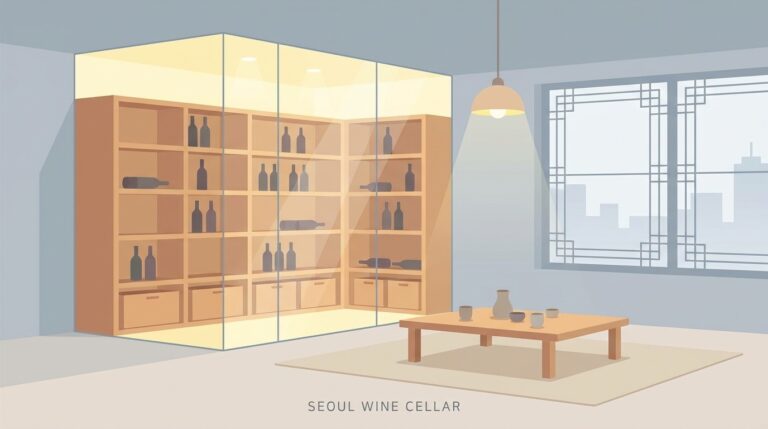
Picture this: You are invited to a stylish rooftop penthouse dinner in Hannam-dong overlooking the twinkling Han River. Your host, an avid collector who frequently flies to Bordeaux and Piedmont, opens the door to a custom glass-walled wine cellar. As you step in, they proudly point out an allocated bottle of Grand Cru Burgundy alongside a rare, structured Barolo. They turn to you with a warm smile and ask, “한국의 극단적인 사계절 날씨 속에서 이 섬세한 친구들을 어떻게 관리하는 게 좋을까요?” (How should we manage these delicate friends amidst Korea’s extreme four-season weather?)
You have an immense passion for viticulture, understand the critical balance between ambient humidity and cork elasticity, and know precisely why a temperamental Pinot Noir cannot withstand vibration. Yet, your tongue ties. You find yourself reverting to rudimentary phrases like “온도가 중요해요” (Temperature is important) or “시원하게 두세요” (Keep it cool). That intellectual, nuanced dinner conversation instantly shrinks into elementary-level banter.
Many of our advanced C1 learners reach out with this exact frustration: when discussing high-concept lifestyle topics such as terroir, aging potential, and cellar microclimates in Korean, textbook vocabulary simply runs dry. Wine culture in South Korea has evolved into an art form, especially across private salon tastings in Gangnam and natural wine hotspots in Seongsu. Speaking about wine preservation with elegance elevates both social and professional bonds. This master guide delivers native-level linguistic precision, non-verbal social etiquette, and cultural context tailored for serious connoisseurs navigating Korea’s fine wine circuit.
Phase 2: Core Expressions In-Depth Analysis
1. 뉘앙스를 온전히 살리려면 셀러 온도를 일정하게 유지해야 해요.
- Pronunciation: [Nyu-ang-seu-reul on-jeon-hi sal-li-ryeo-myeon sel-leo on-do-reul il-jeong-ha-ge yu-ji-hae-ya hae-yo] (Pronounce ‘on-jeon-hi’ smoothly like ‘own-john-hee’, emphasizing steady flow)
- Meaning: Literal: “To fully revive the nuances, cellar temperature must be maintained consistently.” | Nuance: Emphasizes safeguarding the subtle, sophisticated flavor profiles of fine wine against thermal shock.
- K-Culture Moment: Often heard in high-end Korean dramas like The Penthouse or Mine, where connoisseurs subtly display their refined taste during private cellar tours.
- Editor’s Insight: ‘온전히 살리다’ (to bring out/preserve entirely) elevates this phrase beyond basic verbs like ‘보관하다’ (to store). It conveys aesthetic sensitivity toward the winemaker’s craft.
- Situation Spectrum: Casual ⚠️ | Semi-formal ✅ | Formal ✅
- 🤔 Think About It: In English, we often say “keep it steady.” Korean uses ‘온전히’ (intactly, wholly), reflecting a philosophical respect for keeping an object’s essence unspoiled.
2. 피노 누아 같은 섬세한 품종은 진동과 직사광선에 특히 취약해요.
- Pronunciation: [Pi-no nu-a ga-teun seom-se-han pum-jong-eun jin-dong-gwa jik-sa-gwang-seon-e teuk-hi chwi-yak-hae-yo] (Think ‘chwi-yak’ like a sharp snap: ‘chwee-yahk’)
- Meaning: Literal: “Delicate grape varieties such as Pinot Noir are especially vulnerable to vibration and direct sunlight.” | Nuance: Explains the biochemical fragility of thin-skinned varietals with technical credibility.
- K-Culture Moment: Frequently uttered by high-profile sommeliers in private Cheongdam wine clubs when guiding clients on cellar compressor selection.
- Editor’s Insight: The word ‘취약하다’ (susceptible/vulnerable) instantly marks you as a C1-level speaker. It transforms casual observations into authoritative advice.
- Situation Spectrum: Casual ⚠️ | Semi-formal ✅ | Formal ✅
- 🤔 Think About It: Notice how Korean pairs descriptive adjectives like ‘섬세하다’ (delicate/sensitive) with botanical categories to humanize the grape varietal.
3. 장기 숙성을 위해선 코르크가 마르지 않게 적정 습도를 맞춰야 하죠.
- Pronunciation: [Jang-gi suk-seong-eul wi-hae-seon ko-reu-keu-ga ma-reu-ji an-ke jeok-jeong seup-do-reul mat-chwo-ya ha-jyo] (Flow ‘seup-do’ with soft aspiration: ‘soop-doh’)
- Meaning: Literal: “For long-term aging, you must balance appropriate humidity so the cork does not dry out.” | Nuance: Signals deep awareness of cellar mechanics, cork elasticity, and oxidative prevention.
- K-Culture Moment: A staple remark among wine collectors comparing bespoke dual-zone compressor cellars on lifestyle YouTube channels like Wassup Man or specialized sommelier podcasts.
- Editor’s Insight: Ending with ‘-하죠’ rather than ‘-해야 합니다’ softens technical instruction into collegial consensus, inviting mutual affirmation.
- Situation Spectrum: Casual ✅ | Semi-formal ✅ | Formal ✅
- 🤔 Think About It: The ending ‘-하죠’ implies “as we both well know,” establishing shared status and mutual respect without sounding pedantic.
Phase 3: Textbook Korean vs. Real Korean
Situation 1: Discussing bottle storage posture
- 📖 교과서 한국어: 와인은 코르크를 젖게 만들기 위해 수평으로 눕혀서 보관해야 합니다. (Wine must be stored horizontally lying down to make the cork wet.)
- 🗣️ 진짜 한국어: 코르크 마름이랑 산화 방지하려면 무조건 눕혀서 셀러링해야죠. (To prevent cork drying and oxidation, horizontal cellaring is an absolute must.)
- 💡 왜 다를까? Real-world wine circles adopt loanwords like ‘셀러링’ (cellaring) and concise nominal phrases like ‘코르크 마름’ rather than formal grammar structures.
Situation 2: Checking storage temperature suitability
- 📖 교과서 한국어: 이 레드 와인은 너무 차가운 곳에 두면 맛이 없어집니다. (If you put this red wine in too cold a place, it loses its taste.)
- 🗣️ 진짜 한국어: 이 품종은 저온에 방치하면 탄닌이 굳어버려서 제 캐릭터를 못 보여줘요. (If left in low temperatures, the tannins harden and the varietal fails to showcase its true character.)
- 💡 왜 다를까? Advanced speakers anthropomorphize wine using ‘캐릭터’ (character) and ‘굳어버리다’ (stiffen up) to describe structural shifts in tannin and acidity.
Phase 4: K-Culture Deep Dive & Non-Verbal Etiquette
4-1. 눈치 (Nunchi) & Non-Verbal Gestures
When invited into a Korean collector’s private cellar room or dining room:
* Praising the Cellar Setup: Do not casually touch or pull bottles from racks uninvited. In Korea, an allocated cellar represents years of curated relationships and investment. Instead, step slightly back, tilt your head appreciatively, and focus your gaze on the labels while saying: “온습도 관리가 정말 완벽하네요” (The temperature and humidity management is truly immaculate).
* Two-Handed Appreciation: If your host retrieves a treasured bottle—say, an aged Nebbiolo—to show you the sediment clarity, cup the base lightly with both hands or support your right forearm with your left hand. This physical cue conveys honor toward both host and vintage.
4-2. Cultural Code: The ‘Sool-Culture’ Evolution
In South Korea, high-end wine appreciation has rapidly merged with Hansik (Korean fine dining) gastronomy. In upscale areas like Dosan Park and Hannam, the traditional binge-drinking corporate culture (hoesik) has shifted among younger executives toward intimate wine salons (와인 모임). Showing fluency in preserving wine demonstrates cosmopolitan refinement, self-discipline, and deep respect for hospitality.
Phase 5: Real-Life Roleplay Scenario
Setting: A discreet, temperature-controlled private wine salon in Cheongdam-dong. Sommelier Min-jae is inspecting rare arrivals with you before an exclusive tasting.
- 민재 (Min-jae): 오늘 도착한 부르고뉴 프리미에 크뤼 라인업인데, 오는 동안 열화되었을까 봐 살짝 걱정이네요.
(Oneul dochak-han bureugonyu peurimie keuryu rain-eop-inde, oneun dongan yeol-hwa-doe-eosseulkka bwa saljjak geok-jeong-i-neyo.)
“Here is the Burgundy Premier Cru lineup that arrived today; I’m slightly worried they suffered heat damage during transit.”
🎭 Checking the ullage and capsules under warm cellar lighting -
Learner: 해외 직배송이었나요? 여름철 운송 스트레스를 받으면 산미 밸런스가 쉽게 무너지잖아요.
(Hae-oe jik-bae-song-i-eonnayo? Yeo-reum-cheol un-song seu-teu-re-seu-reul bad-eu-myeon san-mi bael-leon-seu-ga swip-ge mu-neo-ji-janh-a-yo.)
“Was it direct overseas shipping? If it undergoes transit stress in summer, the acid balance collapses easily, right?”
🎭 Leaning closer to examine cork heights without touching -
민재 (Min-jae): 맞아요. 그래서 일단 안정화될 때까지 셀러 최하단에 눕혀두려고 합니다.
(Maj-a-yo. Geu-rae-seo il-dan an-jeong-hwa-doel ttae-kkaji sel-leo choe-ha-dan-e nup-hyeo-du-ryeo-go ham-ni-da.)
“Exactly. That’s why I plan to lay them on the bottom shelf of the cellar until they stabilize.”
🎭 Carefully sliding the wooden rack open -
Learner: 탁월한 선택이네요. 진동을 최소화하고 13도 안팎에서 한두 달은 휴지기를 줘야 본래 모습을 찾겠죠.
(Tak-wol-han seon-taek-i-neyo. Jin-dong-eul choe-so-hwa-ha-go sip-sam-do an-ppakk-e-seo han-du dal-eun hyu-ji-gi-reul jwo-ya bon-rae mo-seup-eul chat-get-jyo.)
“Excellent choice. Minimizing vibration and granting a one-to-two-month resting period around 13 degrees will help it recover its true self.”
🎭 Nodding thoughtfully while observing the digital thermometer display -
민재 (Min-jae): 역시 와인에 조예가 깊으시군요! 습도는 대략 70% 선으로 세팅해 두었습니다.
(Yeok-si wa-in-e jo-ye-ga gip-eu-si-gun-yo! Seup-do-neun dae-ryak chil-sip-peo-sen-teu seon-eu-ro se-tting-hae du-eot-seum-ni-da.)
“As expected, your connoisseurship is profound! I have calibrated the humidity around the 70% line.”
🎭 Smiling with genuine professional respect -
Learner: 한국 겨울철엔 건조해서 습도 유지가 까다로운데, 컴프레서 관리에 손이 많이 가셨겠어요.
(Han-guk gyeo-ul-cheol-en geon-jo-hae-seo seup-do yu-ji-ga kka-da-ro-un-de, keom-peu-re-seo gwan-ri-e son-i man-i ga-syeot-get-eo-yo.)
“Korean winters are notoriously dry making humidity tricky; maintaining the compressor must require tremendous effort.”
🎭 Looking admiringly at the dual-zone unit -
민재 (Min-jae): 알아봐 주시니 보람차네요. 이 까베르네 소비뇽 매그넘은 5년 뒤 시음적기까지 묵혀둘 생각입니다.
(Al-a-bwa ju-si-ni bo-ram-cha-ne-yo. I kka-be-reu-ne so-bi-nyong mae-geu-neom-eun o-nyeon dwi si-eum-jeok-gi-kkaji muk-hyeo-dul saeng-gak-im-ni-da.)
“It is so rewarding that you recognize that. I plan to age this Cabernet Sauvignon Magnum until its peak drinking window in five years.”
🎭 Pointing gently to the upper reserves -
Learner: 탄닌 구조감이 탄탄해서 완벽한 셀러링을 거치면 환상적인 부케를 보여주겠네요.
(Tan-nin gu-jo-gam-i tan-tan-hae-seo wan-byeok-han sel-leo-ring-eul geo-chi-myeon hwan-sang-jeok-in bu-ke-reul bo-yeo-ju-get-neyo.)
“Its tannic structure is formidable; through flawless cellaring, it will unveil a spectacular bouquet.”
🎭 Raising eyebrows in pleasant anticipation
🔀 Interactive Decision Point
Min-jae asks: “화이트 와인 보관 칸이 꽉 찼는데, 부르고뉴 샤르도네를 레드랑 같은 15도 구역에 둬도 괜찮을까요?” (My white wine compartment is full; is it okay to store this Burgundy Chardonnay in the same 15°C zone as the reds?)
- Choice A: “장기 보관용이라면 14~15도 단일 온도에서도 숙성 잠재력을 지킬 수 있으니 큰 무리 없어요.” (For long-term storage, keeping it at a uniform 14–15°C still preserves aging potential, so it’s not a major issue.)
- Choice B: “화이트 와인은 무조건 5도 냉장고에 넣어야 상하지 않아요.” (White wine must unconditionally go into a 5°C refrigerator so it doesn’t spoil.)
- Choice C: “그냥 거실 선반에 올려두고 마실 때 얼음물에 담그는 게 제일 편해요.” (Just leave it on the living room shelf and dunk it in ice water when drinking; that’s easiest.)
Decision Feedback:
* Choice A (Best): Perfect C1 answer! Demonstrates that cellaring temperature (long-term preservation ~12-15°C) differs from serving temperature, impressing the sommelier with your technical expertise.
* Choice B (Bad): Amateur misconception. Storing fine Burgundy Chardonnay at refrigerator temperatures long-term dries out the cork and freezes its evolution.
* Choice C (Risk): High social risk! Treating a prized bottle of Burgundy like grocery-store plonk will instantly raise eyebrows among serious Korean wine collectors.
Phase 6: 10-Second Emotional Shadowing Drill
[🧐 분석적이고 신중하게]
피노 누아는 / 온도 변화에 극도로 예민해서 / 전용 셀러 없이는 / 그 잠재력을 / 온전히 끌어올리기 힘들어요.
(Pi-no nu-a-neun / on-do byeon-hwa-e geuk-do-ro ye-min-hae-seo / jeon-yong sel-leo eop-si-neun / geu jam-jae-ryeok-eul / on-jeon-hi kkeul-eo-ol-li-gi him-deul-eo-yo.)
“Because Pinot Noir is / exceptionally sensitive to thermal fluctuations / without a dedicated cellar / unlocking its latent potential / is exceedingly arduous.”-
[🍷 깊은 감탄과 확신을 담아]
완벽히 제어된 온습도에서 / 장기 숙성된 보르도는 / 시간이 지나면서 / 차원이 다른 부케를 / 피워 올립니다.
(Wan-byeok-hi je-eo-doen on-seup-do-e-seo / jang-gi suk-seong-doen bo-reu-do-neun / si-gan-i ji-na-myeon-seo / cha-won-i da-reun bu-ke-reul / pi-wo ol-lim-ni-da.)
“Bordeaux aged long-term / under flawlessly controlled climate / as time elapses / unfurls a multi-dimensional bouquet / of supreme elegance.”
Phase 7: K-Culture Mini Dictionary
- 시음적기 (Si-eum-jeok-gi) | Optimal Drinking Window
- The golden period where tannins soften, fruit concentration balances, and secondary aromas flourish. Widely used in bottle discussions: “이 빈티지는 아직 시음적기에 도달하지 않았어요” (This vintage has not yet reached its optimal drinking window).
- 열화 (Yeol-hwa) | Heat Damage / Thermal Degradation
- Wine damaged by heat exposure during shipping or flawed storage. Used crucially when inspecting provenance: “코르크가 밀려 올라온 걸 보니 열화 흔적이 있네요” (Judging by the pushed cork, there are clear traces of heat damage).
- 부케 (Bu-ke) | Bouquet (Tertiary Aromas)
- Differentiates primary grape aromas (아로마) from complex notes born through bottle age and oak contact. Used in sophisticated sensory reviews: “숙성이 진행되면서 가죽과 젖은 흙 같은 복합적인 부케가 피어나네요” (With age, complex tertiary bouquets of leather and forest floor emerge).
- 셀러링 (Sel-leo-ring) | Cellaring / Aging Wine
- Konglish/Koreanized viticulture term universally adopted by modern sommeliers and collectors to signify intentional cellaring.
Phase 8: Traveler’s Survival Kit
Top 3 Survival Expressions
- “와인 셀러 내부 온도가 몇 도로 맞춰져 있나요?”
(Wa-in sel-leo nae-bu on-do-ga myeot do-ro mat-chwo-jyeo in-na-yo?)
Pro Tip: Essential when purchasing expensive bottles from boutique wine shops in Seoul to ensure they haven’t been stored under hot display lamps. - “선물용인데 장기 보관에 적합한 품종으로 추천해 주실 수 있나요?”
(Seon-mul-yong-in-de jang-gi bo-gwan-e jeok-hap-han pum-jong-eu-ro chu-cheon-hae ju-sil su in-na-yo?)
Pro Tip: Use this at department store cellars (like Shinsegae Gangnam) to signal you want structured, age-worthy wines (e.g., Barolo, Pauillac) rather than everyday gluggers. - “장거리 비행에 코르크가 상하지 않게 꼼꼼하게 에어캡 포장 부탁드립니다.”
(Jang-geo-ri bi-haeng-e ko-reu-keu-ga sang-ha-ji an-ke kkom-kkom-ha-ge e-eo-kaep po-jang bu-tak-deu-rim-ni-da.)
Pro Tip: Critical when bringing prized bottles out of Korea. Korean retail staff provide impeccable protective wrapping if asked politely.
Editor’s Travel Note
- If you want to source rare fine wines or allocated bottles while visiting Seoul, download the 네이버 지도 앱 다운로드 to find premier boutique cellars in Seongsu and Cheongdam. You can also explore curated local selections through convenience retail networks via 와인25플러스 스마트오더 앱 다운로드.
- Climate Warning: Korea swings from humid, sweltering monsoon summers (+35°C, 85% humidity) to bone-dry freezing winters (-15°C, 20% humidity). Never leave premium bottles in an Airbnb or hotel room without running climate control; even 48 hours of seasonal fluctuation can ruin fragile varietals.
Phase 9: One Step Deeper
In Korean culture, wine cellaring transcends individual culinary preference—it intersects with the ancestral spirit of Jeong (정) and Daejeop (대접, formal hospitality). Historically, Korean households brewed and preserved seasonal fermented drinks (Gahyangju) in earthenware jars (Onggi), carefully monitoring cellar temperature under the earth to honor visiting dignitaries. When a modern Korean host opens their personal wine cellar and uncorks an allocated vintage preserved at meticulous humidity, they are extending supreme hospitality. Acknowledging the deliberate discipline behind their storage methods honors their generosity.
💬 Your Turn: What is the most delicate grape variety you preserve in your home cellar, and what temperature range do you rely on? Share in the comments below using the phrase: “저는 [품종 이름]을(를) [온도]도에서 보관해요!”
Phase 10: FAQ & Misconceptions
Q: Is it okay to keep open wine in a standard kimchi refrigerator (김치냉장고)?
A: While a kimchi refrigerator maintains superior temperature stability compared to standard household refrigerators, its default chill (0°C to -1°C) can stun fine wine and strip delicate aromatic complexity. If your kimchi fridge features a dedicated ‘와인/주류’ (Wine/Beverage) setting (~10°C to 12°C), it serves as a wonderful alternative to an expensive wine cellar!
Q: Why do Koreans use both ‘품종’ (pum-jong) and ‘포도 품종’ (podo pum-jong)?
A: ‘품종’ broadly means variety/breed across all biology. In a wine-tasting setting, saying simply ‘품종’ (variety) is more concise, elegant, and native: “이 품종 특유의 산미가 매력적이네요” (The acidity characteristic of this varietal is charming).
Q: Does keeping a bottle standing upright for a few days damage it?
A: For everyday commercial wines with screw caps or synthetic corks, upright storage is harmless. However, for traditional natural corks during dry Korean autumns and winters, keeping them upright for prolonged periods dries the cork, causing shrinkage and rapid oxidation.
🚨 Common Mistakes Warning Board
- Mistake: Using “시원한 방에 보관해요” (I store it in a cool room) when talking about fine aging.
- Correct Action: Say “항온 항습 셀러에서 안정화하고 있어요” (It is stabilizing in a temperature-and-humidity-controlled cellar).
- Mistake: Confusing ‘아로마’ (primary varietal aromas) with ‘부케’ (aging tertiary complexity).
- Correct Action: Use ‘부케’ specifically when praising tertiary characteristics developed through careful cellar storage.
- Mistake: Overusing “와인이 맛있다” (The wine is delicious) in fine-dining circles.
- Correct Action: Highlight balance and condition: “산미와 탄닌의 밸런스가 흐트러짐 없이 잘 보존되었네요” (The balance of acidity and tannin has been preserved without distortion).
Phase 11: Action Missions
- 🥉 Bronze Level: Stand in front of your mirror and deliver Shadowing Drill Sentence #1 three times with confident sommelier cadence.
- 🥈 Silver Level: Take a photo of your favorite wine bottle or cellar shelf and post it on Instagram with the caption: “섬세한 풍미를 온전히 살리기 위한 셀러링 🍷 #매일한글 #와인보관법”
- 🥇 Gold Level: Visit a local wine bar or bottle shop in Seoul. Inquire about their storage practices using: “이 품종은 몇 도로 맞춰진 셀러에서 보관되었나요?”
- 🎮 K-Culture Mission: Watch an episode of a high-society K-Drama (such as Queen of Tears or Mine). Spot the wine cellar scene and identify how characters inspect bottles before serving!
Phase 12: Interactive Quiz Challenge
Question 1: Situational Judgment
You are visiting a Korean wine collector’s home. They open their cellar and show you an aged vintage Pinot Noir. Which response best reflects C1 cultural and linguistic elegance?
* A) “날씨 더우니까 냉동실에 10분만 넣어뒀다 마셔요!”
* B) “섬세한 피노 누아 특유의 뉘앙스가 깨지지 않도록 완벽한 온도에서 관리하셨네요.”
* C) “어차피 포도주니까 아무 데나 눕혀둬도 맛은 똑같아요.”
Question 2: Fill-in-the-Blank
코르크가 건조해져 산화되는 것을 막으려면 셀러 내부의 적정 _______(을/를) 유지해야 합니다.
(To prevent the cork from drying out and oxidizing, appropriate _______ inside the cellar must be maintained.)
Question 3: True or False
In Korea’s dry winter climate, storing prized natural cork bottles upright on an open living room display shelf is completely safe for multi-year aging.
* [True / False]
👉 Click here for Answers & Explanations
- Question 1 Answer: B
Explanation: Choice B demonstrates deep respect for the varietal’s fragility and compliments the host’s meticulous cellar mastery. Choice A (putting fine Pinot in the freezer) and Choice C dismiss the host’s efforts. - Question 2 Answer: 습도 (Seup-do / Humidity)
Explanation: Humidity is vital for keeping natural corks expanded and pliable to block ambient oxygen entry. - Question 3 Answer: False
Explanation: Korean winters feature exceptionally low humidity due to indoor floor heating (ondol). Upright storage causes corks to dry, shrink, and ruin the wine through premature oxidation.







