

안녕하세요! 매일한글 에디터입니다.
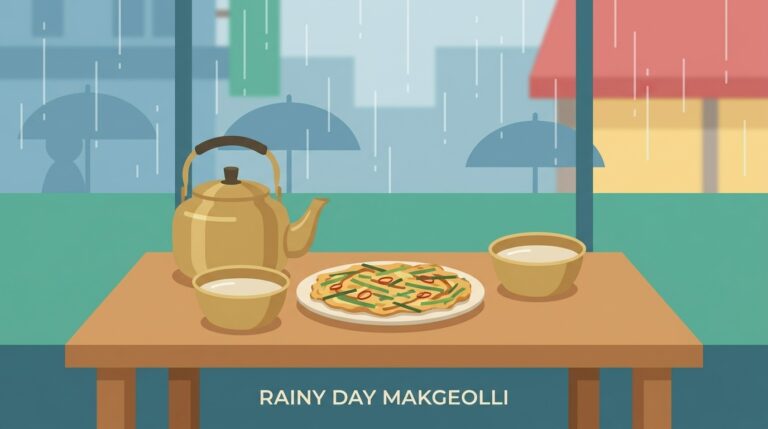
The moment rain starts drumming against the asphalt in Seoul, something fascinating happens. Office group chats explode with the exact same three words: “비 오니까 전?” (Since it’s raining, pancakes?) Before you know it, traditional wooden taverns (주점 – jujeom) across Hongdae and Jongno are packed to the brim. Outside, raindrops splatter against retro windows; inside, golden brass kettles clatter against shallow bowls, and the irresistible scent of scallions sizzling in hot oil fills the air.
For many Korean learners, this iconic scene can feel intimidating. How do you handle that slippery brass kettle without making a mess? Do you shake the cloudy rice wine (막걸리 – makgeolli) or leave it clear? And how do you invite your Korean friends out using natural, intermediate-level phrasing instead of robotic textbook lines? Drawing from 10 years of mentoring B1-level learners through Seoul’s lively nightlife, I have created this ultimate cultural navigation guide. By the end of this lesson, you will confidently order, pour, and chat your way through a rainy night in Korea just like a local.
Phase 2: Core 3 Expressions Deep Dive
1. 비 오니까 파전에 막걸리 땡기네요 (Bi onikka pajeone makgeolli ttaenggineyo)
- Pronunciation: [Bi o-ni-kka pa-jeon-e mak-geol-li ttaeng-gi-ne-yo] (Think of ‘ttaeng’ snapping like a taut guitar string: “t-t-ang”)
- Meaning: Literal: “Because it’s raining, scallion pancake and makgeolli are pulling me.” / Nuance: “Since it’s raining, I’m seriously craving pajeon and makgeolli!”
- K-Culture Moment: You will hear this in almost every contemporary K-Drama whenever characters look out an office window on a gloomy afternoon and decide to skip overtime for drinks.
- Editor’s Insight: The verb 땡기다 (ttaenggida) is the king of colloquial craving expressions. While textbook Korean uses 먹고 싶어요 (meokgo sipeoyo), 땡기다 conveys an instinctive, mouth-watering urge that you simply can’t fight.
- Situation Spectrum: Casual: ✅ | Semi-formal: ✅ | Formal: ⚠️ (Keep it with friends, peers, and friendly coworkers; avoid in formal client presentations)
- 🤔 Think About It: In English, we say “I’m craving comfort food.” Why do you think Korean uses a physical pulling sensation (땡기다) to express an appetite triggered by the weather?
2. 첫 잔은 흔들지 말고 맑게 마셔봐요 (Cheot janeun heundeulji malgo malke masyeobwayo)
- Pronunciation: [Cheot jan-eun heun-deul-ji mal-go mal-kke ma-syeo-bwa-yo] (Pro tip: ‘malke’ rhymes with the English word ‘balmy’, but ending cleanly with ‘keh’)
- Meaning: Literal: “Don’t shake the first glass, try drinking it clearly.” / Nuance: “Let’s drink the clear top layer for our first round before mixing it!”
- K-Culture Moment: Seen in foodie variety shows like Baek Jong-won’s Street Food Fighter, where food connoisseurs savor the clean, champagne-like upper layer of premium unpasteurized makgeolli.
- Editor’s Insight: Makgeolli naturally separates into a clear rice wine top (청주 – cheongju) and a milky sediment bottom (탁주 – takju). Savvy drinkers often enjoy the tart, crisp top half first, then shake the rest later for a velvety dessert-like finish.
- Situation Spectrum: Casual: ✅ | Semi-formal: ✅ | Formal: 🚫
- 🤔 Think About It: Does your home culture enjoy different phases or layers of a single beverage, or do you always stir everything together immediately?
3. 지글지글 빗소리랑 전 부치는 소리가 똑같죠? (Jigeul-jigeul bitsorirang jeon buchineun soriga ttokgatjyo?)
- Pronunciation: [Ji-geul-ji-geul bit-so-ri-rang jeon bu-chi-neun so-ri-ga ttok-gat-jyo] (Feel the rhythmic sizzle: ‘jee-geul jee-geul’)
- Meaning: Literal: “The sizzling rain sound and pancake frying sound are identical, right?” / Nuance: “Doesn’t the sizzling sound of frying pancakes sound just like the falling rain?”
- K-Culture Moment: The quintessential icebreaker used on variety shows and blind dates whenever two people sit near an open rain-splattered tavern window.
- Editor’s Insight: Koreans have onomatopoeia for virtually every sensory detail. 지글지글 (jigeul-jigeul) paints an immediate auditory picture of batter hitting boiling oil on a cast-iron skillet.
- Situation Spectrum: Casual: ✅ | Semi-formal: ✅ | Formal: ✅
- 🤔 Think About It: Why do you think sound associations play such a powerful role in food cravings across Korean culture?
Phase 3: Textbook Korean vs. Real Korean
Situation 1: Suggesting Drinks on a Gloomy Afternoon
- 📖 Textbook Korean: 비가 내리니 막걸리를 마시러 갈까요? (Bi-ga naerini makgeollireul masireo galkkayo? – Because rain is falling, shall we go drink makgeolli?)
- 🗣️ Real Korean: 비도 오는데 막걸리 한잔 콜? (Bi-do oneunde makgeolli hanjan kol? – It’s raining anyway, down for a glass of makgeolli?)
- 💡 Why the Difference? Adding 도 (-do, also/even) softens the suggestion into a shared mood excuse, while appending “콜?” (Call?) is the universal modern slang for “Are you game?”
Situation 2: Describing a Flawless Pancake Texture
- 📖 Textbook Korean: 이 전은 겉은 바삭하고 속은 부드럽습니다. (I jeoneun geoteun basakhago sogeun budeureopseumnida. – This pancake is crispy outside and soft inside.)
- 🗣️ Real Korean: 와, 전 완전 겉바속촉 미쳤다! (Wa, jeon wanjeon geot-ba-sok-chok michyeotda! – Wow, this pancake’s crispy-outside-soft-inside game is insane!)
- 💡 Why the Difference? 겉바속촉 (Geot-ba-sok-chok) is an essential modern portmanteau. Saying 미쳤다 (michyeotda, literally “crazy”) is how millennials and Gen Z express maximum sensory satisfaction.
Phase 4: K-Culture Deep Dive & Non-Verbal Manners
4-1. Nunchi (눈치) & Table Etiquette
- The Two-Handed Kettle Grip: Traditional brass kettles (주전자 – jujeonja) are clumsy. When pouring for someone older or of higher rank, grip the handle firmly with your right hand while lightly resting your left fingers on your right wrist or forearm. It shows respect and ensures zero accidental spills.
- The Cup Angle: Makgeolli bowls are wide and shallow. Receive drinks with both hands holding the rim, and when clinking glasses (짠! – jjan!), lower your rim slightly below the senior person’s bowl as a sign of humility.
- The Decarbonation Swirl: Fresh makgeolli has natural carbonation. Never shake the bottle furiously like a cocktail shaker, or you will cause a fermented geyser. Instead, hold it upright, invert it slowly once or twice, or gently swirl the base in circular motions on the table.
4-2. The Cultural Code: Why Rainy Days?
Why does the entire country think of the exact same menu whenever precipitation starts?
1. Acoustic Psychology: The frequency of falling rain measures between 500 to 2,000 Hz—almost identical to the sound of frying oil (지글지글). Your brain makes an unconscious auditory leap from raindrop sounds to crispy batter.
2. Agrarian Rhythm: In historic Korea, farmers could not work the fields during heavy downpours. It was their only designated day off. Village communities gathered in communal sheds, ground fresh flour, tossed wild leeks into iron lids, and drank leftover farmhouse rice wine together.
3. Serotonin Boost: Gloomy, overcast weather causes blood sugar and serotonin levels to dip. The carbohydrates in wheat flour coupled with the vitamin B and amino acids in fermented rice wine act as a natural, uplifting antidote.
Phase 5: Real-Life Roleplay Scenario
Setting: A cozy retro tavern in Insadong. Yellow paper lanterns glow overhead, rain trickles down the tiled eaves, and a golden kettle sits between you and your cheerful Korean team coworker, Minji.
Character: 민지 (Minji) – A warm, foodie colleague who loves sharing traditional food lore.
- 민지: 오늘 비 진짜 많이 온다. 이런 날엔 역시 전집이지!
(Oneul bi jinjja mani onda. Ireon naren yeoksi jeonjip-iji!)
“It’s really pouring today. On days like this, a pancake pub is the only answer!”
🎭 Shakes the water off her umbrella and takes a seat across from you with a huge grin. -
You: 맞아요, 빗소리 들으니까 파전에 막걸리 완전 땡겼어요.
(Majayo, bitsori deureunikka pajeone makgeolli wanjeon ttaenggyeosseoyo.)
“Totally! Hearing the rain made me crave pajeon and makgeolli so bad.”
🎭 Unwraps wooden chopsticks and arranges the side dish of pickled onions. -
민지: 센스 대박! 그럼 일단 해물파전 하나 시키고, 막걸리는 뭘로 할래?
(Senseu daebak! Geureom ildan haemulpajeon hana sikigo, makgeollineun mwollo hallae?)
“Great minds think alike! Let’s get a seafood scallion pancake first. Which makgeolli do you want?”
🎭 Hands you the weathered wooden menu board. -
You: 민지 씨 추천으로 마셔보고 싶어요. 뭐가 제일 맛있어요?
(Minji ssi chucheoneuro masyeobogop sip-eoyo. Mwo-ga jeil masisseoyo?)
“I’d love to try your recommendation, Minji. What is the tastiest here?”
🎭 Leans in curiously, pointing at the diverse list of regional rice wines. -
민지: 오, 그럼 이 집 시그니처인 지평막걸리 먹어보자. 달달하고 탄산이 딱 적당해.
(O, geureom i jip sigeunicheoin Jipyeong makgeolli meogeoboja. Daldalhago tansani ttak jeokdanghae.)
“Oh, let’s try their signature Jipyeong Makgeolli. It’s subtle, sweet, and has the perfect fizz.”
🎭 Waves toward the kitchen counter to catch the owner’s attention. -
민지: 사장님, 여기 해물파전 하나랑 막걸리 한 병 먼저 주세요!
(Sajangnim, yeogi haemulpajeon hanarang makgeolli han byeong meonjeo juseyo!)
“Owner, could we please get one seafood scallion pancake and a bottle of makgeolli first!”
🎭 The owner brings a chilled green bottle and two round brass bowls. -
You: 제가 한 잔 따라드릴게요. 첫 잔은 안 흔들고 맑게 마셔볼까요?
(Jega han jan ttaradeurilgeyo. Cheot janeun an heundeulgo malke masyeobolkkayo?)
“Allow me to pour for you. Shall we try the first cup clear without shaking?”
🎭 Carefully picks up the bottle with both hands, steadying the base. -
민지: 헐, 너 막걸리 마실 줄 아는구나? 완전 인정! 짠 하자!
(Heol, neo makgeolli masil jul aneunguna? Wanjeon injeong! Jjan haja!)
“Whoa, you really know how to drink makgeolli! Total respect. Let’s clink!”
🎭 Laughs delightfully and clinks her brass bowl against yours.
🔀 Interactive Decision Point
The crispy seafood pancake (해물파전) arrives steaming hot at your table, but it isn’t sliced into neat pizza triangles. How do you respond?
- Option A: Use your chopsticks to help Minji tear the pancake apart into bite-sized rustic pieces along the grain of the scallions.
- Option B: Ask the tavern owner loudly for a pair of scissors and a pizza roller to cut it into clean squares.
- Option C: Pick up the entire giant pancake with your chopsticks and fold it into your individual plate.
* **Option A (Best Choice):** ⭐ Perfect! In Korea, traditional jeon is celebrated when torn irregularly with chopsticks (*젓가락으로 찢어 먹기*). It traps the dipping soy sauce better and keeps the texture crispy.
* **Option B (Bad Choice):** ❌ While servers might hand you kitchen scissors (*가위*) if asked, cutting traditional pajeon into rigid geometric slices flattens the fluffiness and marks you as an impatient tourist.
* **Option C (Risk Choice):** ⚠️ High risk! Jeon is meant to be shared communally right from the center hot platter. Taking the whole pancake looks greedy and breaks the shared dining warmth (*정 - jeong*).
Phase 6: 10-Second Emotion Shadowing Drill
Practice matching natural pauses (/) and dynamic pitch changes to sound completely native:
- [😋 Anticipatory craving & Bright]
비 오니까 / 파전에 막걸리 / 완전 땡기네요!
(Bi onikka / pajeone makgeolli / wanjeon ttaenggineyo!) -
[💡 Thoughtful & Cultured]
첫 잔은 흔들지 말고 / 맑게 한잔 / 마셔봐요.
(Cheot janeun heundeulji malgo / malke hanjan / masyeobwayo.) -
[😍 Amazed & Overjoyed]
와, 전 테두리가 / 진짜 바삭바삭해서 / 너무 맛있어요!
(Wa, jeon teduriga / jinjja basak-basakhaeseo / neomu masisseoyo!)
Phase 7: K-Culture Mini Dictionary
- 주전자 (Jujeonja) | Brass Kettle
The nostalgic yellow aluminum or brass kettle used to serve draft makgeolli. It keeps the drink ice-cold and creates a satisfying glug-glug acoustic when pouring. - 파전 (Pajeon) | Scallion Pancake
A savory pancake made with whole green scallions laid flat in batter. Variations include Haemul-pajeon (seafood) and Dongnae-pajeon (thicker style with sweet leeks). - 모둠전 (Modumjeon) | Assorted Pancake Platter
An incredible tasting platter featuring battered zucchini (호박전), skewered meats, minced beef patties (동그랑땡), and stuffed chili peppers (고추전). - 겉바속촉 (Geot-ba-sok-chok) | Crispy Outside, Soft Inside
The gold standard descriptor for Korean fried delicacies, particularly the crunchy crust and custardy center of a perfectly pan-fried jeon.
Phase 8: Traveler’s Survival Kit
Top 3 Survival Phrases
- 이 집에서 제일 잘나가는 막걸리가 뭐예요? (I jibeseo jeil jal-naganeun makgeolliga mwoyeyo?)
“What is the best-selling makgeolli in this pub?”
Pro Tip: Use this to bypass confusing regional brand names and sample the freshest house favorite. - 양파 장아찌 리필 좀 부탁드려요. (Yangpa jang-ajji ripil jom butakdeuryeoyo.)
“Could we please get a refill of the pickled soy onions?”
Pro Tip: Dipping your pancake in the savory soy sauce and resting a translucent pickled onion on top cuts through oiliness instantly. - 지평 하나랑 사이다 한 캔 주세요. (Jipyeong hanarang saida han kaen juseyo.)
“Please give us one bottle of Jipyeong and a can of Chilsung cider.”
Pro Tip: Combine two parts makgeolli with one part cider to make Mak-sa (막사), Korea’s favorite refreshing DIY low-alcohol party cocktail!
Editor’s Travel Note
- Navigation Tip: Forget Google Maps in Seoul. To find hidden, rain-soaked retro taverns in Bukchon or Euljiro, use a verified Naver Map app download to search for “민속주점” (folk tavern) or “전집” (jeon specialty house).
- Waitlist Reality: On rainy Fridays, popular spots like Nolbu Pajeon in Hoegi-dong or Ganginhan Pocha develop 40-minute waitlists by 6:30 PM. Download the Catch Table reservation app to check live remote queuing before braving the storm.
Phase 9: One Step Deeper (Reflective Essay)
In Western dining, rain often drives people home to solitary comfort. In Korea, rain acts as an invisible social magnet that pulls colleagues, lovers, and old friends into circular tables. Sharing jeon is inherently communal; you do not eat from segregated plates, but rather reach into the shared pan together, rhythmically tearing pieces apart with your chopsticks. In this small act, the communal warmth known as Jeong (정) shines through. The dreary rain ceases to be an inconvenience—it becomes a cultural permission slip to pause, listen to the sizzle, and connect.
💬 Your Turn: What is the traditional comfort food or ritual people turn to in your country whenever it rains? Have you ever experienced a similar culinary connection to the weather? Drop your thoughts below!
Phase 10: FAQ & Common Mistakes
Q: Why do Koreans drink Makgeolli from shallow metal bowls instead of glasses?
A: Makgeolli contains sediment that settles quickly. Wide, shallow brass or ceramic bowls make it easy to gently swirl your drink before sipping. Historically, it was also the humble drink of farmers who drank quickly from wide bowls to quench midday thirst during harvest.
Q: Does Makgeolli give you a terrible hangover?
A: Traditional, unpasteurized (생막걸리 – saeng makgeolli) with high-quality rice and no artificial sweeteners (아스파탐 – aspartame) causes surprisingly mild hangovers because the active lactobacillus aids digestion. Hangovers usually happen when people mix makgeolli with soju or beer in heavy drinking sessions.
Q: What if I don’t shake the bottle at all?
A: You don’t have to! Drinking the clear upper liquid (청주 – cheongju) provides a clean, fruity, floral taste similar to dry white wine. You can drink the top half first, and then shake the remaining half to enjoy two completely different flavor profiles from one single bottle.
🚨 Common Mistakes Alert
- Mistake: Shaking a pressurized, freshly opened carbonated bottle vigorously like soda.
Correct Action: Invert the bottle gently or open and close the plastic cap slightly several times to release the gas before giving it a final swirl. - Mistake: Pouring your own drink when dining with others.
Correct Action: Always check your companions’ bowls first. If someone’s bowl is less than a third full, offer to pour for them before accepting a refill for yourself. - Mistake: Cutting the pancake into symmetrical bite-size blocks with a knife.
Correct Action: Use your chopsticks to pull it apart naturally along the green scallion stems for the optimal balance of crispy batter and tender filling.
Phase 11: Action Missions
- 🥉 Bronze Level (Solo Master): Stand in front of your mirror, mimic holding a golden kettle with both hands, and shadow Expression 1 out loud three times: “비 오니까 파전에 막걸리 완전 땡기네요!”
- 🥈 Silver Level (Social Sharing): Snap a photo of a rainy window or your favorite rainy day comfort meal, post it to Instagram Stories, and tag
#매일한글 #비오는날엔파전with the Korean caption: “비도 오는데 막걸리 한잔 콜?” - 🥇 Gold Level (Real-World Test): Next time rain clouds gather over your city, text a Korean friend or classmate to invite them out for pancakes using the exact dialogue from Phase 5.
🎮 K-Culture Mission: Watch an episode of a slice-of-life drama like Hospital Playlist or Reply 1988. Spot the scene where the characters gather to eat jeon during a storm, and listen carefully to the sound effect (지글지글) used in the audio mix!
Phase 12: Interactive Quiz Challenge
1. Situational Judgment
Your Korean boss looks out the office window at 5:00 PM on a rainy Tuesday and sighs, “아, 비 오네…” (Ah, it’s raining…). Which response shows the highest cultural charm and intermediate fluency?
* (A) 네, 우산을 준비하세요. (Yes, please prepare an umbrella.)
* (B) 부장님, 오늘 같은 날엔 파전에 막걸리 한잔 땡기시죠? (Director, on a day like today, don’t you crave pajeon and makgeolli?)
* (C) 비가 내리니 도로가 막힐 것입니다. (Because rain falls, traffic will be jammed.)
2. Fill-in-the-Blank
Complete the ultimate textural compliment for a newly fried scallion pancake:
* “와, 이 파전 진짜 겉은 바삭하고 속은 촉촉해요! 완전 [ _____ ] 대박이다!”
3. True or False Cultural Trivia
- (T/F) Makgeolli should always be shaken instantly until it turns totally chalk-white before opening the cap, without exception.
👉 Click here to reveal the answers and explanations!
- Answer: (B)
Explanation: Suggesting 파전에 막걸리 taps straight into collective Korean nostalgia and shows you understand the social mood (눈치 – nunchi) beyond mechanical grammar. - Answer: 겉바속촉 (Geot-ba-sok-chok)
Explanation: The essential Korean slang abbreviation for “crispy on the outside, moist on the inside” (겉은 바삭, 속은 촉촉). - Answer: False
Explanation: Many connoisseurs prefer tasting the delicate, crystal-clear upper layer first without shaking it, or gently tilting the bottle to prevent carbonation explosions.







