

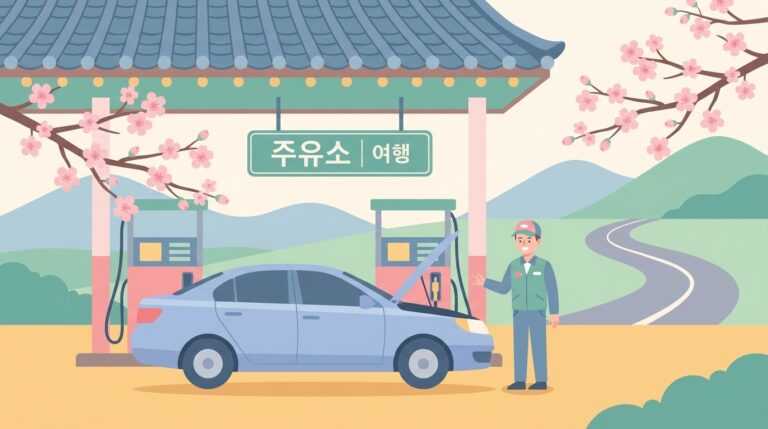
Phase 1: Empathy (Opening Story)
안녕하세요! 매일한글 에디터입니다. (Hello! I’m your Daily Hangul editor.)
Picture this: You are on an epic road trip along the coastal highways of Gangwon-do or cruising past the tangerine groves of Jeju Island. The playlist is perfect, the vibe is unmatched, until—splat. A huge bug lands dead center on your windshield. You flick the wiper stalk, but instead of a satisfying spray of blue cleaning fluid, your wipers screech dryly across the glass, leaving a dreadful, murky smear. You are officially out of windshield washer fluid.
You nervously pull into a local Korean gas station (주유소). Friendly pump attendants in bright neon vests are zipping between vehicles. You want to ask for washer fluid, but sudden panic sets in: What is the word for windshield fluid in Korean? Will they look at me weirdly if I pop the hood? Do I have to pay extra, or is it complimentary?
Many of our beginner learners tell us that car-related errands in Korea feel intimidating because automotive terms seem heavy and technical. But here is the good news: navigating this situation at an A2 level doesn’t require mechanical jargon. With just three conversational building blocks, you can pull up, get your windshield fluid refilled with confidence, and earn a warm smile from the local station attendant. Let’s master this essential road trip skill together!
Phase 2: Deep-Dive into 3 Key Expressions
1. 워셔액 좀 넣어 주실 수 있나요? (Wosyeo-aek jom neo-eo jusil su innayo?)
- Pronunciation: [Wash-your-eck jom nuh-uh joo-sheel soo een-na-yo?] (Think of the English word washer plus aek, sounding like “wash-your-egg” with a crisp ending).
- Meaning: Literal: “Could you put in some washer fluid for me?” / Practical Nuance: A warm, ultra-polite request that instantly turns you into a considerate driver rather than an demanding customer.
- K-Culture Moment: In popular Korean travel shows like 2 Days & 1 Night (1박 2일), cast members frequently pull into rural gas stations and ask the friendly attendant (주유원 아저씨) to top up their fluid before hitting unpaved countryside roads.
- Editor’s Insight: The tiny word 좀 (jom) literally means “a little,” but in conversational Korean, it acts as an emotional shock-absorber. Dropping 좀 into your requests softens your tone instantly from a rigid demand into a friendly inquiry.
- Situation Spectrum: Casual 🚫 | Semi-formal ✅ | Formal ✅
- 🤔 Think About It: In English, we often say “Can I get some washer fluid?” focusing on what we receive. Korean polite requests frequently focus on the action the other person performs for you (
-어 주시다). How does shifting focus toward the helper change how you view everyday service encounters?
2. 본넷 좀 열어 드릴까요? (Bonnet jom yeoreo deurilkkayo?)
- Pronunciation: [Boh-net jom yuh-ruh deu-ril-kka-yo?]
- Meaning: Literal: “Shall I open the bonnet/hood for you?” / Practical Nuance: Proactively offering to pop open the hood latch from the driver’s seat so the attendant can pour the fluid.
- K-Culture Moment: You will notice in K-dramas that drivers rarely jump out of the car right away. Instead, they roll down their window and coordinate before popping the hood open.
- Editor’s Insight: Notice the word 본넷 (bonnet)! While American English uses hood, Korean daily automotive slang inherited the British automotive term bonnet (often pronounced bon-net or written as 보닛). If you say “hood” (후드), attendants might think of a clothing hoodie!
- Situation Spectrum: Casual ⚠️ | Semi-formal ✅ | Formal ✅
- 🤔 Think About It: Why do you think Korea adopted British automotive terms like bonnet (본넷) and handle (핸들 for steering wheel)? Language preserves fascinating historical crossroads of international trade!
3. 워셔액 얼마예요? (Wosyeo-aek eolmayeyo?)
- Pronunciation: [Wash-your-eck uhl-mah-yay-yo?]
- Meaning: Literal: “How much is the washer fluid?” / Practical Nuance: Clear, straightforward check on the price.
- K-Culture Moment: At many full-service Korean gas stations, if you fill up your gas tank to full (가득), the station attendant might offer washer fluid for free as a courtesy (서비스). Asking this question lets you confirm whether it’s a gift or an item to be billed.
- Editor’s Insight: At self-service stations, bottled washer fluid typically costs between 2,000 KRW and 4,000 KRW ($1.50 – $3.00 USD). Don’t hesitate to ask before they crack open the seal!
- Situation Spectrum: Casual ⚠️ | Semi-formal ✅ | Formal ✅
- 🤔 Think About It: In your home culture, is it normal to buy car supplies directly at the gas pump, or must you go inside a convenience store? In Korea, service happens right at your driver-side window.
Phase 3: Textbook Korean vs. Real-Life Korean
Situation 1: Asking if the gas station provides washer fluid
- 📖 교과서 한국어 (Textbook Korean): 여기에 워셔액이 구비되어 있습니까? (Yeogie wosyeo-aegi gubidoeeo itsseumnikka? / “Is windshield washer fluid equipped and prepared here?”)
- 🗣️ 진짜 한국어 (Real-Life Korean): 여기 워셔액도 있어요? (Yeogi wosyeo-aekdo itsseoyo? / “Do you have washer fluid here too?”)
- 💡 왜 다를까? (Why is it different?): Textbook Korean often relies on Sino-Korean bureaucratic vocabulary like 구비 (prepared/equipped). Real Koreans simply use the elementary verb 있어요? (Do you have / Is there?) with the additive particle -도 (too/also).
Situation 2: The attendant telling you to pop the hood
- 📖 교과서 한국어 (Textbook Korean): 자동차 보닛 레버를 당겨 주시기 바랍니다. (Jadongcha bonit reobeoreul danggyeo jusigi baramnida. / “We hope that you will pull the automobile bonnet lever.”)
- 🗣️ 진짜 한국어 (Real-Life Korean): 앞쪽 본넷 한 번만 열어 주세요! (Ap-jjok bonnet han beonman yeoreo juseyo! / “Please open the front hood for me once!”)
- 💡 왜 다를까? (Why is it different?): Native speakers use 한 번만 (just once / for a second) as an everyday conversational cushion to make quick instructions sound gentle and collaborative.
Phase 4: K-Culture Deep Dive & Non-Verbal Manners
4-1. 눈치 (Nunchi) & Gas Station Etiquette
- Stay Seated First: Unlike in some countries where drivers immediately exit the vehicle, in Korea, you typically stay in your seat with your seatbelt on until the attendant approaches your window. Rolling down your window halfway with both hands resting politely on the steering wheel shows respect.
- The Hood Latch Alert: Never pop your hood lever without warning! If the attendant is standing directly in front of the vehicle, the hood popping up suddenly can startle them. Always announce it: “본넷 열게요!” (Bonnet yeolgeyo! / I’ll open the hood!).
- Card Exchange Etiquette: When handing over your credit card or cash for payment, use both hands (or support your right forearm lightly with your left hand). It is the golden rule of Korean everyday respect.
4-2. Cultural Code: The Magic of “서비스” (Service)
In Korean commercial culture, 서비스 (seobiseu) doesn’t just mean customer service—it specifically refers to free perks or complementary goods given to show appreciation. Traditional Korean full-service gas stations take pride in hospitality: while pumping your gas, attendants frequently wipe down your front windshield with a squeegee and may even top off your washer fluid for free if you purchase a full tank. Accepting this with a bright “감사합니다!” (Gamsahamnida!) builds instant community warmth.
Phase 5: Real-Life Roleplay Scenario
Setting: A sunny afternoon along the coastal road of Gangneung. You pull your white rental sedan into Haetsal Gas Station (햇살주유소). Attendant Park Min-ho (민호 아저씨), wearing a cap and an orange high-visibility vest, trots over to your driver-side window.
- Turn 1 (Min-ho): 어서 오세요! 얼마 넣어 드릴까요? (Eoseo oseyo! Eolma neo-eo deurilkkayo?)
🎭 Smiling brightly with a polite nod.
(Welcome! How much gas should I put in for you?) -
Turn 2 (You): 5만 원 주유해 주세요. 그리고 혹시 워셔액 좀 넣어 주실 수 있나요? (O-man-won juyuhae juseyo. Geurigo hoksi wosyeo-aek jom neo-eo jusil su innayo?)
🎭 Rolling down window smoothly and speaking clearly.
(50,000 won of gas, please. And by any chance, could you refill the washer fluid?) -
Turn 3 (Min-ho): 아, 워셔액이요? 네, 가능합니다! 워셔액은 3천 원 추가되는데 괜찮으세요? (A, wosyeo-aegiyo? Ne, ganeunghamnida! Wosyeo-aegeun sam-cheon-won chugadoeneunde gwaenchaneuseyo?)
🎭 Pointing toward the blue washer fluid bottles neatly displayed near the pump island.
(Ah, washer fluid? Yes, we can! Washer fluid adds 3,000 won, is that okay?) -
Turn 4 (You): 네, 괜찮아요. 본넷 좀 열어 드릴까요? (Ne, gwaenchanayo. Bonnet jom yeoreo deurilkkayo?)
🎭 Placing your hand near the hood release lever under the dashboard.
(Yes, that’s fine. Shall I pop the hood for you?) -
Turn 5 (Min-ho): 네! 레버 한 번만 당겨 주세요! (Ne! Reobeo han beonman danggyeo juseyo!)
🎭 Stepping to the front grille to catch the hood safety latch.
(Yes! Please pull the lever just once!) -
Turn 6 (You): 네, 본넷 열었어요! (Ne, bonnet yeoreosseoyo!)
🎭 Pulling the lever with a satisfying ‘clunk’ sound.
(Okay, I opened the hood!) -
Turn 7 (Min-ho): 다 넣었습니다! 보닛 닫았으니 출발하셔도 됩니다. 결제 도와드릴게요. (Da neoeosseumnida! Bonit dadasseuni chulbalhasyeodo doemnida. Gyeolje dowadeurilgeyo.)
🎭 Wiping the bottle rim and offering the mobile credit card terminal.
(All filled up! I closed the hood so you’re good to go. I’ll help you with the payment.) -
Turn 8 (You): 정말 감사합니다! 수고하세요! (Jeongmal gamsahamnida! Sugohaseyo!)
🎭 Handing your payment card with two hands.
(Thank you so much! Have a great day!)
🔀 Interactive Branching Point
After Min-ho asks: “워셔액은 3천 원 추가되는데 괜찮으세요?” (It’s an extra 3,000 won, is that okay?), how do you respond if you actually brought your own washer fluid bottle in the trunk?
- Option A: “아, 트렁크에 제 것이 있어요. 제가 넣을게요!” (Ah, teureongkeue je geosi itsseoyo. Jega neoeulgeyo! / Ah, I have mine in the trunk. I will put it in myself!)
- Option B: “너무 비싸요! 그냥 물 넣으세요!” (Neomu bissayo! Geunyang mul neoeuseyo! / Too expensive! Just put water in!)
- Option C: “안 돼요! 공짜 아니에요?” (An dwaeyo! Gongjja anieyo? / No way! Isn’t it free?)
Feedback:
* Selection A [BEST]: Perfect! Polite, clear, and proactive. The attendant will gladly let you handle it or might even offer a funnel.
* Selection B [RISK]: Dangerous! Never put regular tap water in modern vehicle washer reservoirs, especially during winter (it will freeze and crack the tank lines), and the tone sounds accusatory.
* Selection C [BAD]: Offensive. While some stations offer free washer fluid during promotional events, demanding free items (공짜) violates Korean business etiquette.
Phase 6: 10-Second Emotion Shadowing Drill
Practice reading these sentences aloud, matching the rhythm markers (/) and the emotional cues:
[😊 Polite & Cheerful]
워셔액 좀 / 넣어 주실 수 있나요?
(Wosyeo-aek jom / neo-eo jusil su innayo?)
Pitch rises gently at “워셔액 좀” and finishes with an inviting upward tilt on “-있나요?”.-
[🤝 Helpful & Cooperative]
본넷 레버 / 지금 열어 드릴까요?
(Bonnet reobeo / jigeum yeoreo deurilkkayo?)
Clear, steady cadence with a brief pause after “본넷 레버”. -
[🙏 Warm & Grateful]
깨끗하게 닦아 주셔서 / 정말 감사합니다!
(Kkaekkeuthage dakk-a jusyeoseo / jeongmal gamsahamnida!)
Warm, resonant lower tone conveying heartfelt appreciation for their physical labor.
Phase 7: K-Culture Mini Dictionary
-
워셔액 (Wosyeo-aek)
Literal Translation: Washer liquid / Windshield wiper fluid.
Everyday Usage: Sold in 1.8-liter translucent plastic jugs at gas stations, hypermarkets (E-Mart, Homeplus), and Daiso. In winter, look for 사계절용 (all-season / anti-freeze). -
본넷 / 보닛 (Bonnet / Bonit)
Literal Translation: Car hood.
Everyday Usage: Originating from British English, this is the universal term used by mechanics, gas station attendants, and rental agencies across South Korea. -
셀프 주유소 (Selpeu Juyuso)
Literal Translation: Self-service gas station.
Everyday Usage: Marked with large “SELF” signage in English and Korean. Fuel is slightly cheaper here, and washer fluid is sold inside the affiliated kiosk or mini-mart. -
가득 (Gadeuk)
Literal Translation: Full / To the brim.
Everyday Usage: The magic word when ordering gas: “가득 채워 주세요” (Gadeuk chaeweo juseyo / Fill it up completely, please).
Phase 8: Traveler’s Survival Kit
Top 3 Survival Expressions for Driving in Korea
-
“휘발유예요 / 경유예요.” (Hwiballyuyeyo / Gyeongyuyeyo.)
Romanization: [Hwi-bal-yu-ye-yo / Gyeong-yu-ye-yo]
Pro Tip: 휘발유 is Gasoline (Yellow pump nozzle); 경유 is Diesel (Green or Blue nozzle). Telling the attendant your fuel type avoids catastrophic engine mistakes in rental cars! -
“영수증 버려 주세요.” (Yeongsujeung beoryeo juseyo.)
Romanization: [Yeong-soo-jeung buh-ryuh joo-say-yo]
Pro Tip: Means “Please discard the receipt.” Attendants will hold the receipt up to ask if you need it. If you don’t, say this with a gentle hand wave. -
“세차도 되나요?” (Sechado doenayo?)
Romanization: [Say-cha-doh dway-nah-yo?]
Pro Tip: Means “Is the automated car wash available too?” Gas stations often give discount car-wash vouchers right after refueling.
Editor’s Travel Note
When driving in South Korea, foreign Google Maps navigation is limited due to local mapping regulations. Before hitting the road, make sure to read our detailed guide on the [Naver Map App download for English navigation]. Also, remember that credit cards are accepted at 99.9% of Korean gas stations, but international chip cards occasionally require insertion rather than contactless tap at older pump stands.
Phase 9: “한 발 더 깊이” (One Step Deeper)
In an era dominated by hyper-efficient automated self-service kiosks, traditional Korean full-service gas stations remain one of the few places where everyday 정 (Jeong)—Korea’s unique emotional bond of mutual care and warmth—still thrives between strangers. When an elder gas station attendant hurries across the concrete lot on a freezing day, vigorously scrubs your frosted windshield, and checks your fluid levels without being asked, they are treating you not merely as a transaction, but as a traveler passing through their neighborhood safely.
💬 Your Turn: In your home country, do service stations still offer full human service, or has everything turned entirely automated? How do you feel about small human touches like wiping windshields? Share your thoughts in the comments below!
Phase 10: FAQ & Avoiding Misunderstandings
Q: Is windshield washer fluid always free at Korean gas stations?
A: No, it depends on the station! If you buy a large amount of fuel at a full-service station, attendants will sometimes pour a complementary half-bottle (서비스) to be kind. However, standard policy is that washer fluid is an inventory item costing 2,000 to 4,000 KRW. Always ask “얼마예요?” (Eolmayeyo? / How much is it?) to prevent awkward assumptions.
Q: Where is the hood release lever located in Korean rental cars?
A: In standard Korean sedans (like Hyundai Avante/Sonata or Kia K5), the lever is located on the lower-left plastic kick panel below the steering wheel, near the footrest. Look for an icon of a car with an open hood.
Q: Can I just pour bottled drinking water into the washer reservoir in an emergency?
A: In extreme emergencies during warm summer months, distilled water works temporarily. But in Korea’s sub-zero winter temperatures, plain water will freeze solid, burst your fluid tank, and shatter the wiper tubing. Always purchase certified Korean 사계절용 워셔액 (all-season washer fluid) containing ethanol antifreeze.
🚨 Common Mistakes Alert Board
- Mistake: Calling the car hood “후드” (Hoodeu).
Correct Action: Use 본넷 (Bonnet). Attendants instantly understand this loanword. - Mistake: Pulling the lever for the fuel door instead of the hood.
Correct Action: Modern Korean cars have two distinct levers down by your left foot: one marked with a gas pump (fuel lid) and one marked with an open front hood. Double-check before pulling! - Mistake: Tipping the attendant cash.
Correct Action: South Korea is strictly a non-tipping culture. Tipping can confuse or embarrass service workers. A sincere “감사합니다, 수고하세요!” (Thank you, keep up the good work!) is the best reward.
Phase 11: Action Missions
- 🥉 Bronze Mission (Solo Practice): Sit in your chair, mimic holding a steering wheel, roll down an imaginary window, and say aloud three times: “워셔액 좀 넣어 주실 수 있나요?”.
- 🥈 Silver Mission (Social Sharing): Share this post to your Instagram Story or Korean study group, tagging someone you would love to go on a scenic Korean road trip with!
- 🥇 Gold Mission (Real-Life Execution): On your next visit to South Korea, pull into a gas station, purchase washer fluid, and communicate entirely in Korean using our Phase 5 roleplay script!
- 🎮 K-Culture Media Mission: Watch an episode of a Korean road-trip show (such as House on Wheels or Camping Vibes) and spot whether the cast members visit a 셀프 (Self) or 일반 (Full-Service) gas station!
Phase 12: Interactive Quiz Challenge
Test your knowledge before hitting the highway!
1. Situational Judgment:
You pull into a full-service station and want to check if the attendant can refill your washer fluid. Which phrase is the most natural and polite for an A2 learner?
(A) 야! 워셔액 빨리 줘!
(B) 워셔액 좀 넣어 주실 수 있나요?
(C) 자동차 보닛의 액체 저장을 요구합니다.
2. Fill-in-the-Blank:
Before the attendant opens the engine compartment, you want to politely offer:
“본넷 좀 _____ 드릴까요?” (Shall I open the hood for you?)
(A) 닫아 (dada)
(B) 열어 (yeoreo)
(C) 사 (sa)
3. True or False:
In South Korea, it is customary to leave a 15% cash tip when an attendant refills your washer fluid. (True / False)
👉 Click here to reveal Answers & Explanations!
-
Question 1 Answer: (B)
Explanation: (B) uses the polite softening word 좀 and the respectful request form -어 주실 수 있나요?. (A) is rude, and (C) sounds like an instruction manual written by a robot! -
Question 2 Answer: (B) 열어 (yeoreo)
Explanation: The base verb is 열다 (yeolda / to open). Combined with -어 드리다, it forms 열어 드릴까요? (Shall I open it for you?). 닫다 means to close, and 사다 means to buy. -
Question 3 Answer: False
Explanation: South Korea does not have a tipping culture. Excellent service is included in the price, and a warm verbal thank you (감사합니다!) is the perfect etiquette.







