

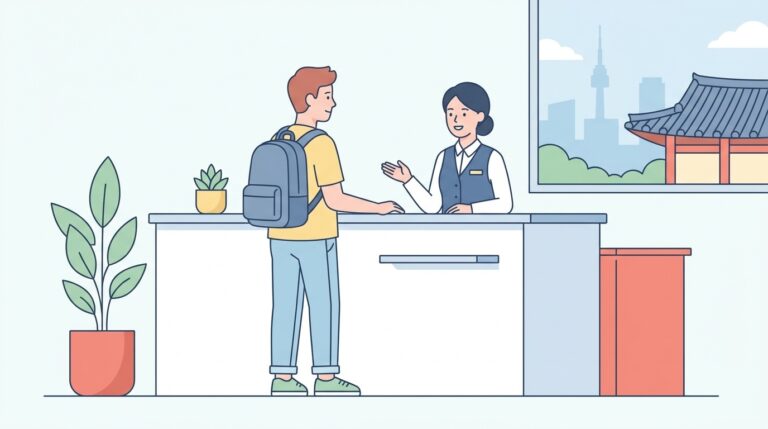
Send Money in Korea Like a Local: Essential Bank Phrases for Beginners
Phase 1: Empathy (Story-Driven Opening)
안녕하세요! 매일한글 에디터입니다. (Hello! I’m your Daily Hangul editor.)
Picture this: You are standing in the middle of a bustling, sparkling clean bank in Gangnam. You clutched your ticket number, and your turn just lit up on the digital board with a pleasant ding-dong. Your heart suddenly starts racing. You need to pay your monthly apartment maintenance fee, or perhaps you won’t get those sold-out K-Pop concert tickets unless you wire the money to the seller within the next ten minutes.
You have the account number typed out in your phone notes, but when you sit down at the counter, the teller greets you with rapid-fire Korean banking terminology. Your mind goes totally blank. Sound familiar?
Sending money—called 송금 (songgeum) or 계좌이체 (gyejwaj-iche) in Korea—is one of the most nerve-wracking tasks for any expat or traveler. Over the past decade guiding international students and travelers, I have seen so many people freeze up at this exact moment. But here is the secret: Korean bank tellers are incredibly efficient and helpful. You do not need to memorize complex financial jargon. With just three simple, polite sentences, you can confidently walk up to any teller or tackle any ATM without breaking a sweat. Let’s master them together!
Phase 2: Core Expressions Deep-Dive
1. 돈 보내려고 해요. (Don bonaeryeogo haeyo.)
- Pronunciation: Don bo-nae-ryeo-go hae-yo (Sounds like: Don like ‘dawn’ + bo-nae like ‘bonnet’ + ryeo-go + hae-yo)
- Meaning: Literal: “I intend to send money.” vs Real Nuance: “I’d like to transfer some money, please.”
- K-Culture Moment: In K-Dramas, whenever a hardworking protagonist visits a bank counter to send monthly living allowances back home to their parents in the countryside, this is the exact line they use.
- Editor’s Insight: The grammar ending -(으)려고 해요 (-ryeogo haeyo) signals your plan or intention. In Korean culture, directly commanding “Transfer my money” sounds harsh. Stating your intention softly invites the teller to help you naturally.
- Situation Spectrum: Casual: ⚠️ (Use ‘돈 보내려고’ with close friends) | Semi-formal: ✅ | Formal: ✅
- 🤔 Think About It: In English, you might say “I need to wire funds.” Why do you think Korean uses softer phrasing like “I intend to send money” when making requests to service professionals?
2. 계좌이체 해 주세요. (Gyejwaj-iche hae juseyo.)
- Pronunciation: Gye-jwa-i-che hae ju-se-yo (Sounds like: Gay-jwah-ee-cheh hae joo-say-yo)
- Meaning: Literal: “Please do an account transfer.” vs Real Nuance: “Could you process this wire transfer for me?”
- K-Culture Moment: Seen at Korean flea markets like Dongmyo or while picking up secondhand items through Karrot Market (당근마켓), where sellers prefer instant bank transfers over cash.
- Editor’s Insight: 계좌 (gyejwa) means ‘bank account’ and 이체 (iche) means ‘transfer’. Combined with 해 주세요 (hae juseyo, ‘please do it for me’), this phrase is your golden ticket whenever you want a direct bank-to-bank transfer.
- Situation Spectrum: Casual: 🚫 (Sounds unnatural; use ‘이체해 줘’) | Semi-formal: ✅ | Formal: ✅
- 🤔 Think About It: While personal paper checks are common in Western countries, South Korea skipped them almost entirely in favor of instant mobile account transfers. How does speed shape communication in Korean transactions?
3. 여기 계좌번호 있어요. (Yeogi gyejwabeonho isseoyo.)
- Pronunciation: Yeo-gi gye-jwa-beon-ho is-seo-yo (Sounds like: Yuh-gee gay-jwah-bun-ho eat-suh-yo)
- Meaning: Literal: “Here is the account number.” vs Real Nuance: “Here is the account information (on my paper/phone).”
- K-Culture Moment: In comedy skits and reality shows when a friend offers to split the bill and promptly flashes their banking digits on a smartphone screen.
- Editor’s Insight: 여기 (yeogi) means ‘here’ and 계좌번호 (gyejwabeonho) means ‘account number’. Whenever you show your phone or hand over a deposit slip, say this while offering the item with both hands.
- Situation Spectrum: Casual: ⚠️ (To a friend: ‘여기 계좌번호 있어’) | Semi-formal: ✅ | Formal: ✅
- 🤔 Think About It: Notice how Koreans hand over phones, cards, and documents with both hands while speaking. Why is physical delivery just as vital as vocal politeness in Korea?
Phase 3: Textbook Korean vs. Real Korean
Situation 1: Stating your transfer request at the desk
- 📖 교과서 한국어 (Textbook): 송금을 진행하고 싶습니다. (Songgeumeul jinhaenghago sipsumnida. – “I wish to proceed with a remittance.”)
- 🗣️ 진짜 한국어 (Real-life): 돈 좀 보내려고요. (Don jom bonaeryeogoyo. – “I’d like to send some money.”)
- 💡 왜 다를까? (Why is it different?): Native speakers rarely use heavy Sino-Korean words like ‘진행’ (proceed) in face-to-face daily conversations. Adding the word 좀 (jom, ‘a little/please’) softens the sentence instantly, making you sound approachable and natural.
Situation 2: Asking for bank details
- 📖 교과서 한국어 (Textbook): 귀하의 금융기관 계좌번호를 기재해 주십시오. (Ggwihaui geumyunggigwan gyejwabeonhoreul gijaehae jusipsio. – “Please write down your financial institution account number.”)
- 🗣️ 진짜 한국어 (Real-life): 계좌번호 알려주세요. (Gyejwabeonho allyeojuseyo. – “Please let me know your account number.”)
- 💡 왜 다를까? (Why is it different?): Official forms use dense legal phrasing, but in real spoken Korean, simple everyday verbs like 알려주세요 (allyeojuseyo, ‘please let me know’) are used by both tellers and customers for rapid, stress-free communication.
Phase 4: K-Culture Deep-Dive & Non-Verbal Manners
4-1. 눈치 (Nunchi) & Gestures
When interacting with bank staff in Korea, your non-verbal cues establish trust immediately:
* The Two-Hand Rule (두 손): Always hand your ID card (외국인등록증 – Alien Registration Card / ARC) or your smartphone with both hands. Supporting your right forearm with your left hand is an extra gesture of utmost respect.
* The Silent Nod: While the teller types rapidly on their keyboard, maintain a gentle, relaxed eye contact followed by an occasional polite nod. Do not lean over the protective glass or peer aggressively at their computer terminal.
4-2. Cultural Code: The “Dutch Pay” & KakaoPay Revolution
If you watch modern K-Dramas like Hospital Playlist or Business Proposal, you will notice that Koreans rarely split cash at dining tables. Instead, one person pays the bill, and within seconds everyone asks: “계좌 보내줘!” (“Send me your account number!”). Splitting expenses evenly—often called 엔빵 (N-bbang, dividing by ‘N’ people) or 더치페이 (deochi-pei, Dutch Pay)—happens instantly over digital transfers. Understanding how account transfers work is your gateway into actual Korean social life!
Phase 5: Real-Life Roleplay Scenario
- Setting: A quiet, modern branch of Hana Bank near Sinchon Station.
- Characters: You (an expat learner) and Min-ji (a patient, friendly bank teller wearing a navy blazer).
- Min-ji: 어서 오세요! 어떤 업무 도와드릴까요? (Eoseo oseyo! Eotteon eommu dowadeurilkkayo? – “Welcome! How can I help you today?”)
[🎭 Smiles warmly and gestures to the seat across the counter] -
Learner: 안녕하세요. 돈 보내려고 해요. (Annyeonghaseyo. Don bonaeryeogo haeyo. – “Hello. I would like to transfer some money.”)
[🎭 Bows head lightly and sits down comfortably] -
Min-ji: 네, 계좌이체 도와드릴게요. 신분증 있으신가요? (Ne, gyejwaj-iche dowadeurilgeyo. Sinbunjeung isseusingayo? – “Sure, I will assist your transfer. Do you have an ID card?”)
[🎭 Sets a small document tray on the counter] -
Learner: 네, 여기 외국인등록증 있어요. (Ne, yeogi oeguk-indeungnokjeung isseoyo. – “Yes, here is my Alien Registration Card.”)
[🎭 Hands over the card using both hands] -
Min-ji: 감사합니다. 보내실 계좌번호와 금액 알려주시겠어요? (Gamsahamnida. Bonaesil gyejwabeonhowa geumaek allyeojusigesseoyo? – “Thank you. Could you let me know the recipient’s account number and amount?”)
[🎭 Ready to input numbers on her terminal] -
Learner: 여기 계좌번호 있어요. 십만 원 보내주세요. (Yeogi gyejwabeonho isseoyo. Simman won bonaejuseyo. – “Here is the account number. Please send 100,000 won.”)
[🎭 Shows the phone screen displaying the saved bank details] -
Min-ji: 네, 확인했습니다. 받는 분 성함이 ‘김민수’ 님 맞으신가요? (Ne, hwaginhaessumnida. Banneun bun seonghami ‘Kim Min-su’ nim majeusingayo? – “Yes, confirmed. Is the recipient’s name Mr. Kim Min-su?”)
[🎭 Points toward the small PIN pad display so you can check] -
Learner: 네, 맞아요! 감사합니다. (Ne, majayo! Gamsahamnida. – “Yes, that’s correct! Thank you.”)
[🎭 Smiles with relief and signs the digital signature pad]
🔀 Interactive Branching Point
When Min-ji asks: “받는 분 성함이 ‘김민수’ 님 맞으신가요?” (Is the recipient’s name Kim Min-su?), how should you reply?
- Option A: “네, 맞아요.” (Ne, majayo. – Yes, that’s right.)
👉 [Best Outcome] Perfect! Tellers always verify the recipient’s name (예금주) to prevent wire fraud. The transfer finishes safely in 10 seconds. - Option B: “몰라요. 그냥 보내주세요.” (Mollayo. Geunyang bonaejuseyo. – I don’t know. Just send it anyway.)
👉 [Risk Outcome] Red flag! In Korea, banks will stop the transaction immediately if the name does not match the account holder to protect against voice phishing (보이스피싱). - Option C: “돈 없어요.” (Don eopseoyo. – I don’t have money.)
👉 [Bad Outcome] Confusing! The teller will think your balance is zero or that you entered an empty bank account, halting the entire session.
Phase 6: 10-Second Emotion Shadowing Drill
Read these out loud, pausing at each slash (/) and channeling the exact emotion indicated in brackets:
- Drill 1:
[😊 Confident & Friendly]
안녕하세요! / 돈 보내려고 해요.
(Annyeonghaseyo! / Don bonaeryeogo haeyo.) -
Drill 2:
[🤲 Polite & Helpful]
여기 / 계좌번호 있어요.
(Yeogi / gyejwabeonho isseoyo.) -
Drill 3:
[😄 Relieved & Cheerful]
네, / 맞아요! / 감사합니다.
(Ne, / majayo! / Gamsahamnida.)
Phase 7: K-Culture Mini Dictionary
- 계좌이체 (Gyejwaj-iche): Account Transfer. The everyday term used when transferring money directly between Korean bank accounts.
- 송금 (Songgeum): Remittance / Wire Transfer. The formal banking term you will see printed on ATM touchscreens and mobile banking apps.
- 예금주 (Yegeumju): Account Holder Name. The registered owner of the receiving account. Always double-check this name on the screen before confirming any payment!
- 수수료 (Susuryo): Commission / Transaction Fee. Usually 0 to 1,000 KRW if you transfer money between different banking institutions or outside regular business hours (after 4:00 PM).
Phase 8: Survival Kit for Travelers
Top 3 Survival Phrases
- 1. 계좌이체 돼요? (Gyejwaj-iche dwaeyo?)
Meaning: “Can I pay via bank transfer?”
Pro Tip: Handy when street food vendors or vintage shop owners run out of card change. - 2. 영수증 주세요. (Yeongsujeung juseyo.)
Meaning: “Please give me a receipt.”
Pro Tip: Essential proof if you transfer money for rental deposits or event items. - 3. ATM 어디에 있어요? (ATM eodie isseoyo?)
Meaning: “Where is the ATM?”
Pro Tip: If bank branches are closed, head straight inside any 24-hour convenience store (CU, GS25, 7-Eleven).
Editor’s Travel Note
Need to locate an ATM or branch quickly? Open your smartphone and use the Naver Map mobile navigation app instead of standard international maps. Search for 은행 (eunhaeng, bank) or ATM. Almost every Korean ATM features an “English” language button in the upper right corner of the initial screen. Operating hours for branch tellers are strictly 9:00 AM to 4:00 PM on weekdays, so plan your visit early in the morning!
Phase 9: A Step Deeper (Reflection)
Korea’s banking experience is deeply intertwined with its legendary Ppalli-Ppalli (빨리빨리 – fast, fast) culture. In a country where your ordered parcel arrives at your front door before dawn, waiting days for a wire transfer to clear is virtually unthinkable. Yet, behind this hyper-speed lies a profound emphasis on safety and personal responsibility: the system mandates that the recipient’s legal name (예금주) flashes before your eyes before a single won leaves your account. Speed never compromises thoroughness.
💬 Your Turn: Have you ever experienced a cashless transfer in your home country (like Venmo or Zelle)? How does it compare to Korea’s direct bank-to-bank transfer culture? Drop your thoughts in the comments below!
Phase 10: FAQ & Mistake Prevention
Q: What is the exact difference between 계좌이체 and 송금?
A: They both refer to sending money, but 계좌이체 specifically highlights transferring money directly from one bank account into another bank account. 송금 is the broader financial term meaning remittance (including overseas money wiring).
Q: Can I use an ATM to send money without having a Korean bank card?
A: Most ATMs require either a domestic Korean cash card or an account login to send money directly. If you only hold foreign credit cards or cash, it is much safer to visit the bank teller counter in person with your passport.
Q: What should I bring when visiting a Korean bank branch to transfer money?
A: Always bring your original Passport or Alien Registration Card (외국인등록증), your Korean phone (for SMS two-factor verification), and the exact written account number with the recipient’s full name.
🚨 Common Mistakes Warning Board
- Mistake 1: Confusing 계좌번호 (Account number) with 전화번호 (Phone number).
Correction: Phone numbers start with 010. Bank accounts come in various digit lengths (usually 11-14 digits) and are tied to a specific bank brand (e.g., KB, Shinhan, Woori, KakaoBank). - Mistake 2: Forgetting to verify the 예금주 (Recipient Name).
Correction: Always verify the recipient’s real name on the confirmation screen before pressing the confirmation button. - Mistake 3: Arriving after 4:00 PM.
Correction: Korean physical bank doors lock promptly at 16:00. Arrive before 15:30 to ensure you get a waiting ticket!
Phase 11: Action Missions & Engagement
- 🥉 Bronze Mission (Solo Practice): Stand in front of a mirror and say “돈 보내려고 해요” smoothly three times with a natural smile.
- 🥈 Silver Mission (Note it down): Write down your primary Korean bank details in your phone note in this format:
[은행 이름] + [계좌번호] + [예금주](e.g., 하나은행 123-456-7890 김민수). - 🥇 Gold Mission (Real-world try): Walk up to an ATM or a bank teller counter in Korea and find or say the word “송금” or “계좌이체”!
🎮 K-Culture Mission: In the next K-drama episode you watch, listen closely during a restaurant or workplace scene. Can you spot someone saying “계좌” (gyejwa) or “입금” (ipgeum)? Share the drama title in our comment section!
Phase 12: Interactive Quiz Challenge
1. Situation Check: You are at the bank counter, and the teller asks what you would like to do today. What do you say?
* A) 영수증 없어요. (I don’t have a receipt.)
* B) 돈 보내려고 해요. (I’d like to transfer money.)
* C) 외국인등록증 주세요. (Please give me an alien registration card.)
2. Fill in the Blank: Complete this phrase to ask the teller for an account transfer:
계좌_____ 해 주세요. (Hint: 2 syllables, means transfer)
3. True or False: In Korea, writing handwritten paper checks is the most common way to pay monthly utility bills and rent.
* True or False?
👉 Click here to reveal answers & explanations!
- Answer: B (돈 보내려고 해요 is the natural, polite way to state your intention to transfer money).
- Answer: 이체 (계좌이체 해 주세요 = Please do an account transfer).
- Answer: False! (South Korea operates on a virtually paperless financial infrastructure. Almost all rent, bills, and peer payments are processed via instant digital bank account transfers – 계좌이체!)







