

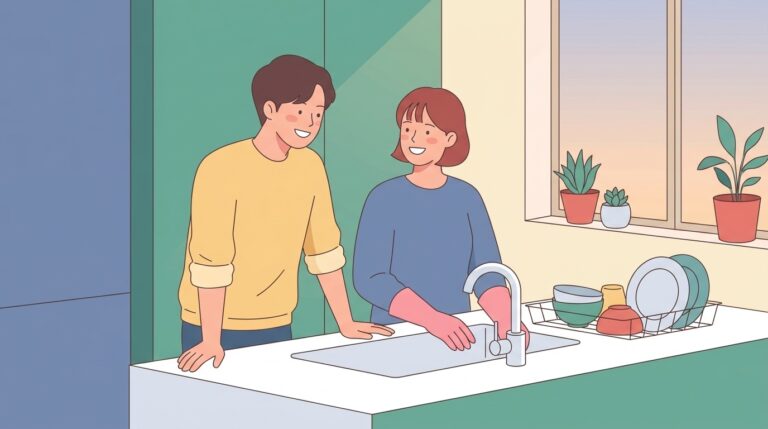
Phase 1: 공감 (The Awkward Kitchen Dilemma)
안녕하세요! 매일한글 에디터입니다.
Picture this classic K-Drama scene: You’re sitting on the heated wooden floor of your Korean friend’s cozy apartment. You’ve just polished off a steaming bowl of homemade Kimchi-jjigae, a golden scallion pancake (pajeon), and a dozen side dishes. Your stomach is blissfully full, and your friend is already smiling, brewing barley tea. But then, you spot it: the kitchen sink. A vibrant tower of red-tinted bowls, chopsticks, and pans is staring right back at you.
Suddenly, your inner guest-radar alarms start blaring. Should I sit here quietly like royalty? Will I look entitled if I don’t move? But wait, if I jump in and start scrubbing, am I violating their private kitchen sanctuary?
If you’ve ever felt this distinct post-dinner paralysis, you are definitely not alone! One of our intermediate students, Sarah from Chicago, told us: “My Korean mother-in-law literally blocked the sink with her body like a secret service agent when I offered to wash the dishes. I had no idea whether I should fight back playfully or just retreat to the sofa!”
In Korean culture, offering to do the dishes (설거지, seolgeoji) after being treated to a meal isn’t just about clean plates; it is a delicate dance of showing gratitude, demonstrating nunchi (눈치, situational wit), and returning jeong (정, warm affection). Today, we’re leveling up your Korean from textbook politeness to natural, witty insider expressions so you know exactly how to insist on doing the dishes without causing awkward kitchen traffic jams!
Phase 2: 핵심 표현 3선 심층 분석 (3 Core Expressions)
1. 제가 설거지할게요! (Jega seolgeoji-halgeyo!)
- Pronunciation: [Je-ga seol-geo-ji-hal-ge-yo] (Think: “Je” like ‘gem’ without ‘m’, “seol” like ‘sole’, “geo” like ‘gull’ without ‘ll’, “ji” like ‘jeep’ without ‘p’, “hal-ge-yo”)
- Meaning: “I will do the dishes!”
- Literal vs. Actual Nuance: Literally “I will do dishwashing.” In real life, it’s the standard, enthusiastic opening salvo of dinner cleanup diplomacy. It shows you’re proactive and don’t take your host’s labor for granted.
- K-Culture Moment: Seen in almost every variety show like Three Meals a Day (삼시세끼) when a guest finishes eating and immediately rolls up their sleeves to earn their keep.
- Editor’s Insight: The grammar ending
-(으)ㄹ게요indicates a promise or an offer made in response to the immediate situation. It sounds infinitely warmer and more collaborative than-(으)ㄹ 거예요. - Situation Spectrum: Casual (⚠️ – use
내가 할게), Semi-formal (✅ – perfect for peers, friends’ parents), Formal (⚠️ – use제가 설거지하겠습니다in ultra-formal settings). - 🤔 Think About It: In Western dinner parties, guests often ask “Can I help with anything?” In Korea, specific offers like washing dishes carry much more sincerity than vague open-ended questions.
2. 밥 맛있게 먹었으니까 뒷정리는 제가 할게요. (Bap mas-itge meogeosseunikka dwitjeongnineun jega halgeyo.)
- Pronunciation: [Bap ma-sit-ge meo-geo-sseu-ni-kka dwit-jeong-ni-neun je-ga hal-ge-yo] (Notice the sound change: 뒷정리 is pronounced as [뒫쩡니 -> 뒨쩡니 / dwin-jeong-ni])
- Meaning: “Since I ate such a delicious meal, I’ll take care of the clean-up.”
- Literal vs. Actual Nuance: Literally, “Because rice was eaten deliciously, back-organizing I will do.” Nuance: A balanced social contract! It frames your chore not as a burden, but as a direct, delighted reward for the host’s cooking.
- K-Culture Moment: The heartwarming scene in Hospital Playlist where the friends barter cooking duties versus cleanup duties around the meal table.
- Editor’s Insight:
뒷정리(dwitjeongni) means wrapping up, clearing the table, and restoring order after an event. It covers more than just dishes—it includes wiping the table and packing leftovers. - Situation Spectrum: Casual (✅ – swap
제가to내가), Semi-formal (✅ – the golden standard), Formal (✅). - 🤔 Think About It: Notice the causal connective
-으니까(since/because). How does framing clean-up as a direct consequence of gratitude change the emotional tone?
3. 아이 참, 가만히 계세요! 제가 금방 뚝딱 해놓을게요. (Ai cham, gamanhi gyeseyo! Jega geumbang ttukttak haenokeulgeyo.)
- Pronunciation: [A-i cham, ga-man-hi gye-se-yo! Je-ga geum-bang ttuk-ttak hae-no-eul-ge-yo]
- Meaning: “Oh come on, please just stay put! I’ll knock this out in no time.”
- Literal vs. Actual Nuance: Literally, “Oh my, exist quietly! I will quickly, snap-snap, have it done.” Nuance: An affectionate, slightly playful pushback when your host protests and tells you to relax.
- K-Culture Moment: Typical motherly or close-friend banter where physical affection is communicated through mock exasperation (
아이 참!). - Editor’s Insight:
뚝딱(ttukttak) is an onomatopoeia describing completing a task effortlessly and rapidly, like magic. - Situation Spectrum: Casual (✅), Semi-formal (✅ – with close seniors or friendly in-laws), Formal (🚫 – too playful for strict business associates).
- 🤔 Think About It: Why does mock scolding (
가만히 계세요!) feel warm rather than rude in Korean domestic spaces?
Phase 3: 교과서 한국어 vs 진짜 한국어 (Textbook vs. Real Korean)
Scenario 1: When stepping up to the sink right after the meal
- 📖 교과서 한국어 (Textbook): 제가 식기를 세척하겠습니다. (Jega sikgireul secheok-hagetseumnida. / “I shall clean the tableware.”)
- 🗣️ 진짜 한국어 (Real-Life): 설거지는 제 몫이에요! (Seolgeojineun je moksieyo! / “The dishes are my job!”)
- 💡 왜 다를까? Nobody uses Sino-Korean medical or industrial vocabulary like
세척(washing/sterilizing) at home unless you’re an automated dishwasher! Real Koreans use the concept of몫(share/duty) to assert good manners in a lively, friendly tone.
Scenario 2: When the host tries to shoo you away
- 📖 교과서 한국어 (Textbook): 거절하지 마십시오. 제가 하겠습니다. (Geojeolhaji masipsio. Jega hagetseumnida. / “Do not refuse. I will do it.”)
- 🗣️ 진짜 한국어 (Real-Life): 에이, 저 다음에도 또 놀러 오려면 이거 꼭 해야 돼요! (Ei, jeo daeumedo tto nolleo oryeomyeon igeo kkok haeya dwaeyo! / “Come on, if I want to get invited back next time, I totally have to do this!”)
- 💡 왜 다를까? Koreans rarely issue direct commands like “Do not refuse.” Instead, they use humor—jokingly implying that being a bad guest would get them barred from future parties—to overcome the host’s polite protests.
Phase 4: K-Culture 딥다이브 & 비언어적 매너 (Deep Dive & Etiquette)
4-1. 눈치 (Nunchi) & The Physical Etiquette
In Korea, doing the dishes involves a scripted three-step cultural dance:
1. The First Refusal: When you stand up and say 제가 설거지할게요!, 99% of Korean hosts will instinctively wave their hands and say: “아니에요, 손님이 왜 해요! 편하게 계세요!” (No way, why would a guest do it? Just relax!). Do not sit down immediately! Taking the first refusal literally can make you appear passive.
2. The Sleeve Roll (소매 걷기): Actions speak louder than words. While smiling, roll up your sweater sleeves and start stacking small plates or carrying bowls toward the sink. This non-verbal cue signals: “I’m not just offering out of empty courtesy; I’m genuinely ready.”
3. Reading the Sink Sanctuary: Watch the host’s body language closely. If they gently push you back into the living room saying “진짜 괜찮아요, 과일 깎아 놓을 테니 TV 보고 계세요” (Really it’s okay, I’ll peel fruit, go watch TV), accept the gesture graciously! Korean kitchens can feel intensely private, and some hosts genuinely dislike others seeing their drying racks or messy sponges.
4-2. Cultural Code: 대접 (Hospitality) vs. 품앗이 (Mutual Reciprocity)
Traditional Korean dining is anchored in Daejeop (대접)—treating a guest with royal generosity. A good host will feed you until you can barely walk. However, an enlightened guest counters this with Pumasi (품앗이)—the ancient tradition of sharing domestic labor. By insisting on washing the dishes, you relieve your host from feeling like a servant, transforming a one-sided favor into a warm communal friendship.
Phase 5: 실전 롤플레이 시나리오 (Roleplay Scenario)
Setting: Minjun’s (민준) cozy apartment in Mapo-gu after a generous Dak-bokkeum-tang (spicy braised chicken) dinner. You (Alex) and Minjun are finishing the last sips of tea.
- Turn 1 (Alex): 와, 민준 씨, 진짜 배부르게 잘 먹었어요! 오늘 요리 최고였어요.
(Wa, Minjun ssi, jinjja baebureuge jal meogeosseoyo! Oneul yori choegoyeosseoyo. / “Wow, Minjun, I ate so well! Today’s cooking was top-tier.”)
🎭 [배를 두드리며 만족스러운 미소를 짓는다 / Pats stomach with a satisfied smile] -
Turn 2 (Minjun): 입에 맞았다니 다행이에요! 더 드실 줄 알았는데 아쉽네요.
(Ibe majatdani dahaeng-ieyo! Deo deushil jul aranneunde aswimneyo. / “I’m so glad it suited your taste! I thought you’d eat even more.”)
🎭 [흐뭇하게 웃으며 빈 반찬 그릇을 정리한다 / Smiles warmly while gathering empty side-dish plates] -
Turn 3 (Alex): 밥 맛있게 먹었으니까 뒷정리는 제가 할게요! 여기 두고 잠깐 앉아 계세요.
(Bap mas-itge meogeosseunikka dwitjeongnineun jega halgeyo! Yeogi dugo jamkkan anja gyeseyo. / “Since I had such a delicious meal, cleanup is mine! Leave it here and take a seat.”)
🎭 [자연스럽게 일어나 소매를 걷어붙인다 / Naturally stands up and rolls up sleeves] -
Turn 4 (Minjun): 에이, 알렉스 씨! 무슨 소리예요. 손님한테 설거지를 어떻게 시켜요!
(Ei, Alex ssi! Museun soriyeyo. Sonnimhante seolgeojireul eotteoke sikyeoyo! / “Come on, Alex! What are you talking about? How could I make a guest wash dishes!”)
🎭 [깜짝 놀라며 알렉스의 팔을 살짝 말린다 / Surprised, gently touches Alex's arm to stop them] -
Turn 5 (Alex): 아이 참, 가만히 계세요. 민준 씨 요리하느라 고생하셨잖아요.
(Ai cham, gamanhi gyeseyo. Minjun ssi yorihaneura gosaenghasyeotjanayo. / “Oh come on, please sit back. You worked so hard cooking, Minjun.”)
🎭 [고무장갑을 향해 손을 뻗으며 장난스레 웃는다 / Reaches toward the rubber gloves with a playful grin] -
Turn 6 (Minjun): 아이구, 정 그러시면… 진짜 딱 그릇만 물에 헹궈 주실래요? 나머진 제가 할게요!
(Aigu, jeong geureosimyeon… jinjja ttak geureutman mure henggwo jusillaeyo? Nameojin jega halgeyo! / “Oh dear, if you insist… could you just rinse the plates with water? I’ll do the rest!”)
🎭 [못 이기는 척 고무장갑 한 짝을 건넨다 / Gives in reluctantly, handing over one rubber glove] -
Turn 7 (Alex): 좋아요! 그럼 제가 물로 쓱 헹궈 놓을 테니, 민준 씨는 소화 좀 시키고 계세요.
(Joayo! Geureom jega mullo sseuk henggwo noheul teni, Minjun ssineun sohwa jom sikigo gyeseyo. / “Deal! I’ll rinse them down, so you go sit back and digest.”)
🎭 [익숙하게 물을 틀며 그릇을 모은다 / Confidently turns on the tap and rounds up the bowls] -
Turn 8 (Minjun): 고마워요, 알렉스 씨. 덕분에 진짜 든든하네요!
(Gomawoyo, Alex ssi. Deokbune jinjja deundeunhaneyo! / “Thank you, Alex. Having you here is such a great relief!”)
🎭 [안도하며 소파에 편하게 기댄다 / Relaxes back onto the sofa with genuine relief]
🔀 인라인 브랜치 인터랙션 (Interactive Decision Point)
At Turn 4, Minjun vigorously blocks your path to the sink. How do you respond?
- Choice A: “알겠어요, 그럼 안 할게요.” (Okay, then I won’t do it.) and sit right back down.
- 👉 Feedback (Risk): You accepted the very first rejection! While not a social sin, Minjun might inwardly wonder if your offer was merely performative. Try pushing back at least once!
- Choice B: “에이, 민준 씨 혼자 고생하게 둘 순 없죠! 저 설거지 엄청 잘해요.” (Come on, I can’t let you struggle alone! I’m amazing at doing dishes.)
- 👉 Feedback (Best!): Perfect blend of humor and affectionate stubbornness. It lightens the mood while proving genuine willingness.
- Choice C: Push Minjun aside physically and turn on the hot water forcefully without speaking.
- 👉 Feedback (Bad): Yikes! Invading personal kitchen boundaries without playful verbal banter can make your host feel deeply uncomfortable about their private domestic space.
Phase 6: 10초 감정 섀도잉 드릴 (Shadowing Drill)
Practice matching the rhythm, breath, and exact emotional posture! The slash mark / represents a natural micro-pause.
- [😊 밝고 싹싹하게 / Bright and energetic]
밥 맛있게 먹었으니까 / 뒷정리는 / 제가 싹 할게요!
(Bap mas-itge meogeosseunikka / dwitjeongnineun / jega ssak halgeyo!) -
[🥺 애교 섞인 단호함 / Playfully firm and teasing]
아이 참, / 가만히 좀 계세요! / 저 다음에도 / 또 밥 먹으러 와야 한단 말이에요.
(Ai cham, / gamanhi jom gyeseyo! / Jeo daeumedo / tto bap meogeureo waya handan marieyo.) -
[🤝 융통성 있게 제안하며 / Compromising warmly]
그러면 / 제가 물로 헹궈만 놓을게요, / 쉬고 계세요!
(Geureomyeon / jega mullo henggwoman noheulgeyo, / swigo gyeseyo!)
Phase 7: K-Culture 미니 사전 (Mini Dictionary)
-
뒷정리 (Dwitjeongni)
- Meaning: Post-event cleanup / clearing up.
- Real-world usage: Used whenever wrapping up meals, party rooms, or work projects. Example: “뒷정리 같이 하자!” (Let’s clean up together!).
- 고무장갑 (Gomujang-gap)
- Meaning: Korean pink/red heavy-duty rubber dishwashing gloves.
- Real-world usage: The universal symbol of Korean domestic labor. Grabbing the pink rubber gloves is the iconic non-verbal declaration that you mean serious cleaning business!
- 대접하다 (Daejeopada)
- Meaning: To treat or host someone with dedicated care and food.
- Real-world usage: Expresses honor. When visiting a Korean friend’s home, they take pride in having daejeop-ed you nicely.
- 설거지옥 (Seolgeoji-ok)
- Meaning: “Dishwashing Hell” (Blend of 설거지 + 지옥/hell).
- Real-world usage: Colloquial slang used when stacks of barbecue pans and soup pots pile up mountain-high after Chuseok or house parties.
Phase 8: 여행자를 위한 생존 키트 (Survival Kit)
Top 3 Survival Phrases
- 제가 그릇 모아 둘게요! (Jega geureut moa dulgeyo!)
- Meaning: “I’ll at least gather the dishes together!”
- Pro Tip: If the host strictly refuses to let you wash dishes, this is the ultimate polite compromise. Gather plates by size and wipe down stray crumbs.
- 진짜 잘 먹었습니다! (Jinjja jal meogeotseumnida!)
- Meaning: “I truly ate well!”
- Pro Tip: Say this with a deep bow before and after offering to clean.
- 행주 어디 있어요? (Haengju eodi isseoyo?)
- Meaning: “Where is the dishcloth / table rag?”
- Pro Tip: Asking for the
행주to wipe the table signals that you know your way around a Korean dining table.
Editor’s Travel Note
When heading to a Korean friend’s home for a housewarming (집들이, jipdeuri), never show up empty-handed! It’s customary to bring toilet paper (wishing their fortune unrolls smoothly) or laundry detergent (wishing bubbles of wealth). You can easily arrange nearby cafe desserts or gift sets on the go using the 네이버 지도 앱 다운로드 to find local bakeries on your walking route. Always remember to take off your shoes facing toward the door at the entryway (hyeon-gwan)!
Phase 9: “한 발 더 깊이” (Cultural Insights)
In many Western cultures, a guest’s comfort is defined by passive relaxation: you are invited to sit back, enjoy your wine, and let the host run the show. However, Korean domestic culture operates on dynamic intimacy. The kitchen is often considered the emotional heart of a Korean household, and lingering too rigidly in the guest chair can subtly enforce an emotional barrier. By playfully stepping up to the sink, you are saying: “We are not stiff business acquaintances; we share warmth, informal comfort, and life together.”
💬 Your Turn: In your home country, is it considered polite or intrusive to walk into a host’s kitchen and start cleaning dishes after dinner? Share your culture’s unwritten rules in the comments below!
Phase 10: FAQ & 오해 방지 (FAQ)
Q: What should I do if the host gets visibly agitated when I touch the dishes?
A: Stop immediately and apologize with a friendly smile! Simply say: "아, 실례가 되었다면 죄송해요! 너무 맛있게 먹어서 뭐라도 돕고 싶었어요." (A, sillyega doeotdamyeon joesonghaeyo! Neomu mas-itge meogeoseo mworado dopgo sipeosseoyo. / Oh, sorry if I overstepped! It was just so delicious I wanted to help out somehow.)
Q: Does this cleanup rule apply when dining out at Korean restaurants?
A: Absolutely not! In Korean restaurants, never clear your plates or carry them to the commercial kitchen. That is the restaurant staff’s workplace, and doing so can disrupt their workflow. Simply stack empty dishes neatly at the edge of your table if you want to be extra considerate.
Q: Can I offer to wash dishes if the host is a much older Korean elder (e.g., friend’s grandmother)?
A: Yes, but your phrasing must shift to higher honorifics: "할머니, 제가 씻어 놓겠습니다!" (Halmeoni, jega ssiseo noket-seumnida!). They will likely swat you away fondly, at which point you should smoothly transition to peeling fruit or pouring tea.
🚨 흔한 실수 (Common Mistakes) 경고판
| Mistake | Why It Fails | Correct Action |
|---|---|---|
| 1. Throwing leftover food down the sink drain | Korea strictly sorts Food Waste (음식물 쓰레기). Bones, shells, and large scraps belong in separate bins! | Ask: "음식물 어디에 버릴까요?" (Where should I throw the food waste?) |
| 2. Using bathroom towels to dry dishes | In Korea, dishcloths (행주) and hand towels have strictly designated zones. | Always look for the dedicated dish rack or ask for the 행주 (haengju). |
| 3. Giving up after one polite “No” | Leaving after the host’s first polite refusal can come off as slightly insincere or formal. | Insist warmly at least twice before yielding to their hospitality! |
Phase 11: 액션 미션 & 참여 유도 (Action Missions)
- 🥉 Bronze Mission (Solo Shadowing): Stand in front of your own kitchen sink right now. Put on your imaginary pink rubber gloves, and repeat Phase 6’s line 2 out loud three times with maximum drama: “아이 참, 가만히 계세요! 제가 다 할게요!”
- 🥈 Silver Mission (SNS Sentence Share): Post a photo of your latest home meal or favorite Korean dish on Instagram or Threads. Caption it with:
밥 맛있게 먹었으니까 뒷정리는 제가 할게요! 🍽️and tag@DailyHangul. - 🥇 Gold Mission (Real-Life Deployment): Next time you visit a Korean home or share a shared kitchen with Korean roommates, successfully engage in the “Two-Push Dishwashing Tango” and report back in our community forum!
- 🎮 K-Culture Mission: Watch an episode of tvN’s reality show Unexpected Business (어쩌다 사장) or Youn’s Stay (윤스테이). Spot who gets assigned dishwashing duty and observe how they negotiate the chores!
Phase 12: 인터랙티브 퀴즈 챌린지 (Interactive Quiz)
1. 상황 판단 퀴즈 (Situational Judgement)
You just finished a hearty Korean dinner at your colleague’s home. The host starts gathering plates. Which response represents top-tier B1 Korean etiquette and tone?
* A) 가만히 앉아 휴대폰을 보며 휘파람을 분다. (Sit still looking at phone and whistling.)
* B) “제가 그릇을 세척하는 기계가 되겠습니다.” (I shall become a machine that washes tableware.)
* C) “밥 진짜 맛있게 먹었어요! 뒷정리는 제가 싹 해놓을 테니 쉬고 계세요.” (I ate so well! I’ll clean up completely, so take a break.)
🔍 정답 및 해설 확인하기 (Click to reveal answer)
정답: C
* 해설: C strikes the ideal balance between authentic gratitude (밥 진짜 맛있게 먹었어요), proactive responsibility (뒷정리는 제가), and natural conversational vocabulary (싹 해놓을게요). A is impolite, and B is bizarre textbook grammar!
2. 빈칸 채우기 (Fill in the Blank)
Complete the sentence using the friendly onomatopoeia meaning “done in a flash”:
“아이 참, 여기 계세요! 제가 10분 만에 [ ] 끝내 놓을게요!”
🔍 정답 및 해설 확인하기 (Click to reveal answer)
정답: 뚝딱 (ttukttak)
* 해설: 뚝딱 describes knocking something out quickly and effortlessly without making a fuss. “제가 10분 만에 뚝딱 끝내 놓을게요!” sounds like a true native speaker.
3. 문화 O/X 퀴즈 (True or False)
In Korea, when a host says “아니에요, 손님인데 편하게 계세요!” on your first offer, good manners dictate that you should immediately sit down and drop the subject.
🔍 정답 및 해설 확인하기 (Click to reveal answer)
정답: X (False)
* 해설: The first rejection is almost always habitual social politeness (chaerye or chemyon). You should pleasantly insist at least once or twice to show genuine heart before finally accepting their pampering!







