

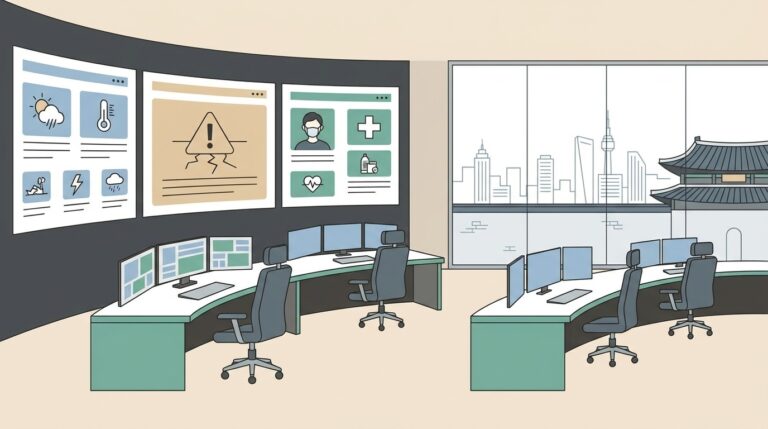
Phase 1: Empathy & Immersive Opening
안녕하세요! 매일한글 에디터입니다.
Imagine sitting in a high-floor boardroom in central Seoul during a tense strategy meeting. Suddenly, every smartphone on the table vibrates in unison with that piercing, unmistakable sound of the 긴급재난문자 (emergency disaster text alert). In a split second, the atmosphere shifts from quarterly KPIs to collective civic mobilization. If you have watched high-stakes K-dramas like Happiness or crisis thrillers such as The Flu, you know that South Korea’s public health infrastructure functions with surgical precision and rapid administrative shifts. But when you are operating at an executive, legal, or diplomatic level in Korea, handling disaster safety is not merely about understanding simple warnings like “wear a mask” or “stay home.” You are expected to interpret high-level bureaucratic notices, evaluate the four-tier alert framework (관심 → 주의 → 경계 → 심각), and audit company protocols against municipal executive orders in flawless, authoritative Korean.
Many of our advanced C2 learners—including legal counsels, NGO directors, and regional corporate leads—confide that while they can comfortably debate Korean philosophy or literature, navigating the stringent, socio-legal jargon of South Korea’s 감염병예방법 (Infectious Disease Control and Prevention Act) during a fluid emergency leaves them second-guessing their communication. This masterclass is designed to eliminate that gap. Built upon real-world administrative manuals and verified insider corporate protocols, this guide empowers you to command Korean crisis containment discourse with utmost fluency, institutional authority, and cultural tact.
Phase 2: Deep Dive into 3 Core Expressions
1. 감염병 위기경보를 ‘심각’ 단계로 격상하다 (Gamyeombyeong wigi-gyeongboreul ‘simgak’ danggyero gyeoksanghada)
- Pronunciation: [Gam-yeom-byeong wi-gi-gyeong-bo-reul sim-gak dang-gye-ro gyeok-sang-ha-da] (Think of gyeoksang as “ge-ok-sang”, sharp and resolute, like striking a decisive gavel).
- Meaning: Literally “To elevate the infectious disease crisis alert to the ‘Serious’ level.” Nuance: Signifies the activation of supreme inter-agency emergency powers, triggering nationwide centralized command under the Prime Minister or Central Disaster and Safety Countermeasures Headquarters.
- K-Culture Moment: In political-disaster dramas, this is the pivotal moment where the Central Disaster Headquarters takes over civil administration, mobilizing the police and civil defense corps.
- Editor’s Insight: Korea utilizes a four-tier alert system: 관심 (Blue – Concern) → 주의 (Yellow – Caution) → 경계 (Orange – Alert) → 심각 (Red – Serious). Using the verb ‘격상하다’ (elevate/upgrade rank) instead of the generic ‘올리다’ immediately establishes an administrative, C2-level register.
- Situation Spectrum: Casual: 🚫 | Semi-formal: ⚠️ | Formal: ✅
- 🤔 Think About It: Why does Korean administrative language use Sino-Korean terms like 격상 (格上) and 격하 (格下) instead of pure Korean verbs when calibrating institutional alert levels?
2. 역학조사에 비협조 시 구상권을 청구하다 (Yeokhagjosaye bihyeopjo si gusang-gwoneul cheong-guhada)
- Pronunciation: [Yeok-hak-jo-sa-e bi-hyeop-jo si gu-sang-gwo-neul cheong-gu-ha-da] (Pronounce gusang-gwon cleanly with a crisp ‘g’ sound, conveying legal weight).
- Meaning: Literally “To claim the right to indemnification/reimbursement in the event of non-cooperation with epidemiological investigations.”
- K-Culture Moment: Frequently seen in news broadcasts and legal dramas when authorities hold individuals or organizations financially accountable for virus containment costs incurred due to concealment of movement logs.
- Editor’s Insight: 구상권 (right of indemnification) is a potent civil-law instrument heavily utilized during national emergencies in South Korea to hold negligent actors civilly liable for state expenditures (treatment costs, quarantine mobilization, diagnostic testing).
- Situation Spectrum: Casual: 🚫 | Semi-formal: ⚠️ | Formal: ✅
- 🤔 Think About It: How does the threat of state-led civil indemnity reflect the Korean societal balance between individual civil liberty and communal survival?
3. 방역 수칙 위반에 따른 무관용 원칙을 적용하다 (Bang-yeok suchik wibane ttareun mugwanyon wonchigeul jeok-yonghada)
- Pronunciation: [Bang-yeok su-chik wi-ba-ne tta-reun mu-gwan-yong won-chi-geul jeok-yong-ha-da] (Flow naturally: mu-gwan-yong rhymes loosely with the cadence of “who-can-long”).
- Meaning: Literally “To apply the zero-tolerance principle toward violations of quarantine rules.” Nuance: Implies immediate legal sanctions, administrative closure, or penal indictment without preliminary warnings or lenient dispensations.
- K-Culture Moment: Declared by municipal mayors and safety chiefs in high-stakes ministerial press briefings when cluster infections threaten metropolitan density.
- Editor’s Insight: ‘무관용’ (Zero tolerance / No leniency) coupled with ‘엄정 대응’ (stern countermeasure) forms the linguistic backbone of South Korean official administrative deterrence.
- Situation Spectrum: Casual: 🚫 | Semi-formal: ⚠️ | Formal: ✅
- 🤔 Think About It: In Western legal contexts, warnings often precede penalties; why does Korean administrative discourse emphasize public moral censure and instantaneous ‘zero tolerance’ during crises?
Phase 3: Textbook Korean vs. Real Korean
Situation 1: Internal Corporate Crisis Announcement
- 📖 교과서 한국어 (Textbook Korean): “상황이 안 좋으니 회사 매뉴얼을 잘 따라 주십시오.” (Sanghwangi an joeuni hoesa maenyueoreul jal ttara jusipsio. / “The situation is not good, so please follow the company manual well.”)
- 🗣️ 진짜 한국어 (Real Native C2): “정부의 ‘심각’ 단계 격상에 발맞추어, 당사 비상대응 매뉴얼에 의거한 재택근무 및 필수 인력 교대 체제를 즉각 가동해 주시기 바랍니다.” (Jeongbuui ‘simgak’ danggye gyeoksange balmatchueo, dangsa bisangdaeeung maenyueore uigeohan jaetaekgeunmu mit pilsu illyeok gyodae chejereul jeukgak gadonghae jusigi baramnida. / “In lockstep with the government’s elevation to the ‘Serious’ alert level, please immediately activate the work-from-home protocol and essential-personnel rotation system pursuant to our corporate contingency manual.”)
- 💡 왜 다를까? (Why the difference?): Executive Korean prioritizes administrative justification (정부 방침에 발맞추어), legal foundation (매뉴얼에 의거한), and prompt organizational posture (즉각 가동).
Situation 2: Issuing Compliance Directives to Clients or Visitors
- 📖 교과서 한국어 (Textbook Korean): “규칙을 안 지키면 건물에 들어올 수 없습니다.” (Gyuchigeul an jikimyeon geonmure deureool su eopseumnida. / “If you do not follow the rules, you cannot enter the building.”)
- 🗣️ 진짜 한국어 (Real Native C2): “원내 감염 확산 방지를 위한 행정명령에 따라, 출입 명부 미작성 및 발열 확인 거부 시 시설 출입이 엄격히 제한될 수 있음을 양해 바랍니다.” (Wonnae gamyeom hwaksan bangjireul wihan haengjeongmyeongnyeonge ttara, churip myeongbu mijakseong mit balyeol hwagin geobu si siseol churibi eomgyeokhi jehandoel su isseumeul yanghae baramnida. / “Pursuant to the administrative order aimed at preventing intra-facility spread, please understand that access will be strictly restricted upon failure to log entry or refusal of thermographic screening.”)
- 💡 왜 다를까? (Why the difference?): Rather than issuing personal ultimatums, professional institutions deflect confrontational friction onto external administrative authority (행정명령에 따라) accompanied by formal honorific deference (양해 바랍니다).
Phase 4: K-Culture Deep Dive & Non-verbal Manners
4-1. 눈치 (Nunchi) & Crisis Decorum
In South Korean organizational culture, crisis response is an exercise in heightened collective 눈치 (situational awareness). When a disaster alert level escalates, overt dissent or casually questioning preventative measures is perceived as a major breach of communal solidarity. When conducting briefings or inspecting manual compliance:
* Demeanor: Maintain a subdued, serious vocal register. Smiling, dismissive shrugs, or unprompted levity in an emergency briefing are interpreted as professional negligence (기강 해이).
* Physical Protocol: When sanitizing, scanning QR codes, or having your temperature checked at checkpoints, bow slightly (목례) to show institutional respect toward the civil response staff.
4-2. Cultural Code: The Mechanics of “K-방역” (K-Quarantine)
South Korea’s disaster safety apparatus relies on high-context civic trust coupled with state-of-the-art administrative intervention. During national health crises, the concept of 공동체 의식 (communal consciousness) often supersedes individual inconvenience. Smartphone geo-alerts, dynamic routing transparency, and rigorous manual compliance are widely viewed not as state intrusion, but as reciprocal collective protection. Navigating this environment at a C2 level means acknowledging that public safety manuals are treated as non-negotiable social contracts.
Phase 5: Real-life Roleplay Scenario
Setting: A high-level emergency executive committee meeting at a foreign multinational enterprise’s Seoul branch in Jongno. The Ministry of Health and Welfare has just elevated the crisis alert to the highest tier.
Characters:
* 민 부국장 (Vice Director Min): Veteran Head of the Emergency Response Task Force.
* You: Senior Operations & Legal Director.
민 부국장: 방금 중대본에서 감염병 위기경보를 ‘심각’ 단계로 격상했습니다. 당사 매뉴얼 점검 현황은 어떻습니까? (Banggeum jungdaeboneseo gamyeombyeong wigi-gyeongboreul ‘simgak’ danggyero gyeoksanghaessseumnida. Dangsa maenyueol jeomgeom hyeonhwangeun eotteosseumnikka?)
🎭 [Holding an urgent government briefing memorandum, looking gravely at you over his glasses]
“The Central Disaster Headquarters has just raised the crisis alert to the ‘Serious’ stage. What is the current status of our manual review?”
You: 네, 부국장님. 비상대응 매뉴얼 4단계 프로토콜에 따라 선제적 방역 조치 사항을 전수 점검 완료했습니다. (Ne, bugukjangnim. Bisangdaeeung maenyueol sadangye peurotokore ttara seonjejeok bang-yeok jochi sahang-eul jeonsu jeomgeom wanryohaessseumnida.)
🎭 [Firm, poised, opening the crisis operational dossier without hesitation]
“Yes, Vice Director Min. In accordance with Tier 4 protocols of our emergency manual, we have completed a full audit of preemptive quarantine measures.”
민 부국장: 현장 사업장과 본사 간의 비상 연락망 가동 및 역학조사 협조 체계는 빈틈없이 구축되었나요? (Hyeonjang saeopjanggwa bonsa ganui bisang yeollangmang gadong mit yeokhagjosa hyeopjo chegyeneun binteumeopsi guchukdoeeonnayo?)
🎭 [Leaning forward, tapping the table with an ink pen to emphasize urgency]
“Have the emergency contact network between on-site plants and HQ, as well as the epidemiological cooperation framework, been established without loopholes?”
You: 각 거점별 총괄 책임자를 지정하여 일일 모니터링 체계를 확립했고, 보건 당국과의 핫라인을 상시 개방해 두었습니다. (Gak geojeombyeol chonggwal chaegimjareul jijeonghayeo iril moniteoring chegyereul hwangnibhaetgo, bogeon danggukgwaui hatraineul sangsi gaebanghae dueossseumnida.)
🎭 [Presenting the organizational emergency tree directly onto the digital conference screen]
“We designated designated incident commanders for each operational hub, established daily monitoring, and maintained an active 24/7 hotline with public health authorities.”
민 부국장: 만일 사내 밀접 접촉자가 발생할 경우, 자가격리 행정명령 이행을 위한 사후 대책은 마련되어 있습니까? (Manil sanae miljeop jeopchokjaga balsaenghal gyeong-u, jagagyeongni haengjeongmyeongnyeong ihaeng-eul wihan sahu daechaegeun maryeondoeeo isseumnikka?)
🎭 [Crossing his arms, testing your contingency preparedness under worst-case parameters]
“If a close contact emerges inside the company, do we have follow-up measures in place to execute self-quarantine administrative orders?”
You: 의심 증상자 격리 공간을 즉시 확보하고, 대체 인력 투입 및 원격 근무 전환 프로토콜을 즉시 가동하도록 조치했습니다. (Uisim jeungsangja gyeongni gongganeul jeuksi hwakbohago, daeche illyeok tuip mit wongyeok geunmu jeonhwan peurotokoreul jeuksi gadonghadorok jochihaessseumnida.)
🎭 [Maintaining steady eye contact, demonstrating complete command over operational resilience]
“We have designated temporary isolation spaces and prepared protocols to immediately deploy backup personnel and trigger remote operations.”
민 부국장: 훌륭합니다. 방역 수칙 위반 시 무관용 원칙을 적용한다는 공지도 전 임직원에게 명확히 전달해 주십시오. (Hullyunghamnida. Bang-yeok suchik wiban si mugwanyon wonchigeul jeok-yonghandaneun gongjido jeon imjigwonege myeonghwakhi jeondalhae jusipsio.)
🎭 [Nodding with visible relief, signing off on the proposed operational directive]
“Excellent. Please also ensure that the directive enforcing zero tolerance for quarantine infractions is unequivocally communicated to all executives and staff.”
You: 즉시 전사 공문을 발송하고, 감염병 위기 단계별 매뉴얼 이행 실태를 상시 점검하겠습니다. (Jeuksi jeonsa gongmuneul balsonghago, gamyeombyeong wigi danggyebyeol maenyueol ihaeng siltaereul sangsi jeomgeomhaegessseumnida.)
🎭 [Bow smoothly, gathering documents with an air of prompt executive execution]
“I will dispatch the company-wide official notice immediately and maintain continuous oversight over the manual’s execution across all tiers.”
🔀 Interactive Decision Branch
What should you say if Vice Director Min asks whether non-regular subcontracted workers on the factory floor are covered under the same emergency safety manual?
- Option A: “파견업체 관할이므로 당사 매뉴얼 적용 대상에서 제외됩니다.” (It is under the dispatch agency’s jurisdiction, so they are excluded from our manual.)
- Option B: “원·하청 공동 대응 지침을 수립하여 매뉴얼 적용 범위를 전면 확대하고 일괄 방역 물품을 지급하겠습니다.” (We will establish a joint prime-subcontractor guideline, broaden the manual’s scope completely, and supply uniform quarantine materials.)
- Option C: “상황을 지켜보고 확진자가 발생하면 그때 가서 고려해 보겠습니다.” (Let’s monitor the situation and consider it later if a confirmed case occurs.)
Feedback:
* Option A (Risk): Fails South Korea’s Serious Accidents Punishment Act (중대재해처벌법) standard, risking legal liability and public relations catastrophe.
* Option B (Best): Demonstrates flawless corporate governance, understanding that modern Korean administrative crisis standards mandate comprehensive contractor safety inclusivity.
* Option C (Bad): Shows passive negligence (소극 행정), strictly violating proactive emergency crisis paradigms.
Phase 6: 10-Second Emotional Shadowing Drill
Practice these high-stakes crisis sentences aloud. Follow the intonation slashes (/) and embody the bracketed emotional cues.
[🚨 긴박하고 단호하게 - Urgent & Decisive]
“정부의 위기경보 격상에 발맞추어 / 전사 비상대응 체계를 / 즉각 가동해 주시기 바랍니다.”
(Jeongbuui wigi-gyeongbo gyeoksange balmatchueo / jeonsa bisangdaeeung chegyereul / jeukgak gadonghae jusigi baramnida.)-
[🛡️ 엄중하고 타협 없이 - Solemn & Non-compromising]
“방역 수칙 위반 시 / 예외 없는 무관용 원칙을 적용하여 / 엄정 조치할 방침입니다.”
(Bang-yeok suchik wiban si / ye-oe eomneun mugwanyon wonchigeul jeok-yonghayeo / eomjeong jochihal bangchimimnida.) -
[📊 객관적이고 절제된 어조로 - Objective & Restrained]
“역학조사관의 동선 확인 요구 시 / 일체의 은폐 없이 / 신속히 협조 체계를 구축하십시오.”
(Yeokhagjosagwanui dongseon hwagin yogu si / ilcheui eunpye eopsi / sinsokhi hyeopjo chegyereul guchukhasipsio.)
Phase 7: K-Culture Mini Dictionary (4 Key Terms)
- 중대본 (Jungdaebon / Central Disaster and Safety Countermeasures Headquarters)
- Formal: 중앙재난안전대책본부. The ultimate executive crisis response body convened during “심각” (Serious) alerts in Korea, chaired directly by the Prime Minister.
- 역학조사관 (Yeokhagjosagwan / Epidemiological Intelligence Officer)
- Licensed public health officers authorized under the Infectious Disease Control Act to audit CCTV footage, transaction logs, and location coordinates during contact tracing.
- 선제적 격리 (Seonjejeok Gyeongni / Preemptive Quarantine)
- Proactively quarantining suspected individuals or cohort facilities before diagnostic test confirmation to curb latent viral reproduction.
- 비상소집 (Bisangsojip / Emergency Mobilization Roll Call)
- Mandatory executive muster of designated personnel to corporate or public defense headquarters outside normal operating hours during national emergencies.
Phase 8: Survival Kit for Travelers & Expats
Top 3 Crisis Survival Expressions
- “선별진료소 위치와 운영 시간을 확인해 주시겠습니까?” (Seonbyeoljinryoso wichiwa un-yeong siganeul hwaginhae jusigessseumnikka?)
- Pro Tip: Use this to locate dedicated municipal walk-in triage screening clinics.
- “자가격리 대상자 통지서를 수령하여 재택 격리 중입니다.” (Jagagyeongni daesangja tongjiseoreul suryeonghayeo jaetaek gyeongni jung-imnida.)
- Pro Tip: Standard phrase to declare administrative quarantine status to immigration, employers, or building security.
- “외국인 전용 감염병 상담 핫라인(1339) 연결을 요청합니다.” (Oegugin jeon-yong gamyeombyeong sangdam hatrain [il-sam-sam-gu] yeongyeoreul yocheonghamnida.)
- Pro Tip: 1339 is the Korea Disease Control and Prevention Agency (KDCA) call center, offering multi-lingual crisis navigation.
Editor’s Travel Note
Always keep the official Korean civil disaster portal installed on your smartphone: 안전디딤돌 재난안전 앱 다운로드 provides immediate push notifications for local emergency alerts with English UI settings. To find nearby official triage stations and operational medical facilities, use 네이버 지도 감염병 선별진료소 확인 and search for ‘선별진료소’ or ‘국민안심병원’.
Phase 9: “A Step Deeper” (Cultural Reflection)
In Korean jurisprudence and administrative philosophy, public safety is inherently viewed through the prism of 상호 연대성 (mutual solidarity) and 공공복리 (public welfare). While Anglo-American legal paradigms often center strictly on individual autonomy, Korean constitutional framework (Article 37, Clause 2) readily authorizes the temporary curtailment of individual liberties when necessary for national security or communal maintenance. This cultural-legal dynamic explains why compliance with disaster safety manuals is not treated merely as corporate risk mitigation, but as an acute test of moral citizenship. When you speak fluent crisis Korean, you demonstrate not just linguistic skill, but deep philosophical alignment with South Korea’s collective social contract.
💬 Your Turn: In your home country, does disaster response emphasize centralized governmental mandates or decentralized individual discretion? How would you translate your local crisis protocols into high-register Korean? Share your thoughts below!
Phase 10: FAQ & Avoiding Misconceptions
Q: What is the exact administrative difference between “경계” and “심각” stages?
A: In the 경계 (Alert/Orange) stage, the Ministry of Health and Welfare acts as the central hub managing domestic community transmission. Once upgraded to 심각 (Serious/Red), the national crisis apparatus scales up to an all-government mobilization headed directly by the Prime Minister via the Central Disaster and Safety Countermeasures Headquarters (중대본).
Q: Can a company legally enforce “무관용 원칙” regarding health check compliance?
A: Yes. Under Article 49 of the Infectious Disease Control and Prevention Act, businesses are bound by municipal administrative orders. Corporate directives requiring employee compliance during an active alert are legally defensible under workplace occupational safety duties.
Q: What does “역학조사 방해죄” entail?
A: Deliberate concealment of movement logs, falsifying entry records, or destroying surveillance evidence during an active contact tracing audit constitutes an indictable offense punishable by imprisonment or heavy statutory fines under Korean law.
🚨 Common Mistakes Warning Board
- Mistake 1: Translating “manual check” as “수동 점검” (manual vs. automatic).
- Correct Action: Use 매뉴얼 점검 (manual review/audit) or 대응 지침 점검 (guideline inspection).
- Mistake 2: Using informal “격리해요” in legal or corporate compliance documentation.
- Correct Action: Use formal nominalizations such as 자가격리 조치 (self-quarantine measure) or 시설 격리 처분 (facility isolation administrative disposition).
- Mistake 3: Confusing “구상권 청구” (civil recovery of state costs) with “손해배상 청구” (general tort damages).
- Correct Action: In pandemic containment contexts, specifically employ 구상권 (Right to indemnity) when referring to recouping public medical/tracing costs.
Phase 11: Action Missions
- 🥉 Bronze Mission: Practice reading Phase 6’s 3 emotional shadowing sentences aloud with precise pauses (
/) in front of a mirror until you can deliver them without looking at the romanization. - 🥈 Silver Mission: Write a 3-sentence internal emergency memo in C2 Korean announcing an internal safety audit, using the terms 격상, 매뉴얼 점검, and 무관용 원칙.
- 🥇 Gold Mission: Watch a live Korean governmental briefing (e.g., KTV 국민방송 or 질병관리청 official YouTube) and transcribe three crisis-management terms used by the government spokesperson.
- 🎮 K-Culture Mission: Watch Episode 1 of the drama Happiness or the movie Deranged (연가시) and listen for how public officials announce crisis escalation tiers (위기경보 단계).
Phase 12: Interactive Quiz Challenge
Test your C2 mastery of Korean disaster safety management.
1. Situation Judgment
A foreign subcontractor working at your Incheon logistics plant refuses to provide transit logs during an on-site epidemiological investigation. Which Korean statement represents the most legally accurate and professional response?
* (A) “그냥 집에 가시고 나중에 경찰 오면 얘기하세요.”
* (B) “역학조사 거부 시 감염병예방법에 의거하여 고발 조치 및 구상권 청구 대상이 될 수 있음을 고지합니다.”
* (C) “우리는 상관없으니 보건소와 직접 싸우십시오.”
2. Fill-in-the-Blank
“정부는 감염병 확산세가 지속됨에 따라 위기경보를 최고 수준인 [ ] 단계로 [ ]하기로 결정했습니다.”
* Hint: Think of the 4th tier (Red) and the elevated Sino-Korean verb for “upgrade”.
3. True or False Cultural Quiz
- (T/F): In Korea, when a corporation applies the “무관용 원칙” to quarantine violations, it is seen as an excessively authoritarian violation of labor harmony rather than standard risk management.
👉 Click here to reveal Answers and Explanations
- Answer: (B)
- Explanation: Option B cleanly cites the statutory basis (감염병예방법에 의거하여), warns of penal consequence (고발 조치), and explicitly specifies civil indemnity liabilities (구상권 청구 대상), reflecting quintessential C2 administrative competence.
- Answer: ‘심각’ / 격상
- Explanation: The four tiers culminate in 심각 (Serious), and the correct institutional verb for elevating an alert status is 격상(格上)하다.
- Answer: False
- Explanation: Quite the opposite. During severe health crises, the strict application of zero tolerance (무관용 원칙) is widely commended by the public, unions, and municipal bodies as vital institutional accountability ensuring collective survival.
- Explanation: Quite the opposite. During severe health crises, the strict application of zero tolerance (무관용 원칙) is widely commended by the public, unions, and municipal bodies as vital institutional accountability ensuring collective survival.







