

Phase 1: Empathy (스토리 몰입형 오프닝)
안녕하세요! 매일한글 에디터입니다.
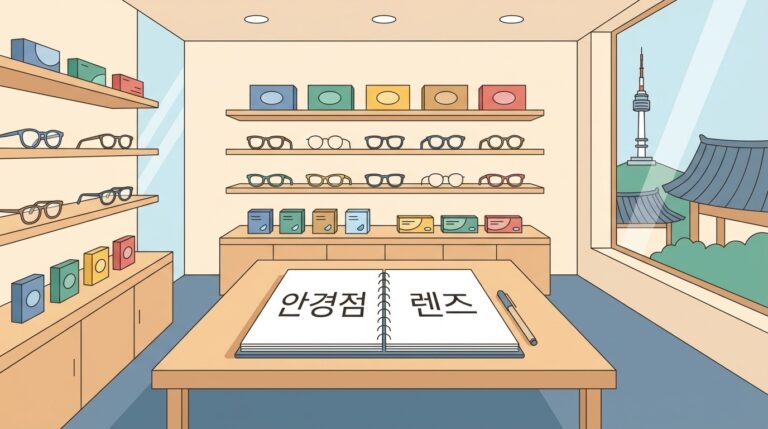
Imagine this: You have just arrived in Seoul. Tomorrow morning, you are headed to a vibrant K-pop festival in Hongdae or exploring the historic alleys of Bukchon Hanok Village. But as you take out your contact lenses at the hotel, one rips in half! Or worse, you realize you left your entire supply back home on your desk. Panic sets in as you look out your window. You see signs everywhere with eye icons and glasses, known locally as an 안경점 (angyeongjeom – optical shop), but your heart starts racing: “Do I need a doctor’s medical prescription here? How do I say daily lenses in Korean? What if they ask me my prescription numbers in Korean?”
Take a deep breath, my friend! I have been navigating Korean culture and guiding travelers for over ten years, and I can tell you a wonderful secret: buying contact lenses in South Korea is faster, smoother, and friendlier than almost anywhere else in the world. You do not need to book an expensive clinic visit, and you do not need fluent Korean. With just a handful of authentic phrases tailored for beginners (A1 level), you can walk into any lens shop, get your eyes checked for free on the spot, and walk out looking like your favorite K-pop star in under ten minutes. Let us dive in together!
Phase 2: 핵심 표현 3선 심층 분석
1. 렌즈 주세요 (Ren-jeu ju-se-yo)
- Pronunciation: Ren-jeu ju-se-yo (Pronounce it like “Ren-zoo” + “Jew-say-yo”)
- Meaning: Literal: “Lenses, please give” vs. Actual Nuance: “I would like to buy contact lenses, please.”
- K-Culture Moment: You will hear this everywhere from trendy specialty shops like O-Lens in Myeongdong to neighborhood optical stores when customers want quick service without overcomplicating their order.
- Editor’s Insight: In Korean, the word contact is dropped in casual daily speech. Everyone simply says 렌즈 (ren-jeu). Adding 주세요 (ju-se-yo) makes the request instantly polite and friendly without needing complex grammar.
- Situation Spectrum: Casual (⚠️ – with close friends say ‘렌즈 줘’), Semi-formal (✅), Formal (✅)
- 🤔 Think About It: Why does Korean drop the pronoun “I” in this sentence? In Korean culture, shared context is everything. Because you are standing at the counter, the listener already knows who needs the lenses!
2. 원데이 있어요? (Won-de-i iss-eo-yo?)
- Pronunciation: Won-de-i iss-eo-yo? (Sounds like the English words “One day” + “Eess-uh-yo?”)
- Meaning: Literal: “One-day exists?” vs. Actual Nuance: “Do you have daily disposable lenses?”
- K-Culture Moment: Seen in travel vlogs where adventurers pack light and grab disposable packs for weekend getaways to Busan or Jeju Island.
- Editor’s Insight: Koreans use “Konglish” (Korean-style English) for lens types! Daily lenses are called 원데이 (won-de-i), while monthly lenses are called 한달용 (han-dal-yong). If you want standard daily lenses, this three-word sentence is your golden ticket.
- Situation Spectrum: Casual (⚠️), Semi-formal (✅), Formal (✅)
- 🤔 Think About It: Konglish words like 원데이 show how Korean seamlessly adopts foreign loanwords to create fast, intuitive communication.
3. 시력 검사할 수 있어요? (Si-ryeok geom-sa-hal su iss-eo-yo?)
- Pronunciation: Si-ryeok geom-sa-hal su iss-eo-yo? (Sounds like “See-ryuck gum-sah-hahl soo eess-uh-yo?”)
- Meaning: Literal: “Is eyesight test possible?” vs. Actual Nuance: “Can I get an eye exam here?”
- K-Culture Moment: Classic K-Drama makeover scenes where a character visits a sleek optician, sits before a futuristic machine, and receives new colored contacts that transform their look.
- Editor’s Insight: Unlike many countries where eye tests require an appointment at an eye clinic, Korean optical shops have licensed optometrists and high-tech auto-refractors in-store. The test is almost always free if you purchase lenses or glasses!
- Situation Spectrum: Casual (🚫), Semi-formal (✅), Formal (✅)
- 🤔 Think About It: What does free, instant eye testing say about South Korea’s fast-paced service culture (Ppalli-ppalli)?
Phase 3: 교과서 한국어 vs 진짜 한국어
Situation 1: Letting the staff know you want to browse lenses
- 📖 교과서 한국어: 콘택트렌즈를 구입하고 싶습니다. (Kontaekteurenjeureul gu-ip-ha-go sip-seum-ni-da.) – “I wish to purchase contact lenses.”
- 🗣️ 진짜 한국어: 렌즈 좀 보려고 하는데요. (Ren-jeu jom bo-ryeo-go ha-neun-de-yo.) – “I am just looking to check out some lenses.”
- 💡 왜 다를까?: The textbook phrase sounds like a formal written business contract. Real Koreans soften their approach with 좀 (jom, “a little / just”) and end with -는데요 (neun-de-yo), which politely invites the shopkeeper to assist without being demanding.
Situation 2: Asking for the total price
- 📖 교과서 한국어: 이것의 가격은 얼마입니까? (I-geot-ui ga-gyeog-eun eol-ma-im-ni-ka?) – “What is the price of this item?”
- 🗣️ 진짜 한국어: 이거 얼마예요? (I-geo eol-ma-ye-yo?) – “How much is this?”
- 💡 왜 다를까?: Spoken Korean naturally contracts pronouns (이것의 becomes 이거), and the polite informal ending -예요 (-ye-yo) is the natural standard for daily retail interactions.
Phase 4: K-Culture 딥다이브 & 비언어적 매너
4-1. 눈치 (Nunchi) & Gestures in the Optical Shop
When entering an optical shop, give a gentle nod and a 15-degree bow as you say hello. If you have an existing lens box or a picture of your prescription on your phone, hold your phone with both hands when presenting it to the optician. In Korea, offering items with both hands communicates respect and attentiveness (Nunchi). When pointing to display cases, avoid pointing with an aggressive single finger; instead, gesture smoothly with an open palm or a gentle index finger pointing downward.
4-2. Cultural Code: The K-Beauty Colored Lens Boom
In South Korea, contact lenses are not just medical devices—they are quintessential K-Beauty accessories! K-pop idols from groups like NewJeans, IVE, and BTS wear subtle “circle lenses” (써클렌즈) that naturally enlarge the iris or tint the eye with warm hazel, olive, or cool gray tones. Dedicated chain stores such as O-Lens, Lens Town, and Hapa Kristin line every major shopping district. Even if your eyesight is 20/20, you can ask for 도수 없는 렌즈 (do-su eop-neun ren-jeu – zero-prescription cosmetic lenses) to experience this iconic K-pop beauty routine!
Phase 5: 실전 롤플레이 시나리오
- Setting: A bright, modern optical shop in Hongdae, Seoul.
- Characters:
- Alex: A beginner traveler whose lenses tore during the flight.
- Min-woo: A cheerful Korean optician wearing a neat apron and stylish frames.
- Alex: 안녕하세요! 렌즈 좀 보려고 하는데요. (Annyeonghaseyo! Renjeu jom boryeogo haneundeyo.)
🎭 [Bows slightly with a polite smile]
“Hello! I would like to look at some contact lenses.” -
Min-woo: 어서 오세요! 어떤 렌즈 찾으세요? (Eoseo oseyo! Eotteon renjeu chajeuseyo?)
🎭 [Steps out from behind the counter to greet Alex]
“Welcome! What kind of lenses are you looking for?” -
Alex: 원데이 렌즈 있어요? (Wondei renjeu isseoyo?)
🎭 [Points gently toward the disposable lens section]
“Do you have daily disposable lenses?” -
Min-woo: 네, 투명이랑 컬러 렌즈 다 있어요. 도수 아세요? (Ne, tumyeong-irang keolleo renjeu da isseoyo. Dosu aseyo?)
🎭 [Takes out a tray showing different lens packs]
“Yes, we have both clear and colored lenses. Do you know your prescription?” -
Alex: 잘 몰라요. 시력 검사할 수 있어요? (Jal mollayo. Siryeok geomsahal su isseoyo?)
🎭 [Tilts head apologetically, holding hands together in front]
“I am not sure. Can I get an eye exam here?” -
Min-woo: 그럼요! 바로 무료로 검사해 드릴게요. 이쪽으로 오세요. (Geureomyo! Baro muryoro geomsa-hae deurilgeyo. Ijjogeuro oseyo.)
🎭 [Gestures warmly toward the digital examination room]
“Of course! We will test your eyes right now for free. Please come this way.” -
Alex: 와, 정말 감사해요! (Wa, jeongmal gamsahaeyo!)
🎭 [Expresses relief and smiles brightly]
“Wow, thank you so much!” -
Min-woo: 편하게 앉으세요! (Pyeonhage anjeuseyo!)
🎭 [Pulls out the stool in front of the testing machine]
“Please take a comfortable seat!”
🔀 인터랙티브 분기점 (Interactive Branch)
Situation: Min-woo asks you: “도수 아세요? (Do you know your prescription?)” How do you respond?
- Choice A: “네, 마이너스 2.5예요.” (Ne, maineoseu i-jeom-o-ye-yo.)
Feedback: Best Choice! Clear, accurate, and uses the standard Korean way to state negative diopters (마이너스 = minus). - Choice B: “몰라! 그냥 렌즈 줘!” (Molla! Geunyang renjeu jwo!)
Feedback: Bad Choice! Drops honorifics and sounds aggressive. The staff will be shocked by the sudden impoliteness. - Choice C: “제 안경 보여드릴게요.” (Je angyeong boyeodeurilgeyo.)
Feedback: Risk / Safe Alternative! If you do not remember numbers, hand over your regular glasses. They have a machine that reads the exact power in five seconds!
Phase 6: 10초 감정 섀도잉 드릴
Practice matching your voice and body language to these emotional pause marks (/):
[😊 Bright and Courteous]
안녕하세요! / 렌즈 좀 / 보려고 하는데요.
(Annyeonghaseyo! / Renjeu jom / boryeogo haneundeyo.)-
[🤔 Curious and Inquiring]
원데이 렌즈 / 있어요?
(Wondei renjeu / isseoyo?) -
[🥺 Polite and Slightly Shy]
도수를 모르는데, / 시력 검사 / 할 수 있어요?
(Dosureul moreuneunde, / siryeok geomsa / hal su isseoyo?) -
[🥰 Relieved and Grateful]
와, / 정말 / 감사해요!
(Wa, / jeongmal / gamsahaeyo!)
Phase 7: K-Culture 미니 사전 (핵심 키워드 4개)
-
도수 (Do-su)
Translation: Optical prescription strength / Diopter power.
Real-life usage: In Korea, 도수 also means alcohol percentage in drinks! But at an optician, it refers strictly to lens power. Say 도수 있는 것 (with vision correction) or 도수 없는 것 (zero-power for aesthetics). -
원데이 (Won-de-i)
Translation: Daily disposable contact lens.
Real-life usage: The go-to phrase for travelers wanting hygiene and zero maintenance while on vacation. -
투명 렌즈 (Tu-myeong ren-jeu)
Translation: Clear / Transparent lenses.
Real-life usage: Use this when you do not want cosmetic colored lenses and prefer standard, invisible vision correction. -
컬러 렌즈 (Keol-leo ren-jeu)
Translation: Colored cosmetic lenses.
Real-life usage: Popular across all ages in Korea. Staff will present a catalog with photos of lenses worn on natural eyes so you can pick your preferred shade.
Phase 8: 여행자를 위한 생존 키트
Top 3 Survival Phrases
- 샘플 볼 수 있어요? (Saempeul bol su isseoyo?)
“Can I see a sample?”
Pro Tip: Optical shops have silicone eye models where they place colored lenses so you can see how natural they look before buying. - 보존액도 주세요 (Bo-jon-aek-do ju-se-yo)
“Please give me contact lens solution too.”
Pro Tip: If 보존액 is hard to remember, simply ask for “리뉴 주세요” (Rinyu juseyo – Renu, please), as brand names are widely understood. - 계산해 주세요 (Gye-san-hae ju-se-yo)
“Check out, please / I’d like to pay.”
Pro Tip: Present your payment card with both hands to end your shopping on a high cultural note.
Editor’s Travel Note
Always search for nearby opticians using the 네이버 지도 앱 다운로드 instead of Google Maps, which has limited transit and storefront mapping in Korea. Big, reputable national chains include 다비치안경 (Davich Optical) and specialized lens boutiques like 오렌즈 (O-Lens). Most accept major international credit cards without issue.
Phase 9: “한 발 더 깊이” (생각 질문)
In many Western nations, optometry is strictly divided between medical doctor visits and commercial retail stores. In Korea, opticians operate at the intersection of high medical precision, retail convenience, and beauty culture. The ability to receive a computerized corneal test within minutes without an advance appointment reflects the broader Korean social value of 효율성 (Efficiency) and client-centered hospitality. Eye care is democratized and accessible right on the street corner.
💬 Your Turn: In your home country, how complicated is it to get a new pair of contact lenses? Would you enjoy the Korean speed-walk-in experience? Share your thoughts in the comments below!
Phase 10: FAQ & 오해 방지 (FAQ Schema)
Q: Do I need to bring an official medical prescription from my eye doctor back home?
A: No, you do not need an official medical letter. Korean opticians are fully licensed to measure your eyesight in-store using automated refractometers and eye charts immediately.
Q: Can I buy colored circle lenses if I have perfect eyesight?
A: Absolutely! Just ask for 도수 없는 렌즈 (do-su eop-neun ren-jeu). These are non-corrective cosmetic lenses designed purely for beauty and fashion.
Q: Are eye tests really free at Korean optical shops?
A: Yes, if you are purchasing contact lenses or eyeglasses at that store, the eye exam is universally complimentary as part of their customer service.
🚨 흔한 실수 (Common Mistakes) 경고판
- Mistake: Handing the optician a handwritten paper slip from your home country doctor in complex medical abbreviations.
Correct Action: Hand over your current glasses or let them give you a 2-minute digital eye test right in the shop. - Mistake: Saying “Contact” alone instead of “렌즈” (Ren-jeu).
Correct Action: Locals rarely use the word ‘contact’ alone; always say 렌즈 (ren-jeu). - Mistake: Paying or receiving your shopping bag with one hand while looking away.
Correct Action: Use two hands to pass your credit card and make gentle eye contact with a warm nod.
Phase 11: 액션 미션 & 참여 유도
- 🥉 Bronze Mission (Solo Drill): Look into your mirror and practice saying “원데이 렌즈 있어요?” three times with a natural smile.
- 🥈 Silver Mission (Social Share): Save this post and share your favorite Korean lens style on Instagram or TikTok using the hashtag
#DailyHangulLenses. - 🥇 Gold Mission (Real Life Action): Next time you step into an optical shop in Korea, walk right to the counter, skip English, and say: “안녕하세요! 렌즈 좀 보려고 하는데요.”
- 🎮 K-Culture Mission: Watch a video of your favorite K-pop bias performing on stage. Can you spot the color of their circle lenses?
Phase 12: 인터랙티브 퀴즈 챌린지
Q1. [Situation Check] You walk into a lens shop in Myeongdong and want to ask if they sell daily disposable lenses. What should you say?
* A) 안경 주세요 (Angyeong juseyo)
* B) 원데이 있어요? (Wondei isseoyo?)
* C) 시력 검사 싫어요 (Siryeok geomsa sileoyo)
👉 Click to reveal Answer & Explanation
Correct Answer: B) 원데이 있어요? (Wondei isseoyo?)
Explanation: Option A asks for glasses (안경), and Option C means “I dislike eye tests.” Option B is the natural and accurate way to ask for daily disposables!
Q2. [Fill in the Blank] Fill in the missing word to politely request lenses:
“렌즈 ________.” (Please give me lenses.)
👉 Click to reveal Answer & Explanation
Correct Answer: 주세요 (ju-se-yo)
Explanation: 주세요 (ju-se-yo) is the magic polite phrase in Korean meaning “Please give me.”
Q3. [True / False Cultural Quiz] In South Korea, you must visit a separate hospital clinic to get a signed doctor’s prescription before you can buy contact lenses.
* True
* False
👉 Click to reveal Answer & Explanation
Correct Answer: False
Explanation: Licensed opticians in Korean optical shops can test your eyesight on the spot for free with purchase—no separate hospital clinic prescription required!






