

Phase 1: Empathy (Story Immersion Opening)
안녕하세요! 매일한글 에디터입니다. (Hello! This is your Daily Hangul editor.)
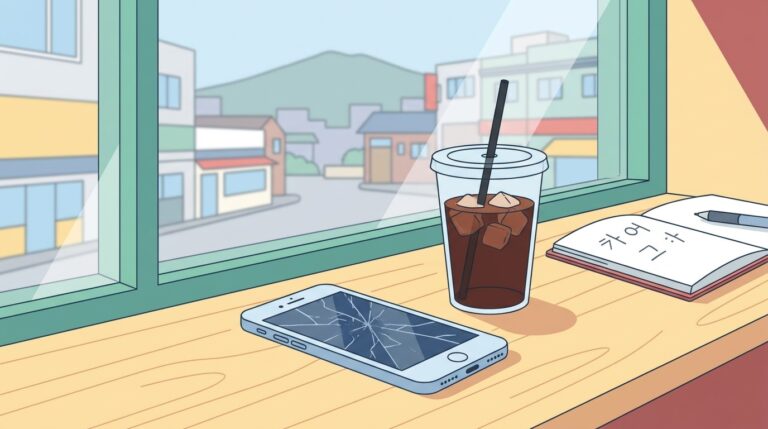
Picture this: You are having the most cinematic Seoul moment of your life. You’re walking past the glittering LED billboards of Gangnam, holding an iced Americano in one hand, filming an Instagram reel with the other. Suddenly, someone hurries past you to catch the green light—bump! Your phone flies through the crisp night air, landing face-down on the granite pavement with a stomach-dropping crunch. You turn it over, hoping for a miracle, but all you see is a spiderweb mosaic across your screen. To make matters worse, you can’t read your KakaoMap or flash your mobile subway pass.
The next morning, you rush into an official customer service center (서비스 센터). You show the phone to the technician behind the sleek counter, holding your breath. He taps his keyboard, hands you a quote slip, and says a number that makes your jaw hit the floor: repair fees that rival a weekend flight to Jeju Island!
Experiencing a broken smartphone in a hyper-connected country like South Korea can feel like losing your life support system. But freeze-ups happen not just because your screen is dead, but because explaining hardware problems in another language is terrifying. Based on real feedback from dozens of intermediate learners living in Korea, we built this survival guide so you can tackle tech disasters smoothly, discuss the repair bill with confidence, and never let high repair costs catch you off guard again!
Phase 2: Core 3 Expressions In-Depth
1. 액정이 산산조각 났어요 (Aekjeong-i sansanjogak nasseoyo)
- Pronunciation: [Aek-jeong-i san-san-jo-gak na-sseo-yo] (Sounds like “eck-jung-ee sahn-sahn-jo-gahk nah-ssuh-yo”)
- Meaning: Literal: “The display/LCD has shattered into pieces.” | Nuance: “My screen is totally smashed/spiderwebbed to bits.”
- K-Culture Moment: Seen in nearly every modern K-Drama when a character drops their phone in pure shock upon discovering an earth-shattering secret.
- Editor’s Insight: 액정 (aekjeong) specifically refers to the display/glass panel. Combining it with 산산조각 (sansanjogak), an expressive mimetic-like noun meaning “in tiny broken shards,” vividly conveys that it didn’t just scratch—it was obliterated.
- Situation Spectrum: Casual: ✅ | Semi-formal: ✅ | Formal: ⚠️ (In very formal situations, 액정 파손이 심합니다 is preferred)
- 🤔 Think About It: Notice how Korean uses 나다 (to emerge/come about) here instead of “I broke it.” How does shifting focus away from personal blame change the emotional feel of reporting an accident?
2. 수리비가 너무 많이 나왔어요 (Suribiga neomu mani nawasseoyo)
- Pronunciation: [Su-ri-bi-ga neo-mu ma-ni na-wa-sseo-yo] (Sounds like “soo-ree-bee-gah nuh-moo mah-nee nah-wah-ssuh-yo”)
- Meaning: Literal: “The repair fee came out too much.” | Nuance: “The repair bill is ridiculously high / came out way more than expected.”
- K-Culture Moment: You’ll hear university students in Sinchon sitting at a cafe, showing their receipt to a friend with a dramatic pout and sighing this exact line.
- Editor’s Insight: In Korean, billing amounts “come out” (나오다 – naoda). Saying 비싸요 (it’s expensive) sounds like an evaluation of a price tag, whereas 많이 나왔어요 emphasizes the shocking realization of the final tally.
- Situation Spectrum: Casual: ✅ | Semi-formal: ✅ | Formal: ✅
- 🤔 Think About It: Why do you think bills “come out” (나오다) in Korean? Does your native language treat bills as things that emerge independently rather than something people charge you?
3. 배보다 배꼽이 더 커요 (Baeboda baekkobi deo keoyo)
- Pronunciation: [Bae-bo-da bae-kko-bi deo keo-yo] (Sounds like “bae-boh-dah bae-kkoh-bee duh kuh-yoh”)
- Meaning: Literal: “The belly button is bigger than the belly.” | Nuance: “The secondary expense costs more than the main item! / The tail is wagging the dog.”
- K-Culture Moment: Used by variety show hosts on Running Man whenever the cost of fixing or maintaining something exceeds the value of buying a brand-new device.
- Editor’s Insight: This classic Korean proverb is the gold standard for expressing disbelief when an older phone’s screen repair quote equals 80% of what the phone is worth second-hand. Drop this at the counter with a wry smile, and the technician will recognize your real Korean fluency!
- Situation Spectrum: Casual: ✅ | Semi-formal: ✅ | Formal: ⚠️
- 🤔 Think About It: What body part or imagery does your home culture use to describe incidental costs ballooning past the primary item?
Phase 3: Textbook vs. Real Korean
Situation 1: Explaining your screen has stopped working
- 📖 교과서 한국어 (Textbook): 스마트폰 화면이 파손되어 작동하지 않습니다. (Seumateupon hwamyeoni pason-doeeo jakdonghaji antheumnida. / The smartphone screen is damaged and does not operate.)
- 🗣️ 진짜 한국어 (Real-Life Native): 액정이 완전히 나가서 터치가 안 먹혀요. (Aekjeongi wanjeonhi nagaseo teochiga an meokhyeoyo. / The screen completely gave out and touch inputs aren’t responding at all.)
- 💡 왜 다를까?: Textbook Korean relies on rigid Sino-Korean vocabulary (파손, 작동). Real Koreans casually say hardware “went out” (나갔다) and touch responsiveness “eats / is digested” (먹히다).
Situation 2: Reacting to an astronomical repair estimate
- 📖 교과서 한국어 (Textbook): 수리 비용이 예상보다 매우 비쌉니다. (Suri biyongi yesangboda maeu bissamnida. / The repair cost is significantly more expensive than expected.)
- 🗣️ 진짜 한국어 (Real-Life Native): 수리비 폭탄 맞았어요! 차라리 새로 사는 게 낫겠어요. (Suribi poktan majasseoyo! Charari saero saneun ge natgesseoyo. / I got hit with a repair fee bomb! I might as well just buy a new phone.)
- 💡 왜 다를까?: In everyday conversation, Koreans love high-energy metaphors like 폭탄 맞다 (to get hit with a bomb) when expenses, bills, or taxes shoot through the roof.
Phase 4: K-Culture Deep Dive & Non-verbal Manners
4-1. 눈치 (Nunchi) & Tech Counter Manners
When you step into an official Korean service center (A/S 센터), efficiency is king.
* Two-Handed Delivery: When presenting your broken device to the engineer (기사님 – gisanim), hold the phone with both hands or rest your left hand gently under your right forearm. This demonstrates respect and mutual seriousness.
* The Empathetic Bow: Service technicians in Korea are famous for exceptional politeness. Even if the quote breaks your heart, reacting with aggressive gestures or pointing fingers will ruin the room’s energy (눈치). Instead, lean back slightly, let out a soft sigh, and gently touch your chest or forehead. They will often check if any promotional discounts, refurbished glass panels, or trade-in perks apply.
4-2. The Korean “A/S” & Insurance Culture
South Korea practically runs at light speed (빨리빨리), and nowhere is this truer than in after-sales support (A/S – After Service). If you crack an iPhone or Galaxy screen, you don’t send it away for two weeks; you sit in a café-like waiting lounge with free Wi-Fi and complimentary barley tea, and they fix it within 40 minutes.
However, because hardware parts are expensive, nearly all Korean 20-somethings subscribe to carrier device insurance (파손보험 – pason boheom). When locals exclaim “수리비 폭탄 맞았다!” on social media, friends immediately ask: “보험 들어놨어?” (Did you have insurance?). If you live in Korea as an expat or exchange student, signing up for this insurance when activating your Korean SIM can save you hundreds of thousands of won!
Phase 5: Real Roleplay Scenario
Setting: A modern, sunlit tech service center in Gangnam. Minho, a courteous technician in a neat navy polo shirt, inspects your cracked smartphone.
- 민호 (Technician): 어서 오세요 고객님. 어떤 문제로 오셨나요?
(Eoseo oseyo gogaeknim. Eotteon munjero osyeonnayo?)
“Welcome, customer. What issue brings you in today?”
🎭 [He bows politely at a 30-degree angle and gestures toward the inspection mat] -
나 (Learner): 계단에서 떨어뜨려서 액정이 산산조각 났어요.
(Gyedan-eseo tteoreotteuryeoseo aekjeongi sansanjogak nasseoyo.)
“I dropped it down the stairs and the screen completely shattered.”
🎭 [Places the phone onto the mat with two hands, looking apologetic] -
민호 (Technician): 아이고, 충격이 꽤 컸네요. 화면 터치는 작동하시나요?
(Aigo, chunggyeogi kkwae keonneyo. Hwamyeon teochineun jakdonghasinayo?)
“Oh dear, that was quite an impact. Does the touch screen still work?”
🎭 [Picks up the device gently using lint-free gloves] -
나 (Learner): 아니요, 아예 터치가 안 먹혀요. 내부 화면도 깜빡거려요.
(Aniyo, aye teochiga an meokhyeoyo. Naebu hwamyeondo kkamppakgeoryeoyo.)
“No, touch doesn’t work at all. The inner display is flickering too.”
🎭 [Points cautiously at the black ink spot on the glass] -
민호 (Technician): 확인해 보니 메인보드는 괜찮은데, 액정 모듈을 통째로 교체하셔야 합니다. 수리비는 32만 원 정도 나올 것 같습니다.
(Hwaginhae boni meinbodeuneun gwaenchaneunde, aekjeong modyureul tongjjaero gyocehasyeoya hamnida. Suribineun samsip-iman-won jeongdo naol geot gatseumnida.)
“Looking at it, the motherboard is fine, but the entire display module needs replacement. The repair fee will come out to around 320,000 KRW.”
🎭 [Prints out the estimate slip and turns the monitor toward you] -
나 (Learner): 32만 원이요? 수리비가 너무 많이 나왔네요. 배보다 배꼽이 더 커요…
(Samsip-iman-won-iyo? Suribiga neomu mani nawanneyo. Baeboda baekkobi deo keoyo…)
“320,000 won? The repair fee came out way too high. The repair costs more than the phone itself…”
🎭 [Eyes widen in disbelief while placing a hand over the chest] -
민호 (Technician): 혹시 통신사 분실파손보험이나 여행자 보험 가입되어 있으신가요? 견적서와 영수증을 챙겨드릴 수 있습니다.
(Hoksi tongsinsa bunsilpasonboheomina yeohaengja boheom gaipdoeeo isseusingayo? Gyeonjeokseowa yeongsujeungeul chaenggyeodeuril su itseumnida.)
“By any chance, are you enrolled in telecom damage insurance or travel insurance? I can prepare the estimate slip and detailed receipt for your claim.”
🎭 [Smiles reassuringly, highlighting the claim itemization with a yellow pen] -
나 (Learner): 네, 여행자 보험이 있어요! 보험 청구용 서류로 부탁드립니다.
(Ne, yeohaengja boheomi isseoyo! Boheom cheongguyong seoryuro butakdeurimnida.)
“Yes, I have travel insurance! Please issue the paperwork for insurance claims.”
🎭 [Exhales in pure relief and nods enthusiastically]
🔀 Interactive Branch Point: What will you say next?
- Choice A: “너무 비싸서 그냥 새 폰으로 바꿀게요. 취소해 주세요.” (It’s too expensive, so I’ll just change to a new phone. Please cancel.)
- Choice B: “깎아주시면 안 돼요? 현금으로 낼게요!” (Can’t you give me a discount? I’ll pay in cash!)
-
Choice C: “수리하는 데 시간은 얼마나 걸릴까요?” (How long will it take to repair?)
-
Feedback:
- Choice A (Safe Alternative): Perfectly valid! If your device is older, saying this is polite and normal. The technician will pack your phone right back up without charge.
- Choice B (Bad / Cultural Risk 🚫): Official tech centers in Korea have fixed, computerized system pricing. Asking for cash discounts here is culturally inappropriate and puts the staff in an awkward position.
- Choice C (Best Practice ⭐): Natural and practical! He will likely reply: “30분 정도 걸립니다” (It takes about 30 minutes). You can grab a coffee nearby while you wait!
Phase 6: 10-Second Emotion Shadowing Drill
Get ready to shadow these sentences aloud. Emphasize pauses at the slashes (/) and embody the matching emotion!
[😱 멘붕에 빠져서 / Shocked & Panicked]
“핸드폰을 떨어뜨렸는데 / 액정이 산산조각 났어요!”
(Haendeuponeul tteoreotteuryeonneunde / aekjeongi sansanjogak nasseoyo!)
(I dropped my phone / and the screen shattered into pieces!)-
[💸 억울하고 슬프게 / Wallet-Crying Sadness]
“수리비가 / 생각보다 너무 많이 나왔어요… / 완전 폭탄이에요.”
(Suribiga / saenggakboda neomu mani nawasseoyo… / wanjeon poktanieyo.)
(The repair fee / came out way too high compared to what I thought… / it’s a total bomb.) -
[🙏 조심스럽고 정중하게 / Hopeful & Courteous]
“혹시 / 보험 처리할 수 있게 / 수리 견적서 끊어주실 수 있나요?”
(Hoksi / boheom cheorihal su itge / suri gyeonjeokseo kkeuneojusil su innayo?)
(By any chance / so I can process insurance / could you print an official repair estimate?)
Phase 7: K-Culture Mini Dictionary
-
액정 (Aekjeong)
Literal: Liquid Crystal | Nuance: Device Screen / Display Panel
Usage: Whenever you talk about smartphones, tablets, or smartwatches, use 액정 instead of 스크린 or 화면 when discussing physical hardware breaks. Example: 액정 필름 (screen protector film). -
수리비 (Suribi)
Literal: Repair Fee | Nuance: The total labor + parts quote
Usage: Composed of 수리 (repair) + 비 (fee/expense). You will see it listed on official repair forms alongside 부품비 (parts cost) and 공임비 (technician labor cost). -
리퍼 (Lipeo)
Literal: Short for Refurbished | Nuance: Replacement unit swap
Usage: Borrowed from English “refurbished,” Apple and electronics users in Korea refer to swapping a damaged device for an official refurbished unit as 리퍼 받다 (to receive a refurb unit). -
멘붕 (Menbung)
Literal: Mental Breakdown | Nuance: Utter shock and cognitive freeze
Usage: The moment you see your cracked screen and hear the repair fee, your state of mind is 멘붕. A ubiquitous slang word used by everyone from high schoolers to office workers.
Phase 8: Traveler’s Survival Kit
Survival Phrases TOP 3
- “보험 청구서류 떼어 주세요.” (Boheom cheongguseoryu tteeo juseyo.)
Pro Tip: Use this to get both the 수리 내역서 (repair breakdown) and 영수증 (detailed tax invoice) required to claim your travel insurance when you return home. - “데이터 백업은 가능한가요?” (Deiteo baegeobeun ganeunghangayo?)
Pro Tip: If the screen is dead, ask this to verify if the technician can rescue your vacation photos before replacing the mainboard or screen module. - “임시폰 대여할 수 있나요?” (Imsipon daeyeohal su innayo?)
Pro Tip: If your phone needs a multi-day motherboard fix, ask this to borrow a temporary loaner phone from authorized customer centers.
Editor’s Travel Note
- Finding Centers Fast: Download the official KakaoMap navigation app or Naver Map navigation app and search “삼성전자서비스” (Samsung Service) or “애플 공인 서비스 센터” (Apple Authorized Service Provider). These apps display live technician queue counts!
- Payment Manners: Credit and debit cards (Visa/Mastercard/Amex) are universally accepted. There is zero need to carry cash for tech repairs in Korea.
Phase 9: “한 발 더 깊이” (Going Deeper)
In South Korea, smartphones are far more than calling gadgets; they represent an individual’s digital identity, housing everything from bank security certificates to daily public transit credentials. Because society operates at such high velocity, an inoperable phone causes severe daily disruptions. This hyper-reliance has created the world’s most rapid repair infrastructure, yet it also amplifies the sting when a heavy repair bill strikes unexpected travelers.
💬 Your Turn: Have you ever cracked your phone while traveling abroad? How did you manage to navigate the city without a screen, and what was your experience like? Share your story in the comments below!
Phase 10: FAQ & Common Mistakes
Q: Can I haggle over repair prices at official Samsung or Apple centers in Korea?
A: No, official service centers operate with nationwide standardized prices programmed into their POS systems. Bargaining is impossible. However, you can ask if they offer 재생 액정 (refurbished original screens) which are significantly cheaper than brand-new display panels.
Q: Do service center technicians speak English?
A: Centers located in major hubs like Gangnam, Hongdae, Myeongdong, or Itaewon usually have designated English-speaking desks. At local branches, technicians will gladly communicate through Papago or visual inspection sheets.
Q: Does Korean repair work void international warranties?
A: Official centers (Samsung, Apple Authorized) maintain global warranty integrity, but foreign model parts might take 2–3 business days to ship in if domestic part serial numbers differ.
🚨 Common Mistakes TOP 3
- Calling the screen “유리” (Glass) alone: While literally glass, saying 유리가 깨졌어요 sounds like you broke a drinking glass or window. Always say 액정이 깨졌어요.
- Forgetting to ask for “수리 견적서” (Repair Quote Slip): Simply keeping a credit card receipt won’t suffice for insurance reimbursement; travel insurers require an itemized parts list (견적서 or 내역서).
- Using informal speech out of frustration: Saying 왜 이렇게 비싸? (Why is it so expensive? – Banmal) will sound rude. Always maintain polite ending: 왜 이렇게 많이 나와요?
Phase 11: Action Mission & Engagement
- 🥉 Bronze Mission (Solo Practice): Stand in front of your mirror with your phone. Look dramatically at the screen and repeat “액정이 산산조각 났어요!” three times with authentic shock.
- 🥈 Silver Mission (Social Connection): Post a picture of an old cracked tech device or phone case on Instagram Stories or Threads. Caption it: “수리비가 너무 많이 나왔어요 ㅠㅠ” and tag a Korean-learning buddy!
- 🥇 Gold Mission (Real-Life Application): Next time you visit an electronics store or phone shop in Korea, casually ask the clerk about screen protector types using the word 액정 (“이 액정 필름 얼마예요?”).
🎮 K-Culture Mission: Watch an episode of a modern drama (like Queen of Tears or Crash Landing on You). Spot any moment someone drops a phone or checks a bill, and see if you catch the word 수리 or the sound of someone gasping over money!
Phase 12: Interactive Quiz Challenge
Test your intermediate smartphone survival skills below!
- Situation Judgment: You dropped your phone and the repair quote is higher than buying a decent used replacement. Which idiom fits the situation best?
- A) 그림의 떡 (Pie in the sky)
- B) 배보다 배꼽이 더 커요 (The belly button is bigger than the belly)
- C) 누워서 떡 먹기 (A piece of cake)
- Fill in the Blank:
“어제 스마트폰을 떨어뜨려서
[ ]이 완전히 깨졌어요.” -
True or False (Cultural Fact):
In Korea, you can negotiate a 10% cash discount on official smartphone display replacements if you pay directly to the technician.
👉 Click here to reveal the answers and explanations!
-
Answer: B) 배보다 배꼽이 더 커요
Explanation: This proverb perfectly captures scenarios where secondary/incidental expenses (the repair fee) exceed the value of the main item itself. -
Answer: 액정 (Aekjeong)
Explanation: 액정 is the dedicated Korean term for device screens and LCD/OLED displays. -
Answer: False (X)
Explanation: Official service centers in Korea use strictly standardized, computer-tracked inventory and pricing. Asking for cash discounts at an official counter is culturally awkward!







