

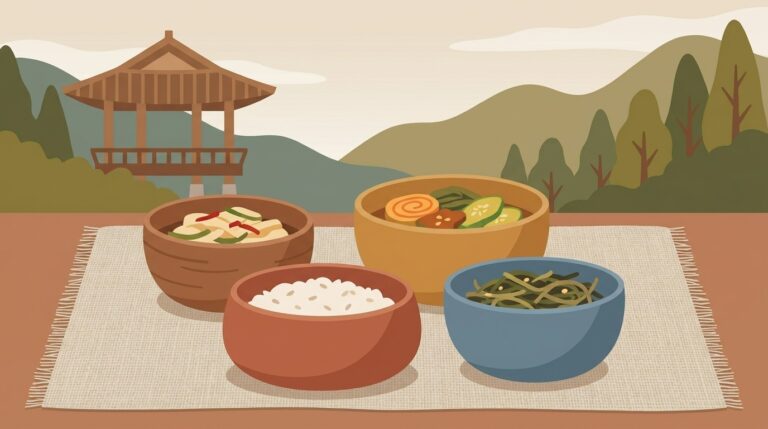
The Ultimate Korean Temple Food Guide for Mindful Vegetarians
Phase 1: Empathy (Immersive Story Opening)
안녕하세요! 매일한글 에디터입니다.
Picture this: You step into a centuries-old Buddhist temple tucked deep into the mist-covered peaks of Odaesan. The air smells of damp pine needles, wild moss, and burning sandalwood. After weeks of traversing Seoul—where trying to order vegetarian food often felt like an extreme sport involving awkward explanations of why fish sauce (aekjeot) doesn’t count as a plant—you breathe a sigh of relief. Here, in the cradle of Korean temple cuisine (sachal eumsik), you are in a plant-based paradise. But just as the bronze gong strikes for Baru Gongyang (monastic formal meal), anxiety sets in. Monks sit in absolute silence. Rows of lacquered wooden bowls line the floor. You suddenly wonder: How do I say I want a smaller portion? What if I can’t finish everything? How do I ask if there are five pungent roots (osinchae) without sounding disrespectful?
If you have ever felt paralyzed between wanting to honor traditional monastic rituals and merely surviving a meal without accidentally committing a cultural faux pas, you are not alone. As an editor who has guided dozens of intermediate learners through weekend retreats at Jogyesa and Woljeongsa, I crafted this guide to solve that exact dread. By the end of this masterclass, you will speak with the poise of an experienced Buddhist culinary explorer, navigate the temple dining hall effortlessly, and express deep appreciation for food in nuanced, culturally resonant B2-level Korean.
Phase 2: Deep Dive into 3 Core Monastic Expressions
1. 공양 맛있게 하세요 (Gongyang mas-itge haseyo)
- Pronunciation: [Gong-yang ma-sit-ge ha-se-yo] (Think of gong like the metallic musical bell, followed by young without the ‘y’, then ma-sit-ge like ‘must eat game’ clipped short).
- Meaning: Literal: “Make your Buddhist offering delicious.” / Nuance: “May you have a peaceful and mindful meal.”
- K-Culture Moment: In the culinary documentary A Nation of Broth or when celebrities visit Baekyangsa in variety shows, you will hear monastic guides greet visitors with this warm phrase instead of the secular “식사 맛있게 하세요 (Siksa mas-itge haseyo).”
- Editor’s Insight: In a temple setting, food is never called bap (meal) or siksa; it is gongyang (供養), an offering to sustain the body for spiritual practice. Using gongyang instantly signals that you understand where you are.
- Situation Spectrum:
- Casual: 🚫 (Never use with close friends at a burger joint)
- Semi-formal: ⚠️ (Only acceptable if discussing temple visits)
- Formal: ✅ (The quintessential gold standard within temple grounds)
- 🤔 Think About It: In English, we say “Enjoy your food,” focusing on sensory pleasure. Why do you think Korean temple language reframes eating as an “offering” (gongyang) rather than consumption?
2. 남김없이 다 먹겠습니다 (Namgimeopsi da meokgetseumnida)
- Pronunciation: [Nam-gim-eop-si da meok-get-seum-ni-da] (Nam-gim sounds like ‘num-geem’, eop-si flows like ‘up-she’ with a soft ‘s’, and meok-get rhymes with ‘puck-get’).
- Meaning: Literal: “I will eat everything without leaving anything behind.” / Nuance: “I pledge to honor this food and waste not a single crumb out of gratitude.”
- K-Culture Moment: During Baru Gongyang workshops featured in shows like I Live Alone (when members stay at a temple), this phrase is uttered to demonstrate humility and vow zero food waste.
- Editor’s Insight: At a Korean temple, leaving even a grain of rice is considered a spiritual blemish. Stating this before taking your food shows your monastic hosts that you intend to serve yourself only what you can finish.
- Situation Spectrum:
- Casual: ⚠️ (Sounds overly dramatic at home, unless you are teasing a family cook)
- Semi-formal: ⚠️ (A bit intense for corporate dinners)
- Formal: ✅ (Perfect for temple stays, culinary workshops, or when receiving an elaborate treat from an elder)
- 🤔 Think About It: Notice the suffix -getseumnida expressing strong willpower. How does verbalizing your determination change your relationship with the food on your plate?
3. 혹시 오신채가 들어갔나요? (Hoksi osinchaega deureogatnayo?)
- Pronunciation: [Hok-si o-sin-chae-ga deu-reo-gat-na-yo?] (Hok-si sounds like ‘hawk-she’, o-sin-chae flows like ‘oh-seen-chay’).
- Meaning: Literal: “By any chance, did the five pungent herbs go in?” / Nuance: “Could you confirm if this dish excludes garlic, green onions, chives, leeks, and wild garlic?”
- K-Culture Moment: Often heard in indie culinary travel vlogs and temple cooking masterclasses with legendary master monks like Jeong Kwan Sunim.
- Editor’s Insight: Pure Buddhist cuisine avoids osinchae (오신채)—five alliums believed to stimulate base passions and disturb meditation. Intermediate learners who ask about osinchae rather than generic “spices” will earn instant respect from temple chefs.
- Situation Spectrum:
- Casual: 🚫 (Puzzling to standard street food vendors)
- Semi-formal: ✅ (At specialized vegan or temple-style restaurants)
- Formal: ✅ (During templestay meal preparations or tea chats)
- 🤔 Think About It: Why do you think Korean culinary culture categorizes these herbs spiritually rather than just nutritionally?
Phase 3: Textbook Korean vs. Real Korean
Situation 1: Explaining your dietary restrictions at check-in
- 📖 교과서 한국어: 저는 채식주의자입니다. 육류를 먹지 않습니다. (Jeoneun chaesikjuuijaimnida. Yungnyureul meokji anseumnida. – “I am a vegetarian. I do not eat meat.”)
- 🗣️ 진짜 한국어: 제가 고기랑 해물 육수를 안 먹어서요, 사찰 식단 그대로 먹으면 될까요? (Jega gogirang haemul yuksureul an meogeoseoyo, sachal sikdan geudaero meogeomyeon doelkkayo? – “Because I don’t eat meat or seafood broth, will eating the standard temple menu be suitable?”)
- 💡 왜 다를까?: Textbook Korean relies on dry labels like chaesikjuuija. Native speakers soften their statements using the explanatory connector -eoseoyo/yeoseoyo (~어서요/여서요) and explicitly mention hidden non-vegetarian elements like seafood broth (haemul yuksu).
Situation 2: Complimenting the meal respectfully to the monastic cook
- 📖 교과서 한국어: 이 사찰음식은 매우 담백하고 맛이 좋습니다. (I sachareumsigeun maeu dambaekago masi joseumnida. – “This temple food is very clean and tastes good.”)
- 🗣️ 진짜 한국어: 간이 세지 않고 삼삼해서 속이 진짜 편안해요. (Gani seji anko samsamhaeseo sogi jinjja pyeon-anhaeyo. – “The seasoning isn’t overpowering and it’s subtly seasoned, so my stomach feels so light and comfortable.”)
- 💡 왜 다를까?: Advanced and intermediate Korean speakers rarely use generic textbook words like masi joseumnida. They employ sensory texture words like samsamhada (delicately salted) and comment on digestion (sogi pyeon-anhada), which monks value far more than intense flavor.
Phase 4: K-Culture Deep Dive & Non-verbal Etiquette
4-1. Nunchi & Silent Table Manners (눈치와 식사 예절)
During Baru Gongyang (바루공양), not a single spoken word is exchanged. Your nunchi (ability to gauge the environment) must be at its sharpest.
1. Bowl Placement: You will receive four nesting wooden bowls (baru). Spread them out strictly left-to-right, clockwise, following the head monk’s hand cues.
2. The Radish Slice Technique: Keep one yellow pickled radish slice (danmuji) untouched in your bowl until the very end. You will pour hot water into your dirty rice bowl, use the radish slice like a sponge to scrape clean every particle of grain and seasoning, drink the water, and then eat the radish! Wiping your bowl clean until it gleams shows ultimate reverence.
3. Holding Your Bowl: Never leave your rice bowl resting flat on the mat while scooping. Lift it with both hands to chest height as an expression of honoring the cosmos and laborers who nurtured the food.
4-2. Cultural Code: The Philosophy of Jeong Kwan Sunim
Made globally famous by Netflix’s Chef’s Table, Korean temple cuisine is not merely “Korean food minus meat.” It is rooted in radical seasonal minimalism. Ingredients travel zero miles; they are foraged from mountain clearings or fermented over decades in earthenware jars (onggi). When speaking to monks, food is celebrated not for being luxurious (hwareohada), but for being natural (jayeonseureopda) and healing (chiyuhada).
Phase 5: Real-Life Roleplay Scenario (The Dining Hall)
- Setting: Woljeongsa Temple dining room. Early morning sunlight filters through sliding rice-paper doors. Steam rises from enormous wooden pots.
- Characters:
- You (민호 / Minho): An intermediate-level international participant.
- Monk Ji-won (지원 스님): The serene yet sharp-eyed coordinator monk.
지원 스님: 민호 씨, 아침 공양 준비되셨습니까? 그릇을 펼치세요.
(Minho ssi, achim gongyang junbidoesyeotseumnikka? Geureuseul pyeolchiseyo.)
“Minho, are you ready for morning meal offering? Please unfold your bowls.”
🎭 행동 지문: 양손으로 가볍게 합장하며 목례를 한다. (Bows lightly with palms pressed together.)
민호: 네, 스님. 남김없이 다 먹겠습니다.
(Ne, seunim. Namgimeopsi da meokgetseumnida.)
“Yes, Venerable. I will finish every drop without leaving anything behind.”
🎭 행동 지문: 네 개의 발우 그릇을 배운 순서대로 정갈하게 놓는다. (Neatly arranges the four bowls in order.)
지원 스님: 오늘은 표고버섯 들깨탕과 취나물무침입니다. 양은 알맞게 더시지요.
(Oneureun pyogobeoseot deulkkaetanggwa chwinamulmuchimimnida. Yangeun almajge deosijiyo.)
“Today we have shiitake perilla soup and seasoned wild aster greens. Serve yourself an appropriate portion.”
민호: 혹시 이 국물에 오신채가 들어갔나요? 제가 위장이 약해서 여쭤봅니다.
(Hoksi i gungmure osinchaega deureogatnayo? Jega wijangi yakaeseo yeojjwobomnida.)
“By any chance, are there five pungent herbs in this soup? I ask because my stomach is delicate.”
🎭 행동 지문: 국자를 조심스럽게 들며 조용한 목소리로 묻는다. (Holds the ladle gently, speaking softly.)
지원 스님: 우리 절에서는 파, 마늘을 일절 쓰지 않고 표고 채수로 맛을 냅니다. 걱정 말고 드세요.
(Uri jeoreseoneun pa, maneureul iljeol sseuji anko pyogo chaesuro maseul naemnida. Geokjeong malgo deuseyo.)
“In our temple, we never use scallions or garlic; we craft the flavor purely from shiitake vegetable stock. Rest assured.”
민호: 간이 세지 않고 삼삼해서 속이 진짜 편안해요.
(Gani seji anko samsamhaeseo sogi jinjja pyeon-anhaeyo.)
“The seasoning is gentle and delicate; it feels so comforting on the stomach.”
🎭 행동 지문: 두 손으로 국그릇을 받쳐 들고 한 모금 음미한다. (Holds the soup bowl with both hands and sips.)
지원 스님: 발우에 남은 김치 국물은 물을 부어 깨끗이 비워내는 것, 잊지 않으셨죠?
(Balu-e nameun gimchi gungmureun mureul bueo kkaekkeusi biwonaeneun geot, itji aneusyeotjyo.)
“You haven’t forgotten to pour water and cleanse the residual kimchi broth from your bowl, right?”
민호: 네! 무 한 조각으로 깨끗이 닦아서 남김없이 다 마시겠습니다.
(Ne! Mu han jogageuro kkaekkeusi dakkaseo namgimeopsi da masigetseumnida.)
“Yes! I will scrub it clean with a slice of radish and drink it all down.”
🎭 행동 지문: 단무지를 집어 들며 미소 짓는다. (Picks up the pickled radish slice and smiles.)
🔀 Interactive Decision Point: The Monk offers you an extra portion of mountain herbs, but you are already full!
- Option A: “아닙니다, 배불러서 못 먹습니다!” (Animnida, baebulleoseo mot meokseumnida!)
Verdict: 🚫 Bad. Too blunt. Using coarse expressions like baebulleoseo inside a meditative setting disrupts the harmony. - Option B: “스님, 정성은 감사하지만 지금 양이 딱 맞아서 더 먹으면 남길 것 같습니다.” (Seunim, jeongseongeun gamsahajiman jigeum yangi ttak majaseo deo meogeomyeon namgil geot gatseumnida.)
Verdict: 🏆 Best! Thoughtful and polite. It balances gratitude (jeongseongeun gamsahajiman) with the core Buddhist principle of not wasting food (namgil geot gatseumnida). - Option C: (Silence, waving your hand back and forth vigorously while smiling awkwardly).
Verdict: ⚠️ Risk. In Korean culture, excessive hand flapping can appear dismissive or childish. Verbalizing respectful boundaries is always preferred.
Phase 6: 10-Second Emotion Shadowing Drill
Master the cadences of mindfulness. Pay attention to pauses marked by / and mirror the designated emotions.
[🙏 차분하고 겸손하게 / Serene and humble]
공양 / 맛있게 / 하세요.
(Gongyang / mas-itge / haseyo.)
Pause softly after gongyang to give weight to the sacred offering.-
[🌿 담백하고 편안한 감탄 / Gentle appreciation]
간이 세지 않고 / 삼삼해서 / 속이 진짜 편안해요.
(Gani seji anko / samsamhaeseo / sogi jinjja pyeon-anhaeyo.)
Let your intonation stay calm and level—temple compliments are whispered reassurances, not loud bursts. -
[💪 단호하고 신중한 다짐 / Firm resolve]
받은 음식은 / 남김없이 / 다 먹겠습니다.
(Badeun eumsigeun / namgimeopsi / da meokgetseumnida.)
Land heavily on the final ‘da meokgetseumnida’ to demonstrate conscious responsibility.
Phase 7: K-Culture Mini Dictionary
-
발우공양 (Baru Gongyang)
Translation: Monastic formal bowl meal.
Context: The traditional multi-bowl eating meditation. In modern daily Korean, people also metaphorically say “오늘 발우공양 했어 (I did Baru Gongyang today)” when someone cleans their lunch plate so thoroughly that no food scrap remains. -
오신채 (Osinchae)
Translation: The Five Pungent Alliums (garlic, scallions, chives, leeks, wild chives).
Context: Crucial vocabulary for strict Buddhists and Jains. If ordering at high-end vegan cafes in Insadong, asking “오신채 빼주실 수 있나요? (Can you exclude the five alliums?)” immediately marks you as an insider to Korean culinary ethics. -
삼삼하다 (Samsamhada)
Translation: Subtly flavored; delicately seasoned without being bland.
Context: Often misunderstood by beginners as “tasteless” (singgeopda). Samsamhada is a high compliment in upscale Korean gastronomy, describing broths where natural umami shines through low sodium. -
차담 (Chadam)
Translation: Tea time talk with a monk.
Context: The Q&A gathering in templestays where travelers sit over green tea (jakseolcha) to discuss life dilemmas with a resident monk. A wonderful environment to practice intermediate-level philosophical Korean.
Phase 8: Traveler’s Survival Kit
Top 3 Monastic Survival Phrases
- 1. 어디에 그릇을 반납하면 되나요? (Eodie geureuseul bannapamyeon doenayo?)
Pro Tip: Used in communal self-service temples. Means: “Where should I return my bowls?” - 2. 물을 조금만 더 주시겠어요? (Mureul jogeumman deo jusigesseoyo?)
Pro Tip: Crucial during Baru Gongyang when you need a splash of hot water (sungnyung) to dissolve the remnants in your bowl. - 3. 채수 베이스인가요? (Chaesu be-iseu-ingayo?)
Pro Tip: Chaesu means vegetable broth. Outside the temple, ask this at traditional restaurants to verify they didn’t toss dried anchovies (myeolchi) into your soybean paste stew!
Editor’s Travel Note
Before heading to the mountains, be sure to set up your mobile travel tools. Relying on Google Maps in rural Korean valleys will leave you stranded. Instead, use the 네이버 지도 앱 다운로드 to search for temple bus connections and trailheads. For booking templestays in English, visit the official 대한불교조계종 템플스테이 예약 사이트 where verified monastic programs across Korea are listed.
Phase 9: “One Step Deeper” (Reflective Thought)
In contemporary metropolitan society, food has evolved into spectacle—measured in camera clicks, oversized cheese pulls, and spicy challenges. Korean temple food stands as a quiet rebellion against this hyper-stimulation. By stripping away artificial enhancers and pungent alliums, it gently forces the diner to encounter the unadorned essence of the ingredient, and in turn, their own wandering mind. When you wash your bowl with a single yellow radish slice, you aren’t merely washing wood; you are confronting your relationship with consumerism and waste.
💬 Your Turn: Have you ever experienced a meal where silence was required? How would your daily dining habits change if you had to publicly drink the water used to clean your dirty plate? Share your thoughts below in the comments!
Phase 10: FAQ & Common Mistakes
Q: Can I wear shorts and a tank top to the temple dining hall if it’s hot?
A: Absolutely not. Modesty is paramount. Even during sweltering summers, knees and shoulders must be covered. You will typically be given a temple uniform (gongyangbok—baggy vest and wide trousers). Always wear clean socks; bare feet are considered disrespectful in monastic halls.
Q: Is all Korean temple food 100% strictly vegan?
A: Almost universally, yes. However, very rarely, some rural temples might occasionally incorporate honey (kkul) or medicinal dairy derivatives for aged monks. Asking “유제품이나 꿀이 포함되어 있나요? (Does this contain dairy or honey?)” will guarantee complete safety if you are strictly vegan.
Q: What should I do if I am given more food than I can stomach during Baru Gongyang?
A: Before the food touches your bowls, you can signal with a gentle hand gesture to take smaller ladles. Once the food rests inside your bowl, leaving it behind is taboo. Always serve yourself half of what you think you can eat on the first round!
🚨 Common Mistakes Alert
- Mistake: Clattering metal spoons loudly against bowls.
Correct Action: Buddhist bowls are made of delicate wood. Eat with gentle movements; the goal is total acoustic harmony. - Mistake: Blowing on hot soup with loud whistling breaths.
Correct Action: Let the steam dissipate naturally or stir silently with your wooden spoon. Blowing loudly is frowned upon. - Mistake: Saying “잘 먹었습니다” loudly like you are leaving a bustling K-BBQ joint.
Correct Action: Fold your hands in hapjang (prayer pose), bow your head at a 45-degree angle, and whisper: “공양 잘 마쳤습니다 (Gongyang jal machyeotseumnida – I have finished the meal mindfully).”
Phase 11: Action Mission & Engagement
- 🥉 Bronze Level: Stand in front of your mirror and practice the 3-second bowing phrase: “남김없이 다 먹겠습니다 (Namgimeopsi da meokgetseumnida)” with correct posture and natural eye contact.
- 🥈 Silver Level: Next time you cook or eat a plant-based meal, snap a photo and post it on Instagram with the caption: “오늘 저녁은 간이 삼삼한 사찰음식 스타일! 속이 편안해요 🌿” and tag
#DailyHangul. - 🥇 Gold Level: Visit a local Korean Buddhist temple (or specialized temple restaurant like Balwoo Gongyang in Seoul) and order entirely in Korean without switching to English!
- 🎮 K-Culture Mission: Search for monk Jeong Kwan on YouTube, watch one of her cooking vignettes, and write down two sensory adjectives she uses to describe mushrooms or lotus leaves!
Phase 12: Interactive Quiz Challenge
Test your knowledge before packing your bags for the monastery!
1. Situation Challenge:
You are served a soup that looks cloudy, and you suspect it might be seasoned with leeks or wild chives. How should you ask the attendant monk politely?
* A) 아저씨, 여기 파 넣었어요? (Ajeossi, yeogi pa neoeosseoyo?)
* B) 스님, 혹시 국물에 오신채가 들어갔나요? (Seunim, hoksi gungmure osinchaega deureogatnayo?)
* C) 채소 맛이 이상해요! (Chaeso masi isanghaeyo!)
👉 Click to reveal Answer & Explanation
Answer: B
Explanation: Monks should never be addressed as ajeossi! Option B addresses the monastic host respectfully (Seunim) and uses the precise Buddhist culinary term for pungent alliums (osinchae).
2. Fill-in-the-Blank:
“간이 세지 않고 ________ 속이 진짜 편안해요.” (The food isn’t salty, it’s delicately seasoned, so my stomach is comfortable.)
* A) 매콤해서 (maekomhaeseo)
* B) 삼삼해서 (samsamhaeseo)
* C) 짜릿해서 (jjarithaeseo)
👉 Click to reveal Answer & Explanation
Answer: B (삼삼해서)
Explanation: Samsamhada is the classic B2 sensory descriptor for clean, low-sodium food that lets earthy, natural flavors shine.
3. True or False:
During Baru Gongyang, it is customary to leave a small portion of rice in the bowl to show modesty.
* [ ] True
* [ ] False
👉 Click to reveal Answer & Explanation
Answer: False
Explanation: In Korean temple dining, leaving any food behind is considered disrespectful and wasteful. Every scrap is consumed, and bowls are washed with clean water and radish!







