

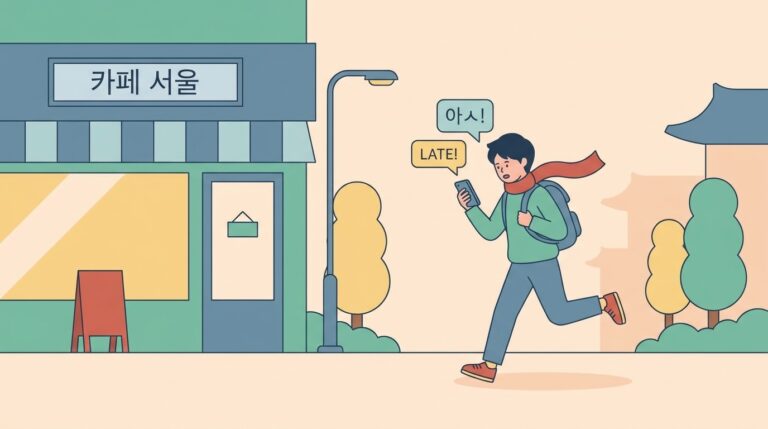
Phase 1: Empathy (Real-Life Story Opening)
안녕하세요! 매일한글 에디터입니다.
Imagine this scene straight out of your favorite slice-of-life K-drama: It is 6:45 PM on a chilly Friday evening. You are squeezed inside Seoul Subway Line 2 heading toward Gangnam Station to meet your Korean friends at a famous barbecue spot. You promised to meet at 7:00 PM sharp. Suddenly, the train slows down between stations, and the digital clock ticks mercilessly: 6:52 PM. Your phone screen lights up with a KakaoTalk message: “어디쯤이야? (Where are you around?)” A cold sweat breaks out on your forehead.
Running late in Korea feels uniquely stressful. Korea is famous for its fast-paced ppalli-ppalli (hurry-hurry) lifestyle and impeccable transit punctuality. Many international learners freeze up in this exact moment because textbook Korean only teaches stiff, robotic apologies like “저는 늦을 예정입니다” (I am scheduled to be tardy). That sounds like an automated subway announcement, not a message to a friend!
Don’t worry. As someone who has navigated Seoul’s rush hours and mentored international students for over a decade, I can tell you that being late happens to everyone—even locals. What matters most in Korean culture isn’t mechanical perfection; it’s how you communicate your situation with thoughtful nunchi (social tact). In this guide, you will master natural, intermediate-level Korean expressions to report delays, soften the blow, and keep your social relationships warm and respectful.
Phase 2: 3 Key Expressions Deep-Dive
1. 조금 늦을 것 같아요
- Pronunciation: [Jogeum neujeul geot gat-ayo] (Sounds like: Cho-geum neu-jeul got ga-tah-yo. The ‘geot gat-ayo’ rhymes with ‘caught got-ah-yo’)
- Meaning: Literal: “It seems like I will be a little late.” / Real Nuance: “I’m running a little behind.”
- K-Culture Moment: Seen frequently in office romance K-dramas where a character gets stuck in an elevator or late meeting and quickly texts their dinner date to cushion expectations.
- Editor’s Insight: Korean speakers rarely state uncomfortable facts with 100% certainty. Instead of bluntly saying “늦어요” (I am late), using the softening ending -ㄹ 것 같아요 (it seems like / I think) makes you sound considerate, humble, and polite. It shows you regret the inconvenience rather than stating it as an unchangeable fact.
- Situation Spectrum: Casual: ⚠️ (Use ‘조금 늦을 것 같아’) | Semi-formal: ✅ | Formal: ⚠️ (Use ‘조금 늦을 것 같습니다’)
- 🤔 Think About It: Why does Korean rely so heavily on indirect phrasing like “it seems like” when delivering disappointing news, compared to English’s direct “I will be 10 minutes late”?
2. 차가 많이 밀려서 15분 정도 늦을 것 같아요
- Pronunciation: [Chaga mani millyeoseo sib-obun jeongdo neujeul geot gat-ayo] (Sounds like: Cha-ga mah-nee meel-lyeo-seo sheep-oh-boon jung-doh neu-jeul got ga-tah-yo)
- Meaning: Literal: “Because the cars are backed up a lot, it seems like I will be late by about 15 minutes.” / Real Nuance: “Traffic is crazy, so I’m likely to be around 15 minutes late.”
- K-Culture Moment: You’ll hear this exact line in almost every Korean movie involving a taxi ride through Mapo Bridge or the Olympic Expressway during rush hour.
- Editor’s Insight: Notice the combination of -어서/아서 (giving a genuine reason) and 정도 (approximately). Giving a concrete estimated time of arrival (ETA) combined with an objective obstacle (traffic) immediately reassures the waiting person. In Korea, an ETA of 10–15 minutes allows your friend to wait inside a warm shop instead of freezing outside.
- Situation Spectrum: Casual: ✅ (Drop the ‘요’ to close friends) | Semi-formal: ✅ | Formal: ✅
- 🤔 Think About It: How does providing an estimated arrival window respect the waiting person’s personal autonomy and comfort?
3. 먼저 들어가 계세요, 제가 커피 쏠게요!
- Pronunciation: [Meonjeo deureoga gyeseyo, jega keopi ssolgeyo!] (Sounds like: Mun-juh deu-ruh-gah gyeh-seh-yo, jeh-gah kuh-pee ssoll-geh-yo!)
- Meaning: Literal: “Please go inside ahead of me, I will shoot (treat) coffee!” / Real Nuance: “Please head inside where it’s cozy, coffee is on me today!”
- K-Culture Moment: A staple line in Korean university life and workplace culture. When a colleague holds a table at a packed restaurant in Hongdae, the latecomer immediately offers to buy the post-lunch iced Americano.
- Editor’s Insight: The verb 쏘다 literally means “to shoot (an arrow/gun),” but in modern conversational Korean, it is the quintessential slang for “treating someone / picking up the tab.” Pairing an honorific imperative (-아/어 계세요) with an offer to treat creates the ultimate etiquette turnaround.
- Situation Spectrum: Casual: ✅ | Semi-formal: ✅ | Formal: 🚫 (In formal business, say: ‘제가 차를 대접하겠습니다’)
- 🤔 Think About It: In Korean social culture, how does sharing food or drinks transform an apology from mere words into a heartfelt gesture?
Phase 3: Textbook Korean vs. Real Korean
Situation 1: Letting someone know you are delayed
- 📖 교과서 한국어 (Textbook): “저는 약속 시간에 지각할 예정입니다.” (Jeoneun yaksok sigane jigakhal yejeong-imnida. / I am scheduled to be tardy for the appointment time.)
- 🗣️ 진짜 한국어 (Real-Life): “차가 막혀서 한 10분 정도 늦을 것 같아요!” (Chaga makhyeoseo han sip-bun jeongdo neujeul geot gat-ayo! / Traffic is backed up, so I think I’ll be about 10 minutes late!)
- 💡 Why the difference? Words like 지각 (tardiness) and 예정 (schedule) sound overly institutional and robotic, like a formal written memo. Native speakers use conversational words like 막히다/밀리다 (traffic jammed) paired with approximation markers like 한 (about) and -ㄹ 것 같다.
Situation 2: Apologizing and suggesting what the other person should do
- 📖 교과서 한국어 (Textbook): “저를 용서하십시오. 밖에서 저를 기다려 주십시오.” (Jeoreul yongseohasipsio. Bakk-eseo jeoreul gidaryeo jusipsio. / Please forgive me. Please wait for me outside.)
- 🗣️ 진짜 한국어 (Real-Life): “진짜 미안해요! 날씨 추운데 카페에 먼저 들어가 있어요!” (Jinjja mianhaeyo! Nalssi chuunde kape-e meonjeo deureoga isseoyo! / I’m so sorry! It’s cold out, so please head inside the cafe first!)
- 💡 Why the difference? Demanding someone to wait outside is bad manners, especially in Korea’s biting winters or humid summers. Real Korean immediately directs the other person to comfort (“먼저 들어가 있어요”) while offering a sincere, conversational apology.
Phase 4: K-Culture Deep Dive & Non-Verbal Manners
4-1. Nunchi (눈치) & Non-Verbal Gestures
When you finally arrive at the meetup spot, your words are only half the message; your physical body language must also show sincerity.
1. The Urgent Hurried Step (종종걸음 – Jongjong-georeum): Even if you are just 5 minutes late, do not casually stroll toward your friend looking at your phone. Quickening your pace as you approach shows that you were rushing and valued their time.
2. The Two-Handed Prayer Apology: Bring both palms together lightly in front of your chest, bow your head slightly, and say “진짜 미안해요!” (Jinjja mianhaeyo!). This universal Korean gesture softens the atmosphere immediately.
3. Do Not Start With Endless Excuses: When you sit down, don’t launch into a 5-minute complaint about the subway conductor. First apologize and check on their comfort: “많이 기다렸죠? (Did you wait long?)”.
4-2. Cultural Code: The Power of “커피 쏘기” (Treating to Coffee)
In Korean social dining, punctuality is deeply tied to mutual respect. However, Koreans also believe strongly in Jeong (정 – relational affection and forgiveness). If you cause an inconvenience, a tangible gesture clears the air faster than a thousand words. That’s why offering to buy the post-dinner dessert or coffee (“제가 오늘 커피 쏠게요!”) is considered the gold standard of adult social etiquette. It transforms a moment of awkward guilt into a warm, shared experience.
Phase 5: Real-Life Roleplay Scenario
Setting: It is 7:05 PM outside a hip cafe in Seongsu-dong (성수동).
NPC: Minji (민지), your friendly Korean study partner who always arrives 5 minutes early.
- Turn 1 (Minji): (메시지를 보내며 / Texting on KakaoTalk) “지금 어디쯤이야? 성수역 도착했어?”
(Jigeum eodijjeumiya? Seongsu-yeok dochakhaesseo? / Where are you around now? Did you arrive at Seongsu Station?) -
Turn 2 (You): 🎭 (Typing quickly while panting slightly on the subway escalator)
“민지 씨, 지하철을 놓쳐서 10분 정도 늦을 것 같아요!”
(Minji ssi, jihacheoreul nochyeoseo sip-bun jeongdo neujeul geot gat-ayo! / Minji, I missed the subway, so I think I will be about 10 minutes late!) -
Turn 3 (Minji): “아, 정말? 오늘 날씨 진짜 추운데 어떡해 ㅠㅠ”
(A, jeongmal? Oneul nalssi jinjja chuunde eotteokhae ㅠㅠ / Oh, really? It’s so cold today, what to do ㅠㅠ) -
Turn 4 (You): 🎭 (Sending a cute apologetic Kakao emoticon)
“너무 미안해요! 밖에서 기다리지 말고 카페 안에 먼저 들어가 계세요!”
(Neomu mianhaeyo! Bakk-eseo gidariji malgo kape ane meonjeo deureoga gyeseyo! / I’m so sorry! Don’t wait outside, please go inside the cafe first!) -
Turn 5 (Minji): “알겠어! 창가 쪽 자리에 앉아 있을게. 천천히 조심히 와.”
(Algesseo! Chang-ga jjok jarie anja isseulge. Cheoncheonhi josimhi wa. / Got it! I’ll be sitting by the window. Take your time and come safely.) -
Turn 6 (You): 🎭 (Bursting into the cafe at 7:15 PM, hands together with a slight bow)
“민지 씨! 많이 기다렸죠? 진짜 미안해요!”
(Minji ssi! Mani gidaryeotjyo? Jinjja mianhaeyo! / Minji! Did you wait long? I’m so sorry!) -
Turn 7 (Minji): 🎭 (Smiling warmly and waving her hand)
“아니야, 나도 온 지 얼마 안 됐어. 뛰어왔어? 숨 좀 돌려!”
(Aniya, nado on ji eolma an dwaesseo. Ttwieowasseo? Sum jom dollyeo! / No, I haven’t been here long either. Did you run? Catch your breath!) -
Turn 8 (You): 🎭 (Taking off your coat and smiling gratefully)
“고마워요. 오늘 기다리게 했으니까 맛있는 디저트는 제가 쏠게요!”
(Gomawoyo. Oneul gidarige haesseunikka masinneun dijeoteuneun jega ssolgeyo! / Thank you. Since I made you wait today, the delicious dessert is on me!)
🔀 Interactive Branching Choice
What should you text Minji when you realize you’ll be late?
* Choice A: “저 오늘 늦어요. 밖에서 기다리세요.” (I am late today. Wait outside.)
* Choice B: “민지 씨, 지하철이 연착돼서 10분 정도 늦을 것 같아요. 추우니까 먼저 들어가 계세요! 제가 커피 쏠게요!” (Minji, the subway is delayed so I think I’ll be about 10 minutes late. It’s cold, so please go inside ahead! Coffee is on me!)
* Choice C: (Read her KakaoTalk message, panic, say nothing, and just run as fast as you can to explain when you arrive).
- Feedback:
- Choice A (Bad): Disastrously blunt and rude. It orders the other person to endure the cold with zero empathy.
- Choice B (Best!): Perfect! It gives an objective reason, an estimated time, prioritizes her comfort, and offers a warm gesture.
- Choice C (High Risk): The “ghosting run” is the worst trap. Leaving someone wondering in the dark damages trust far more than being 10 minutes late with advance notice.
Phase 6: 10-Second Emotional Shadowing Drill
Practice saying these lines out loud. Pay attention to the pause markers (/) and embody the emotion tags!
[🥺 죄송하고 다급하게 - Apologetic & Urgent]
“민지 씨! / 차가 너무 밀려서 / 15분 정도 늦을 것 같아요!”
(Minji ssi! / chaga neomu millyeoseo / sib-obun jeongdo neujeul geot gat-ayo!)-
[☕ 다정하고 배려 깊게 - Warm & Considerate]
“밖에서 기다리지 마시고 / 카페에 먼저 / 들어가 계세요!”
(Bakk-eseo gidariji masigo / kape-e meonjeo / deureoga gyeseyo!) -
[😊 고맙고 유쾌하게 - Grateful & Cheerful]
“기다려 줘서 진짜 고마워요! / 오늘 디저트는 / 제가 쏠게요!”
(Gidaryeo jwoseo jinjja gomawoyo! / oneul dijeoteuneun / jega ssolgeyo!)
Phase 7: K-Culture Mini Dictionary
- 지각 (Jigak) | Tardiness / Being late
- Real-world usage: Used formally at school or company attendance records (“지각 1회” – 1 late record). In casual texts, avoid using it about yourself; stick to 늦다 (to be late).
- 눈치 (Nunchi) | Social tact / The art of gauging moods
- Real-world usage: Having nunchi when you are late means sending an update before the scheduled time arrives, not 5 minutes after you were already supposed to be there.
- 쏘다 (Ssoda) | To treat / To pay for someone (Slang)
- Real-world usage: Ubiquitous among friends and friendly colleagues. Saying “내가 쏠게!” (It’s on me!) creates instant camaraderie.
- 도착 (Dochak) | Arrival
- Real-world usage: Often combined with 전 (before) or 직전 (right before), as in “성수역 도착 직전이에요!” (I’m just about to arrive at Seongsu Station!).
Phase 8: Survival Kit for Travelers
Survival Expressions TOP 3
- 길을 잘 몰라서 조금 헤맸어요.
- Romanization: [Gireul jal mollaseo jogeum hemaesseoyo.]
- Pro Tip: “I got a little lost because I don’t know the streets well.” The ultimate honest, sympathetic phrase for tourists.
- 거의 다 왔어요! 5분 뒤에 도착해요.
- Romanization: [Geoui da wasseoyo! Obun dwie dochakhaeyo.]
- Pro Tip: “I’m almost there! Arriving in 5 minutes.” Send this when you exit the subway turnstile.
- 천천히 오세요, 저 괜찮아요!
- Romanization: [Cheoncheonhi oseyo, jeo gwaenchanayo.]
- Pro Tip: “Take your time, I’m totally fine!” Use this gracious phrase when your Korean companion is the one running late.
Editor’s Travel Note
- Download Local Transit Navigation: Google Maps does not provide accurate walking or real-time transit routes in South Korea due to national map data regulations. Before your trip, make sure to read our guide on the Naver Map navigation app download to check real-time subway arrival intervals down to the exact second.
- Rush Hour Buffer: If your meetup is between 5:30 PM and 7:30 PM in high-density areas (Gangnam, Hongdae, Jongno), always add a 15-minute buffer. Subway platforms get packed, and taking a taxi can take triple the expected transit time!
Phase 9: One Step Deeper (Cultural Reflection)
In Western communication, clarity and direct accountability are prized: “I will be 10 minutes late because my alarm failed.” In Korean society, however, language is framed around collective harmony and relationship preservation. Grammar structures like -ㄹ 것 같다 (it seems like) exist not because Koreans are unsure of their arrival time, but because softening the statement displays modesty and shields the listener from harsh, blunt facts. Language in Korea is not just a tool for exchanging data; it is an emotional shock absorber.
💬 Your Turn: In your home country, what is the polite window of tardiness, and what do you say when you realize you’re running late? Share your story in the comments below!
Phase 10: FAQ & Common Mistakes
Q: Can I use “미안해” (Mianhae) if I am meeting someone older than me?
A: No! “미안해” is casual language (banmal) reserved strictly for same-age close friends or younger people. For anyone older, acquaintances, or colleagues, you must say “죄송합니다” (formal) or “정말 죄송해요 / 미안해요” (polite).
Q: When should I send the late text message?
A: The golden rule of Korean nunchi is to notify the other person at least 15 to 20 minutes before the scheduled time, or the very second you realize you will miss your train. Texting at 7:01 PM for a 7:00 PM appointment is considered poor etiquette.
Q: What if I am only 3 to 5 minutes late? Do I still need to text?
A: If you are meeting at a busy subway exit or outside, yes! A quick text like “거의 다 왔어요! 3분 뒤 도착해요!” (Almost there! Arriving in 3 minutes!) prevents them from scanning the crowd anxiously.
🚨 Common Mistakes TOP 3
- Mistake: Texting “저는 지각입니다” (I am tardy).
- Correct Action: Say “조금 늦을 것 같아요” (I think I’ll be a little late).
- Mistake: Offering no concrete ETA and just saying “곧 가요” (Coming soon).
- Correct Action: Give a concrete bracket: “10분~15분 정도 늦을 것 같아요”.
- Mistake: Arriving late and immediately checking your phone or talking about yourself.
- Correct Action: Make eye contact, bow lightly, and ask “많이 기다렸죠?” (Did you wait long?).
Phase 11: Action Mission & Engagement
- 🥉 Bronze Mission (Self-Practice): Record your voice saying “차가 밀려서 10분 정도 늦을 것 같아요. 먼저 들어가 계세요!” until it rolls off your tongue smoothly in under 5 seconds.
- 🥈 Silver Mission (Social Sharing): Screenshot your favorite K-drama scene where a character is late. Identify what phrase they use and share it in our community study group!
- 🥇 Gold Mission (Real-Life Application): The next time you make plans with a Korean friend or language partner, send a real-time status update in natural Korean 15 minutes before meeting.
- 🎮 K-Culture Mission: Watch Episode 1 of any romantic comedy K-drama (like Business Proposal or Crash Landing on You). Listen closely for the verbs 늦다 (to be late) and 밀리다 (to be backed up). How many times do you hear them?
Phase 12: Interactive Quiz Challenge
1. Situational Judgment:
You are stuck in Seoul subway traffic and will be 15 minutes late to dinner with an older language exchange partner. Which message is the most polite and natural?
* A) 미안! 나 15분 늦어.
* B) 죄송해요, 지하철이 늦어서 15분 정도 늦을 것 같아요. 먼저 식당에 들어가 계세요!
* C) 저는 지각할 계획입니다. 밖에서 기다려 주십시오.
2. Fill in the Blank:
“오늘 기다리게 해서 너무 미안해요. 커피는 제가 [ ______ ]!” (Hint: The slang verb meaning ‘to treat’ like shooting an arrow)
3. True or False:
In Korean communication, using expressions like -ㄹ 것 같아요 (it seems like) means the speaker is completely uncertain and guessing about their own schedule.
👉 Click here to reveal the answers and explanations!
Answers & Explanations:
1. Answer: B.
* Explanation: Option B uses proper polite honorifics (죄송해요, -아/어 계세요), provides an ETA, and thoughtfully directs the person inside. Option A is informal banmal (inappropriate for an older partner), and Option C uses unnatural, robotic grammar.
2. Answer: 쏠게요 (ssolgeyo)
* Explanation: From the verb 쏘다 (to shoot/treat). The ending -ㄹ게요 expresses your willingness or promise to buy the coffee.
3. Answer: False.
* Explanation: While -ㄹ 것 같다 translates to “it seems like,” in social contexts it functions as an essential politeness buffer to avoid sounding blunt or unapologetic about negative news.







