

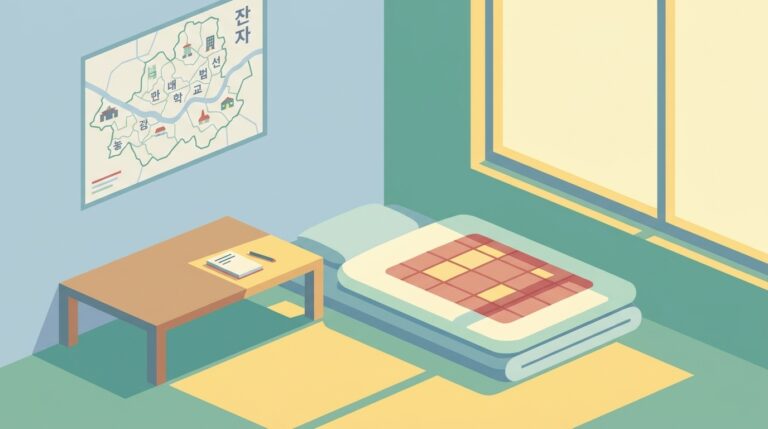
House Hunting in Korea: Finding Your Dream Room with Confidence
Phase 1: Empathy (Story-Driven Opening)
안녕하세요! 매일한글 에디터입니다. (Hello! I’m your Daily Hangul editor.)
Picture this: You step out of a bustling subway station near Hongdae or Sinchon, your heart racing. The streets are alive with the scent of roasted street food and upbeat K-Pop hits playing from nearby shops. But you have a serious mission today: finding your very first room in Seoul. You spot a real estate office—a budongsan (부동산)—with windows plastered in dozens of bright yellow and red handwritten paper signs displaying cryptic numbers like “500/45” or “1000/60”.
You hesitate right outside the sliding glass door. Your palms sweat. You’ve watched characters in K-dramas like Because This Is My First Life search for rooftop rooms (oktapbang), but in reality, your mind goes completely blank. What if the agent speaks zero English? What if you accidentally sign up for a five-year contract when you only need six months?
Take a deep breath! You are not alone. Almost every international student and traveler experiences this exact “door freeze.” The good news? You do not need fluent Korean to secure a clean, cozy room. By mastering just three core phrases and understanding how Korean real estate etiquette works, you will transform from an anxious outsider into a confident room hunter. This guide is crafted from real classroom feedback and ground-level Seoul living experience to give you the exact words, body language, and cultural radar you need today.
Phase 2: Core 3 Expressions In-Depth
1. 방 구하고 있어요 (Bang guhago isseoyo)
- Pronunciation: [Bang gu-ha-go i-sseo-yo] (Sound analogy: “Bahng” sounds like the gong sound ‘bong’ with an ‘ah’, “gu-ha-go” sounds like ‘goo-ha-go’, “i-sseo-yo” sounds like ‘ee-so-yo’.)
- Meaning: Literal: “I am seeking a room.” / Real Nuance: “Hello, I am in the market looking to rent a room/apartment.”
- K-Culture Moment: In slice-of-life dramas, whenever a college freshman moves to Seoul and walks into a neighborhood agency with a wheeled suitcase, this is the magical sentence they utter to break the ice.
- Editor’s Insight: The verb guhada (구하다) means to look for, rescue, or obtain. Using the progressive form -go isseoyo (-고 있어요) makes you sound polite, natural, and proactive.
- Situation Spectrum: Casual: 🚫 (Bang guhae) | Semi-formal/Polite: ✅ (Bang guhago isseoyo) | Formal: ✅ (Bang-eul guhago issseumnida)
- 🤔 Think About It: In English, we often say “I want an apartment.” In Korean, using “seeking” (guhada) sounds softer and less demanding than “I want.” How does stating your search rather than your demand change the conversation’s atmosphere?
2. 원룸 있어요? (Wonrum isseoyo?)
- Pronunciation: [Won-rum i-sseo-yo] (Sound analogy: “Won” sounds like ‘one’ or Korean currency ‘won’; “rum” sounds like ‘room’ with a soft rolled ‘r’; “i-sseo-yo” sounds like ‘ee-so-yo’.)
- Meaning: Literal: “Is there a one-room?” / Real Nuance: “Do you have any studio apartments available?”
- K-Culture Moment: Konglish at its finest! In Korea, a studio apartment (single room with kitchenette and private bathroom) is universally called a wonrum (원룸). If you watch Fight for My Way, the cozy single-room pads the characters live in are classic wonrum setups.
- Editor’s Insight: Don’t ask for a “studio” (스튜디오); in Korean, seutyudio often refers to a photography or music recording studio! Stick firmly to wonrum.
- Situation Spectrum: Casual: ⚠️ (Wonrum isseo? – close friends only) | Semi-formal/Polite: ✅ (Wonrum isseoyo?) | Formal: ✅ (Wonrum-i issseumnikka?)
- 🤔 Think About It: Why do you think Korean uses Konglish terms like wonrum (one-room), tworum (two-room), and officetel instead of direct translations? How does this reflect Korea’s fast modernization and urban living structure?
3. 보증금이랑 월세가 얼마예요? (Bojeunggeum-irang wolse-ga eolmayeyo?)
- Pronunciation: [Bo-jeung-geum-i-rang wol-se-ga eol-ma-ye-yo] (Sound analogy: “Boh-jung-gum ee-rahng wall-seh gah ull-mah-yeh-yo”.)
- Meaning: Literal: “Deposit-and monthly rent how much is it?” / Real Nuance: “What are the deposit and monthly rent amounts?”
- K-Culture Moment: The core financial question in every housing drama. When you see real estate listings posted as “500/50”, 500 means 5,000,000 KRW deposit (bojeunggeum), and 50 means 500,000 KRW monthly rent (wolse).
- Editor’s Insight: Irang (이랑) is the friendly everyday particle for “and.” Always ask this early so you don’t fall in love with a room way outside your budget.
- Situation Spectrum: Casual: 🚫 | Semi-formal/Polite: ✅ (Bojeunggeum-irang wolse-ga eolmayeyo?) | Formal: ✅ (Bojeunggeum-gwa wolse-neun eolma-imnikka?)
- 🤔 Think About It: Korean rental contracts rely heavily on large deposits (bojeunggeum) to lower monthly rent. How does this system compare to rental deposits in your home country?
Phase 3: Textbook Korean vs. Real Korean
Situation 1: Walking in and stating your intent
- 📖 Textbook Korean: 방을 찾고 있습니다. (Bang-eul chatgo issseumnida. – “I am in the process of searching for a room.”)
- 🗣️ Real Korean: 원룸 알아보러 왔어요. (Wonrum araboro wasseoyo. – “I came by to look into some studio rooms.”)
- 💡 Why is it different? Chatda (to find) sounds like you dropped your wallet and are looking under the sofa. Native speakers prefer araboroda (to check out/inquire) or guhada (to seek/hunt), which implies exploring options.
Situation 2: Asking about hidden extra fees
- 📖 Textbook Korean: 추가 비용이 존재합니까? (Chuga biyong-i jonjaehamnikka? – “Do additional costs exist?”)
- 🗣️ Real Korean: 관리비 포함이에요? (Gwanribi poham-ieyo? – “Does that include maintenance fees?”)
- 💡 Why is it different? Nobody asks about abstract “additional costs.” Korean apartments have a specific monthly building fee called gwanribi (cleaning, water, elevator, internet). Asking Gwanribi poham-ieyo? instantly shows the realtor you know how Korea works!
Phase 4: K-Culture Deep Dive & Non-Verbal Manners
4-1. Nunchi & Real Estate Body Language
- The Instant Coffee Ritual: When you walk into a neighborhood budongsan, the agent (often a sweet or sharp middle-aged auntie or uncle, Imo or Sojangnim) will almost certainly offer you a warm paper cup of Maxim yellow instant coffee. Always accept it with both hands, give a slight nod, and take a sip. Declining too briskly can make the interaction stiff.
- The Shoe Etiquette at Showings: When the agent takes you to view a room, stop at the hyeon-gwan (sunken entryway). Never step onto the raised wood floor wearing shoes. Slip your shoes off quickly and step up in socks. Keep your toes pointed back toward the door if possible—it’s the ultimate polite touch that agents adore.
4-2. Culture Code: Jeonse vs. Wolse
Korea has a unique housing system. You will hear two words constantly:
1. 월세 (Wolse – Monthly Rent): You pay a lump-sum key deposit (e.g., 5,000,000 KRW to 10,000,000 KRW) and a monthly rent (e.g., 450,000 to 700,000 KRW).
2. 전세 (Jeonse – Lump-Sum Deposit Lease): No monthly rent at all! Instead, you deposit 50% to 80% of the property’s market value (often $80,000 to $200,000+ USD) which the landlord returns in full when you move out. As a beginner expat or student, you will almost exclusively look for Wolse (월세).
Phase 5: Real Role-Play Scenario
Setting: A tidy real estate agency in Sinchon on a breezy Tuesday afternoon. Soft piano radio music is playing. Behind the desk sits Agent Park (박 소장님), wearing gold reading glasses and a welcoming smile.
- Turn 1 (You): 안녕하세요! 저… 방 구하고 있어요. (Annyeonghaseyo! Jeo… bang guhago isseoyo.)
🎭 Entering politely, giving a respectful 30-degree bow. - Turn 2 (Agent Park): 어서 와요! 학생이에요? 이쪽으로 앉아요. (Eoseo wayo! Haksaeng-ieyo? Ijjok-euro anjayo.)
🎭 Smiling warmly and pulling out a chair while gesturing toward it. - Turn 3 (You): 네, 학생이에요. 신촌 근처 원룸 있어요? (Ne, haksaeng-ieyo. Sinchon geuncheo wonrum isseoyo?)
🎭 Sitting down lightly and keeping hands resting on knees. - Turn 4 (Agent Park): 그럼요, 많지! 생각한 보증금이랑 월세는 얼마예요? (Geureomyo, manji! Saenggakhan bojeunggeum-irang wolse-neun eolmayeyo?)
🎭 Clicking her pen, ready to write in her ledger. - Turn 5 (You): 보증금 500에 월세 50만 원 정도요. (Bojeunggeum obaek-e wolse osipman-won jeongdoyo.)
🎭 Showing your budget clearly with a calm, friendly tone. - Turn 6 (Agent Park): 마침 역 5분 거리에 깨끗한 방 하나 나왔는데, 보러 갈래요? (Machim yeok obun geori-e kkaekkeutan bang hana nawanneunde, boreo gallaeyo?)
🎭 Standing up and grabbing a bunch of keys with a bright smile. - Turn 7 (You): 네, 좋아요! 관리비 포함이에요? (Ne, joh-ayo! Gwanribi poham-ieyo?)
🎭 Asking the crucial follow-up question while nodding eagerly. - Turn 8 (Agent Park): 수도랑 인터넷 포함해서 5만 원이에요. 같이 가봐요! (Sudo-rang inteonet pohamhaeseo oman-won-ieyo. Gachi gabwayo!)
🎭 Putting on her sneakers by the door and gesturing for you to follow.
🔀 Interactive Choice Point
Agent Park shows you the room. It has a great window, but the washing machine looks slightly old. What do you say?
- Option A: “이거 너무 낡았어요. 새 걸로 바꿔줘요!” (Igeo neomu nalg-asseoyo. Sae geol-ro bakkwojwoyo! – “This is too old. Change it to a new one!”)
- Option B: “방이 밝아서 좋아요. 혹시 세탁기 잘 작동해요?” (Bangi balg-aseo joh-ayo. Hoksi setakgi jal jakdonghaeyo? – “I like that the room is bright. By any chance, does the washing machine work well?”)
- Option C: “그냥 다 마음에 안 들어요. 갈게요.” (Geunyang da maeum-e an deureoyo. Galgeyo. – “I just don’t like any of it. I’m leaving.”)
Feedback:
* Option A (Risk): Demanding a brand-new appliance aggressively before signing can offend the landlord or agent. Negotiation requires gentle diplomacy.
* Option B (Best!): Perfect! You praise the room first (nunchi!), then politely ask about functionality using hoksi (“by any chance”).
* Option C (Bad): Too blunt and burns bridges. The agent will not show you their unlisted “secret” good rooms.
Phase 6: 10-Second Emotional Shadowing Drill
Read these aloud, hitting the natural pauses (/) and channeling the given emotion!
[😊 Bright and polite]
안녕하세요! / 원룸 / 알아보러 왔어요.
(Annyeonghaseyo! / Wonrum / araboro wasseoyo.)
Hello! / A studio room / I came to check out.-
[🤔 Curious and smart]
월세에 / 관리비 / 포함이에요?
(Wolse-e / gwanribi / poham-ieyo?)
In the monthly rent / maintenance fee / is it included? -
[🤩 Delighted and decisive]
방이 깨끗해서 / 진짜 / 마음에 들어요!
(Bangi kkaekkeut-haeseo / jinjja / maeum-e deureoyo!)
Because the room is clean / really / I like it so much!
Phase 7: K-Culture Mini Dictionary
- 원룸 (Wonrum) | Studio Apartment | The bread-and-butter living space for solo dwellers in Korea. Kitchen, bed, and desk in one space.
- 보증금 (Bojeunggeum) | Security Deposit | A sizable deposit paid up front, held by the landlord, and returned upon lease end.
- 월세 (Wolse) | Monthly Rent | The fixed payment made every month, usually via direct bank transfer (gyejwa-iche).
- 관리비 (Gwanribi) | Building Maintenance Fee | Covers hallway lights, trash disposal, building cleaning, and often internet/water. Must always be checked!
Phase 8: Survival Kit for Expats & House Hunters
Top 3 Survival Phrases
- 역에서 가까워요? (Yeok-eseo gakkawoyo?) – Is it close to the subway station? (Pro tip: Always verify walking minutes yourself; “5 minutes” to an agent can mean an Olympic sprint uphill!)
- 채광 좋아요? (Chaegwang joh-ayo?) – Does it get good natural sunlight? (Critical for preventing mold in basement or semi-basement rooms!)
- 언제 입주할 수 있어요? (Eonje ipjuhal su isseoyo?) – When can I move in?
Editor’s Travel & Housing Note
- App vs. Footwork: Start your search using apps to gauge local price ranges. However, many ultra-cheap listings online are bait. The most reliable strategy in Seoul is walking directly into physical offices. Search on the Naver Map application using the keyword 부동산 (Budongsan) around your preferred university or subway line.
- Banking Prep: Ensure your foreign bank card limit allows domestic transfers or open a local Korean bank account as soon as your Alien Registration Card (ARC) is issued.
Phase 9: “One Step Deeper” (Cultural Reflection)
In Korean culture, a room isn’t just concrete walls; jip (집 – home) represents safety and community. Landlords often act like extended family elders, checking if you’ve eaten or asking if your room is warm enough during bitter winters. By approaching the house-hunting process with respect, politeness, and curiosity, you aren’t just signing a rental agreement—you are stepping into a Korean neighborhood network.
💬 Your Turn: In your home country, what is the single most important factor when choosing an apartment: price, location, or sunlight? Share your thoughts in the comments below!
Phase 10: FAQ & Common Mistakes
Q: Can a foreigner rent a room in Korea on a tourist visa?
A: Technically yes, but most traditional real estate agents require an Alien Registration Card (ARC) or a valid long-term visa (such as D-2 student or E-2 teacher) to register the official contract. For short stays under 90 days, consider verified guesthouses, goshiwon (compact micro-rooms), or licensed monthly rentals.
Q: What does “1000/60” mean on agency windows?
A: The first number is the deposit (bojeunggeum) in ten-thousands of won: 1,000 = 10,000,000 KRW (~$7,500 USD). The second number is the monthly rent (wolse): 60 = 600,000 KRW (~$450 USD).
Q: Is the real estate agent fee fixed by law?
A: Yes! It is called bokbi (복비) or junggae susuryo (중개수수료). It is regulated by municipal laws as a small percentage (usually 0.4% to 0.5% of the transaction value for studios). You pay this fee only upon signing a finalized contract.
🚨 Common Mistakes Alert
- Mistake: Wearing outdoor shoes past the entryway while viewing.
- Correct Action: Kick your shoes off at the doorstep and step up in socks.
- Mistake: Forgetting to ask about the maintenance fee (gwanribi).
- Correct Action: Always ask “관리비 포함이에요? (Gwanribi poham-ieyo?)” so your monthly expenses don’t suddenly jump by 100,000 KRW.
- Mistake: Trusting online photos 100%.
- Correct Action: Wide-angle lenses make tiny 4-pyeong rooms look like royal suites. Always view the space in person during daylight hours.
Phase 11: Action Missions
- 🥉 Bronze Mission (Solo): Stand in front of your mirror and practice saying: “안녕하세요! 원룸 구하고 있어요.” five times with a clear smile.
- 🥈 Silver Mission (Social): Open your favorite navigation or map tool, locate three budongsan near your dream Seoul subway station, and write down their phone numbers or locations.
- 🥇 Gold Mission (Real Life): When you watch your next K-drama or visit Korea, spot the paper signs outside an agency and decipher at least one deposit/rent pair (e.g., 500/40)!
- 🎮 K-Culture Mission: Watch Episode 1 of Because This Is My First Life or Strangers from Hell and observe how the main characters react when entering different types of rental spaces.
Phase 12: Interactive Quiz Challenge
1. Situation Judgment:
You walk into a real estate office and want to tell the agent you are looking for a studio apartment. Which sentence is the most natural for a beginner?
* A) 원룸 주세요! (Wonrum juseyo!)
* B) 원룸 구하고 있어요. (Wonrum guhago isseoyo.)
* C) 원룸을 발견합니다. (Wonrum-eul balgyeonhamnida.)
2. Fill-in-the-Blank:
When asking if the monthly maintenance fee is included, you ask: “관리비 ________이에요?”
* A) 포함 (Poham)
* B) 라면 (Ramyeon)
* C) 출발 (Chulbal)
3. True or False:
Wonrum in Korea refers to a large music recording studio.
* True / False
👉 Click here to reveal the answers and explanations!
- Answer: B (원룸 구하고 있어요.)
Explanation: “Wonrum juseyo” sounds like ordering a room off a restaurant menu! “Guhago isseoyo” is the respectful, natural phrase for room hunting. - Answer: A (포함 – Poham, meaning ‘included’)
Explanation: “Gwanribi poham-ieyo?” means “Is the maintenance fee included?” - Answer: False
Explanation: In Korea, a *wonrum (one-room) is a studio apartment! If you want a music studio, you would specify eum-ak seutyudio.*







