

Phase 1: 공감 (Story Opening)
안녕하세요! 매일한글 에디터입니다.
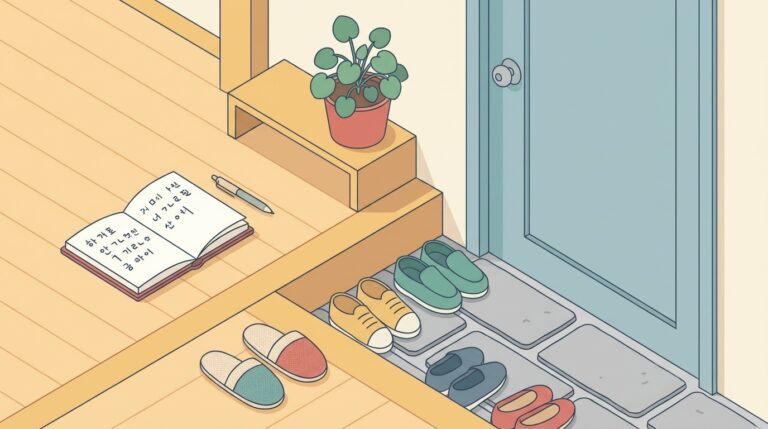
Picture this: You are invited to your Korean friend’s apartment for a cozy homemade dinner. You arrive, ring the doorbell, and the door opens with the delicious aroma of kimchi jjigae wafting into the hallway. But the second you step into the small sunken entryway—known in Korea as the hyeongwan (현관)—a sudden wave of panic strikes. Do your shoes come off right this instant? Do you step onto the elevated wooden floor in socks, or do you wait for slippers? What if you accidentally wore mismatched socks with a tiny hole in the big toe?
Every K-drama fan has watched characters kick off their sneakers effortlessly while trading warm greetings at the doorway. Yet, standing there in real life, it is remarkably easy to freeze. In fact, over 70% of beginner learners in our Daily Hangul tutoring community confess that their very first home visit in Korea felt intimidating purely because of front-door etiquette!
Don’t worry—you are not alone. Stepping into a Korean home is a wonderful cultural bonding moment once you understand the rhythm. In this A2-tailored guide, you will master essential conversational phrases, unlock the secrets of front-door nunchi (눈치, quick cultural intuition), and glide across any Korean entryway with total poise and warmth.
Phase 2: 핵심 표현 3선 심층 분석 (Top 3 Core Expressions)
1. 신발 벗고 들어가면 돼요? (Sinbal beotgo deureogamyeon dwaeyo?)
- Pronunciation: [Sin-bal beot-go deu-reo-ga-myeon dwae-yo?] (Think of “sin-ball”, then “but-go”, “doo-ruh-gah-myun dway-yo”)
- Meaning: Literal: “If I take off shoes and enter, is it okay?” vs Nuance: “Should I take off my shoes here?”
- K-Culture Moment: A relatable scene in modern slice-of-life dramas like Hospital Playlist where guests arrive at an apartment and politely ask where to step.
- Editor’s Insight: The grammar pattern
-(으)면 돼요?is the gold standard for A2 learners asking permission. It sounds humble, soft, and naturally conversational.- Situation Spectrum: Casual (✅ with close peers as “신발 벗어?”) / Semi-formal (✅ “신발 벗고 들어가면 돼요?”) / Formal (⚠️ use “신발을 벗고 들어가면 되겠습니까?”)
- 🤔 Think About It: In many Western households, asking about shoes can feel slightly formal, but in Korea, proactively asking demonstrates instant respect for the sanctuary of the host’s clean floor.
2. 실례하겠습니다 (Sillyehagessumnida)
- Pronunciation: [Sil-lye-ha-get-seum-ni-da] (Pronounced like “Seal-lyeh ha-get-sum-nee-da”)
- Meaning: Literal: “I will commit a discourtesy” vs Nuance: “Pardon me for intruding / Thank you for having me.”
- K-Culture Moment: Classic romantic dramas where the main lead enters their partner’s parents’ home for the first time, dipping their head with polished manners.
- Editor’s Insight: Say this phrase the exact moment your foot transitions from the entrance threshold onto the indoor flooring. It acts as an auditory signal of courtesy.
- Situation Spectrum: Casual (🚫 too stiff) / Semi-formal (✅) / Formal (✅)
- 🤔 Think About It: Why announce a “discourtesy” when you were warmly invited? Korean etiquette values acknowledging the disruption your presence brings to someone’s private peace.
3. 실내화 신으시면 돼요 (Sinnaehwa sineusimyeon dwaeyo)
- Pronunciation: [Sil-nae-hwa sin-eu-si-myeon dwae-yo] (Sounds like “Seal-neh-hwa shin-ew-she-myun dway-yo”)
- Meaning: Literal: “You may wear indoor slippers” vs Nuance: “Here, please slide into these slippers.”
- K-Culture Moment: A welcoming friend pulling out a set of fluffy matching indoor slippers from the shoe cabinet.
- Editor’s Insight: This is a phrase you will hear from your host. When they say this, simply reply with a smiling “감사합니다” (Gamsahamnida, Thank you) and step into them.
- Situation Spectrum: Casual (✅ as “실내화 신어”) / Semi-formal (✅) / Formal (✅ as “실내화 신으십시오”)
- 🤔 Think About It: Indoor slippers protect feet from hard floors and prevent noise between apartment levels. Accepting them respects the host’s household care.
Phase 3: 교과서 한국어 vs 진짜 한국어 (Textbook vs Real Korean)
Situation 1: Asking where to take off your footwear
- 📖 교과서 한국어: 신발을 어디에 벗어 놓아야 합니까? (Sinbareul eodie beoseo noaya hamnikka?)
- 🗣️ 진짜 한국어: 신발 여기 벗으면 돼요? (Sinbal yeogi beoseumyeon dwaeyo?)
- 💡 왜 다를까?: The textbook version sounds like a soldier reporting for duty! Everyday Korean conversation frequently drops topic/object particles like
-을and uses the softer-(으)면 돼요?ending.
Situation 2: The host inviting the guest to step inside
- 📖 교과서 한국어: 어서 방 안으로 들어오십시오. (Eoseo bang aneuro deureoosipsio.)
- 🗣️ 진짜 한국어: 신발 벗고 편하게 들어와요! (Sinbal beotgo pyeonhage deureowayo!)
- 💡 왜 다를까?: Modern homes are open-concept living spaces rather than compartmentalized traditional rooms (bang). Hosts focus on making you feel at home using “편하게” (comfortably).
Phase 4: K-Culture 딥다이브 & 비언어적 매너 (Deep Dive & Manners)
4-1. 눈치 (Nunchi) & Gestures
- The Direction of the Shoes: As you take off your shoes, turn them around so the toes point toward the outside entrance door. This neat trick readies your shoes for a quick departure later and keeps the foyer clutter-free.
- The Clean Step: Never step onto the dirty tiled foyer with bare or sock-covered feet! Step directly from the inside of your shoe right onto the raised wooden floor or into a slipper in one smooth motion.
4-2. Cultural Code: The Ondol (온돌) Philosophy
In Korea, the floor is not a passive walking surface; it is living space. Rooted in traditional ondol (sub-floor radiant heating), Koreans sit on floor cushions, socialize around low dining tables, and often sleep on comfortable floor mattresses (yo). Street footwear carries outside dirt, dust, and negative urban energy into this immaculate private sanctuary. Therefore, taking off shoes is both an absolute hygiene rule and a profound sign of psychological respect.
Phase 5: 실전 롤플레이 시나리오 (Roleplay Scenario)
- Setting: Visiting your Korean colleague Minji’s modern apartment for a weekend housewarming party in Seoul.
- Characters: You (visiting friend) and Minji (enthusiastic host).
- You: 안녕하세요, 민지 씨! 초대해 주셔서 감사해요. (Annyeonghaseyo, Minji ssi! Chodaehae jusyeoseo gamsahaeyo. / Hello, Minji! Thank you for inviting me. 🎭 Holding up a housewarming gift with two hands.)
- Minji: 어서 와요! 들어와요, 들어와요! (Eoseo wayo! Deureowayo, deureowayo! / Welcome! Come on in, come on in! 🎭 Opening the door wide with a bright smile.)
- You: 신발 여기 벗으면 돼요? (Sinbal yeogi beoseumyeon dwaeyo? / Should I take off my shoes here? 🎭 Pausing at the tiled threshold.)
- Minji: 네, 거기 두고 실내화 신으세요! (Ne, geogi dugo sinnaehwa sineuseyo! / Yes, leave them right there and put on these slippers! 🎭 Placing a pair of cute slippers right in front of you.)
- You: 실례하겠습니다. 집이 정말 따뜻해요. (Sillyehagessumnida. Jibi jeongmal ttatteuthaeyo. / Excuse me for entering. Your home is so warm. 🎭 Stepping neatly into the slippers.)
- Minji: 하하, 실례는요! 편하게 계세요. (Haha, sillyeneunyo! Pyeonhage gyeseyo. / Don’t mention it! Please make yourself comfortable. 🎭 Taking your coat carefully.)
- You: 와, 거실이 정말 예뻐요! (Wa, geosiri jeongmal yeppeoyo! / Wow, the living room is truly lovely! 🎭 Looking around the clean space admiringly.)
- Minji: 고마워요! 소파에 편하게 앉아 계세요. (Gomawoyo! Sopae pyeonhage anja gyeseyo. / Thank you! Feel free to sit comfortably on the couch. 🎭 Guiding you warmly toward the living area.)
🔀 인터랙티브 분기점 (Interactive Choice)
You kick off your sneakers at the front door. What is your next move?
* Choice A: Step out of your shoes directly onto the elevated wooden floor, then turn your shoes to face the door.
👉 [Best Choice]: Perfect 100-point etiquette! You keep your socks completely clean and prepare your footwear for leaving.
* Choice B: Walk two steps onto the wooden floor with sneakers on to set your bag down, then take off your shoes.
👉 [Bad Choice]: Cultural emergency! Walking on Korean floors with outdoor footwear will visibly shock your host.
* Choice C: Step in your socks directly onto the dirty entryway tile while unlacing, leaving shoes scattered diagonally.
👉 [Risk Choice]: Not offensive, but your host will worry that your clean socks got dusty and will rush to organize your shoes for you.
Phase 6: 10초 감정 섀도잉 드릴 (Emotional Shadowing Drill)
Read these out loud, pausing at each slash (/) and matching the emotional tone!
[😊 Polite and respectful]
“신발 벗고 / 들어가면 돼요? / 실례하겠습니다!”
(Sinbal beotgo / deureogamyeon dwaeyo? / Sillyehagessumnida!)-
[🥰 Warm and appreciative]
“초대해 주셔서 / 감사해요! / 집이 정말 예뻐요.”
(Chodaehae jusyeoseo / gamsahaeyo! / Jibi jeongmal yeppeoyo.)
Phase 7: K-Culture 미니 사전 (Mini Dictionary)
- 현관 (Hyeongwan) | Entryway / Foyer | The sunken stone or tile threshold separating the outdoor world from the clean interior of a Korean building.
- 실내화 (Sinnaehwa) | Indoor slippers | Footwear provided by hosts or workplaces to keep floors clean, warm, and quiet.
- 온돌 (Ondol) | Traditional Korean floor heating | The radiant underfloor heating system responsible for Korea’s floor-sitting lifestyle.
- 집들이 (Jipdeuri) | Housewarming party | A celebratory gathering at a new home where guests traditionally gift toilet paper (wishing wealth rolls out smoothly) or laundry detergent.
Phase 8: 여행자를 위한 생존 키트 (Traveler’s Survival Kit)
Survival Expressions TOP 3:
- 신발 벗어야 돼요? (Sinbal beoseoya dwaeyo?) — Do I need to take off my shoes?
Pro Tip: Essential when entering traditional BBQ spots, tea houses, or temples. - 신발장 어디예요? (Sinbaljang eodiyeyo?) — Where is the shoe cabinet?
Pro Tip: Handy in public bathhouses (jjimjilbang) or traditional dining halls with individual shoe lockers. - 그냥 들어가도 돼요? (Geunyang deureogado dwaeyo?) — Can I just go in with my shoes on?
Pro Tip: Great for trendy cafes that look traditional but have concrete floors and normal chair seating.
Editor’s Travel Note:
When hunting for authentic neighborhood eateries, search for locations using the Naver Map app download guide. Notice whether restaurant photos show floor seating (jwasik, 좌식) or table seating (ipsik, 입식). Even if a restaurant has chairs, a raised wooden step at the main door means shoes come off! Always pack a clean, stylish pair of socks in your day bag before heading out.
Phase 9: “한 발 더 깊이” (Reflective Essay)
In Western cultures, personal space is often maintained through physical distance or closed bedroom doors. In Korea, personal boundaries begin right at the front door threshold (hyeongwan). By removing your shoes, you leave behind the dust, pollution, and frantic pace of public society, agreeing to enter a communal sanctuary of warmth and hygiene. Taking off your shoes is not a barrier or a chore; it is an intimate invitation to step into a family’s comfort zone.
💬 Your Turn: What is the shoe tradition in your home country? Do guests keep their footwear on, or is there a special place to leave them? Share your story in the comments below!
Phase 10: FAQ & 오해 방지 (FAQ Schema)
Q: What should I do if my host tells me, “신발 그냥 신고 들어오세요” (Just keep your shoes on)?
A: Korean hosts often say this to foreign guests purely out of extreme courtesy so you do not feel burdened! Unless they are actively moving furniture or doing construction, it is polite to say, “아니에요, 벗을게요!” (Anieyo, beoseulgeyo! / No, I will take them off!) and slip off your shoes anyway.
Q: Do I always have to wear indoor slippers if provided?
A: Yes, it is recommended! Slippers prevent damp socks, keep feet warm on unheated floors, and significantly reduce floor noise (cheung-gan-so-eum, 층간소음) in Korean apartment complexes.
Q: Can I visit a friend’s house in summer with bare feet?
A: Showing bare feet in someone else’s home can sometimes feel overly casual or slightly unhygienic. If you are wearing sandals, consider slipping a small pair of cotton ankle socks into your bag to put on before stepping inside.
🚨 흔한 실수 (Common Mistakes) 경고판:
- Stepping onto the foyer tile in your socks: Keep your socked feet strictly on the raised floor area. Stepping on the shoe floor defeats the purpose of removing shoes!
- Leaving your shoes pointed inward: Always align your shoes facing toward the exit. It shows mindfulness for the next person arriving or leaving.
- Wearing damaged or mismatched socks: Shoe removal happens spontaneously in Korea. Always check your sock condition before leaving your accommodation!
Phase 11: 액션 미션 & 참여 유도 (Action Missions)
- 🥉 Bronze Mission: Practice pronouncing “신발 벗고 들어가면 돼요?” aloud 5 times in front of your room door.
- 🥈 Silver Mission: Leave a comment below answering the “Your Turn” question using one Korean keyword from Phase 7.
- 🥇 Gold Mission: Use “실례하겠습니다” and align your shoes neatly facing the exit the very next time you enter a Korean home or traditional restaurant!
- 🎮 K-Culture Mission: Watch any episode of a contemporary K-drama (like Our Beloved Summer or Business Proposal). Spot the exact moment a character enters the front door and note whether house slippers are offered!
Phase 12: 인터랙티브 퀴즈 챌린지 (Interactive Quiz)
1. Situation Decision Quiz
You arrive at your Korean language teacher’s house. Which phrase is the most polite greeting as you cross the threshold into the living area?
a) 잘 있었어? (Jal isseosseo?)
b) 실례하겠습니다 (Sillyehagessumnida)
c) 신발 벗어! (Sinbal beoseo!)
🔍 View Answer & Explanation
Correct Answer: b) 실례하겠습니다 (Sillyehagessumnida)
Explanation: Option b is the polite, respectful phrase signaling that you are entering their private sanctuary. Option a is informal casual talk (banmal), and option c is an impolite command ordering someone else to take off their shoes!
2. Fill-in-the-Blank Quiz
Complete the sentence:
“신발 여기 ______ 돼요?” (Should I take off my shoes here?)
a) 벗으면 (beoseumyeon)
b) 먹으면 (meogeumyeon)
c) 자면 (jamyeon)
🔍 View Answer & Explanation
Correct Answer: a) 벗으면 (beoseumyeon)
Explanation: The verb 벗다 means “to take off (clothing/shoes)”. When combined with -(으)면 돼요? (permission/confirmation pattern), it becomes 벗으면 돼요?.
3. Cultural True or False
True or False: In Korea, turning your shoes so that the toes point toward the outside door when you take them off is considered polite behavior.
🔍 View Answer & Explanation
Correct Answer: True
Explanation: Turning your shoes outward keeps the entryway organized and makes stepping back into your shoes effortless when it is time to say goodbye.







