

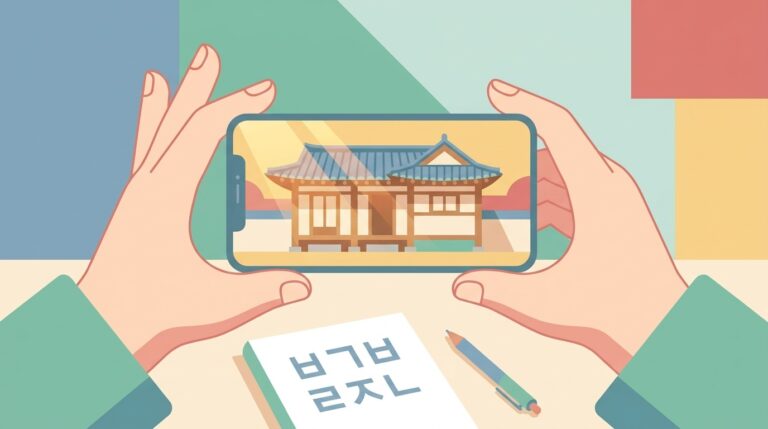
Phase 1: 공감 (Story-Driven Opening)
안녕하세요! 매일한글 에디터입니다.
Picture this: You are standing in front of an idyllic red-brick cafe in Seongsu-dong, or perhaps along the stone wall walkway of Deoksugung Palace. The golden-hour sunlight is hitting just right, your outfit is on point, and you finally gather the courage to ask a friendly passerby or your Korean friend to snap a picture. You utter the textbook phrase you memorized: “사진 좀 찍어주시겠어요?” (Sajin jom jjigeojusigesseoyo? / Could you take a picture of me?)
They smile warmly, hold up your phone, and hit the shutter multiple times. You bow, exchange polite thank-yous, and step aside to check your camera roll—only to feel your heart sink. Your feet are awkwardly cut off at the ankles, your head is trapped squarely in the dead center of the frame, the horizon line tilts precariously by 12 degrees, and two-thirds of the photo is just empty pavement. You want to ask for a retake, but you lack the advanced, natural vocabulary to describe exact visual composition without sounding pedantic, demanding, or rude.
At a C1 level, fluency is not merely about surviving conversations—it is about articulating delicate aesthetic nuances with effortless social tact. In Korea’s vibrant visual culture, directing a shot is a shared social bonding ritual. When you know how to politely specify grid balance, headroom, and angle adjustments, you transform an awkward photo attempt into an enjoyable creative collaboration. Based on real feedback from advanced learners who navigate Seoul’s trendiest spots every day, this masterclass will elevate your visual Korean from textbook stiff to effortlessly sophisticated.
Phase 2: 핵심 표현 3선 심층 분석
1. 발끝을 프레임 하단에 맞춰 주세요 (Balkeuteul peureim hadane matchwo juseyo)
- Pronunciation: [Bahl-kkeut-eul pey-ray-im ha-dan-eh maht-chwo joo-say-yo] (Think of hadan like “ha-dawn”, meaning lower tier)
- Meaning: Literal: “Please align my tiptoes to the bottom of the frame.” | Nuanced: “Could you position the bottom edge right at my feet to elongate my silhouette naturally?”
- K-Culture Moment: Frequently heard behind the scenes of fashion magazine shoots and variety shows like I Live Alone (나 혼자 산다), where celebrities guide their travel mates to avoid the dreaded “short-legged effect.”
- Editor’s Insight: In Korea, this is universally recognized as the foundational golden rule of smartphone photography. Pairing “발끝” (tiptoes) with “프레임 하단” (frame bottom) conveys high-level technical clarity without sounding confrontational.
- Situation Spectrum:
- Casual: ✅ (발끝 여기 아래에 맞춰줘!)
- Semi-formal: ✅ (발끝을 프레임 하단에 맞춰 주세요.)
- Formal: ⚠️ (발끝을 프레임 하단부에 위치시켜 주시기를 부탁드립니다.)
- 🤔 Think About It: Why do you think Korean visual culture emphasizes proportions and elongation over centered framing? How does your culture view directing someone who takes your photo?
2. 여백을 좀 더 살려서 수평 맞춰 주실 수 있나요? (Yeobaegeul jom deo sallyeoseo supyeong matchwo jusil su innayo?)
- Pronunciation: [Yeo-baek-eul jom deo sal-lyeo-seo soo-pyeong maht-chwo joo-shil soo een-na-yo?] (Blend sal-lyeo-seo smoothly like “sahl-lyuh-suh”)
- Meaning: Literal: “Could you revive the empty space a bit more and match the horizon?” | Nuanced: “Could you leave a bit more negative space for aesthetic balance and keep the horizon level?”
- K-Culture Moment: Often uttered by aesthetic cafe curators in Yeonnam-dong or Han River picnickers framing the skyline with scenic headroom.
- Editor’s Insight: The verb “살리다” (to revive/bring to life) is an indispensable C1 stylistic device. Instead of saying the dry “여백을 만드세요” (make empty space), native speakers use “여백을 살리다” to invoke the traditional artistic value of “여백의 미” (the beauty of negative space).
- Situation Spectrum:
- Casual: ✅ (여백 좀 살리고 수평 맞춰줘!)
- Semi-formal: ✅ (여백을 좀 더 살려서 수평 맞춰 주실 수 있나요?)
- Formal: ✅ (여백을 충분히 살려 수평을 맞춰 주시면 감사하겠습니다.)
- 🤔 Think About It: How does the concept of “reviving negative space” (여백을 살리다) reflect traditional Korean visual aesthetics in contrast to Western rule-of-thirds framing?
3. 구도 이대로 잡고 연사로 여러 장 부탁드려요 (Gudo idaero japgo yeonsaro yeoreo jang butakdeuryeoyo)
- Pronunciation: [Goo-doh ee-dae-ro jahp-go yeon-sa-ro yeo-reo jahng boo-tahk-deu-ryeo-yo] (Yeon-sa rhymes with “sun-star” without the final ‘t’)
- Meaning: Literal: “Hold this composition as is and request multiple continuous shots.” | Nuanced: “I’ve locked in this framing, so please fire off a quick burst of shots so we catch natural movement!”
- K-Culture Moment: The signature tactic of Korean MZ influencers on Instagram and travel vloggers seeking spontaneous mid-walk or hair-flip snapshots.
- Editor’s Insight: “연사” is the colloquial abbreviation for “연속 촬영” (continuous burst photography). By handing over the phone with the framing already staged, you save the photographer stress while ensuring candid naturalism.
- Situation Spectrum:
- Casual: ✅ (구도 이대로 잡고 연사로 파바박 찍어줘!)
- Semi-formal: ✅ (구도 이대로 잡고 연사로 여러 장 부탁드려요.)
- Formal: ⚠️ (해당 구도를 유지한 채 연속 촬영으로 진행해 주십시오.)
- 🤔 Think About It: What cultural expectation does “연사” satisfy regarding the burden placed on someone helping you take photos?
Phase 3: 교과서 한국어 vs 진짜 한국어
Situation 1: Asking someone to lower the camera angle to enhance height and posture
- 📖 교과서 한국어: 저의 다리가 길어 보이게 밑에서 위를 향하여 카메라를 위치시켜 주십시오. (Jeoui dariga gireo boige mit-eseo wireul hyanghayeo kamerareul wichisikyeo jusipsio. / Please position the camera from below toward the top so that my legs look long.)
- 🗣️ 진짜 한국어: 폰 살짝만 눕혀서 밑에서 위로 앵글 잡아주실 수 있어요? (Pon saljjakman nupyeoseo mit-eseo wiro aenggeul jabajusil su isseoyo? / Could you tilt the phone back slightly and catch the angle from below?)
- 💡 왜 다를까? Textbook phrasing relies on stiff mechanical commands (“위치시켜 주십시오”). In actual Korean everyday speech, speakers use visceral, tactile verbs like “눕히다” (to lay flat/tilt backwards) and natural loanwords like “앵글” to maintain warmth and clarity.
Situation 2: Asking for a balanced, wide shot that emphasizes the cafe atmosphere
- 📖 교과서 한국어: 제 뒤편의 배경과 제가 균형을 이루도록 원거리에서 촬영해 주시기 바랍니다. (Je dwipyeonui baegyeong-gwa jega gyunhyeon-geul irudorok won-geori-eseo chwaryeonghae jusigi baramnida. / I hope you shoot from a long distance so the background behind me and I are balanced.)
- 🗣️ 진짜 한국어: 인물 위주보다는 배경 감성 살게 상반신만 살짝 걸쳐주세요! (Inmul wijubodaneun baegyeong gamseong salge sangbansinman saljjak geolchyeojuseyo! / Rather than focusing solely on me, please catch just my upper body so the ambient background vibe really shines through!)
- 💡 왜 다를까? Modern Korean social photography prioritizes “감성” (aesthetic vibe) and conversational idioms like “걸치다” (to casually frame/drape into view), creating a cooperative artistic tone rather than an instruction manual.
Phase 4: K-Culture 딥다이브 & 비언어적 매너
4-1. 눈치 (Nunchi) & Gestures: The Smartphone Handoff Etiquette
- The Pre-framing Courtesy: Never hand someone a locked phone or an uncalibrated camera screen. Open the default camera app, activate the 3×3 grid (격자), frame a test sample to show them on screen (“이 느낌으로 부탁드려요”), and then hand the phone over with both hands.
- The Committed Squat (기마자세): If you are taking the picture for a Korean friend, adopting a deep athletic squat or lowering your center of gravity isn’t comical—it is celebrated as the ultimate sign of sincerity and loyalty. The lower your camera lens dips, the deeper your friendship.
- The Instant Gratitude Check: When receiving your phone back, do not scrutinize the photos with a furrowed brow. Immediately preview the first shot and exclaim warm affirmation: “우와, 구도 진짜 대박이에요! 완전 금손이시네요!” (Wow, this composition is incredible! You have golden hands!)
4-2. Culture Code: “인생샷” (Insaeng-shot) & 품앗이 (Puma-asi)
In contemporary Korean culture, an “인생샷” (a once-in-a-lifetime shot) is not considered superficial vanity. It is an artistic artifact marking personal milestones, social outings, and memories. Consequently, asking a stranger or acquaintance to take a photo carries an unspoken code of mutual exchange known historically as “품앗이” (communal labor reciprocity). If someone dedicates thirty seconds to craft your 인생샷, social etiquette encourages you to immediately offer: “제가 한 번 멋지게 찍어드릴까요?” (Shall I take a great shot for you in return?)
Phase 5: 실전 롤플레이 시나리오
- Location: The rooftop terrace of a design cafe in Seongsu-dong, bathed in late-afternoon sunlight.
- Characters: You (Advanced learner exploring Seoul) and Minseo (민서, 27, brand visual director with an uncompromising eye for aesthetics).
- 민서: 여기 자연광 대박이다! 너 저기 콘크리트 기둥 옆에 서 봐. 내가 오늘 인생샷 한 장 건져줄게! (Yeogi jayeon-gwang daebag-ida! Neo jeogi kongkeuriteu gidung yeope seo bwa. Naega oneul insaeng-syat han jang geonjyeojulge! / The natural light here is insane! Go stand next to that concrete pillar. I’m going to score you a once-in-a-lifetime shot today!)
🎭 Action: 민서 pulls out her phone, immediately wiping her lens on her sleeve. -
You: 와, 진짜 고마워! 발끝 화면 맨 아래 프레임에 맞춰줄 수 있어? (Wa, jinjja gomawo! Balkeut hwamyeon maen arae peureime matchwojul su isseo? / Wow, thank you so much! Could you align my feet with the very bottom frame of the screen?)
🎭 Action: You step into place and lightly tap the toe of your sneaker on the wooden deck. -
민서: 오케이, 발끝 라인 잡았어. 근데 지금 머리 위 여백이 너무 꽉 차는데, 폰 살짝 눕혀서 로우앵글로 갈까? (Okei, balkeut rain jabasseo. Geunde jigeum meori wi yeobaeegi neomu kkwak chaneunde, pon saljjak nupyeoseo rou-aenggeullo galkka? / Okay, foot line locked. But the headroom above your head feels a bit too cramped right now—shall I tilt the phone back slightly for a low angle?)
🎭 Action: 민서 tilts her wrist down slightly and lowers her hips into a half-squat. -
You: 응, 그렇게 눕히고 뒤에 있는 아치형 창문까지 살려서 수평 좀 맞춰줘! (Eung, geureoke nupigo dwie inneun achihyeong changmunkkaji sallyeoseo supyeong jom matchwojwo! / Yes, tilt it like that, keep the arched window in the back alive, and level out the horizon for me!)
🎭 Action: You adjust your posture, angling your shoulders slightly sideways to catch the light. -
민서: 격자선 기준 아치 중앙에 뒀고, 수평 완벽해. 너무 굳어 있지 말고 커피 잔 들면서 자연스럽게 시선 아래로 떨궈봐. (Gyeokjaseon gijun achi jung-ange dwotgo, supyeong wanbyeokhae. Neomu gudeo itji malgo keopi jan deulmyeonseo jayeonseureopge siseon araero tteolgweobwa. / Based on the grid lines, the arch is centered, and the horizon is perfect. Don’t freeze up; pick up the coffee cup and drop your gaze naturally downward.)
🎭 Action: 민서 holds the phone rock-steady with both hands. -
You: 좋아. 구도 딱 이대로 고정하고 연사로 서너 장 연달아 파바박 찍어줘! (Joha. Gudo ttak idaero gojeonghago yeonsaro seoneo jang yeondara pababak jjigeojwo! / Perfect. Keep the framing exactly locked like that and fire off three or four burst shots in a row!)
🎭 Action: You pick up your iced latte and look casually toward the courtyard. -
민서: 간다! 찰칵, 찰칵, 찰칵! 와, 대박. 바람 살짝 불어서 머리카락 날릴 때 분위기 완전 찢었다. 얼른 와서 봐 봐! (Ganda! Chalkak, chalkak, chalkak! Wa, daebak. Baram saljjak bureoseo meorikarang nallil ttae bun-wigi wanjeon jjijeotda. Eolleun waseo bwa bwa! / Here it comes! Click, click, click! Whoa, epic. The breeze blew slightly and your hair fluttered—the vibe absolutely crushed it. Come check this out right now!)
🎭 Action: 민서 turns the screen around with a triumphant grin. -
You: 미쳤다! 비율 완전 사기 수준인데? 민서야, 너 진짜 감각 타고난 황금손이다! (Michyeotda! Biyul wanjeon sagi sujuneinde? Minseoya, neo jinjja gamgak tagonan hwang-geumson-ida! / Insane! My proportions look totally unreal! Minseo, you are an absolute born golden-hand artist!)
🎭 Action: You clap your hands in awe and immediately offer to shoot her photos next.
🔀 Interactive Branching Point
After reviewing the photos, what do you say next to demonstrate the highest level of Korean social tact?
* Choice A: “민서야, 진심으로 구도 예술이다! 이제 내가 너 찍어줄 테니까 저기 창가 쪽에 서 봐. 똑같이 연사로 담아줄게.” (Minseoya, jinsimeuro gudo yesul-ida! Ije naega neo jjigeojul tenikka jeogi changga jjoge seo bwa. Ttokgati yeonsaro damajulge.)
* Choice B: “사진 마음에 드네. 근데 얼굴이 살짝 어두우니까 보정 어플 켜서 한 번만 다시 찍어줄래?” (Sajin maeume deune. Geunde eolguri saljjak eodu-unikka bojeong eopeul kyeoseo han beonman dasi jjigeojullae?)
* Choice C: “고마워. 다음 장소로 이동할까?” (Gomawo. Daeum jangsoro idonghalkka?)
Branching Feedback:
- Choice A (Best): Flawless C1 social navigation! You validated her effort with genuine enthusiasm and seamlessly initiated reciprocal “품앗이” etiquette.
- Choice B (Risk): While constructive, immediately asking for an unfiltered retake with an editing app can deflate the mood and make the other person feel unappreciated.
- Choice C (Bad): Walking away without returning the favor or praising her framing breaches Korean social etiquette regarding shared photo expeditions.
Phase 6: 10초 감정 섀도잉 드릴
Practice these rhythm chunks aloud, honoring the pause markers (/) and emotional tone cues.
- [😊 자신감 넘치고 명쾌하게 / Crisp & Confident]
“발끝을 / 프레임 하단에 딱 맞추고, / 폰 살짝만 눕혀주세요!”
(Balkeuteul / peureim hadane ttak matchugo, / pon saljjakman nupyeojuseyo! / Align the feet right at the frame bottom, / and tilt the phone back just a bit!) -
[🥺 조심스럽고 공손하게 / Polite & Tactful]
“혹시 / 뒤에 수평 조금만 맞춰서 / 연사로 여러 장 / 부탁드려도 될까요?”
(Hoksi / dwie supyeong jogeumman matchwoseo / yeonsaro yeoreo jang / butakdeuryeodo doelkkayo? / By any chance, / could you level out the horizon a bit in back / and take a burst shot / if you don’t mind?) -
[🤩 감탄하며 극찬하듯이 / Awe-struck & Appreciative]
“우와, / 구도 진짜 사기예요! / 완전 인생샷 건졌어요, / 감사해요!”
(Uwa, / gudo jinjja sagiyeyo! / Wanjeon insaeng-syat geonjyeosseoyo, / gamsahaeyo! / Wow, / the framing is pure magic! / I totally scored a once-in-a-lifetime shot, / thank you!)
Phase 7: K-Culture 미니 사전
- 인생샷 (Insaeng-shot | Life Shot)
* Literal: Life shot | Usage: The single finest photograph of your life, capturing optimal lighting, angle, and atmosphere. Widely used across social media and casual lifestyle conversations.
- 금손 (Geum-son | Golden Hand) vs 똥손 (Ddong-son | Clumsy Hand)
* Literal: Gold hand vs. Poop hand | Usage: “금손” describes someone blessed with innate artistic flair, photography finesse, or culinary skill. “똥손” is lighthearted self-deprecating slang for someone whose photos always turn out blurry or horribly framed.
- 수평 맞추기 (Supyeong Matchugi | Horizon Leveling)
* Literal: Matching horizontal balance | Usage: Ensuring the ground line or ocean horizon parallel to the frame grid. Skewed horizons are considered the prime sign of an amateur smartphone photo in Korea.
- 여백의 미 (Yeobaeg-ui Mi | Aesthetic of Negative Space)
* Literal: The beauty of empty borders | Usage: Originating from classical ink-wash painting, this phrase is now dynamically used in modern photography to describe generous headroom and intentional minimalist space around the subject.
Phase 8: 여행자를 위한 생존 키트
Top 3 Survival Phrases
- “가로로 한 장, 세로로 한 장 부탁드려요.” (Garoro han jang, seroro han jang butakdeuryeoyo.)
- Meaning: “Could you take one horizontal shot and one vertical shot, please?”
- Pro Tip: Essential when you’re undecided between an Instagram Story (vertical) and a landscape background shot.
- “배경 위주로 넓게 담아주실 수 있나요?” (Baegyeong wijuro neolbge damajusil su innayo?)
- Meaning: “Could you capture a wide view with an emphasis on the background?”
- Pro Tip: Perfect at royal palaces or Han River lookouts when you want to look small amidst grandeur.
- “제가 먼저 구도 잡아둘게요, 셔터만 눌러주세요!” (Jega meonjeo gudo jabadulgeyo, syeoteoman nulleojuseyo!)
- Meaning: “I’ll frame the composition first; you just have to press the shutter!”
- Pro Tip: The most considerate way to ask an elderly Korean or busy stranger for a photo without burdening them.
Editor’s Travel Note
When hunting for top-tier scenic compositions across Seoul, search for location tags using the Naver Map photo spot search. It provides pinpoint user-uploaded photos showing the exact angle from which landmark shots were taken. If traveling via transit, install the KakaoMap subway guide for real-time exit proximity. Note that Korea’s domestic smartphones have mandatory camera shutter sounds by law; do not be alarmed when strangers’ phones emit a distinct “찰칵!” in quiet public spaces.
Phase 9: “한 발 더 깊이” (생각 질문)
In modern Korean society, framing a photo is an eloquent exercise in empathy. Directing another person’s camera angle or adjusting your posture to shoot for someone else is a tangible manifestation of “정” (jeong, deep social bonding) and “배려” (consideration). When a Korean friend drops to one knee on a cold sidewalk to get your feet aligned with the lower frame, they are offering an act of communal hospitality. Photography becomes a silent dialogue of validation: I see you at your best, and I want the world to see you that way, too.
💬 Your Turn: Have you ever felt hesitant to direct someone taking your photo due to language barriers? What Korean composition phrase will you test out first at your next travel stop? Share your thoughts below!
Phase 10: FAQ & 오해 방지
Q: Is it rude to ask a stranger to retake a photo in Korea if the first shot has poor framing?
A: It depends entirely on your phrasing and tone! If you say “다시 찍어주세요” (Shoot it again), it comes across as demanding. However, if you enthusiastically praise the first shot and politely add, “혹시 너무 잘 찍어주셨는데, 세로로 한 장만 더 부탁드려도 될까요?” (You took such a great photo—could I trouble you for just one more vertically?), almost any Korean will happily oblige.
Q: Why do Koreans insist on putting the feet at the exact bottom of the frame?
A: Smartphone wide-angle lenses naturally stretch imagery slightly at the peripheral edges. Aligning the feet near the lower edge utilizes optical barrel distortion to make the subject’s legs appear elongated and elegant without needing digital manipulation apps.
Q: What is the most natural way to decline when someone asks you to take their photo?
A: If you are in a rush or feel uncomfortable, use soft honorific hedging: “죄송해요, 제가 지금 이동해야 해서요!” (I’m so sorry, I have to get moving right now!) with a polite nod.
🚨 Common Mistakes Warning Board
- ❌ Saying “제 키를 크게 찍으세요!” (Commanding: “Shoot my height big!”)
- ⭕ Correct Action: “다리 길어 보이게 폰 살짝만 눕혀주세요!” (Polite, technical, and natural).
- ❌ Handing over your phone with camera gridlines disabled.
- ⭕ Correct Action: Always turn on the 3×3 grid (격자) in camera settings so the helper can instantly benchmark horizontal lines.
- ❌ Inspecting the photos silently before walking away.
- ⭕ Correct Action: Immediately beam with appreciation, offer verbal compliments (“완전 금손이세요!”), and ask if they’d like a photo taken in return.
Phase 11: 액션 미션 & 참여 유도
- 🥉 Bronze Mission (Solo Practice): Open your camera right now, turn on the 3×3 grid, and rehearse saying aloud: “발끝을 프레임 하단에 맞추고 폰 살짝 눕히기!”
- 🥈 Silver Mission (Social Share): Take an aesthetic photo today utilizing “여백의 미” (negative space). Post it with the Korean caption: “오늘의 구도: 여백 살리고 수평 맞추기 성공!” and tag @DailyHangul.
- 🥇 Gold Mission (Real-World Execution): Next time you are at a cafe or landmark, hand your phone to a friend or local using the exact phrase: “구도 이대로 잡고 연사로 여러 장 부탁드려요!”
🎮 K-Culture Mission: Watch the latest episode of any Korean travel variety show (such as Earth Arcade or Europe Outside Your Tent). Spot how many times the cast members drop into a low squat or say “수평 맞춰!” while taking photos for each other.
Phase 12: 인터랙티브 퀴즈 챌린지
1. 상황 판단 퀴즈 (Situational Judgment)
You want your friend to capture the grandeur of a Hanok roof above you while ensuring your legs do not look short. Which phrase achieves this with authentic C1 nuance?
A) 제 얼굴을 중앙에 놓고 하늘을 많이 찍어주십시오.
B) 발끝 하단에 맞추고, 한옥 처마 여백 살려서 수평 맞춰줄 수 있어?
C) 사진기가 무거우니 빨리 아무렇게나 셔터를 누르세요.
2. 빈칸 채우기 (Fill in the Blanks)
“배경 분위기 살게 인물은 상반신만 살짝 [ ], 폰 살짝 [ ] 앵글 잡아주세요.”
(Hint: Words for ‘lightly draping/framing into view’ and ‘tilting backward’)
3. 문화 진위 퀴즈 (True or False)
True or False: In Korea, asking for burst mode photography (“연사”) is considered annoying and impolite to the person holding the camera.
👉 Click here to reveal answers & detailed explanations!
- Answer: B
- Explanation: Option B masterfully combines foot-line alignment (“발끝 하단”), negative headroom (“처마 여백 살려서”), and horizon alignment (“수평 맞추기”). Option A ruins proportions, and Option C is rude.
- Answer: 걸쳐주시고 / 눕혀서
- Explanation: “걸치다” creates that chic, intentional framing where the subject naturally enters the frame without dominating it, while “눕히다” is the go-to verb for lowering/tilting the lens angle.
- Answer: False
- Explanation: Quite the opposite! Asking for “연사” (burst shots) frees the photographer from the high pressure of capturing one immaculate shot, allowing both parties to capture relaxed, candid micro-movements effortlessly.
- Explanation: Quite the opposite! Asking for “연사” (burst shots) frees the photographer from the high pressure of capturing one immaculate shot, allowing both parties to capture relaxed, candid micro-movements effortlessly.







