

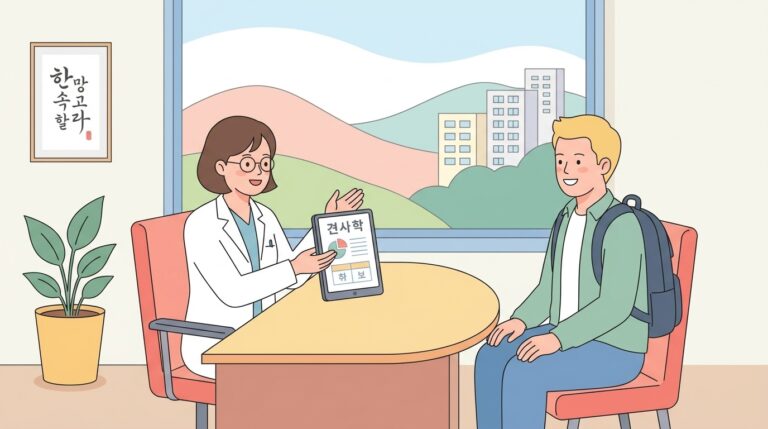
Master Your Korean Health Checkup: From Booking to Results with Confidence
Phase 1: Empathy (Real-Life Hospital Moments)
안녕하세요! 매일한글 에디터입니다. (Hello! I’m your Daily Hangul editor.)
Have you ever watched an episode of Hospital Playlist (슬기로운 의사생활) or Doctor Cha (닥터 차정숙) and wondered how you would fare if you had to navigate a high-tech Korean university medical center on your own? Picture this: You receive an official-looking notification on KakaoTalk reminding you that you are due for your mandatory biennial national health screening (국민건강보험 일반건강검진). Your Korean colleagues casually chat around the water cooler: “이번에 대장내시경도 같이 추가해서 신청했어? (Did you add a colonoscopy this time?)” or “공복 8시간 유지하는 거 너무 힘들다! (Keeping an empty stomach for eight hours is brutal!)”
You nod along, but inside, a wave of anxiety hits. Booking an appointment is one thing, but how do you explain your medical history, request conscious sedation for an endoscopy, or sit down with an attending physician to review tricky test results filled with specialized clinical jargon? Many intermediate learners can comfortably order a flat white in Hongdae or haggle at Dongdaemun, yet freeze completely when handed a two-page health questionnaire (문진표) or listening to a doctor discuss elevated liver enzymes.
You are not alone. Our international community members frequently report that medical consultations are their number one “linguistic roadblock” in Korea. But here is the good news: navigating a Korean general health examination center (종합건진센터) does not require a five-year medical degree. By mastering the core structural patterns, subtle polite registers, and hospital-specific cultural codes (눈치), you can handle your next checkup like an empowered local. Let us walk through this together!
Phase 2: Top 3 Essential Expressions for Health Checkups
1. 위내시경을 수면으로 진행하고 싶은데요. (Wi-naesigyeong-eul sumyeon-euro jinhaenghago sipeundeoyo.)
- Pronunciation: [Wee-nae-she-gyung-eul soo-myeon-eu-ro jin-haeng-ha-go shi-peun-de-yo] (Think of ‘sumyeon’ sounding smoothly like ‘sue-myeon’, gently easing you into sleep).
- Meaning: Literal: “I would like to proceed with the gastroscopy via sleep.” / Real Nuance: “I’d prefer conscious sedation (twilight anesthesia) for my stomach endoscopy.”
- K-Culture Moment: In K-dramas, whenever a corporate worker complains about chronic indigestion, someone invariably asks, “내시경 받아봤어? 꼭 수면으로 해, 비수면은 지옥이야! (Have you had an endoscopy? Make sure to get sedation; unsedated is pure hell!)”
- Editor’s Insight: In Korea, “수면 (sumyeon)” literally means sleep, but in clinical settings it universally refers to conscious twilight sedation (의식하 진정내시경). Saying “수면으로 해주세요” is far more natural than using English medical terminology.
- Situation Spectrum: Casual: ⚠️ (Sounds too formal for street chat) | Semi-formal: ✅ | Formal: ✅
- 🤔 Think About It: Notice how Korean uses the soft sentence ender “~고 싶은데요 (~go sipeundeoyo)” rather than a direct command. Why does hedging requests soften the doctor-patient hierarchy in Korean medical culture?
2. 공복 상태를 몇 시간 동안 유지해야 하나요? (Gongbok sangtae-reul myeot sigan dongan yujihayeoya hanayo?)
- Pronunciation: [Gong-bok sang-tae-reul myut shi-gan dong-an yoo-ji-hae-ya ha-na-yo?] (Think of ‘gong’ like a ringing gong, reminding your empty belly of hollow space).
- Meaning: Literal: “For how many hours must I maintain an empty-stomach state?” / Real Nuance: “How many hours of fasting are required prior to the test?”
- K-Culture Moment: On popular variety shows like I Live Alone (나 혼자 산다), celebrities often collapse on their sofas whining about their 12-hour fast before checkup day, drinking only drops of water while glancing at food delivery apps.
- Editor’s Insight: The Sino-Korean word “공복 (gongbok; 空腹)” is composed of ‘empty’ (공) and ‘abdomen/belly’ (복). Using “공복” marks you immediately as an articulate B2 speaker compared to simply saying “밥 안 먹는 거 (not eating food)”.
- Situation Spectrum: Casual: ⚠️ (A bit stiff for friends) | Semi-formal: ✅ | Formal: ✅
- 🤔 Think About It: Why does Korean healthcare rely heavily on precise Sino-Korean compounds for routine bodily instructions instead of pure native verbs?
3. 재검이나 정밀 검사가 필요한 소견이 있나요? (Jaegeom-ina jeongmil geomsa-ga piryohan sogyeon-i innayo?)
- Pronunciation: [Jae-gum-ee-na jung-mil gum-sa-ga pee-ryo-han so-gyun-ee eep-na-yo?] (Pronounce ‘sogyeon’ crisp and clipped, showing medical inquiry).
- Meaning: Literal: “Is there any opinion requiring retesting or precise examination?” / Real Nuance: “Are there any abnormal findings that require a follow-up test or a more detailed scan?”
- K-Culture Moment: The tense scene in family melodramas where the protagonist waits anxiously across from a stern doctor who adjusts their glasses before reading the checkup dossier.
- Editor’s Insight: “소견 (sogyeon)” is a clinician’s professional observation or diagnostic finding. Asking about “소견” elevates your inquiry from “Am I sick?” to “What is your diagnostic evaluation?”
- Situation Spectrum: Casual: 🚫 | Semi-formal: ✅ | Formal: ✅
- 🤔 Think About It: In your native culture, do you usually ask your doctor directly for detailed test data, or do you wait for them to direct the conversation?
Phase 3: Textbook Korean vs. Real Korean
Situation 1: Inquiring About Additional Optional Screenings
- 📖 교과서 한국어 (Textbook):
- 다른 검사 항목들을 더 추가할 수 있습니까? (Dareun geomsa hangmokdeureul deo chugahal su isseumnikka? – Can I add other inspection items?)
- 🗣️ 진짜 한국어 (Real Korean):
- 이번 검진에 갑상선 초음파도 선택 항목으로 넣을 수 있을까요? (Ibeon geomjine gapsangseon cho-eumpado seontaek hangmogeuro neoeul su isseulkkayo? – Could I include a thyroid ultrasound as an optional add-on for this checkup?)
- 💡 왜 다를까? (Why is it different?):
- Textbook Korean uses stiff military-style “-습니까” endings. Real patients use soft conditional forms like “~넣을 수 있을까요?” while explicitly naming typical Korean add-on screenings (선택 항목) like ultrasounds (초음파).
Situation 2: Asking if a Result Finding is Dangerous
- 📖 교과서 한국어 (Textbook):
- 이 결과는 위험한 질병을 의미합니까? (I gyeolgwaneun wiheomhan jilbyeongeul uimihamnikka? – Does this result signify a dangerous disease?)
- 🗣️ 진짜 한국어 (Real Korean):
- 크게 걱정할 만한 수치는 아닌 거죠? 그냥 추적관찰만 하면 될까요? (Keuge geokjeonghal manhan suchineun anin geojyo? Geunyang chujeokgwanchalman hamyeon doelkkayo? – It’s not an alarming number, right? Can we just monitor it over time?)
- 💡 왜 다를까? (Why is it different?):
- Real native speakers look for reassurance using tag questions like “~인 거죠?” and employ the standard clinical phrase “추적관찰 (chujeok-gwanchal; regular follow-up monitoring)” rather than catastrophizing with words like “위험한 질병”.
Phase 4: K-Culture Deep Dive & Non-Verbal Etiquette
4-1. Hospital Nunchi (눈치) & Body Language
- Two-Handed Handover: When handing over your alien registration card (ARC), insurance paperwork, or your stool/urine collection kit, always support your right forearm with your left hand, or hold the item with both hands. It communicates deep respect in Korean institutional spaces.
- The Attentive Nod (끄덕임): Korean doctors speak fast and value efficiency. While the doctor scrolls through your chest X-ray and blood panel, do not interrupt mid-sentence. Maintain soft eye contact, nod rhythmically with an occasional “네, 원장님 (Yes, doctor),” and save your clarifying questions until they finish their initial clinical summary.
4-2. Cultural Code: The Biennial Checkup Ritual (국가건강검진 문화)
In Korea, health screening is not an occasional luxury; it is a civic rhythm. Under the National Health Insurance Service (NHIS), all enrolled residents receive free general checkups every two years based on whether their birth year is odd or even (e.g., odd birth years in 2025). Furthermore, Korean companies treat comprehensive screenings (종합검진) as a core employee welfare package (복지). You will often hear coworkers discussing which partner hospital offers the best breakfast porridge voucher (죽 쿠폰) after your checkup. Embracing this screening culture is a definitive badge of living like a true Korean resident!
Phase 5: Real-World Roleplay Scenario
Setting: Seoul Asan Medical Examination Center (건강검진센터 상담실). The room smells subtly of antiseptic and warm roasted barley tea. Coordinator Kim Min-ji sits behind a dual monitor displaying lab charts.
- 간호사 김민지 (Nurse Kim): 안녕하세요, 데이비드 님. 문진표 작성하신 거 확인해 드렸고요, 오늘 검진 항목 최종 확인 도와드릴게요.
(Annyeonghaseyo, David-nim. Munjinpyo jakseonghasin geo hwaginhae deuryeotgoyo, oneul geomjin hangmok choejong hwagin dowadeurilgeyo.)
“Hello, David. I’ve checked your medical questionnaire, and I will assist you with the final confirmation of today’s screening package.”
🎭 [Reviewing the tablet screen and smiling politely] -
학습자 (David): 네, 감사합니다. 저, 오늘 기본 검진 외에 위내시경도 포함되어 있는 거죠?
(Ne, gamsahamnida. Jeo, oneul gibon geomjin oe-e wi-naesigyeongdo pohamdoe-eo inneun geojyo?)
“Yes, thank you. Um, besides the basic checkup, a gastroscopy is included today, right?”
🎭 [Glancing down at the checklist paper] -
간호사 김민지 (Nurse Kim): 네, 맞습니다. 그런데 수면으로 신청하셨는데, 어젯밤 9시 이후로 물 포함해서 완전히 금식하셨나요?
(Ne, matseumnida. Geureonde sumyeon-euro sincheonghasyeonneunde, eojetbam ahopsi ihuro mul pohamhaeseo wanjeonhi geumsikhasyeonnayo?)
“Yes, that’s correct. You applied for sedation; did you fast completely, including water, after 9 PM last night?”
🎭 [Tapping the screen with her stylus] -
학습자 (David): 네, 어제 저녁 8시에 가볍게 죽 먹고 지금까지 물 한 모금도 안 마셨어요.
(Ne, eoje jeonyeok yeodeolsie gabyeopge juk meokgo jigeumkkaji mul han mogeumdo an masyeosseoyo.)
“Yes, I ate light porridge at 8 PM yesterday and haven’t had a single sip of water since.”
🎭 [Nodding affirmatively] -
간호사 김민지 (Nurse Kim): 아주 잘하셨어요! 혹시 오늘 자가운전해서 오셨을까요? 수면내시경 후에는 절대 운전하시면 안 되거든요.
(Aju jalhasyeosseoyo! Hoksi oneul jaga-unjeonhaeseo osyeosseulkkayo? Sumyeon-naesigyeong hueneun jeoldae unjeonhasimyeon an doegeodeunyo.)
“Splendid! By any chance, did you drive here yourself today? You must absolutely not drive after conscious sedation.”
🎭 [Looking up with a cautious, caring expression] -
학습자 (David): 걱정 마세요. 지하철 타고 왔습니다. 결과 상담은 당일에 바로 들을 수 있나요?
(Geokjeong maseyo. Jihacheol tago wasseumnida. Gyeolgwa sangdameun dang-ire baro deureul su innayo?)
“Don’t worry. I came by subway. Can I get the consultation on the results today?”
🎭 [Shaking head lightly and smiling] -
간호사 김민지 (Nurse Kim): 당일에는 혈액 검사나 조직 검사 결과가 나오지 않아서요. 2주 뒤에 우편이나 카카오톡 모바일 문서로 상세 소견서를 받아보실 수 있어요.
(Dang-ireneun hyeoraek geomsa-na jojik geomsa gyeolgwaga naoji anaseoyo. I-ju dwie upyeon-ina kakaotok mobail munseoro sangse sogyeonseoreul badabosil su isseoyo.)
“Blood tests and biopsy results don’t come out on the same day. You can receive your detailed report via post or mobile KakaoTalk documents in two weeks.”
🎭 [Handing a barcode wristband with two hands] -
학습자 (David): 알겠습니다. 이상 소견이 나오면 그때 다시 내원해서 진료받으면 되겠네요.
(Algetseumnida. Isang sogyeoni naomyeon geuttae dasi naewonhaeseo jinryobadeumyeon doegenneyo.)
“Understood. If there are any abnormal findings, I can just visit the clinic again for consultation then.”
🎭 [Fastening the wristband and bowing slightly]
🔀 Interactive Branching Moment
Suppose the doctor reviews your initial ultrasound and says: “간 수치가 기준치보다 조금 높게 나왔네요. (Your liver enzyme level came back slightly above baseline.)” How do you respond?
- Choice A: “당장 입원해서 수술해야 하나요? (Do I need to be hospitalized and have surgery right now?)”
- Feedback (Bad): Too extreme! Moderate enzyme elevations are common. Asking this sounds overly dramatic and puts clinical staff on edge.
- Choice B: “피곤해서 그런 것 같은데, 그냥 약국 가서 우루사 사 먹으면 되죠? (I think it’s just fatigue; I can just buy Ursa at the pharmacy, right?)”
- Feedback (Risk): Self-diagnosing based on Korean commercials will make the doctor sigh. Let the doctor interpret the root cause.
- Choice C: “최근 야근이 잦았는데 그 영향일까요? 다음 달에 재검을 받아보는 게 좋을까요? (I’ve had frequent overtime recently; could that be the cause? Should I schedule a retest next month?)”
- Feedback (Best!): Highly contextual and polite. You provide relevant lifestyle context while asking for professional guidance on a retest (재검).
Phase 6: 10-Second Emotional Shadowing Drill
Practice these lines with rhythm, feeling the pauses marked by /.
- [😰 살짝 긴장한 목소리로 – Slightly tense and cautious]
위내시경 받을 때 / 수면 마취가 / 중간에 깨지는 않겠죠?
(Wi-naesigyeong badeul ttae / sumyeon machwiga / junggan-e kkaejineun anketjyo?)
“When I get the gastroscopy… the sedation won’t wear off in the middle, right?” -
[🩺 진지하고 또렷하게 – Serious and articulate]
가족력으로 / 당뇨가 있어서 / 당화혈색소 수치를 / 자세히 보고 싶습니다.
(Gajongnyeogeuro / dangnyoga isseoseo / danghwahyeolsaekso suchireul / jasehi bogo sipseumnida.)
“Because of my family history of diabetes, / I would like to examine / my HbA1c levels in detail.” -
[😊 안도하며 정중하게 – Relieved and appreciative]
특별한 용종이나 / 이상 소견이 없어서 / 정말 다행이네요. 감사합니다!
(Teukbyeolhan yongjong-ina / isang sogyeoni eopseoseo / jeongmal dahaeng-ineyo. Gamsahamnida!)
“I am so relieved / that there were no notable polyps / or abnormal findings. Thank you!”
Phase 7: K-Culture Mini Dictionary
- 건강검진 (Geongang-geomjin) | General Health Examination / Screening
- The overarching term for statutory or corporate health screenings in Korea. Distinct from an emergency room visit (응급실 진료) or outpatient clinic visit (외래 진료).
- 수면내시경 (Sumyeon-naesigyeong) | Endoscopy Under Twilight Sedation
- Literally “sleep endoscopy”. If you don’t want to swallow an active camera tube while wide awake, this compound is your lifeline.
- 공복 (Gongbok) | Fasting State / Empty Stomach
- Used on instructions: “공복 유지 (maintain fast)” or “공복 혈당 (fasting blood sugar)”. In Korea, this strictly means no coffee, no chewing gum, and no water!
- 추적관찰 (Chujeok-gwanchal) | Follow-Up Observation / Active Monitoring
- When a benign thyroid nodule or tiny polyp is spotted, doctors will say, “6개월 뒤에 추적관찰 합시다 (Let’s monitor it with a follow-up in six months).” It means keep calm, no panic needed.
Phase 8: Expat & Traveler Medical Survival Kit
Survival Expressions TOP 3
- 문진표 영어 버전이 있나요?
(Munjinpyo yeong-eo beojeon-i innayo?)
Pro Tip: Major university centers always have English questionnaires; asking this saves 20 minutes of translating medical acronyms on your phone. - 조영제 부작용이 있어서 CT 촬영 전에 확인 부탁드립니다.
(Joyeongje bujagyongi isseoseo CT chwallyeong jeone hwagin butakdeurimnida.)
Pro Tip: If you have allergies to contrast agents (조영제), memorize this sentence to protect yourself during advanced scans. - 검진 결과표를 이메일 PDF 파일로도 보내주실 수 있나요?
(Geomjin gyeolgwapyoreul imeil PDF pail-rodo bonaejusil su innayo?)
Pro Tip: Postal delivery to studio apartments can get lost; receiving the digital report is essential for international insurance records.
Editor’s Travel & Expat Note
- Check Your Eligibility: Log into the 국민건강보험공단 건강iN 포털 using your digital certificate (Kakao or Toss Pay auth) to verify your biennial checkup tier.
- Finding Multilingual Centers: Search “외국인 검진센터” on the 네이버 지도 앱 다운로드 to locate designated international healthcare centers (국제진료센터) near Gangnam, Sinchon, or Bundang.
Phase 9: “One Step Deeper” (한 발 더 깊이)
In many Western cultures, seeking diagnostic testing occurs primarily after acute symptoms emerge. In South Korea, healthcare philosophy leans heavily into collective preventative vigilance. Driven by both rapid economic industrialization and a high population density, Korea established universal preventative screenings as early as the late 1990s. Taking care of your body is seen not merely as private maintenance, but as a reciprocal duty to your workplace and family—avoiding sudden burden on the community.
💬 Your Turn: How does health screening work in your home country? Is preventative checkup culture common, or do you only visit clinics when feeling unwell? Drop your experiences in the comments below!
Phase 10: FAQ & Avoiding Misconceptions
Q: Can I drink a small sip of water in the morning if my mouth feels bone-dry?
A: If your screening includes a gastroscopy (위내시경) or abdominal ultrasound, absolutely not. Water reflects light on the endoscopic camera lens and dilutes stomach secretions, making micro-lesions harder to spot. Rinse your mouth, spit it all out, and maintain absolute fasting (절대 금식).
Q: What should I do if I am a woman and my scheduled screening coincides with my menstrual cycle?
A: Immediately inform the reception desk. Urine tests and Pap smears (자궁경부암 검사) will produce skewed false-positive red blood cell counts. The center will simply reschedule those specific tests for another date.
Q: Will my private corporate checkup results be leaked to my boss?
A: No. Under the strict Personal Information Protection Act (개인정보보호법), medical institutions send comprehensive confidential dossiers only to the individual. The company only receives a simplified compliance confirmation stating you finished your mandatory duty.
🚨 Common Mistakes Warning Board
- Mistake: Assuming “비수면 (non-sedated)” endoscopy is easy because it is free.
- Correct Action: If you have a sensitive gag reflex, pay the extra 50,000–80,000 KRW for “수면 (sedation)”. You will wake up refreshed after a 20-minute nap.
- Mistake: Drinking black coffee thinking it’s not food.
- Correct Action: Caffeine stimulates bile acid production in the gallbladder, ruining ultrasound images. No coffee!
- Mistake: Driving a car home because you “feel awake” after sedation.
- Correct Action: Korean hospitals strictly prohibit sedated patients from driving. Your reflexes remain impaired for hours. Take the subway (지하철).
Phase 11: Action Mission & Community Challenge
- 🥉 Bronze Mission (Solo Mastery): Practice saying “위내시경 수면으로 예약하고 싶어요” out loud three times while timing your pause correctly.
- 🥈 Silver Mission (Shadow & Share): Record yourself reading the Phase 6 Shadowing Drill on voice memo. Listen back for clean pronunciation of the Sino-Korean vowels in 추적관찰 and 소견.
- 🥇 Gold Mission (Real Life Action): Check your NHIS status or call your neighborhood clinic reception desk (접수처) to ask: “올해 건강검진 대상자인지 확인해 주시겠어요? (Could you check if I am eligible for this year’s health checkup?)”
- 🎮 K-Culture Mission: In the next medical K-drama you watch, spot when a doctor uses the term “소견” or “추적관찰” and write down the scene context!
Phase 12: Interactive Quiz Challenge
Test your intermediate medical Korean skills!
1. Fill-in-the-blank:
“검사 전날 밤 9시부터 물과 음식을 모두 끊는 상태를 [ ] 상태라고 합니다.”
2. Situational Decision:
You receive your report and see a benign polyp was safely removed during your endoscopy. Which phrase should you use to ask the doctor about future surveillance?
* A) 당장 입원 날짜를 잡을게요.
* B) 앞으로 몇 년 주기로 추적관찰하면 될까요?
* C) 약국에서 소화제 매일 먹어야 하나요?
3. True or False:
In Korea, you are legally permitted to drive your car home right after a 수면내시경 as long as you can walk steadily.
👉 Click here to reveal the answers and explanations!
- Answer: 공복 (Gongbok)
- Explanation: Maintaining an empty stomach is called “공복 상태 유지”.
- Answer: B (앞으로 몇 년 주기로 추적관찰하면 될까요?)
- Explanation: “추적관찰 (active follow-up monitoring)” is the exact medical concept used for post-polyp checks.
- Answer: False
- Explanation: Driving after conscious sedation (수면내시경) is strictly prohibited by hospitals due to the delayed sedative effect of midazolam or propofol.
- Explanation: Driving after conscious sedation (수면내시경) is strictly prohibited by hospitals due to the delayed sedative effect of midazolam or propofol.







