

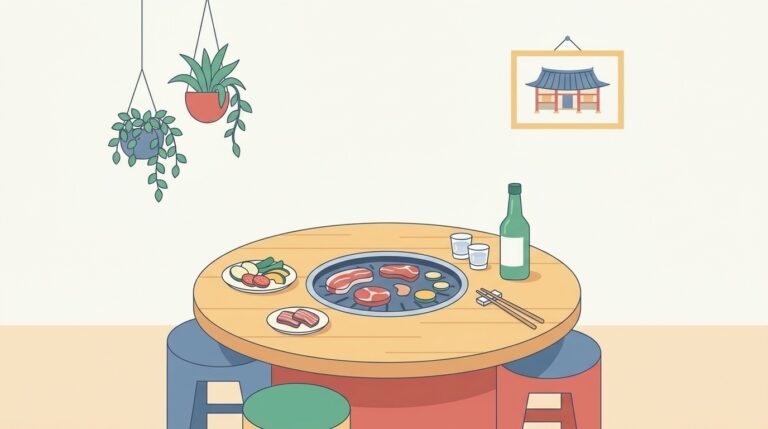
안녕하세요! 매일한글 에디터입니다.
Imagine this classic K-drama scene: It is Friday at 5:58 PM. You are packing your laptop, mentally tasting your weekend takeout, when your team manager suddenly claps his hands and declares: “Hey everyone, tonight is pork belly and soju night! Let’s bond!” Your stomach drops. You have plans with a close friend, but looking around, all your Korean coworkers are already putting on their jackets with polite smiles. You quietly wonder: Wait, is this compulsory? Is this actually part of my job description?
If you have ever felt confused, anxious, or overwhelmed by Korean company dinners—known as 회식 (Hoeshik)—you are definitely not alone. Many of our international learners tell us that navigating the blurred boundary between socializing and corporate duty is one of the trickiest cultural hurdles in Korea. In this guide, tailored specifically for intermediate learners (B1), we will decode why Koreans say “Hoeshik is an extension of work,” give you polite phrases to survive (or gracefully exit), and help you read the room like a Seoul corporate veteran.
Phase 2: Core Expressions Deep Dive
1. 회식도 업무의 연장이에요 (Hoesik-do eommu-ui yeonjang-ieyo)
- Pronunciation: [Hwe-sik-do eom-mu-ui yeon-jang-i-ye-yo] (Sounds like: “Hway-seek-doe um-moo-we yun-jahng-ee-yeh-yo”)
- Meaning: “Company dinners are an extension of work.”
- K-Culture Moment: You will hear this spoken with a weary sigh in office dramas like Misaeng (Incomplete Life) when employees dread attending an after-hours drinking session but know it affects office evaluations.
- Editor’s Insight: This phrase explains the entire psychological framework of Hoeshik. Even though it happens off the clock at a BBQ joint or pub, social hierarchies remain active. It implies that your professional demeanor, respect toward bosses, and team loyalty are still being observed.
- Situation Spectrum:
- Casual with close peers: ✅
- Semi-formal (talking with mentors/colleagues): ✅
- Formal (official meeting with senior directors): ⚠️ (Can sound slightly complaining if said directly to top executives)
- 🤔 Think About It: In your home culture, where does the boundary between work and personal life begin? Does shared eating feel like a personal favor or an implied duty?
2. 오늘 선약이 있어서요… (Oneul seonyag-i isseoseoyo…)
- Pronunciation: [Oh-neul seon-yahk-ee ee-ssuh-suh-yo]
- Meaning: “The thing is, I have a prior commitment today…”
- K-Culture Moment: A character in Business Proposal bowing slightly with a regretful expression, hands pressed together, stepping back as the group heads toward the elevator.
- Editor’s Insight: Ending with
-어서요... (-eoseoyo...)leaves the sentence softly trailing off. In Korean etiquette, leaving the reason unstated or subtle sounds far more humble and less confrontational than saying flatly “I can’t go.” - Situation Spectrum:
- Casual: ✅
- Semi-formal: ✅
- Formal: ✅
- 🤔 Think About It: Why does Korean communication prioritize softening the blow over delivering direct, blunt facts?
3. 1차만 하고 가보겠습니다 (Il-cha-man hago gabogesseumnida)
- Pronunciation: [Eel-cha-mahn ha-go ga-bo-get-seum-nee-da]
- Meaning: “I will just join for the first round and then head out.”
- K-Culture Moment: A hardworking junior employee who shows loyalty by eating dinner with the team during Round 1, then politely excuses themselves before the team moves on to Round 2 karaoke.
- Editor’s Insight: Korean gatherings move in waves: 1차 (dinner), 2차 (drinks/pub), 3차 (karaoke/noraebang). Committing to Round 1 shows respect and builds rapport while preserving your personal evening.
- Situation Spectrum:
- Casual: ⚠️ (Use “1차만 하고 갈게”)
- Semi-formal / Formal: ✅
- 🤔 Think About It: How does negotiating a compromise (attending partially) help preserve harmony in collective societies?
Phase 3: Textbook Korean vs. Real Korean
Situation 1: Declining an invitation to drink after work
- 📖 교과서 한국어 (Textbook): 저는 술을 마시고 싶지 않아서 회식에 안 갑니다. (Jeo-neun sul-eul ma-si-go sip-ji an-a-seo hoe-sig-e an gam-ni-da. – “Because I do not want to drink alcohol, I am not going to the company dinner.”)
- 🗣️ 진짜 한국어 (Real Native): 죄송하지만 오늘 몸이 좀 안 좋아서 1차만 참석해도 될까요? (Joesong-hajiman oneul mom-i jom an jo-aseo il-cha-man cham-seok-hae-do doel-kka-yo? – “I’m really sorry, but I’m feeling a bit under the weather today. Would it be alright if I just join for the first round?”)
- 💡 Why the difference? Textbook Korean is grammatically correct but culturally disastrous. Declining outright based on personal preference damages collective rapport. Blaming mild health fatigue (몸이 안 좋다) allows your manager to save face while letting you off easy.
Situation 2: Asking if you can slip away quietly
- 📖 교과서 한국어 (Textbook): 이제 집에 가도 됩니까? (Ije jib-e ga-do doem-nik-ka? – “May I go home now?”)
- 🗣️ 진짜 한국어 (Real Native): 팀장님, 내일 외근 일정이 있어서 먼저 일어나 보겠습니다! (Timjangnim, naeil oe-geun il-jeong-i isseoseo meonjeo ireona bogesseumnida! – “Manager, since I have an off-site client schedule tomorrow morning, I will get going first!”)
- 💡 Why the difference? Direct questions sound like you are challenging the atmosphere. Framing your departure around work obligations tomorrow makes your exit look diligent and responsible.
Phase 4: K-Culture Deep Dive & Non-Verbal Manners
4-1. 눈치 (Nunchi) & Drinking Gestures
At a Korean company dinner, your hands and eyes do half the talking:
* Two-Handed Respect: When an elder or superior pours you a drink, hold your glass with both hands (or place your left hand gently under your right forearm or wrist).
* The Head Turn: Never drink face-to-face with your boss. Turn your torso and head 45 degrees away to take your sip while subtly shielding the glass with your free hand.
* The Water Shield: If you do not drink alcohol, accept the first pour to maintain harmony, then subtly switch to cider (Chilsung Cider) or water. Nobody questions a glass that stays full!
4-2. Culture Code: The “MZ Generation” vs. “Kkondae” Shift
In classic workplace K-Dramas, Hoeshik was portrayed as mandatory binge drinking where the boss gave endless speeches. However, Korean workplace culture is currently undergoing a massive transformation. The younger workforce (often called the MZ generation) increasingly views after-hours dinners as unnecessary unpaid overtime. In response, modern companies now hold lunch hoeshiks, coffee tastings, or “cultural hoeshiks” (like watching a movie together). Still, older traditional managers (often nicknamed 꼰대, kkondae) cherish these dinners as genuine bonding.
Phase 5: Real-World Roleplay Scenario
Setting: A bustling Korean BBQ restaurant in Gangnam. Sizzling samgyeopsal fills the air. Manager Park is in high spirits, holding a green soju bottle.
- Turn 1 (Manager Park): 자, 오늘 다들 고생 많았으니까 한잔하자고! 받아, 민수 씨! (Ja, oneul dadeul gosaeng man-asseunikka han-jan-ha-ja-go! Bada, Minsu-ssi!)
- 🎭 Action: Leans forward with a wide grin, tilting the bottle to pour into your glass.
- Turn 2 (You): 아, 네! 감사합니다, 팀장님. (A, ne! Gamsahamnida, timjangnim.)
- 🎭 Action: Hold your shot glass securely with both hands, nodding respectfully.
- Turn 3 (Manager Park): 그래! 마시고 털어버려! 2차는 내가 단골인 노래방으로 가자! (Geurae! Masigo teol-eo-beo-ryeo! I-cha-neun nae-ga dan-gol-in noraebang-euro ga-ja!)
- 🎭 Action: Slams his glass down happily, looking around the table for approval.
- Turn 4 (Colleague Minji): 팀장님, 오늘 다들 피곤해 보이는데 1차로 마무리하면 어떨까요? (Timjangnim, oneul dadeul pigon-hae boineunde il-cha-ro mamuri-hamyeon eotteolkkayo?)
- 🎭 Action: Smiles gently, attempting a subtle diplomatic defense on behalf of the team.
- Turn 5 (Manager Park): 에이, 벌써 가면 섭섭하지! 민수 씨도 갈 거지? (Ei, beolsseo gamyeon seopseophaji! Minsu-ssi-do gal geoji?)
- 🎭 Action: Fixes his eyes on you, waiting for your enthusiastic agreement.
- Turn 6 (You): 팀장님, 오늘 고기 정말 맛있었습니다! 다만 제가 내일 이른 아침 미팅이 있어서요… (Timjangnim, oneul gogi jeongmal masisseosseumnida! Daman je-ga naeil ireun achim miting-i isseoseoyo…)
- 🎭 Action: Bow your head slightly with a polite smile, hands neatly folded on your lap.
- Turn 7 (Manager Park): 아, 그래? 내일 중요한 미팅이야? 아쉽지만 어쩔 수 없네! (A, geurae? Naeil jung-yohan miting-iya? A-swip-ji-man eo-jjeol su eomne!)
- 🎭 Action: Waves his hand lightly, letting go of the pressure gracefully.
- Turn 8 (You): 배려해 주셔서 감사합니다. 먼저 일어나 보겠습니다! (Baeryeohae jusyeoseo gamsahamnida. Meonjeo ireona bogesseumnida!)
- 🎭 Action: Stand up quietly, bow at a 30-degree angle to the table, and pick up your coat.
🔀 Interactive Branch: What would you say if pressured for Round 2?
- Choice A: “저는 노래방 가기 싫습니다. 집에서 쉬겠습니다.” (Jeoneun noraebang gagi sileumnida. Jib-eseo swigesseumnida. – I hate karaoke. I will rest at home.)
- 👉 Feedback [BAD]: Extremely blunt. It kills the festive mood and paints you as uncooperative. Avoid expressing direct dislike.
- Choice B: “저도 정말 가고 싶지만, 내일 일정이 있어서 오늘은 1차만 하고 가보겠습니다!” (Jeodo jeongmal gago sipjiman, naeil iljeong-i isseoseo oneureun il-cha-man hago gabogesseumnida!)
- 👉 Feedback [BEST]: Validates the boss’s excitement (“I really want to go, but…”), cites a reasonable constraint, and firmly excuses yourself with high respect.
- Choice C: Just silently grab your bag and sneak out while everyone is shouting cheers.
- 👉 Feedback [RISK]: Known as 도망 (escaping). While tempting, disappearing without saying goodbye to your direct supervisor can create serious friction the next morning.
Phase 6: 10-Second Emotional Shadowing Drill
Read these out loud, pausing at / and infusing the targeted emotion!
[🍻 Cheerful & Professional]- 팀장님, / 오늘 프로젝트 끝난 기념으로 / 제가 건배사 해도 되겠습니까? (Timjangnim, / oneul peurojekteu kkeunnan ginyeom-euro / je-ga geonbaesa hae-do doegesseumnikka?)
[😅 Apologetic but Firm]- 마음은 정말 함께하고 싶은데요, / 오늘 개인적인 약속이 있어서 / 먼저 가보겠습니다. (Ma-eum-eun jeongmal hamkke-hago sipeundeyo, / oneul gaeinjeog-in yaksog-i isseoseo / meonjeo gabogesseumnida.)
[🙏 Grateful & Polite]- 오늘 맛있는 저녁 사주셔서 감사합니다! / 조심히 들어가세요! (Oneul masinneun jeonyeok sajusyeoseo gamsahamnida! / Josimhi deureogaseyo!)
Phase 7: K-Culture Mini Dictionary
- 1차 / 2차 (Il-cha / I-cha): “Round 1 / Round 2.” Refers to sequential venues during a night out (e.g., Round 1 BBQ $\rightarrow$ Round 2 Pub $\rightarrow$ Round 3 Noraebang).
- 건배사 (Geonbaesa): “A toast speech.” Short, witty toasts given before everyone clinks glasses, often using clever acronyms.
- 막내 (Maknae): “The youngest or rookie member.” In traditional hoeshik settings, the maknae is subtly expected to set out chopsticks, napkins, and grill the meat.
- 꼰대 (Kkondae): A slang term for an older, authoritarian person or boss who lectures juniors and forces outdated traditions.
Phase 8: Traveler’s Survival Kit
Top 3 Survival Expressions
- 건배! (Geonbae!) – “Cheers!” (Pro tip: Always make eye contact with your table partners as your glasses touch).
- 물 좀 더 주실 수 있나요? (Mul jom deo jusil su innayo?) – “Could we have some more water, please?” (Pro tip: Lifesaver when Korean spicy stews hit your palate).
- 영수증 챙겨주세요 (Yeongsujeung chaenggyeojuseyo) – “Please give me the receipt.” (Pro tip: Essential if your company reimburses dinner expenses).
Editor’s Travel Note
- If a company dinner runs late into the night, remember that the Seoul Metropolitan Subway halts service around midnight. Prepare your route in advance by checking the Naver Map Route Planner.
- If you miss the last train, avoid hailing taxis on the roadside in busy entertainment districts like Hongdae or Gangnam; instead, use the Kakao T Taxi Calling Service for fair, safe metered pickups.
Phase 9: Going Deeper (Thought Question)
In Western corporate spaces, professional competency is primarily judged during designated office hours through output, metrics, and meetings. However, Korean professional culture historically stems from an agricultural collective ethos where sharing food (정, Jeong) represents emotional solidarity and mutual survival. When Korean coworkers invite you to Hoeshik, they are frequently offering you an embrace into their inner circle. Balancing your personal boundaries while recognizing this collective hospitality is the hallmark of true cross-cultural maturity.
💬 Your Turn: How does your home country view socializing with coworkers after 6:00 PM? Drop a comment below and let’s discuss!
Phase 10: FAQ & Avoiding Misunderstandings
Q: Is it illegal or rude to refuse alcohol at a Korean company dinner?
A: It is definitely not illegal, nor is it considered rude today! While pouring drinks back and forth is a symbol of friendship, health concerns, personal choices, and religious restrictions are widely respected now. Simply accept the first cup with two hands, put it down on the table, and say: “건강상의 이유로 술을 못 마십니다” (Due to health reasons, I cannot drink alcohol).
Q: Do employees split the bill (Dutch pay) at a Hoeshik?
A: Rarely. In virtually all company dinners, the highest-ranking manager pays with the corporate card (법인카드) or out of their own pocket. Offering to split the bill can actually insult an older boss who wants to treat the team.
Q: Can I leave after Round 1 without asking for permission?
A: Never slip away completely unannounced. Even if you want to leave quietly, walk over to your direct manager or team lead, bow politely, and quietly mention that you are heading out so they do not worry or search for you.
🚨 Common Mistakes Warning Board
- Mistake: Pouring your own alcohol when your glass is empty.
- Correct Action: In Korea, pouring for yourself (자작, Jajak) is considered lonely or improper. Pour for someone whose glass is half-empty, and they will gladly return the favor!
- Mistake: Starting to eat before the highest-ranking executive takes their first bite.
- Correct Action: Wait until the eldest or most senior colleague picks up their spoon or chopsticks before digging into the side dishes.
- Mistake: Turning down an invitation with blunt personal hobbies (e.g., “I want to go play video games”).
- Correct Action: Always cite formal obligations, family plans, or rest for tomorrow’s work performance to preserve office harmony.
Phase 11: Action Missions & Engagement
- 🥉 Bronze Level: Practice saying “1차만 하고 가보겠습니다” in front of a mirror three times using a polite, warm tone of voice.
- 🥈 Silver Level: Share in the comments below your go-to excuse for skipping an unwanted social obligation in your native language!
- 🥇 Gold Level: Next time you eat out with friends or coworkers, practice receiving a drink using two hands and turning your head sideways to take a sip.
- 🎮 K-Culture Mission: Watch Episode 1 of the drama Misaeng (Incomplete Life). Notice how the rookie intern carries himself around his superiors during office meals.
Phase 12: Interactive Quiz Challenge
Test your Hoeshik street smarts!
1. Situation Judgment: The dinner has moved to Round 2 at a pub. You have an early morning train tomorrow. What should you do?
* A) Jump up and announce loudly: “This meeting is taking too long!”
* B) Disappear into the restroom and run to the subway without telling anyone.
* C) Quietly approach your manager, thank them for dinner, mention your early morning schedule, and bow before departing.
2. Fill-in-the-Blank:
“오늘 선약이 ________ 1차만 참석하겠습니다.”
(Due to having a prior commitment today, I will attend round 1 only.)
* Choice: 있어서요 / 없어서 / 싫어서
3. True or False: In Korea, pouring your own alcohol at a company dinner is considered standard etiquette.
* [True / False]
👉 Click here to reveal the answers and explanations!
- Answer: C. Approaching your manager directly shows high respect and prevents unnecessary misunderstandings the next morning.
- Answer: 있어서요. The grammatical connector for stating a soft reason is 있어서(요) (having / because there is).
- Answer: False. In Korea, teammates pour drinks for each other to nurture camaraderie. Pouring your own drink is taboo at formal dinners.







