

Phase 1: 공감 (Story Immersion Opening)
안녕하세요! 매일한글 에디터입니다.
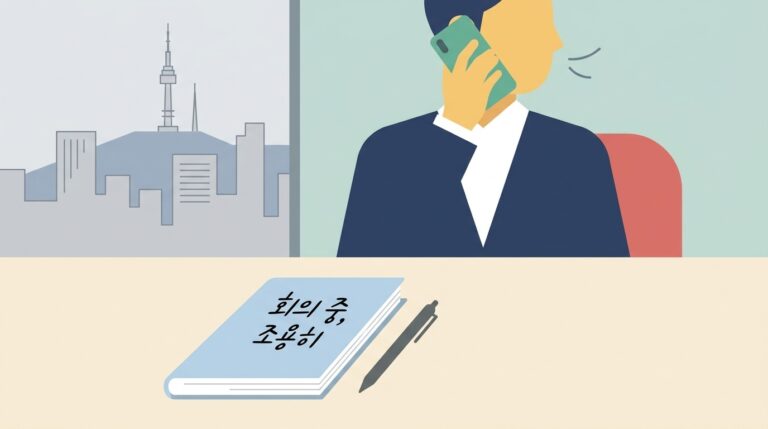
Picture this: You are sitting in a glass-walled conference room in a sleek office building in Yeouido, Seoul. The room is dead quiet except for the hum of the projector and your team lead presenting quarterly metrics. Suddenly, your phone vibrates vigorously against the polished wooden table. Buzz… buzz… buzz. You peek down at the screen: it is a crucial call from a client, an apartment landlord, or a senior colleague. Your heart begins to race. You frantically slide your finger to answer, but your tongue freezes up. Do you whisper an abrupt “안녕” (Annyeong)? Do you just hit decline and look painfully rude? Or do you blurt out broken English and pray they understand?
If you have ever panicked over phone calls in Korea, you are not alone. In our Daily Hangul tutoring community, intermediate learners constantly tell us: “I can order food or chat over coffee, but speaking on the phone without visual cues terrifies me!” Phone conversations strip away comforting lip-reading and hand gestures, forcing you into high-speed conversational agility. Mastering the art of gracefully excusing yourself—such as saying you are in a meeting and will call back—is an absolute superpower in Korea. It shows impeccable manners (ye-ui), deep respect for the caller’s time, and instant professional polish. Today, let’s banish that phone anxiety together with real-world, natural Korean you will actually use!
Phase 2: 핵심 표현 3선 심층 분석 (Top 3 Core Expressions)
1. 지금 회의 중이라 나중에 전화드릴게요 (Jigeum hoe-ui jung-ira najeung-e jeonhwadeurilgeyo)
- Pronunciation: Jee-geum hway-ee joong-ee-rah nah-joong-eh jeon-hwa-deu-ril-geh-yo (Flow the jung-ira smoothly like “joong-eera” without clipping the ‘g’).
- Meaning: Literal: “Right now, in the middle of a meeting, so later I will give a phone call.” / Real Nuance: “I am currently in a meeting, so I will call you right back shortly.”
- K-Culture Moment: You will recognize this from office K-Dramas like Misaeng or Search: WWW, where employees duck into a corridor with their phone pressed tight against their cheek, whispering this phrase before hanging up.
- Editor’s Insight: Notice the verb 전화드리다 (jeonhwadeurida) rather than 전화하다 (jeonhwahada). Using deurida (the humble honorific form of ‘to give’) elevates the listener instantly, making an interruption sound polished rather than dismissive.
- Situation Spectrum: Casual 🚫 | Semi-formal ✅ | Formal ✅
- 🤔 Think About It: In English, we often say “I can’t talk right now.” Why do Koreans highlight the action they will take for the caller later rather than simply stating their present inability to talk?
2. 통화 가능하신가요? (Tonghwa ganeunghasingayo?)
- Pronunciation: Tong-hwa gah-neung-hah-shin-gah-yo (Similar to asking “Can you talk?” but sounding like a soft question with a gentle upward cadence at the end).
- Meaning: Literal: “Is phone communication possible for you?” / Real Nuance: “Is this a good time to talk? / Are you free for a call?”
- K-Culture Moment: In Crash Landing on You, when business partners or secret allies reach out on burner phones, they never launch straight into their pitch—they always open with this respectful check-in.
- Editor’s Insight: In Korea’s fast-paced work and social culture, calling someone out of the blue without asking this first can be perceived as slightly invasive. Asking this first sets a considerate foundation.
- Situation Spectrum: Casual ⚠️ (Use “지금 통화 돼?” with close friends) | Semi-formal ✅ | Formal ✅
- 🤔 Think About It: Do people in your home country usually check if the other person is free before diving into the point of a phone call?
3. 다시 연락드리겠습니다 (Dasi yeollakdeurigessseumnida)
- Pronunciation: Dah-shi yeol-lak-deu-ri-get-seum-nee-dah (Link the ‘n’ and ‘l’ in yeollak like the double ‘l’ in “yellow”).
- Meaning: Literal: “I will make contact again.” / Real Nuance: “I will get back in touch with you shortly / I will follow up soon.”
- K-Culture Moment: This is the universal sign-off phrase uttered by company executives, receptionists, and delivery drivers across every Korean broadcast network before hanging up.
- Editor’s Insight: Using 연락 (yeollak – contact) instead of just 전화 (jeonhwa – phone call) leaves room for flexibility—you might follow up with a text message, KakaoTalk message, or an email instead of calling back.
- Situation Spectrum: Casual 🚫 | Semi-formal ⚠️ | Formal ✅
- 🤔 Think About It: How does promising a definite follow-up change the emotional security of a business relationship?
Phase 3: 교과서 한국어 vs 진짜 한국어 (Textbook vs. Real Korean)
Situation A: Explaining why you cannot pick up right now
- 📖 교과서 한국어: 저는 지금 바쁩니다. 나중에 통화합시다. (Jeoneun jigeum bappeumnida. Najeunge tonghwahapsida.)
*Translation: “I am busy right now. Let us talk on the phone later.” - 🗣️ 진짜 한국어: 죄송한데 제가 지금 미팅 중이라, 끝나고 바로 전화드려도 될까요? (Joesonghande jega jigeum miting jung-ira, kkeutnago baro jeonhwadeuryeodo doelkkayo?)
*Translation: “I’m so sorry, but I’m in a meeting right now—may I call you back right after it finishes?” - 💡 왜 다를까?: Textbook phrasing sounds blunt, dictatorial, and almost robotically cold. Real native speakers soften refusal with an opening apology (죄송한데), cite the exact context (미팅 중), and ask for gentle permission (전화드려도 될까요?).
Situation B: Asking the caller to send a text instead
- 📖 교과서 한국어: 문자 메시지를 저에게 보내십시오. (Munja mesijireul jeoege bonaesipsio.)
*Translation: “Send a text message to me.” - 🗣️ 진짜 한국어: 혹시 급한 용건이시면 문자 하나만 남겨주시겠어요? (Hoksi geuphan yong-geon-isimyeon munja hanaman namgyeojusigesseoyo?)
*Translation: “If it is urgent, would you mind leaving a quick text message?” - 💡 왜 다를까?: Direct imperative commands (보내십시오) can sound aggressive. Koreans frequently use softening qualifiers like 혹시 (hoksi – by any chance) and -주시겠어요? (-jusigesseoyo? – would you mind doing for me?) to cushion requests.
Phase 4: K-Culture 딥다이브 & 비언어적 매너 (Culture Deep Dive & Non-Verbal Manners)
4-1. 눈치 (Nunchi) & Physical Manners on the Phone
Have you ever noticed Koreans bowing into the air while holding a phone up to their ear? It is a legendary real-life habit! Even though the caller cannot physically see you, physical posture deeply alters vocal pitch and emotional warmth. When picking up a call during a meeting:
1. The Cupped Palm Shield: Always cover your mouth and the phone microphone with your spare palm, ducking your head down slightly. This lowers vocal leakage into the meeting room while ensuring the caller hears your whispered voice clearly.
2. The Apologetic Nod: Even over the phone, a slight tilt of the head conveys sincere remorse for having to cut the conversation short.
3. The Quick Exit: If you must take the call, slip out the door quietly within 3 seconds using the “crouched walk” (게걸음 / Gegeoreum), signaling utmost respect to both the meeting participants and the caller.
4-2. Cultural Code: The Etiquette of “Quick Text Follow-ups”
Korea runs on Ppalli-ppalli (fast-fast) culture, but speed must always be tempered with consideration (Baeryeo). When you reject a call or whisper that you are in a meeting, the golden unwritten rule is to send an immediate follow-up message within 60 seconds. A polite KakaoTalk or SMS like: “팀장님, 지금 회의 중이라 30분 뒤에 연락드리겠습니다!” (Team leader, I am in a meeting right now, so I will contact you in 30 minutes!) completely eliminates anxiety for the caller and showcases elite social Nunchi.
Phase 5: 실전 롤플레이 시나리오 (Real-Life Roleplay Scenario)
Setting: 2:30 PM on a rainy Tuesday afternoon inside the modern glass conference room of a design agency in Gangnam. You are taking meeting minutes while your creative director presents branding mockups. Your phone rings on silent mode. It is Manager Kang (강 과장님), an important supplier partner.
- Manager Kang: 여보세요? OO 씨, 지난주 발주 건 확인 때문에 전화드렸는데요. (Yeoboseyo? OO ssi, jinanju balju geon hwag-in ttaemune jeonhwadeuryeotneundeyo.)
*Translation: “Hello? OO, I’m calling to check on last week’s purchase order.” - You: 🎭 (Covers mouth with one hand, leaning under the desk, whispering softly) 네, 강 과장님! 지금 저희 팀 주간 회의 중이라서요. (Ne, Kang gwajangnim! Jigeum jeohui tim jugan hoe-ui jung-iraseoyo.)
*Translation: “Yes, Manager Kang! We are in the middle of our weekly team meeting right now.” - Manager Kang: 🎭 (Apologetic tone) 아, 회의 중이셨군요! 제가 타이밍을 못 맞췄네요. (A, hoe-ui jung-isyeotgunyo! Jega taiming-eul mot matchwotneyo.)
*Translation: “Ah, you were in a meeting! I got the timing wrong.” - You: 🎭 (Speaking clearly with polite urgency) 아닙니다, 과장님. 회의가 3시쯤 끝날 것 같은데요. (Animnida, gwajangnim. Hoe-uiga sesijjeum kkeutnal geot gateundeyo.)
*Translation: “Not at all, Manager. The meeting should finish around 3 o’clock.” - Manager Kang: 그래요? 그럼 그때 다시 통화할 수 있을까요? (Geuraeyo? Geureom geuttae dasi tonghwahal su isseulkkayo?)
*Translation: “Really? Could we talk again then?” - You: 🎭 (Reassuring, soft tone) 네, 마치는 대로 제가 바로 다시 전화드리겠습니다! (Ne, machineun daero jega baro dasi jeonhwadeurilgeyo!)
*Translation: “Yes, as soon as it wraps up, I will call you right back!” - Manager Kang: 알겠습니다. 회의 잘 마무리하세요! (Algetseumnida. Hoe-ui jal mamurihaseyo!)
*Translation: “Understood. Wrap up your meeting well!” - You: 🎭 (Gently bowing head before pressing end) 네, 과장님! 죄송하고 감사합니다. 들어가세요! (Ne, gwajangnim! Joesonghago gamsahamnida. Deureogaseyo!)
*Translation: “Yes, Manager! Apologies and thank you. Have a great day!”
🔀 Interactive Choice Branch:
What if Manager Kang says: “1분이면 되는데, 지금 잠깐만 메모 가능해요?” (It only takes one minute, can you take a quick memo right now?)
* Option A: “안 돼요. 회의 중이니까 끊을게요.” (No. I’m in a meeting, so I’ll hang up.)
👉 Verdict: Bad 🚫. Severely abrupt and disrespectful to a senior partner. Guaranteed to damage office harmony.
* Option B: “과장님, 지금 발표 중이라 메모가 어려워서요, 혹시 문자 남겨주시면 바로 확인할게요!” (Manager, someone is presenting right now so taking notes is difficult; if you leave a text, I will check it right away!)
👉 Verdict: Best ✅. Explains the physical obstacle gracefully while offering an immediate, constructive alternative.
* Option C: “네… 말씀하세요…” (Yes… go ahead and speak…)
👉 Verdict: Risk ⚠️. You risk getting reprimanded by your team leader in the meeting room while scrambling to write things down.
Phase 6: 10초 감정 섀도잉 드릴 (10-Second Shadowing Drill)
Practice matching the cadence markers / and authentic emotion cues!
[🤫 조용하고 다급하게 - Whispering quietly with polite urgency]
죄송한데 / 지금 회의 중이라서요 / 제가 끝나고 바로 / 전화드릴게요!
(Joesonghande / jigeum hoe-ui jung-iraseoyo / jega kkeutnago baro / jeonhwadeurilgeyo!)-
[😊 차분하고 깍듯하게 - Calm and exceptionally courteous]
과장님 / 혹시 급한 일이시면 / 문자 남겨주시겠어요? / 바로 확인하겠습니다!
(Gwajangnim / hoksi geuphan irisimyeon / munja namgyeojusigesseoyo? / Baro hwag-inhagessseumnida!) -
[🙇♂️ 미안함과 배려를 담아 - Sincere apology with respectful closing]
타이밍을 못 맞춰서 / 정말 죄송합니다 / 10분 뒤에 / 다시 연락드리겠습니다!
(Taiming-eul mot matchwoseo / jeongmal joesonghamnida / sipbun dwie / dasi yeollakdeurigessseumnida!)
Phase 7: K-Culture 미니 사전 (Mini Dictionary)
- 부재중 전화 (Bu-jae-jung jeon-hwa) | Missed call
Usage: Used when checking logs or texting back: “부재중 전화 보고 연락드렸습니다.” (I saw your missed call and am calling back). - 용건 (Yong-geon) | Business at hand / Reason for contacting
Usage: Essential in business: “급한 용건이 있으신가요?” (Do you have urgent business?) - 들어가세요 (Deu-reo-ga-se-yo) | Polite phone sign-off (Lit. “Go inside safely”)
Usage: The golden farewell phrase when hanging up with seniors, colleagues, or service personnel. - 진동 모드 (Jin-dong mo-deu) | Vibrate mode
Usage: Crucial before meetings begin: “회의 시작 전에 핸드폰 진동 모드로 바꿔주세요.” (Please turn your phones to vibrate mode before the meeting starts).
Phase 8: 여행자를 위한 생존 키트 (Traveler’s Survival Kit)
Top 3 Survival Expressions
- 지금 통화가 좀 어려워요 (Jigeum tonghwaga jom eoryeowoyo)
Pronunciation: Jee-geum tong-hwa-ga jom uh-ryeo-wo-yo
Pro Tip: Perfect when you are on a noisy subway or boarding a bus and need to politely dodge a non-urgent call. - 문자 남겨주시면 답장할게요 (Munja namgyeojusimyeon dapjanghalgeyo)
Pronunciation: Moon-jah nam-gyeo-joo-shee-myeon dap-jang-hal-geh-yo
Pro Tip: Ideal for solo travelers when you cannot speak Korean fluently on the spot and prefer translating text messages. - 잠시만요, 밖으로 나가서 받을게요 (Jamsimanyo, bakkeuro nagaseo badeulgeyo)
Pronunciation: Jam-shee-man-yo, bahk-kkeu-ro nah-gah-seo bah-deul-geh-yo
Pro Tip: Use this when dining at quiet traditional Korean restaurants or cafes before answering an urgent call outside.
Editor’s Travel Note
When navigating Korean transportation and busy venues, having instant communication apps ready on your home screen is critical. Don’t waste time typing complex texts on the move; make sure you install the 네이버 지도 앱 다운로드 for real-time subway arrivals and keep the 카카오T 어플리케이션 가이드 handy so taxi drivers can communicate via text rather than unexpected phone calls while you explore Seoul!
Phase 9: “한 발 더 깊이” (Cultural Reflection Essay)
In Western communication cultures, boundaries are often direct: if you cannot pick up, you simply let the phone ring to voicemail. But in Korea, the ringing phone is viewed as a social knock on your personal door. Leaving a caller hanging without acknowledging their knock feels like slamming the door in their face. By answering briefly to say “지금 회의 중이라 나중에 전화드릴게요,” you honor the communal connection before stepping back into your immediate obligation. It reflects a society built on relational balance—where etiquette is not about rigid rules, but about alleviating another person’s uncertainty.
💬 Your Turn: How does your home culture treat incoming phone calls during important meetings or quiet moments? Do you let it go to voicemail, or do you pick up and whisper? Share your experiences in the comments below!
Phase 10: FAQ & 흔한 실수 (FAQ & Common Mistakes)
Q: Can I just decline the call and send the automated rejection text message on my smartphone?
A: Yes, but with caution! Default automated SMS options like “회의 중입니다” (In a meeting) can feel cold if sent to your boss, client, or in-laws. For friends and couriers, it is totally fine. For business partners or seniors, sending a quick customized text message with polite honorifics right after declining is much warmer and safer.
Q: Is it rude to say “나중에 전화해” (Najeunge jeonhwahae) to co-workers?
A: Yes, unless that co-worker is an established personal friend of identical age or junior to you who agreed to speak in Banmal (casual speech). In all other workplace settings, always use -드릴게요 (-deurilgeyo).
Q: Why do Koreans say “들어가세요” (Deureogaseyo) when ending a call even when nobody is entering a house?
A: Historically, it meant “return safely inside your quarters.” In modern phone etiquette, it has evolved into a warm, respectful closing formula equivalent to “Take care and have a pleasant rest of your day.”
🚨 흔한 실수 (Common Mistakes) 경고판
- Mistake: Saying “나중에 전화할게요” to clients or supervisors.
Correction: Replace 할게요 (halgeyo) with humble honorific 드릴게요 (deurilgeyo). - Mistake: Hanging up immediately after saying “회의 중이에요” without promising a callback.
Correction: Always add “끝나고 바로 연락드릴게요” (I’ll call you right back when it ends). - Mistake: Speaking at full volume in public transit or quiet meeting halls.
Correction: Drop to a whisper, cup the mouthpiece, and exit the space promptly.
Phase 11: 액션 미션 & 참여 유도 (Action Missions)
- 🥉 Bronze Mission (Solo Shadowing): Stand in front of your mirror, hold your phone to your ear, cup the mic, and repeat “죄송한데 지금 회의 중이라 10분 뒤에 전화드릴게요!” three times with crisp, polite intonation.
- 🥈 Silver Mission (Voice Memo): Record your voice saying the 10-second shadowing drill from Phase 6, upload it to your study Instagram story, and tag
@DailyHangulfor a pronunciation shout-out! - 🥇 Gold Mission (Real-Life Application): Next time an unexpected call comes from a Korean friend or language exchange partner while you are busy, answer in Korean using Phase 2’s core expressions instead of texting in English.
- 🎮 K-Culture Mission: Watch the first episode of any Korean office drama (like Misaeng or King the Land). Count how many times characters say “다시 연락드리겠습니다” or “들어가세요” during phone calls!
Phase 12: 인터랙티브 퀴즈 챌린지 (Quiz Challenge)
1. Situational Judgment:
You are in a team meeting when your senior department head (부장님) calls your cell phone. Which response is the most natural and polite?
(A) 지금 바쁘니까 나중에 전화하세요.
(B) 부장님, 지금 회의 중이라 끝나고 바로 전화드리겠습니다!
(C) 여보세요? 문자 메시지 보내십시오.
2. Fill-in-the-Blank:
Complete the sentence to politely ask if someone is free to talk:
“지금 혹시 통화 ______?”
(A) 가능하신가요
(B) 해라
(C) 먹었니
3. True or False:
In Korean business etiquette, saying “전화할게요” and “전화드릴게요” hold the exact same degree of politeness toward clients and senior bosses. (True / False)
👉 Click here to reveal the answers and explanations!
- 1. Answer: (B)
Explanation: (B) uses the humble honorific 전화드리겠습니다 and specifies a quick follow-up. (A) and (C) are blunt imperatives that would shock a senior Korean manager. - 2. Answer: (A) 가능하신가요 (ganeunghasingayo)
Explanation: 통화 가능하신가요? is the polite standard way to ask “Is it possible to speak on the phone right now?” - 3. Answer: False
Explanation: 전화드릴게요 uses the humble verb 드리다 (deurida), which elevates the listener. 전화할게요 is informal polite and generally reserved for equals or juniors.







