

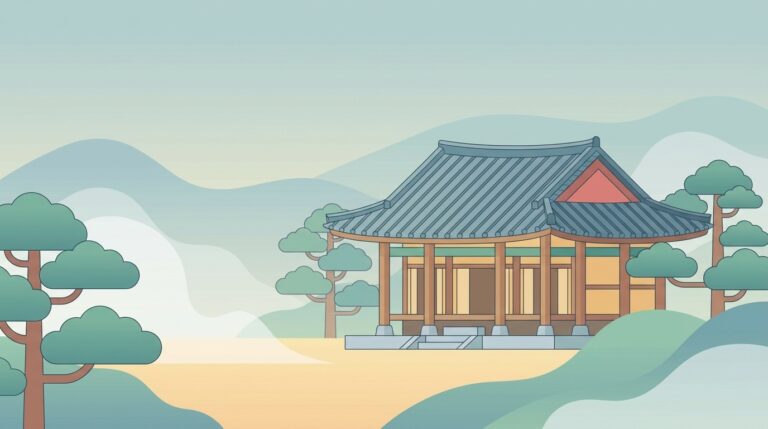
Phase 1: 공감 (Story-Immersive Opening)
안녕하세요! 매일한글 에디터입니다. Have you ever felt utterly drained by the dizzying pace of modern life? Picture this: you’ve spent three hectic days navigating the bustling subways of Seoul, answering never-ending work emails, and darting through the neon-lit maze of Gangnam. Your head is buzzing, and your spirit feels completely depleted. Seeking sanctuary, you step through the 일주문 (Iljumun, the One Pillar Gate) into Bongeunsa Temple. Instantly, the urban roar fades away, replaced by the soft chimes of wind bells (풍경) and the earthy aroma of burning incense. An overwhelming wave of serenity washes over you. A gentle monk smiles warmly and asks how you are feeling. You want to express this profound, tranquil sensation, but your mind goes blank. Do you recite a rigid sentence from an ancient religious text? Or simply mutter “좋아요” (It’s good) and miss the emotional depth of the moment?
You are not alone! Many intermediate learners struggle when expressing spiritual calm and emotional relief in Korean without sounding like an ancient historical drama or an awkward tourist. This curated guide draws directly from real learner experiences and cultural immersion in Korea. By the end of this post, you’ll naturally articulate inner peace, navigate spiritual sanctuaries with impeccable manners, and connect heart-to-heart with native speakers.
Phase 2: 핵심 표현 3선 심층 분석 (3 Core Expressions In-Depth)
1. 마음이 편안해져요 (Mae-um-i pyeon-an-hae-jyeo-yo)
- Pronunciation: [Mae-um-i pyeon-an-hae-jyeo-yo] (Sounds like “May-oom-ee pyon-ahn-hay-jyo-yo” — let the “pyeon” glide smoothly like exhaling a deep breath)
- Meaning: Literally “My mind/heart is becoming comfortable” vs. Actual Nuance: “A wave of peacefulness is settling into my soul / I feel deeply at peace.”
- K-Culture Moment: In healing travel shows like Three Meals a Day (삼시세끼) or Hyori’s Homestay, cast members frequently utter this line while watching the sunset over the sea or sipping warm tea in a quiet courtyard.
- Editor’s Insight: In Korean, 마음 (mae-um) encompasses both the mind and the heart. The grammar pattern ‘-어/아지다’ indicates a gradual transformation, showing that tranquility is slowly flowing into you.
- Situation Spectrum: Casual: ⚠️ (Use 마음이 편안해 with close friends) | Semi-formal: ✅ | Formal: ✅ (마음이 편안해집니다)
- 🤔 Think About It: In English, we often say “I am relaxed,” emphasizing our personal state. In Korean, we say “My heart/mind is becoming comfortable,” treating our inner world almost like a sacred garden being tended.
2. 마음을 비우고 있어요 (Mae-um-eul bi-u-go iss-eo-yo)
- Pronunciation: [Mae-um-eul bi-u-go i-sseo-yo] (Think of “bee-oo-go” like softly buzzing away your clutter)
- Meaning: Literally “I am emptying my mind/heart” vs. Actual Nuance: “I’m letting go of my worries and mental clutter / Practicing mindfulness.”
- K-Culture Moment: Frequently heard in K-Dramas like Our Blues or Hospital Playlist when a stressed character takes a sabbatical, sits in nature, or engages in deep meditation to reset their emotional equilibrium.
- Editor’s Insight: Emptying (비움) in Korean thought is not a void or loss; it is an active, positive discipline. You empty out trivial desires and stress to create room for genuine calm.
- Situation Spectrum: Casual: ✅ (마음 비우고 있어) | Semi-formal: ✅ | Formal: ✅ (마음을 비우고 있습니다)
- 🤔 Think About It: Does your native culture emphasize “emptying” the mind or “focusing” it when seeking peace? How does this change your approach to meditation?
3. 힐링이 돼요 (Hil-ling-i dwae-yo)
- Pronunciation: [Hil-ling-i dwae-yo] (Just like the English word “healing” followed by “ee dway-yo”)
- Meaning: Literally “Healing is happening” vs. Actual Nuance: “This is so restorative and soothing for my soul.”
- K-Culture Moment: A staple Konglish expression used ubiquitously across K-dramas, YouTube vlogs, and variety shows whenever someone tastes comfort food, listens to acoustic indie music, or walks through a lush bamboo forest.
- Editor’s Insight: While English uses “healing” mostly in physical or heavy psychological contexts, Koreans use “힐링” daily to express sensory delight and spiritual unwinding. Pairing it with 되다 (to become/happen) conveys that the environment is actively rejuvenating you.
- Situation Spectrum: Casual: ✅ (힐링 돼!) | Semi-formal: ✅ | Formal: ⚠️ (In very solemn Buddhist rituals, stick to 마음이 평온합니다)
- 🤔 Think About It: Why do you think modern Korean society embraced the loanword “힐링” so passionately over the past decade?
Phase 3: 교과서 한국어 vs 진짜 한국어 (Textbook vs. Real-World Korean)
Situation 1: Expressing that a sacred or quiet space calmed your chaotic thoughts
- 📖 교과서 한국어: “이곳에서 영혼의 안식을 얻었습니다.” (I have attained spiritual rest for my soul in this place.)
- 🗣️ 진짜 한국어: “여기 오니까 복잡했던 머리가 싹 정리돼요.” (Yeogi onikka bokjapaetdeon meoriga ssak jeongnidoeyo. / Coming here completely cleared my cluttered mind.)
- 💡 왜 다를까?: Textbook Korean relies heavily on dramatic, written Hanja terms (안식, 영혼). Real Koreans convey mental lightness using expressive sound-symbolic adverbs like 싹 (ssak – cleanly, in one sweep) and natural emotional verbs.
Situation 2: Advising a stressed friend to release their anxieties during a quiet retreat
- 📖 교과서 한국어: “모든 번뇌를 소멸시키십시오.” (Extinguish all of your earthly defilements.)
- 🗣️ 진짜 한국어: “잡생각은 다 털어버리고 푹 쉬어요.” (Japsaenggakeun da teoreobeorigo puk swieoyo. / Just brush off all the stray thoughts and rest deeply.)
- 💡 왜 다를까?: Archaic religious vocabulary (번뇌, 소멸) creates distance. Real native speakers use kinetic metaphors like 털어버리다 (to brush off dust) coupled with 푹 (soundly/deeply).
Phase 4: K-Culture 딥다이브 & 비언어적 매너 (Deep Dive & Non-Verbal Etiquette)
4-1. 눈치 (Nunchi) & Gestures in Sacred Spaces
When stepping into a Korean Buddhist temple (절) or quiet sanctuary:
* 합장 (Hapjang – Palm Pressing): Press your palms together gently at chest level and bow your head slightly when greeting monks, nuns, or fellow practitioners. Keep your elbows relaxed by your ribs, not flared out.
* Mind the Threshold (문턱): In traditional temple halls (대웅전), never step directly onto the raised wooden door threshold (문턱). Always step cleanly over it. Stepping on the threshold symbolizes bad fortune and disrespect to the guardians.
* The Subdued Voice Tone: Lower your vocal volume by 50% and keep hand gestures minimal and close to the torso. Avoid pointing at Buddha statues or religious icons with your index finger; if gesturing, use an open, cupped hand with palm facing upward.
4-2. Cultural Code Analysis: The Templestay & “Mung-hit” Culture
Korea’s rapid economic rise created a fiercely competitive society (빨리빨리 culture). In response, a powerful counter-movement emerged: 템플스테이 (Templestay) and 멍때리기 (spacing out). Over 140 historic temples across Korea invite visitors to shed worldly ranks, wear comfortable monk trousers (수련복), and practice 108 prostrations (백팔배) or dawn tea ceremonies (다도). Parallel to this is the modern phenomenon of 숲멍 (forest daydreaming) and 물멍 (water daydreaming)—the art of staring blankly into nature to quiet an overstimulated nervous system. Seeking peace in Korea is not an escape from reality; it is a collective cultural ritual to regain resilience.
Phase 5: 실전 롤플레이 시나리오 (Real-Life Roleplay Scenario)
Setting: The veranda of an ancient wooden tea room at Woljeongsa Temple, surrounded by snow-dusted fir trees. The gentle clinking of porcelain teacups fills the air.
Characters:
* Alex (You): An exhausted digital professional attending a weekend templestay.
* Sunim Jeongwon (정원 스님): The templestay supervisor monk, radiating warmth and calmness.
Dialogue:
1. 스님: 찻잔이 따뜻하지요? 산속이라 공기가 차분합니다.
(Chatjani ttatteuthajiyo? Sansogira gonggiga chabunhamnida.)
“The teacup is warm, isn’t it? Because it’s deep in the mountains, the air is so calm.”
🎭 두 손으로 찻잔을 건네며 온화하게 미소 짓는다. (Gently handing over the teacup with both hands, smiling peacefully.)
2. 알렉스: 네, 스님. 서울에 있을 때는 늘 쫓기듯 살았는데, 여기 오니 마음이 편안해져요.
(Ne, seunim. Seoure isseul ttaeneun neul jjotgideut saranneunde, yeogi oni maeumi pyeon-an-haejyeoyo.)
“Yes, Sunim. When I was in Seoul, I always felt chased by time, but coming here makes my mind feel so peaceful.”
🎭 찻잔을 두 손으로 감싸 쥐고 깊은 숨을 들이마신다. (Holding the teacup with both hands and inhaling deeply.)
3. 스님: 현대인들은 마음속에 짐을 너무 많이 담아두고 살지요.
(Hyeondaeindeureun maeumsoge jimeul neomu mani damadugo saljiyo.)
“Modern people carry far too much baggage in their hearts.”
4. 알렉스: 맞아요. 그래서 이번 주말에는 정말 마음을 비우고 싶어요.
(Majayo. Geuraeseo ibeon jumareneun jeongmal maeumeul biugo sipeoyo.)
“That’s right. That is why I really want to empty my mind this weekend.”
🎭 가슴에 한 손을 얹으며 진심 어린 눈빛으로 고개를 끄덕인다. (Placing a hand on chest, nodding with sincere eyes.)
5. 스님: 비우려고 애쓰는 생각마저 내려놓아 보세요. 그저 숲을 바라보세요.
(Biuryeogo aesseuneun saenggangmajeo naeryeonoa boseyo. Geujeo supeul baraboseyo.)
“Try letting go of even the effort to empty it. Just look at the forest.”
🎭 창밖의 전나무 숲을 가리킨다. (Gesturing toward the fir forest outside the window.)
6. 알렉스: [침묵 속에 숲을 바라보며] 바람 소리만 들어도 정말 힐링이 돼요.
(Baram soriman deureodo jeongmal hilling-i dwaeyo.)
“[Looking at the forest in silence] Just listening to the wind is so healing.”
🎭 어깨의 힘을 완전히 빼고 편안한 표정을 짓는다. (Dropping shoulders completely and showing a tranquil expression.)
7. 스님: 그것으로 충분합니다. 지금 이 순간 평화를 누리세요.
(Geugeoseuro chungbunhamnida. Jigeum i sungan pyeonghwareul nuriseyo.)
“That is more than enough. Enjoy this peace in this very moment.”
8. 알렉스: 좋은 말씀 감사합니다. 깊이 새기겠습니다.
(Joeun malsseum gamsahamnida. Gipi saegigesseumnida.)
“Thank you for your kind wisdom. I will cherish it deeply.”
🎭 두 손을 모아 합장하며 가볍게 상체를 숙인다. (Bringing palms together in Hapjang and bowing slightly forward.)
🔀 인터랙티브 분기점 (Interactive Branching Point)
At turn 8, the monk offers to teach you the 108 prostrations (백팔배) before evening bells. How do you respond?
- Choice A: “스님, 제 마음의 번뇌를 다 털어버릴 수 있도록 꼭 배우고 싶습니다!”
(Sunim, je maeumui beonnoereul da teoreobeoril su itdorok kkok baeugo sipseumnida!)
👉 Feedback [Best]: Polite, culturally attuned, and expresses a sincere desire to practice mindfulness. The monk will appreciate your earnest spirit. - Choice B: “피곤한데 그냥 방에서 자면 안 될까요?”
(Pigonhande geunyang bang-eseo jamyeon an doelkkayo?)
👉 Feedback [Bad]: A bit too blunt for sacred monastic etiquette. Even if tired, soften it: “조금 쉬면서 마음을 가다듬고 참여해도 될까요?” (Could I rest briefly to gather my thoughts before joining?). - Choice C: “백팔배 하면 살도 빠지고 다이어트에도 좋겠네요!”
(Baekpalbae hamyeon saldo ppajigo daieoteuedo jokgenneyo!)
👉 Feedback [Risk]: While prostrations are indeed physical, treating a sacred meditative repentance as a fitness diet regime sounds irreverent in front of a senior monk.
Phase 6: 10초 감정 섀도잉 드릴 (10-Second Emotion Shadowing Drill)
Read these aloud, hitting the breath pauses (/) and capturing the required emotional undertone!
[😌 차분하고 나지막하게 - Calmly and softly]
여기 오니까 / 복잡했던 마음이 / 편안해져요.
(Yeogi onikka / bokjapaetdeon maeumi / pyeon-an-haejyeoyo.)
“Coming here / my cluttered heart / feels completely at peace.”-
[🍃 묵은 짐을 내려놓듯 후련하게 - Relieved, as if dropping a heavy pack]
모든 걱정은 / 잠시 내려놓고 / 마음을 비우고 있어요.
(Modeun geokjeongeun / jamsi naeryeonoko / maeumeul biugo iss-eoyo.)
“Putting down all worries for a moment / I am emptying my mind.” -
[☕ 따뜻하고 벅찬 감동으로 - Warmly with gentle wonder]
따뜻한 차 한잔에 / 온몸이 / 힐링되는 기분이에요.
(Ttatteutan cha hanjane / onmomi / hilling-doeneun gibunieyo.)
“With this cup of warm tea / my entire body / feels utterly restored.”
Phase 7: K-Culture 미니 사전 (Mini Dictionary)
- 템플스테이 (Tem-peul-seu-te-i) | Noun: Templestay
A nationwide cultural program allowing participants to stay overnight at historic Buddhist temples, experiencing monastic vegetarian meals (발우공양), tea rituals, and meditation. - 마음 비우기 (Mae-um Bi-u-gi) | Noun phrase: Emptying the mind
The deliberate practice of letting go of obsessive ambitions, mental clutter, and worries to cultivate psychological stillness. - 숲멍 / 불멍 (Sup-meong / Bul-meong) | Compound slang: Forest spacing out / Campfire spacing out
Part of Korea’s “멍때리기” craze. It describes serenely gazing at trees (숲멍), bonfires (불멍), or ocean waves (물멍) without having any conscious thoughts. - 삼배 (Sam-bae) | Noun: Three formal bows
The ritual of performing three deep, full-body floor bows upon entering a main temple hall, symbolizing respect for the Buddha, Dharma, and Sangha.
Phase 8: 여행자를 위한 생존 키트 (Traveler’s Survival Kit)
Top 3 Survival Phrases for Peaceful Sanctuaries
- “조용히 쉴 수 있는 곳이 어디예요?” (Jo-yong-hi swil su inneun gosi eodi-yeyo?)
Pro Tip: Perfect when visiting large temple complexes or traditional parks like Huwon Secret Garden when seeking an uncrowded contemplation pavilion. - “사진을 찍어도 괜찮을까요?” (Sa-jineul jjigeodo gwaenchaneulkkayo?)
Pro Tip: Never photograph worshippers praying inside Buddhist halls without verbal consent. Ask the monastic staff first! - “마음이 참 맑아지는 것 같아요.” (Mae-umi cham malg-ajineun geot gat-ayo.)
Pro Tip: Use this poetic phrase (“I feel like my heart is clearing up”) when thanking temple staff or hosts after tea.
Editor’s Travel Note
- Planning a retreat? Visit the 대한불교조계종 템플스테이 공식 웹사이트 to search and reserve English-friendly monastic stays across South Korea.
- Navigating serene mountain temples often confuses Google Maps. Make sure to download the 네이버 지도 길찾기 앱 다운로드 for real-time rural bus schedules and secluded hiking paths.
- Always carry slip-on shoes and clean socks. Entering wooden prayer halls requires removing outdoor footwear instantly, and walking bare-footed in temple halls is considered bad manners.
Phase 9: “한 발 더 깊이” (A Step Deeper)
In Western psychological paradigms, self-improvement often centers around “filling”—accumulating knowledge, boosting productivity, and asserting individuality. Traditional Korean philosophy, deeply shaped by Seon (Zen) Buddhism and Daoism, views emotional harmony through 비움 (Bium – Emptying). By emptying the vessel of the self, you reconnect with nature and your community. When Koreans head to misty mountain temples or partake in quiet contemplation, they are not escaping reality; they are unburdening their spirits so they can love their families and colleagues with renewed grace.
💬 Your Turn: When was the last time you actively “emptied your mind” (마음을 비웠어요)? Drop your thoughts or a favorite calming place in Korea in the comments below!
Phase 10: FAQ & 오해 방지 (FAQ Schema & Common Mistakes)
Q: Can non-religious people or Christians participate in Templestay and use these phrases?
A: Absolutely! Over 70% of Templestay participants in Korea view the experience as a cultural, psychological wellness retreat rather than a strict religious conversion. Expressing “마음이 편안해져요” or “힐링이 돼요” carries no dogmatic allegiance; it simply honors your emotional state.
Q: What is the respectful title when addressing a Buddhist monk or nun in Korean?
A: Always address them as 스님 (Seu-nim). Never use their bare secular name or call them “선생님” (teacher) or “아저씨” (uncle/mister), which is considered extremely disrespectful in monastic grounds.
Q: Is “힐링” considered cheesy or outdated slang now?
A: While trendsetters occasionally poke fun at excessive corporate wellness marketing, “힐링” remains one of the most widely accepted everyday conversational terms in modern Korean for authentic relaxation and peace.
🚨 흔한 실수 (Common Mistakes) 경고판
- Mistake: Stepping firmly onto the wooden door threshold (문턱) of temple pavilions.
Correct Action: Step over the threshold cleanly with your right foot first without touching the wood. - Mistake: Saying “기분이 편해요” instead of “마음이 편안해요”.
Correct Action: While 기분 refers to fluctuating emotional moods or vibes, 마음 refers to your inner soul and psychological depth. For inner peace, always use 마음이 편안해요. - Mistake: Using aggressive casual speech (반말) like “마음 비워!” to an elder or monk.
Correct Action: Always maintain polite honorifics: “마음을 비우고 있습니다” or “편안한 마음을 가지세요”.
Phase 11: 액션 미션 & 참여 유도 (Action Missions)
- 🥉 Bronze Mission (Solo Practice): Stand by your open bedroom window, take three deep breaths, and whisper aloud 3 times: “마음이 편안해져요.”
- 🥈 Silver Mission (Social Share): Snap a photo of your morning coffee, tea, or a park bench, and post it to Instagram or X with the caption: “오늘 아침은 힐링되는 기분이에요. 마음을 비우는 중! #DailyHangul #매일한글”
- 🥇 Gold Mission (Real-World Challenge): During your next visit to a Korean teahouse, gallery, or temple, warmly tell the host: “분위기 덕분에 마음이 정말 편안해졌어요. 감사합니다.”
- 🎮 K-Culture Mission: Watch an episode of a gentle drama like Summer Strike (아무것도 하고 싶지 않아) or When the Weather Is Fine (날씨가 좋으면 찾아가겠어요) and catch the exact scene where a character mentions “비우다” or “편안하다”!
Phase 12: 인터랙티브 퀴즈 챌린지 (Interactive Quiz Challenge)
1. Situation Judgment: You are sitting in the courtyard of Haeinsa Temple with a cup of wild green tea. The monastic guide gently asks how your stay is going. Which sentence sounds the most natural, humble, and polite?
(A) 저는 모든 번뇌를 삭제했습니다!
(B) 숲소리를 들으니까 복잡했던 마음이 편안해져요.
(C) 너무 심심해서 졸려요.
2. Fill in the Blank: Complete the phrase for practicing mindfulness:
“복잡한 생각을 버리고 요즘 _________ 비우고 있어요.”
(Hint: Mind / Heart)
3. Cultural True or False: In Korean traditional temples, stepping directly on top of the wooden door threshold (문턱) is recommended as a sign of sturdy grounding. (T / F)
👉 Click here to reveal answers and explanations!
-
Answer: (B)
Explanation: (B) “숲소리를 들으니까 복잡했던 마음이 편안해져요” (Listening to the forest sounds makes my cluttered mind feel at peace) is natural, poetic, and polite. (A) uses clumsy tech vocabulary (“삭제했습니다” – deleted), and (C) is rude. -
Answer: 마음을 (Mae-um-eul)
Explanation: The complete idiom is 마음을 비우다 (to empty one’s heart/mind). -
Answer: False (F)
Explanation: You must never step on the 문턱 (threshold); always step cleanly over it to show reverence and respect for traditional Korean architectural borders.







