

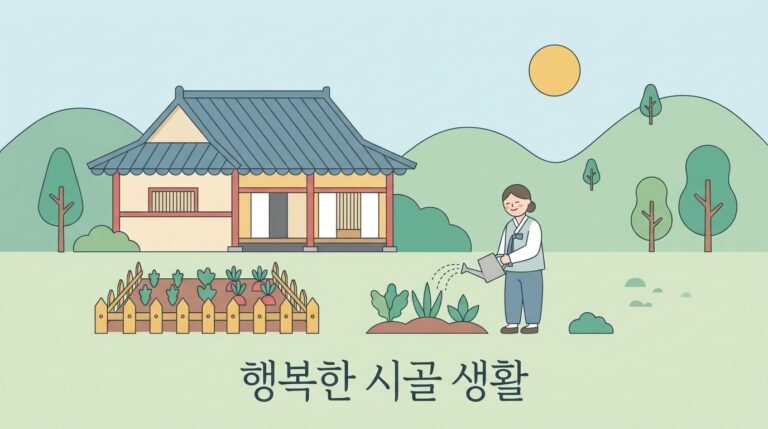
Planning Your Dream “Second Life”: Essential Korean for Post-Retirement Goals
Phase 1: Empathy (A Warm Welcome to Life’s Act Two)
안녕하세요! 매일한글 에디터입니다. (Hello! I’m your Daily Hangul editor.)
Have you ever watched a heartfelt K-drama like Navillera—where a 70-year-old retired mailman finally ties his ballet slippers—or seen a seasoned character in Our Blues leaning against a stone wall, sipping warm tea while daydreaming of quiet days ahead? There is something universally poignant yet deeply exciting about discussing what comes after years of hard work. However, when learners first try talking about retirement in Korean, a sudden wall hits: standard textbooks teach rigid terms like “은퇴 (retirement)” and stiff grammar drills that make you sound like a pension officer filling out paperwork!
In real Korean conversations over late-night samgyeopsal or relaxed afternoon coffee, Koreans rarely talk about retirement as a final stop. Instead, they frame it as an exciting pivot: chasing unrealized dreams, growing crisp lettuce in an idyllic countryside teotbat (vegetable patch), or opening a fragrant roastery cafe.
In this guide, crafted from real classroom breakthroughs and everyday local conversations, you will unlock the natural, warm language necessary to share your future dreams. By mastering these expressions, you won’t just say “I plan to stop working”; you will connect with Korean friends on a deeply emotional level about passion, aging with grace, and living life to the fullest.
Phase 2: Core Expressions Deep Dive
1. 제2의 인생을 준비하고 있어요 (Je-i-ui insaeng-eul junbihago isseoyo)
- Pronunciation: Je-ee-ui in-saeng-eul joon-bi-ha-go ee-sseo-yo (Think of the English “saying” without the ‘s’ for insaeng).
- Meaning: Literal: “I am preparing for my second life.” / Real Nuance: “I am getting ready for my next chapter / Act Two of my life.”
- K-Culture Moment: You will hear this phrase constantly in documentary shows like Human Theater (인간극장) or reality shows where veteran entertainers transition into woodworking, organic farming, or starting indie music bands.
- Editor’s Insight: The term “제2의 인생” (Second Life) carries immense social positivity in Korea. Because modern Koreans worked famously intense hours throughout their twenties to fifties, the “second life” represents personal freedom, self-discovery, and reclaiming lost hobbies.
- Situation Spectrum: Casual ✅ | Semi-formal ✅ | Formal ✅
- 🤔 Think About It: In Western cultures, “retirement” often connotes leisure and stopping work entirely. Why do you think Korean society emphasizes a “second life” full of active endeavors instead of purely resting?
2. 은퇴하면 시골에 내려가서 살고 싶어요 (Euntoehamyeon sigore naeryeogaseo salgo sipeoyo)
- Pronunciation: Eun-twae-ha-myeon shi-gol-eh nae-ryeo-ga-seo sal-go shi-peo-yo (Pronounce sigol like “sea-goal”).
- Meaning: Literal: “When I retire, I want to go down to the countryside and live.” / Real Nuance: “Once I wrap up work, my dream is to settle down in a quiet rural town.”
- K-Culture Moment: Seen in relaxing healing movies like Little Forest or countryside variety shows like Three Meals a Day (삼시세끼). It paints an instant picture of clean air, morning mountain walks, and homegrown meals.
- Editor’s Insight: Notice the directional verb “내려가다” (to go down). In Korean geography and psychology, leaving the bustling metropolitan Seoul area for provincial towns is almost always described as “going down,” regardless of absolute compass directions.
- Situation Spectrum: Casual ✅ | Semi-formal ✅ | Formal ⚠️
- 🤔 Think About It: Does your native culture distinguish between urban and rural living with specific verbs like “going down”? How does language shape our perception of city versus nature?
3. 취미 삼아 소소하게 카페나 해볼까 해요 (Chwimi sama sosohage kapena haebolkka haeyo)
- Pronunciation: Chwee-mee sah-mah so-so-ha-geh kah-peh-na hae-bol-kka hae-yo (Sound analogy: sosohage flows softly like a whisper).
- Meaning: Literal: “Taking it as a hobby, I’m thinking of running a humble cafe or something.” / Real Nuance: “I’m considering opening a cute, stress-free cafe just to keep myself pleasantly occupied.”
- K-Culture Moment: The quintessential Korean middle-aged dream portrayed across slice-of-life dramas: running a seaside roastery, a cozy flower shop, or a neighborhood book cafe.
- Editor’s Insight: Pay attention to two softening markers: “소소하게” (modestly / simply) and the particle “~(이)나” attached to cafe. Koreans deliberately downplay business ambitions when discussing retirement to signal that their motive is peace of mind, not greed or stress.
- Situation Spectrum: Casual ✅ | Semi-formal ✅ | Formal 🚫
- 🤔 Think About It: Why is self-deprecation and modesty so critical when sharing future entrepreneurial dreams in East Asian social circles?
Phase 3: Textbook Korean vs. Real Korean
Situation 1: Talking about your future retirement timing
- 📖 교과서 한국어 (Textbook):
저는 60세에 은퇴할 계획입니다.
(Jeoneun yuksipse-e euntoehal gyehoek-imnida. / I plan to retire at age 60.) - 🗣️ 진짜 한국어 (Real-Life):
나중에 손 털면 제주도 한 달 살기부터 해보려고요!
(Najung-e son teolmyeon Jejudo han dal salgibuteo haeboryeogoyo! / Once I wash my hands of work down the road, I want to start by living in Jeju for a month!) - 💡 왜 다를까? (Why is it different?):
Textbook Korean sounds like an official HR survey response. Real Koreans use vivid idioms like “손(을) 털다” (literally, “to dust off one’s hands,” meaning to step back after finishing a major chapter of labor) and reference modern cultural trends like Jeju Han Dal Salgi (living in Jeju Island for a month).
Situation 2: Asking an elder or senior colleague about their future aspirations
- 📖 교과서 한국어 (Textbook):
은퇴 후의 계획이 무엇입니까?
(Euntoe hu-ui gyehoeg-i mueosimnikka? / What is your plan after retirement?) - 🗣️ 진짜 한국어 (Real-Life):
나중에 일 그만두시면 평소에 꼭 해보고 싶으셨던 거 있으세요?
(Najung-e il geumandusimyeon pyeongsoe kkok haebogo sipeusyeotdeon geo isseuseyo? / Once you step down from work in the future, is there anything you’ve always longed to try?) - 💡 왜 다를까? (Why is it different?):
Directly interrogating someone with “은퇴 후 계획” can feel intrusive or confrontational. Phrasing it around long-held passions (“꼭 해보고 싶으셨던 거”) honors the person’s lifelong sacrifices and invites warm, nostalgic storytelling.
Phase 4: K-Culture Deep Dive & Non-Verbal Manners
4-1. 눈치 (Nunchi) & Respectful Gestures
When discussing career transitions and aging in Korea, Nunchi (social intuition) is vital:
* The Modest Deflection: If an elder mentions their upcoming retirement, never blurt out “와, 이제 편하시겠어요!” (Wow, you must be so relaxed now!). To someone who worked 35 years in a competitive company, retirement can bring anxiety or a sudden loss of identity. Instead, validate their dedication first: “그동안 정말 고생 많으셨어요” (You really worked hard all these years).
* Posture & Eye Contact: Tilt your torso slightly forward when an older conversational partner shares their retirement hobbies. Nod slowly (끄덕임), keeping your eyes soft and receptive rather than staring intensely. When pouring tea or water during these heartfelt chats, remember to hold the teapot or cup with both hands as a baseline sign of deference.
4-2. Cultural Phenomenon: 귀농 (Gwinong) & 귀촌 (Gwichon)
In Korea, leaving corporate city life behind isn’t merely taking vacations—it has birthed a massive cultural movement called 귀농 (returning to farming) and 귀촌 (moving to rural life without commercial farming). Government centers even host specialized academies teaching urbanites how to build eco-friendly wooden houses, cultivate organic garlic in Gangwon-do, or brew craft traditional liquor (makgeolli). Sharing that you appreciate the quiet charm of Korean rural living immediately establishes you as an insightful cultural insider.
Phase 5: Real-Life Roleplay Scenario
Setting: A serene traditional tea house in Insadong, Seoul. Fragrant ssanghwa-cha (herbal tea) steams on the wooden table.
NPC: Manager Park (박 부장님, 56 years old), your dependable team mentor who is contemplating retiring at the end of next year.
- Turn 1 (Manager Park):
김 대리, 나도 이제 회사 다닐 날이 얼마 안 남은 것 같네.
(Kim daeri, nado ije hoesa danil nari eolma an nameun geot ganne.)
“Kim Daeri, it seems like my days of coming into this office are numbered.”
🎭 Looking warmly into his steaming tea cup with a bittersweet smile. -
Turn 2 (You):
부장님, 그동안 정말 청춘을 다 바쳐서 일하셨잖아요. 시원섭섭하시겠어요.
(Bujangnim, geudong-an jeongmal cheongchun-eul da bachyeoseo ilhasyeotjanayo. Siwonseopseophasigesseoyo.)
“Manager Park, you literally dedicated your youth to this place. It must feel so bittersweet.”
🎭 Listening attentively, holding your teacup with two hands. -
Turn 3 (Manager Park):
맞아, 딱 시원섭섭하다는 말이 맞네. 근데 막상 그만두려니 뭘 해야 할지 조금 막막하기도 해.
(Maja, ttak siwonseopseophadaneun mari manne. Geunde maksang geumanduryeoni mwol haeya halji jogeum mangmak-hagido hae.)
“Right, ‘bittersweet’ is the exact word. But now that it’s nearing, feeling like I don’t know what to do is a bit daunting.”
🎭 Scratching the back of his head with an embarrassed chuckle. -
Turn 4 (You):
예전에 목공 배우는 게 오랜 꿈이라고 하셨잖아요. 제2의 인생을 시작하시는 건 어떠세요?
(Yejeone mokgong baeuneun ge oraen kkum-irago hasyeotjanayo. Je-i-ui insaeng-eul sijakhasineun geon eotteoseyo?)
“Didn’t you mention before that learning woodworking was your longtime dream? How about launching your ‘Act Two’ with that?”
🎭 Encouraging him with sincere, bright eye contact. -
Turn 5 (Manager Park):
아, 목공예! 기억하고 있었네? 사실 시골에 작은 공방 하나 차리는 게 내 오랜 버킷리스트였거든.
(A, mokgong-ye! Gieokhago isseonne? Sasil sigore jageun gongbang hana charineun ge nae oraen beokitriseuteuyeotgeodeun.)
“Ah, woodworking! You remembered? Honestly, setting up a tiny workshop in the countryside has been on my bucket list forever.”
🎭 Eyes widening with renewed youthful excitement. -
Turn 6 (You):
우와, 공방이라니 정말 멋져요! 소소하게 취미로 시작하셔도 주변에서 주문 많이 들어올 것 같아요.
(Uwa, gongbang-irani jeongmal meotjyeoyo! Sosohage chwimiro sijakhasyeodo jubyeon-eseo jumun mani deureool geot gatayo.)
“Wow, an artisan workshop sounds incredible! Even if you start modestly as a hobby, I bet orders will pour in.”
🎭 Smiling broadly and nodding with enthusiasm. -
Turn 7 (Manager Park):
하하, 주문은 무슨! 그냥 내가 쓸 의자나 하나 만들면 족하지. 나중에 완공되면 꼭 차 한잔하러 놀러 오게.
(Haha, jumuneun museun! Geunyang naega sseul uijana hana mandeulmyeon jokhaji. Najung-e wang-gongdoemyeon kkok cha hanjanhareo nolleo oge.)
“Haha, what orders! Making a simple wooden chair for myself is plenty. Once it’s built, you must drop by for tea.”
🎭 Waving his hand dismissively in classic humble Korean fashion. -
Turn 8 (You):
네, 부장님! 개업하시면 제가 제일 먼저 양손 무겁게 찾아갈게요!
(Ne, bujangnim! Gaeeophasimyeon jega jeil meonje yangson mugeopge chajagalgeyo!)
“Yes, Manager Park! When you open, I’ll be the very first to visit with hands full of housewarming gifts!”
🎭 Nodding respectfully with an appreciative bow.
🔀 Interactive Choice Point
Manager Park asks you: “자네는 나중에 은퇴하면 뭐 하고 싶나?” (What do you want to do later in life when you retire?) How will you respond?
- Choice A: “저는 그냥 집에서 하루 종일 게임하고 아무것도 안 할 건데요.” (I’m just going to stay home playing video games all day and do nothing.)
- Evaluation: 🚫 Bad! While honest, it ends the philosophical resonance of the conversation abruptly and paints an impression of lacking life vitality in Korean senior-junior dynamics.
- Choice B: “저는 돈을 최대한 많이 벌어서 서울 강남에 빌딩을 사서 임대업을 할 계획입니다.” (My plan is to maximize my fortune, buy a commercial building in Gangnam, and live as a landlord.)
- Evaluation: ⚠️ Risk! Real estate rental is a common dream in Korea, but bragging about wealth ambitions during a poetic tea-house talk about life and dreams can come off as slightly transactional or materialistic.
- Choice C: “저도 부장님처럼 자연 가까운 곳에서 소소하게 작은 빵집이나 책방을 운영해보고 싶어요.” (Like you, Manager Park, I’d love to run a cozy bakery or bookstore close to nature.)
- Evaluation: ✅ Best! It mirrors his sentiment, honors the value of tranquility, and fosters genuine warmth between mentor and mentee.
Phase 6: 10-Second Emotional Shadowing Drill
Practice these lines out loud. Notice the breath pauses (/) and embody the indicated emotion!
[😌 편안하고 여유로운 어조로 / Peaceful and unhurried]
나중에 은퇴하면 / 한적한 시골 마을에서 / 텃밭 가꾸면서 살고 싶어요.
(Najung-e euntoehamyeon / hanjeokan sigol maeureseo / teotbat gakkumyeonseo salgo sipeoyo.)
“When I retire in the future, / in a quiet rural village, / I want to live tending a little vegetable garden.”-
[✨ 눈을 반짝이며 설레는 목소리로 / Eyes sparkling with eager anticipation]
이제부터라도 / 진짜 하고 싶었던 일에 / 도전해 보려고요!
(Ijebuteorado / jinjja hago sipeotdeon ire / dojeonhae boryeogoyo!)
“Starting right now, / the things I truly wanted to do, / I intend to take on the challenge!” -
[🤝 따뜻하고 진심 어린 격려로 / Warm, deeply sincere encouragement]
부장님의 제2의 인생을 / 제가 진심으로 응원하겠습니다!
(Bujangnim-ui je-i-ui insaeng-eul / jega jinsimeuro eungwonhagesseumnida!)
“Your Act Two of life, / I will cheer you on with all my heart!”
Phase 7: K-Culture Mini Dictionary
- 인생 2막 (Insaeng Imak): Noun. Act 2 of Life. Borrowed from theatrical terminology, this describes the vibrant chapter beginning after leaving one’s primary career. Widely used in news, talk shows, and everyday career chats.
- 귀촌 (Gwichon): Noun. Returning to village living. Unlike Gwinong (which focuses strictly on farming for livelihood), Gwichon is focused on lifestyle, fresh air, relaxation, and creative hobbies.
- 텃밭 가꾸기 (Teotbat gakkugi): Phrase. Tending a personal backyard/allotment vegetable patch. Growing your own perilla leaves (kkaennip), peppers, and cherry tomatoes is considered the pinnacle of post-retirement domestic bliss.
- 소확행 (Sohwakhaeng): Noun. Small but certain happiness. A modern Korean portmanteau (소소하지만 확실한 행복) used often by retirees who prefer morning pour-over coffee or evening riverside walks over grandiose, stressful ambitions.
Phase 8: Survival Kit for Travelers
Top 3 Travel Survival Phrases for Visiting Rural Retirement Havens
- 한적하고 경치 좋은 카페가 어디예요? (Hanjeokhago gyeongchi joeun kapega eodiyeyo?)
“Where is a quiet cafe with a beautiful scenic view?”
Pro Tip: Use this when exploring idyllic countryside destinations like Yangpyeong, Damyang, or Namhae. - 이 채소 직접 키우신 거예요? (I chaeso jikjeop kiusin geoyeyo?)
“Did you grow these vegetables yourself?”
Pro Tip: Asking this at countryside restaurants (Sanchae Bibimbap spots) lights up the elderly owners’ faces with pride! - 여기는 공기가 정말 맑고 평화롭네요. (Yeogineun gong-giga jeongmal makgo pyeonghwaromneyo.)
“The air here is so wonderfully clean and peaceful.”
Editor’s Travel Note
When venturing out to experience Korea’s slow-life rural towns, foreign mapping services often lag. Make sure to download the Naver Map navigation application for iOS and Android to easily check rural intercity bus schedules and discover local garden-view cafes. For regional railway bookings to picturesque spots like Gangneung or Jeonju, check schedules easily through the official Korail Talk ticketing service.
Phase 9: A Step Deeper (Reflection)
In many fast-paced societies, identity is tightly intertwined with your job title. When that title disappears, an existential void can loom. Korean society is currently navigating this profound demographic shift. The legendary generation that spearheaded Korea’s rapid economic miracle (often called the Opal Generation—Old People with Active Lives) is redefining retirement not as an idle rocking-chair twilight, but as an opportunity for bold artistic rebirth and mindful community rediscovery. When you speak about post-retirement plans in Korean, you are honoring this resilient cultural spirit of continuous reinvention.
💬 Your Turn: If you had unlimited freedom and zero bills to worry about tomorrow, what would your Korean Insaeng Imak (Act Two) look like? Would you open a vinyl listening bar in Jeju, or tend a peaceful orchard in Gangwon-do? Share your dream in the comments below using the phrase “저는 나중에 ~하고 싶어요”!
Phase 10: FAQ & Avoiding Misunderstandings
Q: Can I use the word “퇴직 (toejik)” interchangeably with “은퇴 (euntoe)”?
A: Not quite! While both relate to stopping work, “퇴직” (resignation/leaving a job) refers to the administrative act of departing a specific workplace or company, regardless of age. “은퇴” refers to stepping away from one’s career profession permanently due to mature age or milestone fulfillment. To express life plans, “은퇴 후 삶” is the proper phrase.
Q: Is it rude to ask an older Korean colleague about their retirement plans?
A: It depends on your phrasing! Asking abruptly “부장님, 언제 은퇴하세요?” (Manager, when are you retiring?) can sound like you are nudging them out the door. However, asking gently about their future hobbies or passion projects (“나중에 시간 생기시면 꼭 해보고 싶으신 취미 있으세요?”) is considered polite, thoughtful, and flattering.
Q: What does “인생 2막을 열다” mean in headlines?
A: It literally translates to “opening Act 2 of life.” It is a classic literary metaphor widely used across Korean journalism, describing former executives becoming bakers, teachers becoming travel writers, or athletes founding charities.
🚨 Common Mistakes Alert
- Mistake: Saying “저는 은퇴하면 아무것도 안 하고 놀 거예요” in formal company.
Correction: In Korean, “놀다” can sound childlike or frivolous. Upgrade it to: “은퇴하면 그동안 못 했던 힐링과 휴식을 취하고 싶어요” (I want to heal and get the rest I missed out on). - Mistake: Using “할머니 / 할아버지” directly when speaking to newly retired 60-somethings.
Correction: Today’s 60-year-olds in Korea look and feel vibrant! Calling them grandparents can inadvertently sting. Address them politely by their professional title (e.g., 선생님 or 부장님). - Mistake: Forgetting the particle “(이)나” when downplaying plans.
Correction: Instead of saying “카페를 차릴 거예요” (which sounds like an intense capital investment), say “소소하게 카페나 해볼까 해요” to sound approachable and humble.
Phase 11: Action Missions & Community
- 🥉 Bronze Level (Solo Drill): Stand in front of your mirror. Look at yourself and say aloud with a relaxed smile: “제2의 인생을 준비하고 있어요.” Record your voice and check your rhythm.
- 🥈 Silver Level (Social Practice): Post an Instagram story or study-log photo of your favorite countryside scenery with the caption: “나중에 은퇴하면 시골에 내려가서 살고 싶어요 🌿”. Tag @DailyHangul so we can cheer you on!
- 🥇 Gold Level (Real-world Chat): In your next Korean exchange session or tutor lesson, ask your Korean conversation partner: “나중에 일 그만두시면 어떤 취미를 제일 해보고 싶으세요?” and actively listen to their life story.
- 🎮 K-Culture Mission: Watch an episode of the Korean drama Navillera (나빌레라) on Netflix. Listen closely for when the main characters talk about their lifelong unfulfilled dreams (꿈) and write down the vocabulary you spot!
Phase 12: Interactive Quiz Challenge
Test your knowledge from today’s guide!
1. Situational Judgment:
You are chatting with an older mentor who is stepping down from their career next month. Which of the following is the most empathetic and polite remark?
(A) “이제 나이도 많으신데 집에서 편하게 쉬세요.”
(B) “그동안 회사에 정말 헌신하셨네요. 부장님의 멋진 인생 2막을 응원합니다!”
(C) “은퇴하시면 국민연금은 많이 나오나요?”
2. Fill-in-the-Blank:
Complete the sentence meaning: “I’m thinking of starting a small garden just as a humble hobby.”
“취미 삼아 ______ 텃밭이나 가꿔볼까 해요.”
3. True or False Cultural Quiz:
In modern Korean culture, people who leave city life to build a rural lifestyle without professional farming are referred to as participating in “귀촌 (Gwichon)”. (True / False)
👉 Click here to view answers and explanations!
-
Answer: (B)
Explanation: Option (B) honors their hard work while warmly cheering on their exciting “Act Two.” Option (A) rudely emphasizes their age, and (C) inappropriately probes into private financial matters. -
Answer: 소소하게 (sosohage)
Explanation: “소소하게” means modestly, simply, or without grandiose ambition, which perfectly matches the peaceful sentiment of retirement gardening. -
Answer: True
Explanation: Exactly right! While Gwinong (귀농) involves full-scale agricultural production, Gwichon (귀촌) focuses on moving to rural surroundings for well-being and peaceful living.







