

Navigating the Korean King Game: How to Set Boundaries Without Ruining the Vibe
Phase 1: Empathy & Storytelling Opening
안녕하세요! 매일한글 에디터입니다. (Hello! I’m your Daily Hangul editor.)
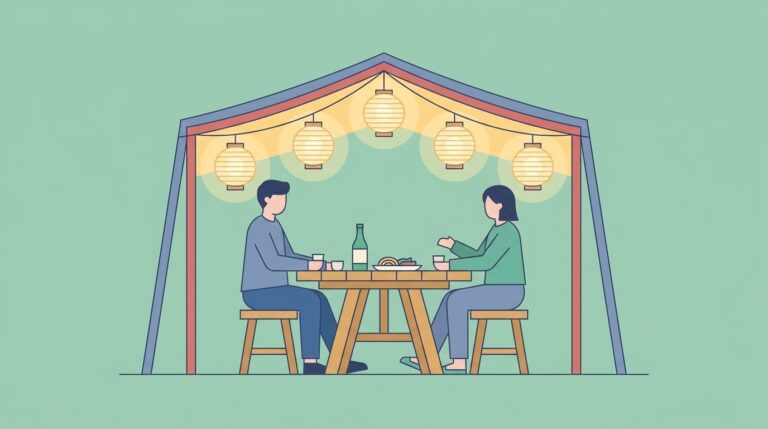
Picture this: You’re packed around a circular metallic drum table at a noisy, neon-lit pocha (tent pub) in Hongdae. Empty green bottles of soju are clustering like bowling pins, the sound of sizzling kimchi jeon fills the air, and someone slams a plastic cup on the table chanting: “Wang-i doeeo bolkka?” (Shall we see who becomes King?). You pick a chopstick from the cup, and your heart races. It’s the notorious Wang Game (왕게임 – The King’s Game).
Suddenly, your table’s most eccentric friend draws the ‘King’ stick and shouts a dare that sounds an awful lot like a steamy scene from a late-night K-drama: “Number 2 and Number 5, pepero kiss right now!” You look at your numbered stick. You are Number 2. And Number 5 is a colleague you met three hours ago.
Your palms sweat. How do you pump the brakes without turning the entire room into a silent freezer? In Korea, this social dread is legendary. Over my ten years navigating after-work hoesik (company dinners) and college MTs, I’ve seen countless international friends either freeze in panic or snap aggressively, completely derailing the party mood. But here is the golden rule of Korean nightlife: Setting boundaries is an art form of wit, not conflict. By the end of this guide, you will master the intermediate linguistic finesse to dial down the intensity, protect your comfort zone, and earn massive respect as someone who possesses elite nunchi.
Phase 2: Core Expressions Deep Dive
1. 선 넘지 말자! (Seon neomji malja!)
- Pronunciation: [Seon neom-ji mal-ja] (Sounds like “Sun numb-jee mal-jah” – imagine saying ‘the sun made my tongue numb’ quickly)
- Meaning: Literal: “Let’s not cross the line!” | Nuance: “Whoa, that’s pushing it! Keep it fun and clean.”
- K-Culture Moment: You hear this constantly in Korean variety shows like Running Man or Knowing Bros whenever a cast member makes a joke or challenge that borders on offensive or too personal.
- Editor’s Insight: This phrase uses the noun 선 (seon – line/boundary). It directly invokes the unwritten boundary of social etiquette. Because it uses the casual imperative -자 (-ja), deliver it with an amused smirk and wide eyes, framing it as friendly banter rather than a formal reprimand.
- Situation Spectrum: Casual ✅ | Semi-formal ⚠️ (switch to 선 넘으시면 안 돼요) | Formal 🚫
- 🤔 Think About It: In Western drinking games, people often say “Hard pass” or “I’m out.” Why do Koreans evoke a collective line (선) rather than individual autonomy?
2. 수위 좀 낮춰줘요. (Suwi jom natchwojwoyo.)
- Pronunciation: [Su-wi jom nat-chwo-jwo-yo] (Sounds like “Soo-wee jome not-chwoh-jwoh-yo”)
- Meaning: Literal: “Please lower the water level a bit.” | Nuance: “Tone down the adult rating / dial back the intensity.”
- K-Culture Moment: Used by MCs when celebrity guests start sharing stories that are a little too scandalous for a broadcast rated PG-15.
- Editor’s Insight: 수위 (suwi) literally means water gauge level, but in pop culture and drinking games, it refers to the maturity rating (e.g., rated 19+ vs. PG-12). Adding 좀 (jom – a little) softens the request instantly, making it cooperative rather than bossy.
- Situation Spectrum: Casual ✅ | Semi-formal ✅ | Formal 🚫
- 🤔 Think About It: How does using media classification metaphors (water level/censorship rating) help avoid direct personal confrontation during social games?
3. 흑기사 소환할게요! (Heukgisa sohwanhalgeyo!)
- Pronunciation: [Heuk-gi-sa so-hwan-hal-ge-yo] (Sounds like “Hook-gee-sah so-hwan-hal-geh-yo”)
- Meaning: Literal: “I will summon a Black Knight!” | Nuance: “I’m exercising my veto/lifeline; who will step in and take this penalty for me?”
- K-Culture Moment: The ultimate K-Drama trope! In romance dramas, the cool male lead dramatically intercepts the heroine’s shot glass or steps into an awkward King dare, declaring himself her 흑기사 (Black Knight)—which always comes with a playful romantic wish/favor later!
- Editor’s Insight: If you identify as female, you summon a 흑기사 (heukgisa). If a guy needs a woman to step in, she is a 흑장미 (heukjangmi – Black Rose). Using this allows you to completely sidestep a dare while keeping the game’s energy electric.
- Situation Spectrum: Casual ✅ | Semi-formal ✅ | Formal 🚫
- 🤔 Think About It: Why is social substitution (having someone drink or act on your behalf) celebrated in Korean drinking culture instead of seen as quitting?
Phase 3: Textbook Korean vs. Real Korean
Situation 1: Refusing an uncomfortable dare from the ‘King’
- 📖 교과서 한국어 (Textbook): 저는 그 명령을 수행할 수 없습니다. (Jeoneun geu myeongnyeong-eul suhaenghal su eopseumnida. – “I am unable to carry out that order.”)
- 🗣️ 진짜 한국어 (Real-life Native): 에이, 그건 진짜 에바지! 다른 거 가자! (Ei, geugeon jinjja ebaji! Dareun geo gaja! – “Ayyy, that’s way over the line! Let’s do something else!”)
- 💡 왜 다를까? (Why the difference?): The textbook version sounds like a soldier reporting to a general during a military court-martial. Real Koreans use the expressive slang 에바 (eba – overkill / going too far, derived from ‘over’) combined with the playful interjection 에이 (ei) to diffuse tension through humor.
Situation 2: Asking the table to tone down the game’s romantic/sexual rating
- 📖 교과서 한국어 (Textbook): 게임의 수위를 적절하게 조절해 주시기 바랍니다. (Geim-ui suwireul jeokjeolhage jojeolhae jusigi baramnida. – “Please adjust the level of the game appropriately.”)
- 🗣️ 진짜 한국어 (Real-life Native): 왕님, 19금 말고 전체 이용가로 갑시다! (Wangnim, sipgugeum malgo jeonche-iyonggaro gapsida! – “Your Majesty, let’s keep it G-rated instead of rated-19, alright?”)
- 💡 왜 다를까? (Why the difference?): Using satirical honorifics like 왕님 (wangnim – King) paired with broadcast ratings like 19금 (sipgugeum – 19+) keeps the interaction immersive and funny while sending a crystal-clear boundary signal.
Phase 4: K-Culture Deep Dive & Non-Verbal Manners
4-1. 눈치 (Nunchi) & Physical Gestures
When the Wang Game starts venturing into awkward territory, words are only 40% of your defense—your non-verbal body language does the heavy lifting:
* The Playful ‘X’ Guard: Cross your forearms in an ‘X’ shape in front of your chest, but keep your head tilted with a wide smile. This signals an unambiguous “hard limit” without looking offended.
* Eye-Tracking (눈치 모드): When a wild dare is uttered, quickly scan the room. Are others uncomfortably chuckling, looking down at their phone, or fidgeting with beer caps? If you catch someone else’s hesitant gaze, lock eyes and give an agreeable nod—you now have an ally to chime in with “선 넘었다!”.
* The Two-Handed Clink & Redirect: Pick up your glass with both hands (a sign of respect to peers and elders), toast the ‘King’, take a tiny sip, and say: “벌주 마시고 패스할게요!” (I’ll take the penalty shot and pass!). You sacrifice your liver a tiny bit, but protect your boundaries honorably.
4-2. Cultural Code: The Evolution of MT (Membership Training) Culture
Historically, university MTs and drinking gatherings in the early 2000s featured notoriously intense King Games. However, modern Korean youth culture (Generation MZ) has experienced a massive paradigm shift. Autonomy, consent, and mutual comfort are now top priorities. Today, anyone who forces excessive physical contact or heavy drinking is immediately branded a 꼰대 (kkondae – stubborn old-fashioned buzzkill). Knowing how to playfully rein in the game’s level is actually seen as high-social-intelligence behavior that saves everyone at the table.
Phase 5: Real-Life Roleplay Scenario
Setting: 11:30 PM. A bustling basement pocha near Sinchon. Yellow paper menus glued to the walls, k-pop blasting. Your friend Min-woo is visibly hyped and wearing an empty cardboard beer box on his head as a crown.
- 민우 (Min-woo): [👑 당당하게 젓가락을 흔들며] 크하하! 내가 왕이다! 이번엔 3번이랑 6번 러브샷 진하게 가자! (Keuhaha! Naega wang-ida! Ibeonen sambon-irang yukbeon leobeusyat jinhage gaja! – “Bwahaha! I am the King! This time, Number 3 and Number 6 do an intense deep love-shot!”)
- 나 (You): [🎭 3번 나무젓가락을 내려놓으며 깜짝 놀란 표정] 헐, 나 3번인데? 민우야, 아무리 그래도 우리 본 지 두 시간 됐다! (Heol, na sambeon-inde? Min-u-ya, amuri geuraedo uri bon ji du sigan dwaetda! – “Whoa, I’m Number 3? Min-woo, no matter what, we met like two hours ago!”)
- 지혜 (Ji-hye): [👀 눈치를 살피며 귓속말로] 너 괜찮아? 6번 정석 오빠인데… (Neo gwaenchana? Yukbeon Jeong-seok oppa-inde… – “Are you okay? Number 6 is Jeong-seok…”)
- 나 (You): [✋ 손으로 엑스자를 그리며 웃음기 섞인 목소리로] 왕님, 오늘 초면인데 이건 선 넘었죠! 수위 조절 좀 부탁드립니다! (Wangnim, oneul chomyeon-inde igeon seon neomeotjyo! Suwi jojeol jom butakdeurimnida! – “King, we just met today, this definitely crosses the line! Please adjust the intensity!”)
- 민우 (Min-woo): [😅 머리를 긁적이며 장난스럽게] 에이~ 분위기 띄우려고 했지! 그럼 벌주 마실래, 소원 들어줄래? (Ei~ bun-wigi tti-uryeogo haetji! Geureom beolju masillae, sowon deureojullae? – “Ayy~ I was just hyping up the vibe! Then will you take the penalty shot, or grant a favor?”)
- 나 (You): [🙋 당차게 외치며] 제 흑기사 해주실 분 계십니까? 소주 한 잔 대신 마셔주면 아이스크림 쏩니다! (Je heukgisa haejusil bun gyesimnikka? Soju han jan daesin masyeojumyeon aiseukeurim ssomnida! – “Is there anyone to be my Black Knight? If someone drinks this shot for me, ice cream is on me!”)
- 정석 (Jeong-seok): [😄 웃으며 컵을 낚아채며] 오케이! 베스킨라빈스 민트초코로 사주라! 내가 마신다! (Okei! Beseukin-rabinseu minteuchokoro sajura! Naega masinda! – “Deal! Buy me Baskin Robbins Mint Chocolate! I’ll drink it!”)
- 민우 (Min-woo): [👏 박수 치며] 인정! 흑기사 인정! 자, 다음 판 간다! (Injeong! Heukgisa injeong! Ja, daeum pan ganda! – “Approved! Black Knight approved! Alright, on to the next round!”)
🔀 Interactive Decision Branch
What if Jeong-seok didn’t step in, and Min-woo kept pressuring you? Choose your response:
* Choice A: “야, 재미없게 왜 이래? 나 집에 갈래.” (Hey, why are you being boring? I’m going home.)
* Outcome (Bad): Total room temperature crash. The party vibe freezes into an awkward gapbunssa (sudden silence).
* Choice B: “왕님, 룰대로 벌주 깔끔하게 마시고 패스하겠습니다! 건배!” (Your Majesty, according to the rules I’ll cleanly take the penalty drink and pass! Cheers!)
* Outcome (Best): Pure cultural mastery. You respected the game’s mechanics, held your physical boundary firmly, and kept the energetic momentum going.
* Choice C: Just freeze, say nothing, and do the dare despite feeling deeply uncomfortable.
* Outcome (Risk): Emotional regret and setting a dangerous precedent where others assume you have no boundaries.
Phase 6: 10-Second Emotion Shadowing Drill
Practice reading these out loud at native speed with emotional modulation:
[😏 장난스럽고 당당하게 / Playful & Confident]- 아 왕님, / 오늘 첫판부터 / 너무 달리시는 거 아니에요? / 워워~
- (A wangnim, / oneul cheotpanbuteo / neomu dallisineun geo anieyo? / Whoa whoa~)
- “Ah King, / aren’t you sprinting way too hard / right from the first round? / Whoa whoa~”
[✋ 단호하지만 유쾌하게 / Firm yet Cheerful]- 에이~ / 이건 진짜 에바지! / 19금 딱지 떼고 / 건전하게 갑시다!
- (Ei~ / igeon jinjja ebaji! / Sipgugeum ttakji ttego / geonjeonhage gapsida!)
- “Ayy~ / this is totally overkill! / Strip off the rated-19 tag / and let’s keep it wholesome!”
[🥺 위트 있게 SOS 치며 / Witty SOS Cry]- 저 살려주실 / 멋진 흑기사 / 어디 안 계십니까? / 편의점 쏩니다!
- (Je sallyeojusil / meotjin heukgisa / eodi an gyesimnikka? / Pyeon-uijeom ssomnida!)
- “Isn’t there any handsome Black Knight / who will save me? / Convenience store treats are on me!”
Phase 7: K-Culture Mini Dictionary
| # | Term (Hangul / Romanization) | Meaning | Real-Life / Social Context |
|---|---|---|---|
| 1 | 수위 (Suwi) | Intensity level / rating | Originally water level; used when asking to tone down risqué game dares or jokes. |
| 2 | 에바 (Eba) | Overkill / Extreme | Urban slang derived from “Over”. Used when something crosses the threshold of common sense. |
| 3 | 흑기사 / 흑장미 (Heukgisa / Heukjangmi) | Black Knight / Black Rose | A person who volunteers to take a penalty shot or dare on your behalf in exchange for a favor. |
| 4 | 갑분싸 (Gapbunssa) | Sudden awkward silence | Short for “Gapjagi bunwigiga ssa-haejim”. Exactly what happens when someone refuses a dare too aggressively. |
Phase 8: Traveler’s Survival Kit
TOP 3 Emergency Phrases
- 벌주 마시고 넘길게요! (Beolju masigo neomgilgeyo!)
- Pro Tip: Use this when you want an immediate exit ticket from any physical dare without explaining yourself.
- 저 술 진짜 못 마셔요, 사이다로 대신할게요! (Jeo sul jinjja mot masyeoyo, saidaro daesinhalgeyo!)
- Pro Tip: If you hit your alcohol limit, announce it clearly and substitute with Chilsung Cider.
- 우리 쉬어가는 타임으로 안주 먹어요! (Uri swieoganeun taimeuro anju meogeoyo!)
- Pro Tip: Excellent deflection to pause high-intensity games and nudge everyone toward eating food.
Editor’s Travel Note
Korean pub districts like Hongdae, Gangnam, or Euljiro run until sunrise. Always ensure your phone has the Kakao T taxi hailing app download pre-configured with a payment card, because catching a late-night street cab on Friday night can be challenging. If a drinking game ever becomes genuinely toxic, you can politely excuse yourself to the restroom and settle the bill or notify a staff member.
Phase 9: A Step Deeper (Reflection)
Korean gatherings operate on an underlying current of Jeong (정 – collective affection) and communal harmony. Drinking games are not designed to embarrass individuals maliciously; rather, historically they served as social equalizers, temporarily suspending rigid age and status hierarchies. When you say “왕님!”, you indulge the game’s fantasy while exercising your own agency. The key to social mastery in Korea isn’t blind compliance—it’s demonstrating that you care about preserving the room’s joyful energy while standing firmly on your personal dignity.
💬 Your Turn: Have you ever experienced a drinking game dare in your home country that made you uncomfortable? How would you translate your culture’s boundary-setting style into Korean? Share your story in the comments below!
Phase 10: FAQ & Common Mistakes
Q: What if the King insists that I cannot refuse the dare or use a Black Knight?
A: In modern Korea, pushing past a clear refusal violates social norms. Simply laugh, cross your arms, and say: “아 왜 이래, 강요 금지인 거 알잖아! 벌주 마셨으니까 쿨하게 패스!” (Come on, you know forcing is prohibited! I took the penalty, so let’s move on cleanly!). The table will back you up.
Q: If someone acts as my 흑기사 (Black Knight), am I legally obligated to grant their wish?
A: Not at all! The traditional wish is almost always something harmless and lighthearted, like buying an ice cream at the convenience store right next to the pub (“숙취 해소엔 초코에몽이지!” – Choco-Emong chocolate milk is the hangover classic!). If someone asks for an inappropriate favor, treat it as another “선 넘는” moment and reject it with a laugh.
Q: Is the Wang Game still popular, or do young Koreans play other games now?
A: While classic Wang Game is still played, modern Koreans lean toward fast-paced rhythm games (like Strawberry Game, Apartment Game, or Hunminjeongeum). Wang Game is usually reserved for intimate MT trips where people already know each other well.
🚨 흔한 실수 (Common Mistakes) Warning Board
- Mistake 1: Exploding in Anger. Snapping “You guys are ridiculous!” instantly halts the party. Correct Action: Use self-deprecating humor or pop-culture lines like “이건 심의위원회(censorship committee) 통과 못 합니다!”.
- Mistake 2: Secretly stewing in discomfort. Doing a dare you hate ruins your night. Correct Action: Take the penalty shot (벌주) immediately or summon a 흑기사.
- Mistake 3: Forgetting to reciprocate. If someone drinks a penalty shot for you, never just say thanks and turn away. Correct Action: Buy them an ice cream or pour their next water glass with two hands!
Phase 11: Action Missions
- 🥉 Bronze Level Mission: Stand in front of your mirror and practice the phrase “선 넘지 말자!” with a cheeky smile and hands making an ‘X’ symbol three times.
- 🥈 Silver Level Mission: Comment below with a sentence combining 수위 and 에바 to describe a dramatic movie scene you watched recently!
- 🥇 Gold Level Mission: At your next Korean dinner or language exchange, when someone makes an outrageous suggestion, playfully call out: “그건 에바지!” and record their reaction.
- 🎮 K-Culture Media Mission: Watch an episode of Workman (워크맨) or Running Man on YouTube. Count how many times the cast members cross their arms or shout “선 넘네!” when teasing each other.
Phase 12: Interactive Quiz Challenge
Test your situational mastery!
- Situational Judgment: The ‘King’ dares you to confess your deepest secret to everyone at the table. You want to decline politely without breaking the vibe. What is your best move?
- A) Slap the table and walk out of the pocha.
- B) Smile, shout “비밀은 무덤까지! 벌주 시원하게 마시겠습니다!” (Secrets go to the grave! I’ll gladly down the penalty drink!), and drink your shot.
- C) Make up a fake secret that insults another player.
- Fill in the Blank: When the dares become rated-19 and you want to dial it back to PG, you say:
- “왕님, 이번 판은 19금 말고 ______ 이용가로 가시죠!”
- True / False: In Korea, if a guy drinks a penalty shot on behalf of a girl, he is referred to as a 흑장미 (Black Rose).
👉 Click to reveal answers and explanations!
- Answer: B – Owning your refusal by gladly embracing the penalty drink (벌주) proves you are a cooperative player who respects their own boundaries.
- Answer: 전체 (Jeonche) – 전체 이용가 means “All Ages Admitted / General Audience (G-Rated)”.
- Answer: False – A male protector is a 흑기사 (Black Knight); a female protector is a 흑장미 (Black Rose)!







