

Phase 1: 공감 (Story Immersion Opening)
안녕하세요! 매일한글 에디터입니다. (Hello! I’m your Daily Hangul editor.)
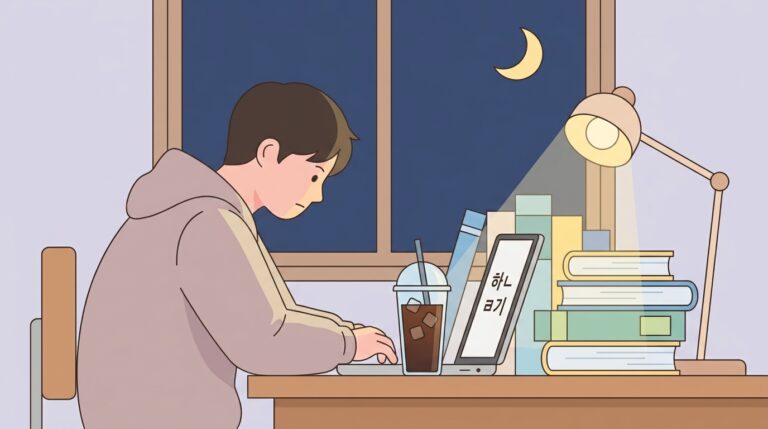
Picture this: It is 3:45 AM during midterm week (시험기간) near Sinchon or Anam. You are huddled inside a warm, buzzing 24-hour study cafe. Stacks of highlighters, crumpled lecture slides, and empty paper cups surround your laptop. Your eyelids feel like lead weights, so what do you do? You grab your third tall Iced Americano (아아) from the convenience store counter, hoping the sheer rush of caffeine will guide your brain through Chapter 14 before your 9:00 AM class.
Every student in South Korea has been in this exact trench. Cramming overnight is practically an Olympic sport here, and talking about coffee intake isn’t just small talk—it’s how students bond through shared survival. If you only know how to say “커피를 마셔요 (I drink coffee),” you are missing out on the rich, hilarious, and deeply empathetic expressions Koreans use when pushing past their physical limits. This lesson is built on real classroom feedback from international university students in Seoul who wanted to sound like authentic campus insiders rather than textbook robots. Let’s dive into the ultimate study-survival Korean!
Phase 2: 핵심 표현 3선 심층 분석
1. 밤새웠어요 (Bam-sae-wot-seo-yo)
- Pronunciation: [Bam-sae-wot-seo-yo] (Sounds like Bahm-seh-waht-suh-yo)
- Meaning: Literal: “The night was brightened” / Real Nuance: “I pulled an all-nighter / I stayed up all night.”
- K-Culture Moment: In college K-dramas like Cheese in the Trap or Weightlifting Fairy Kim Bok-joo, exhausted characters crash down onto lecture desks with dark circles, groaning this exact line to their classmates.
- Editor’s Insight: The base verb is 밤새다 (bamsae-da). While beginner books teach “어젯밤에 안 잤어요 (I didn’t sleep last night),” native speakers almost universally say “밤새웠어요” or “밤샜어요.” It carries a badge of honor—you didn’t just miss sleep, you actively fought the night.
- Situation Spectrum: Casual (밤샜어 ✅) | Semi-formal (밤새웠어요 ✅) | Formal (밤을 새웠습니다 ✅)
- 🤔 Think About It: In English, we say “pulling” an all-nighter, implying an intentional feat of endurance. In Korean, “밤을 새우다” literally means passing through the night until the dawn brightens. Does your native language view sleep deprivation as a battle or a passing of time?
2. 커피를 달고 살아요 (Keo-pi-reul dal-go sal-a-yo)
- Pronunciation: [Keo-pi-reul dal-go sal-a-yo] (Sounds like Kuh-pee-reul dahl-goh sahl-ah-yo)
- Meaning: Literal: “I live with coffee attached/hanging on me” / Real Nuance: “I’m practically living on coffee / I can’t go anywhere without coffee in hand.”
- K-Culture Moment: A tired intern or grad student in an office drama like Misaeng walks into the pantry clutching their tumbler like an IV drip, saying this to an older colleague.
- Editor’s Insight: The verb 달다 (dal-da) means to hang or attach something. Saying you live with something “달고 산다” means an item (or even a condition like a cold) has become part of your body. It sounds vivid, humorous, and instantly conveys heavy caffeine dependence.
- Situation Spectrum: Casual (달고 살아 ✅) | Semi-formal (달고 살아요 ✅) | Formal (달고 삽니다 ⚠️ – A bit colloquial for strictly formal boardrooms)
- 🤔 Think About It: Why does Korean attach habits to physical survival verbs like “살다” (to live)? It reflects how deeply daily routines are tied to Korean communal resilience.
3. 카페인으로 버티고 있어요 (Ka-pe-in-eu-ro beot-ti-go it-seo-yo)
- Pronunciation: [Ka-pe-in-eu-ro beot-ti-go it-seo-yo] (Sounds like Kah-peh-een-eu-roh buht-tee-goh eet-suh-yo)
- Meaning: Literal: “I am enduring via caffeine” / Real Nuance: “I’m surviving on caffeine alone.”
- K-Culture Moment: Webtoon artists and K-Pop trainees often post vlogs showing desks loaded with energy drinks and canned espresso, captioned with this phrase.
- Editor’s Insight: “버티다” (beotida) is one of the most culturally loaded verbs in Korean. It means to hold out, endure, hang in there, or withstand pressure. Combining it with “카페인” tells everyone: “I have zero natural energy left; this beverage is doing all the heavy lifting.”
- Situation Spectrum: Casual (카페인으로 버텨 ✅) | Semi-formal (카페인으로 버티고 있어요 ✅) | Formal (카페인으로 버티는 중입니다 ⚠️)
- 🤔 Think About It: Notice how “버티다” conveys grit. In what situations in your culture do people talk about “just hanging on”?
Phase 3: 교과서 한국어 vs 진짜 한국어
Situation 1: Explaining your massive coffee intake before class
- 📖 교과서 한국어 (Textbook):
저는 졸려서 커피를 많이 마셨습니다.
(Jeo-neun jol-lyeo-seo keo-pi-reul man-i ma-syeot-seum-ni-da.)
“Because I was sleepy, I drank a lot of coffee.” - 🗣️ 진짜 한국어 (Real-world):
잠 깨려고 커피를 계속 들이붓고 있어요.
(Jam kkae-ryeo-go keo-pi-reul gye-sok deul-i-but-go it-seo-yo.)
“I’m literally pouring coffee down my throat just to stay awake.” - 💡 왜 다를까?: Textbook phrases sound detached like a clinical report. Real Koreans use dynamic verbs like “들이붓다” (to pour into) or “때려 넣다” (to cram/slam down) to highlight desperate exam-week dramatics.
Situation 2: Telling a friend how late you studied
- 📖 교과서 한국어 (Textbook):
어제 시험공부를 아침까지 했습니다.
(Eo-je si-heom-gong-bu-reul a-chim-kka-ji haet-seum-ni-da.)
“Yesterday, I did test preparation until morning.” - 🗣️ 진짜 한국어 (Real-world):
어제 과제하느라 꼬박 밤샜어요.
(Eo-je gwa-je-ha-neu-ra kko-bak bam-saes-seo-yo.)
“I pulled a full, non-stop all-nighter finishing the assignment.” - 💡 왜 다를까?: The adverb “꼬박” (kko-bak) adds the nuance of “every single hour without a wink of rest.” It turns a dry timeline into an emotionally relatable achievement.
Phase 4: K-Culture 딥다이브 & 비언어적 매너
4-1. 눈치 (Nunchi) & Gestures
When surviving on caffeine in a Korean university environment, body language speaks volumes:
* The Two-Handed Can Slide: If a classmate spots you nodding off, they won’t loudly say “wake up!” Instead, they’ll buy a warm canned coffee (like Letsbe or Georgia) and gently roll or slide it onto your desk with both hands. Tap your chest or bow your head lightly at a 15-degree angle to express gratitude.
* The Temples Rub: When speaking the line “정신이 멍해요 (My head feels cloudy),” people usually press their index fingers against their temples and squint their eyes. It signals that your brain is lagging like a frozen web browser.
* Study Cafe (스카) Etiquette: In unmanned 24-hour study cafes (스터디카페), whisper in the lounge only. Inside the main study room (열람실), opening a loud canned beverage or typing forcefully without a silicone keyboard cover violates silent social etiquette (nunchi).
4-2. 문화 코드 분석: The “Ah-Ah” (아아) Phenomenon & College Life
In Korea, even during blizzards, you will see college students holding plastic cups of iced coffee. This gave birth to the national slang “얼죽아” (Eol-juk-ah: “Even if I freeze to death, I’ll drink iced Americano”). Why cold coffee during exams? Because hot coffee must be sipped slowly, whereas iced coffee can be ingested rapidly like medicine before a lecture starts! Exam periods also activate campus “간식 사업” (snack drives), where student councils hand out sandwiches, vitamin packs, and coffee coupons to boost morale.
Phase 5: 실전 롤플레이 시나리오
Setting: 8:20 AM. A campus cafe right in front of the Central Library. Fluorescent lights buzz, soft acoustic K-indie music plays, and the air smells of roasted espresso beans.
Characters:
* You: An exchange student taking your first midterms in Korea.
* Minho (민호): Your Korean study partner and department classmate who looks like a zombie.
민호: 🎭 (Rubbing his eyes and leaning on the cafe counter)
야, 너 안색이 왜 그래? 어제 한숨도 못 잤어?
(Ya, neo an-saek-i wae geu-rae? Eo-je han-sum-do mot jat-seo?)
“Hey, why do you look so pale? Did you not sleep a single wink yesterday?”
You: 🎭 (Groaning softly while pointing at your dark circles)
응, 오늘 발표 준비하느라 꼬박 밤새웠어.
(Eung, o-neul bal-pyo jun-bi-ha-neu-ra kko-bak bam-sae-wot-seo.)
“Yeah, I pulled a complete all-nighter preparing for today’s presentation.”
민호: 🎭 (Sighing with deep sympathy, holding up a giant empty tumbler)
진짜 고생했다. 나도 경제학 리포트 때문에 세 시간밖에 못 잤어.
(Jin-jja go-saeng-haet-da. Na-do gyeong-je-hak ri-po-teu ttae-mun-e se si-gan-bak-ke mot jat-seo.)
“You went through so much pain. I only got three hours of sleep too because of the economics paper.”
You: 🎭 (Glancing at the barista machine with yearning)
나 지금 정신이 하나도 없어. 카페인으로 버텨야 해.
(Na ji-geum jeong-sin-i ha-na-do eop-seo. Ka-pe-in-eu-ro beot-tyeo-ya hae.)
“My brain isn’t functioning at all right now. I have to survive on caffeine.”
민호: 🎭 (Nodding solemnly like a wartime comrade)
시험기간에는 다들 커피를 달고 살지. 뭐 마실래? 내가 살게.
(Si-heom-gi-gan-e-neun da-deul keo-pi-reul dal-go sal-ji. Mwo ma-sil-lae? Nae-ga sal-ge.)
“Everyone practically lives on coffee during exam season. What do you want? My treat.”
You: 🎭 (Smiling gratefully with hands clasping chest)
정말? 고마워! 나는 아이스 아메리카노 샷 추가해서 부탁해.
(Jeong-mal? Go-ma-wo! Na-neun a-i-seu a-me-ri-ka-no syat chu-ga-hae-seo bu-tak-hae.)
“Really? Thank you! For me, an Iced Americano with an extra espresso shot, please.”
민호: 🎭 (Chuckling dryly while tapping his debit card on the kiosk)
샷 추가? 너 오늘 심장 터지겠다. 그래도 오늘은 어쩔 수 없지.
(Syat chu-ga? Neo o-neul sim-jang teo-ji-get-da. Geu-rae-do o-neul-eun eo-jjeol su eop-ji.)
“Extra shot? Your heart might explode today. But well, today there’s no other choice.”
You: 🎭 (Taking a deep breath and clenching your fist in determination)
커피 마시고 오늘 시험까지 파이팅 해보자!
(Keo-pi ma-si-go o-neul si-heom-kka-ji pa-i-ting hae-bo-ja!)
“Let’s drink our coffee and fight through our exams today!”
🔀 인터랙티브 분기점 (Interactive Choice Branch)
Minho says your heart might explode from the extra shot. How do you respond?
- Choice A: “죽지 않으려면 어쩔 수 없어. 카페인이 내 피야.” (Juk-ji an-eu-ryeo-myeon eo-jjeol su eop-seo. Ka-pe-in-i nae pi-ya. / “To not die, I have no choice. Caffeine is my blood.”)
- Outcome (Best): Minho bursts out laughing at your hyperbole. You sound 100% like a native Korean college student using dark campus humor.
- Choice B: “저는 건강을 위해 물을 더 선호합니다.” (Jeo-neun geon-gang-eul wi-he mul-eul deo seon-ho-ham-ni-da. / “I prefer water for my health.”)
- Outcome (Bad): Way too stiff! You just asked for an extra espresso shot two seconds ago, and speaking ultra-formal Korean here breaks the friendly comrade mood.
- Choice C: “커피 사줘서 고마운데 나한테 반말하지 마.” (Keo-pi sa-jwo-seo go-ma-un-de na-han-te ban-mal-ha-ji ma. / “Thanks for buying coffee, but don’t use informal speech with me.”)
- Outcome (Risk): Social disaster! Minho is your study friend who offered to buy you a drink. Calling him out aggressively for banmal will instantly freeze the friendship.
Phase 6: 10초 감정 섀도잉 드릴
Shadow these sentences out loud, obeying the slash breaks (/) for breath and matching the emotional cues!
[😴 Exhausted, throat raspy and voice cracking]
어제 과제 때문에 / 꼬박 밤새워서 / 눈이 안 떠져요.
(Eo-je gwa-je ttae-mun-e / kko-bak bam-sae-wo-seo / nun-i an tteo-jyeo-yo.)
“Because of the homework yesterday / I pulled a total all-nighter / and my eyes won’t open.”-
[⚡ Shivering with dramatic caffeine anticipation]
아침부터 / 커피 세 잔째 / 들이붓는 중이에요.
(A-chim-bu-teo / keo-pi se jan-jjae / deul-i-but-neun jung-i-e-yo.)
“Since this morning / my third cup of coffee / I am currently pouring down my throat.” -
[💪 Motivated, fist pump with a supportive smile]
우리 오늘까지만 / 카페인으로 버티고 / 푹 자자!
(U-ri o-neul-kka-ji-man / ka-pe-in-eu-ro beot-ti-go / puk ja-ja!)
“Let’s survive on caffeine / just until today / and then sleep deeply!”
Phase 7: K-Culture 미니 사전 (Core Keywords)
- 벼락치기 (Byeorakchigi) | Cramming (literally: lightning-striking)
- Usage: Used to describe studying at the very last second. Example: “나 오늘 벼락치기 해야 돼 (I have to cram today).”
- 스카 (Seuka) | Study Cafe (Compound abbreviation)
- Usage: Portmanteau of 스터디 (Study) and 카페 (Cafe). Students don’t say the full 5 syllables; they text: “스카 갈래? (Wanna hit the study cafe?)”
- 아아 (A-A) | Iced Americano abbreviation
- Usage: Standard conversational shorthand used at cafes or convenience stores across all of Korea.
- 당 충전 (Dang chungjeon) | Sugar recharge / Sugar rush
- Usage: When caffeine isn’t enough, students buy chocolate macaroons or milk tea, declaring: “당 충전이 필요해 (I need a sugar boost).”
Phase 8: 여행자를 위한 생존 키트
Survival Expressions TOP 3
- 샷 추가해 주세요 (Syat chu-ga-hae ju-se-yo)
- Meaning: “Please add an extra espresso shot.”
- Pro Tip: Kiosk screens will show “샷 추가 (+500원)”. Press this button on the options screen!
- 연하게 타 주세요 (Yeon-ha-ge ta ju-se-yo)
- Meaning: “Please make it mild/watered-down.”
- Pro Tip: Korean espresso is often strong. If your stomach hurts from lack of sleep, use this phrase.
- 콘센트 있는 자리 있어요? (Kon-sen-teu it-neun ja-ri it-seo-yo?)
- Meaning: “Are there seats with electrical outlets?”
- Pro Tip: Essential when carrying a dying laptop through crowded Hongdae or Sinchon study spots.
Editor’s Travel Note
- App Navigation: To locate nearby 24-hour cafes or study zones, search for “24시 카페” on the 카카오맵 길찾기 앱 설치 or check reviews on the 네이버 지도 앱 다운로드.
- Unmanned Kiosk Payment: Many modern study cafes require downloading a local kiosk app or verifying via Korean telephone number. If you only hold an international SIM without local SMS, look for regular franchise cafes like Hollys Coffee (할리스) or A Twosome Place (투썸플레이스) which stay open 24/7 near university campuses and accept international credit cards.
Phase 9: “한 발 더 깊이” (생각 질문)
In Korean culture, the act of suffering through hard study or long work hours is rarely seen as a solitary punishment; it functions as a collective ritual. When you look at the person next to you in a 4:00 AM cafe and notice their empty coffee cup, you instantly feel jeong (정) and camaraderie (jeon-woo-ae, the feeling of shared battlefield brotherhood). Surviving on coffee isn’t celebrated because Koreans love exhaustion, but because persistence (injung and kkutkkuthame) is universally respected.
💬 Your Turn: What is your culture’s go-to fuel when pulling an all-nighter? Is it coffee, energy drinks, black tea, or sugary snacks? Drop your favorite survival ritual in the comments below!
Phase 10: FAQ & 오해 방지
Q: Can I use “밤새웠어요” if I took a two-hour power nap?
A: Technically, yes! Even if you slept for 1–2 hours between 5:00 AM and 7:00 AM, Koreans still casually say “거의 밤새웠어요 (I almost pulled an all-nighter)” or “잠깐 눈만 붙였어요 (I just closed my eyes for a split second).”
Q: What is the difference between “밤새다” and “밤새우다”?
A: Grammatically, 밤새다 (bamsae-da) is an intransitive verb (the night passed), while 밤새우다 (bamsae-u-da) is transitive (I kept the night awake). In conversational daily Korean, people blur them together into “밤샜어요” or “밤새웠어요” interchangeably without any issue.
Q: Is it rude to tell a professor that you “밤새웠어요”?
A: It is fine if you explain why you look exhausted, but frame it formally: “어제 과제를 준비하느라 밤을 새웠습니다 (I stayed up through the night preparing the assignment).” Avoid using casual phrases like “멘붕 와서 들이부었어요 (I broke down and chugged coffee).”
🚨 흔한 실수 (Common Mistakes) 경고판
- Saying “커피를 많이 마시고 살아요” ❌
- Why: It sounds like you are physically living to drink coffee.
- Correct Action: Say “커피를 달고 살아요” ✅ to express continuous attachment.
- Confusing “밤새다” with “새벽” ❌
- Why: Beginners sometimes invent phrases like “새벽했어요.” 새벽 means dawn/early morning (noun).
- Correct Action: Use the fixed verb “밤새우다 / 밤새다” ✅.
- Using “졸려요” in High-Stakes Situations ❌
- Why: “졸려요” sounds cute or childish (like a sleepy toddler).
- Correct Action: Use “피곤해요 (I’m fatigued)” or “정신이 멍해요 (My head is foggy)” in adult university/work contexts ✅.
Phase 11: 액션 미션 & 참여 유도
- 🥉 Bronze Mission (Solo Vocalizer): Record yourself saying: “잠 깨려고 커피를 계속 들이붓고 있어요 (I’m pouring coffee down to wake up)” three times, each time faster and more emotionally dramatic!
- 🥈 Silver Mission (Social Explorer): Next time you hold an iced coffee or study late, take a photo and caption it with:
#시험기간 #카페인충전 #밤새웠어요. - 🥇 Gold Mission (Real Life Speaking): The next time you order at a Korean coffee shop or speak with a Korean language partner, ask for “샷 추가해 주세요” or explain: “요즘 시험 때문에 커피를 달고 살아요!”
- 🎮 K-Culture Mission: Watch any campus drama episode (like Law School or Twenty-Five Twenty-One) and spot the moment a character brings canned coffee to someone studying late. Notice the two-handed handoff!
Phase 12: 인터랙티브 퀴즈 챌린지
1. Situation Judgment
You bump into your Korean professor at 9:00 AM. You haven’t slept because of their assignment. Which statement is the most polite and natural?
* A) 교수님, 저 어제 커피 때려 넣고 멘붕 왔어요.
* B) 교수님, 과제 준비하느라 밤을 새워서 조금 피곤합니다.
* C) 교수님, 어제 안 잤는데 커피 한 잔 사주세요.
2. Fill in the Blank
Complete this natural idiom: “요즘 시험 기간이라 커피를 ______ 살아요.”
* A) 먹고
* B) 달고
* C) 잊고
3. Cultural True or False
In Korea, “얼죽아” refers to people who only drink piping hot Americanos in the winter to keep their hands warm.
* [True / False]
👉 Click here to reveal the answers and explanations!
Answers & Explanations:
1. Answer: B | While A is vivid, it uses severe slang (“때려 넣다”, “멘붕”) which is inappropriate for a professor. C is rude bantering. B is dignified, grammatically polite, and conveys your effort.
2. Answer: B (달고) | The phrase “달고 살다” is a fixed idiom meaning to do or consume something incessantly as if attached to your body.
3. Answer: False | “얼죽아” stands for “얼어 죽어도 아이스 아메리카노” (Even if I freeze to death, I’ll drink iced Americano)! It refers to die-hard iced coffee fans!







