

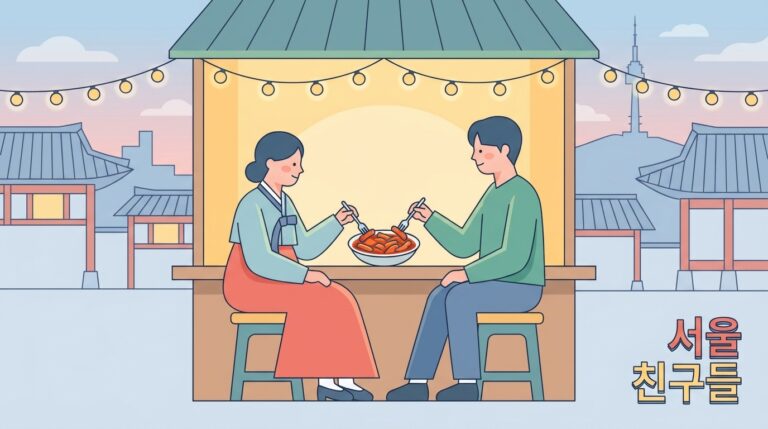
Phase 1: 공감 (Story-Immersive Opening)
안녕하세요! 매일한글 에디터입니다.
Picture this: It is 9:45 PM on a freezing Thursday evening in Gangnam. You have spent the entire day wrestling with tight project deadlines, endless Slack pings, and a supervisor who revised your brief three times. Your shoulders are rock-hard, your jaw is clenched, and your brain feels like a browser with 47 open tabs. In your favorite K-dramas, this is the exact moment the exhausted lead character bursts out of the office lobby, locks eyes with their best friend, and heads straight to a tented street bar (pojangmacha) or a tiny neighborhood coin karaoke room to shed the day’s weight.
Now imagine sitting down across from your Korean coworker or friend. You desperately want to vent, connect, and let your hair down, but all your brain can produce is the textbook line: “스트레스가 많습니다 (I have a lot of stress).” It feels clinical, awkward, and cold—like reading from a medical chart rather than sharing a cathartic human moment. Over the last decade coaching intermediate Korean learners, I have heard this exact complaint hundreds of times: “I know how to say I’m busy, but I don’t know how to complain or unwind naturally without sounding like a robotic foreign tourist.”
Stress relief in South Korea is not a silent solo meditation; it is a shared cultural ritual fueled by flaming-red comfort food, loud singing, and heartfelt sighs. In this comprehensive guide, we will bridge the gap between classroom grammar and the visceral, emotional language of everyday Seoul. Let’s master how to vent, de-stress, and heal like a true local.
Phase 2: 핵심 표현 3선 심층 분석 (Top 3 Core Expressions)
1. 스트레스가 싹 풀려요 (Seuteuleseuga ssak pullyeoyo)
- Pronunciation: [Seu-teu-re-seu-ga ssak pul-ryeo-yo] (Think of ssak like a swift “sock” sound that sweeps everything clean in one breeze).
- Meaning: Literally “My stress completely untangles/dissolves.” In actual nuance, it means your pent-up tension vanished instantly in a clean sweep.
- K-Culture Moment: You will hear this in almost every lifestyle vlog or drama when someone takes their first steaming sip of spicy hangover soup (haejangguk) or steps into a hot outdoor thermal bath (jjimjilbang) after an agonizing week.
- Editor’s Insight: The magic word here is the mimetic adverb 싹 (ssak). It implies a clean, sweeping motion—like brushing breadcrumbs off a table in one stroke. Adding ssak turns a mundane sentence into an expressive native reaction.
- Situation Spectrum: Casual ✅ | Semi-formal ✅ | Formal ⚠️ (Replace with “스트레스가 해소됩니다” in corporate presentations)
- 🤔 Think About It: In English, we say stress “melts” or we “blow off steam.” In Korean, stress is often conceptualized as a knotted rope (풀다, to untangle). What physical metaphor does your native language use for stress?
2. 매운 거 먹으면서 힐링해요 (Maeun geo meogeumyeonseo hillinghaeyo)
- Pronunciation: [Mae-un geo meo-geum-yeon-seo hil-ring-hae-yo] (Mae-un rhymes with “day-un”, and hilling sounds just like the English word “healing”).
- Meaning: Literally “I heal while eating spicy food.” In reality, it means “I de-stress and reset my mood by sweating over super spicy food.”
- K-Culture Moment: Seen whenever a female lead in a drama is dumped or reprimanded at work and immediately orders level-3 spicy chicken feet (tteokbokki or dakbal) with rice balls, wiping tears and sweat while smiling.
- Editor’s Insight: While the English word “healing” sounds spiritual or medical, in contemporary Korean slang 힐링 (healing) simply refers to treating yourself to small comforts that recharge your battery (good food, a quiet cafe, or a scenic walk).
- Situation Spectrum: Casual ✅ | Semi-formal ✅ | Formal 🚫
- 🤔 Think About It: Why do you think modern Koreans associate fiery culinary pain with emotional recovery? Could chemical endorphins be playing a communal role in surviving a high-pressure society?
3. 노래방 가서 소리 좀 지르고 싶어요 (Noraebang gaseo sori jom jireugo sipeoyo)
- Pronunciation: [No-rae-bang ga-seo so-ri jom ji-reu-go si-peo-yo] (Flow sori jom together like “sorry-zohm”).
- Meaning: Literally “I want to go to a karaoke room and scream a bit.” Naturally: “I need to blast my lungs out at karaoke to get this frustration out of my chest.”
- K-Culture Moment: The iconic scene where office colleagues take off their suit jackets, wrap neckties around their foreheads, and belt out nostalgic 90s rock ballads or fast K-pop tracks into glowing microphones.
- Editor’s Insight: Note the softening particle 좀 (jom – a little/bit). Without jom, you sound genuinely angry or unhinged; with jom, it conveys a relatable, humorous longing for catharsis.
- Situation Spectrum: Casual ✅ | Semi-formal ✅ | Formal 🚫
- 🤔 Think About It: Does your home culture view loud vocal shouting as inappropriate, or is there an acceptable venue like sports arenas or concerts where you let it all out?
Phase 3: 교과서 한국어 vs 진짜 한국어 (Textbook vs. Real Korean)
Situation 1: Expressing that work was overwhelming today
- 📖 교과서 한국어: 오늘 업무 때문에 스트레스를 극심하게 받았습니다. (Oneul eommu ttaemune seuteuleseureul geuksimhage badeatseumnida. / “I received extreme stress today due to business affairs.”)
- 🗣️ 진짜 한국어: 아, 오늘 진짜 멘붕 와서 죽는 줄 알았어요. (A, oneul jinjja menbung waseo jungneun jul arasseoyo. / “Ah, I literally had a mental breakdown today; I thought I was gonna die.”)
- 💡 왜 다를까? Textbook phrases sound like clinical incident reports. Real Koreans employ dynamic hyperbolic expressions like 멘붕 (menbung – mental collapse) and ~죽는 줄 알았다 (~thought I was going to die) to build immediate warmth and empathy.
Situation 2: The physical feeling of relief after relaxing
- 📖 교과서 한국어: 휴식을 취하니 기분이 매우 상쾌해졌습니다. (Hyusigeul chwihani gibuni maeu sangkwaehaejyeotseumnida. / “Taking a rest has made my mood remarkably refreshed.”)
- 🗣️ 진짜 한국어: 와, 이제야 좀 살 것 같아요! (Wa, ijeya jom sal geot gatayo! / “Phew, now I finally feel alive!”)
- 💡 왜 다를까? Koreans frame relief not as an intellectual state, but as a bodily revival. “이제야 좀 살 것 같다” (Now I can finally survive/live) is the quintessential phrase uttered after taking off tight shoes, sitting down, or taking a sip of an ice-cold beverage.
Phase 4: K-Culture 딥다이브 & 비언어적 매너 (Cultural Nuances & Gestures)
4-1. 눈치 (Nunchi) & Non-Verbal Manners
When discussing stress or unwinding in Korea, words are only half the battle. Your non-verbal signals convey how sincere you are:
* The Chest Tap (가슴 치기): When describing something infuriating or suffocating (답답하다 – dabdabhada), Koreans will often lightly pat or thump their sternum with a flat hand or loose fist while letting out a heavy puff of air (하아~). This physically signifies clearing stuck energy.
* Empathic Head Tilts: When listening to someone vent, never jump straight to problem-solving. Tilt your head slightly, frown with shared indignation, and click your tongue softly or murmur: “아, 진짜? 그랬어? (Ah, seriously? That happened?)”
* Sigh Etiquette: While heavy sighing in Western contexts can seem rude or dismissive, in casual Korean venting sessions, a collective deep exhalation is an invitation: “I am dropping my social guard with you.”
4-2. Cultural Codes: The Dual Catharsis (K-Food & Coin Noraebang)
- The “Iyeolchiyeol” (이열치열) Food Logic: Koreans combat internal fire with external heat. When life feels unfair, people flock to Bul-dak (fire chicken) or level-3 spicy tteokbokki. The biological rush of capsaicin forces your body to sweat and release endorphins. If you tell a Korean friend, “매운 거 땡겨요 (I’m craving something spicy),” they immediately understand: You had a terrible day, and we need an intervention.
- Coin Noraebang (코노 – Kono): Unlike sprawling private karaoke rooms meant for late-night drinking parties, the modern “Coin Noraebang” allows anyone to insert 1,000 KRW (roughly $0.75 USD) for two or three songs. It functions as an affordable, soundproof urban sanctuary where students and white-collar workers go during lunch breaks or immediately after work just to scream away their anxiety.
Phase 5: 실전 롤플레이 시나리오 (Real-Life Roleplay)
Setting: A bustling, vintage Pojangmacha street tent in Euljiro (Hipjiro) on Friday night. Rain is pattering against the orange plastic tarp. Sizzling oil and spicy scallion scents fill the air.
Characters: You and Minwoo (민우), your close Korean coworker who looks completely drained after a grueling quarterly review.
- Turn 1 (민우): 오늘 부장님 피드백 진짜 너무하지 않았어요? 하루 종일 속 터지는 줄 알았어요. (Oneul bujangnim pideubaek jinjja neomuhaji anatseoyo? Haru jongil sok teojineun jul arasseoyo.)
🎭 Drops his chopsticks onto the metal table and clutches his forehead with a deep groan.
Translation: Wasn’t the department head’s feedback way too harsh today? My insides felt like they were going to explode all day. -
Turn 2 (You): 맞아요, 민우 씨. 옆에서 보는데 제가 다 답답하더라고요. (Majayo, Minwoo ssi. Yeop-eseo boneunde jega da dabdab-hadeoragoyo.)
🎭 Nodding with empathetic furrowed brows while pouring cold barley tea for him.
Translation: Totally, Minwoo. Watching from beside you, even I felt suffocated on your behalf. -
Turn 3 (민우): 하, 일주일 내내 야근했더니 온몸이 쑤셔요. 오늘 진짜 제대로 스트레스 풀어야겠어요. (Ha, iljuil naenae yageunhaetdeoni onmomi ssusyeoyo. Oneul jinjja jedaero seuteuleseupureoyagesseoyo.)
🎭 Rubs the back of his stiff neck and lets out a long sigh.
Translation: Ha, after working overtime all week, my entire body aches. I really need to relieve stress properly tonight. -
Turn 4 (You): 그럼 우리 맛있는 거 시켜요! 매운 거 먹으면서 힐링할까요? (Geureom uri masinneun geo sikyeoyo! Maeun geo meogeumyeonseo hillinghalkkayo?)
🎭 Leaning forward, pointing enthusiastically at the fiery red menu on the tent wall.
Translation: Then let’s order something delicious! Shall we heal by eating something super spicy? -
Turn 5 (민우): 완전 좋아요! 여기 불닭발 진짜 맛있거든요. 계란찜이랑 같이 시켜요. (Wanjeon joayo! Yeogi buldakbal jinjja masitgeodeunyo. Gyeranjjim-irang gachi sikyeoyo.)
🎭 Eyes brightening up immediately as his posture perks up.
Translation: That is so good! The spicy chicken feet here are incredible. Let’s order it with steamed egg soup. -
Turn 6 (You): 좋아요. 다 먹고 2차로 코인 노래방 가서 소리 좀 지르고 가요. (Joayo. Da meokgo icharo koin noraebang gaseo sori jom jireugo gayo.)
🎭 Mimicking holding a karaoke microphone with a playful, encouraging grin.
Translation: Perfect. After eating this, let’s head to a coin karaoke for round two and scream our lungs out. -
Turn 7 (민우): 와, 대박! 역시 통하는 게 있네요. 그렇게 소리치고 나면 스트레스가 싹 풀릴 것 같아요. (Wa, daebak! Yeoksi tonghaneun ge inneyeo. Geureoke sorichigo namyeon seuteuleseuga ssak pullil geot gatayo.)
🎭 Claps his hands together in pure satisfaction, visibly relaxing his tense shoulders.
Translation: Wow, awesome! I knew we were on the same wavelength. Screaming like that will make all our stress vanish completely. -
Turn 8 (You): 그럼요! 오늘 밤은 일 생각 싹 잊고 신나게 놀아요! (Geureomyo! Oneul bameun il saenggak ssak itgo sinnage norayo!)
🎭 Raising a glass for a cheerful, ringing toast.
Translation: Absolutely! Let’s completely forget about work tonight and have a blast!
🔀 Interactive Branching Point
At Turn 4, imagine Minwoo asked: “우리 오늘 밤에 뭐 하면서 스트레스 풀까요? (How should we relieve our stress tonight?)”
How do you respond?
- Choice A: “회사에 건의서를 제출하고 문제를 논리적으로 해결합시다.” (Hoesae geon-uiseoreul jechulhago munjereul nollijeoguro haegyeolhapsida.)
- Feedback (Bad): Mood-killer alert! You brought corporate logic into a late-night pojangmacha venting session. Minwoo will likely shut down emotionally.
- Choice B: “집에 가서 그냥 잠이나 자는 게 어때요? 피곤해 보여요.” (Jibe gaseo geunyang jamina janeun ge eottaeyo? Pigonhae boyeoyo.)
- Feedback (Risk): While practical and caring, it cuts short the communal bonding opportunity. In Korean friendship culture, sharing a venting ritual solidifies intimacy.
- Choice C (Best): “매운 떡볶이 먹고 코인 노래방 가서 소리 질러요! 스트레스 싹 날려야죠!” (Maeun tteokbokki meokgo koin noraebang gaseo sori jilleoyo! Seuteuleseu ssak nallyeoyajyo!)
- Feedback (Best): 100/100! You hit both cultural hallmarks (spicy food + karaoke) and used natural conversational tone. Minwoo will consider you his absolute best friend.
Phase 6: 10초 감정 섀도잉 드릴 (10-Second Emotion Shadowing Drill)
Practice these with natural rhythm. The / marks a brief micro-pause for rhythmic breathing. Match the emotional tag before speaking!
[🔥 답답함과 억울함을 털어놓듯이 - Venting bottled-up frustration]
아, 진짜 / 오늘 하루 종일 / 속 터지는 줄 알았잖아!
(A, jinjja / oneul haru jongil / sok teojineun jul a-rat-jana!)
“Ugh, seriously, my chest felt like it was about to burst all day long!”-
[🌶️ 매운 국물을 한 숟가락 삼키고 개운하게 - Relishing the fiery comfort food]
크으~ / 땀 뻘뻘 흘리면서 먹으니까 / 스트레스가 싹 풀린다!
(Keu-eu~ / ttam ppeol-ppeol heullimyeonseo meogeunikka / seuteuleseuga ssak pullinda!)
“Phew~ sweating buckets while eating this makes all my stress melt right away!” -
[🎤 후련하게 소리치며 해방감을 느끼듯 - Ecstatic release after karaoke]
와, / 소리 꽥꽥 지르고 나니까 / 이제야 좀 살 것 같아!
(Wa, / sori kkwaek-kkwaek jireugo nanikka / ijeya jom sal geot gata!)
“Wow, after screaming my head off, I finally feel like a living human again!”
Phase 7: K-Culture 미니 사전 (Mini Dictionary)
-
불맛 (Bulmat) | Literally: “Fire Taste” (Smoky Char / Scorching Heat)
Usage: Refers to intense smoky wok-charred or brutally spicy food. When young professionals say “오늘 불맛 좀 봐야겠어 (I need some fire taste today),” it means they want to shock their system out of daily workplace apathy. -
힐링 (Hilling) | Konglish: “Healing” (Relaxation / Soul-care)
Usage: Not used for medical surgery. Used for gentle indulgences: watching puppy videos, visiting a forest cafe, or lighting a scented candle. “주말에 집에서 힐링했어 (I did some healing at home over the weekend).” -
당 충전 (Dang chungjeon) | Literally: “Sugar Recharge”
Usage: Essential office vocabulary! Around 3:30 PM, when productivity crashes, someone pulls out macaroons or an iced vanilla latte and announces: “당 충전하러 가실 분? (Who’s down for a sugar recharge?)”. -
속이 뻥 뚫리다 (Sogi ppeong ttullida) | Literally: “Insides are pierced wide open”
Usage: The supreme onomatopoeic sensation of relief. Used when driving past an ocean view, taking a sip of carbonated soda, or finally speaking your mind to a difficult person.
Phase 8: 여행자를 위한 생존 키트 (Traveler’s Survival Kit)
TOP 3 Survival Phrases
- 제일 안 맵게 해주세요! (Jeil an maepge haejuseyo!)
- Meaning: “Please make it the least spicy possible!”
- Pro Tip: If you want to join the destressing food culture but your stomach can’t handle extreme spice, this sentence saves your trip without turning down invitations.
- 여기 코인 노래방 카드 결제 돼요? (Yeogi koin noraebang kadeu gyeolje dwaeyo?)
- Meaning: “Does this coin karaoke accept credit card payments?”
- Pro Tip: Older booths require 500-won coins or 1,000-won bills, but newer ones take cards or Samsung Pay. Always check the kiosk before stepping into a room.
- 여기 한 시간만 더 추가해 주세요! (Yeogi han siganman deo chugahae juseyo!)
- Meaning: “Please add one more hour here!”
- Pro Tip: In regular Noraebang establishments, owners often grant free bonus minutes called 서비스 (service). If you want to guarantee staying longer, use this phrase.
Editor’s Travel Note
When you feel overwhelmed by Seoul’s bustling pace, navigating public transportation or finding cozy spots shouldn’t add to your stress. Instead of relying on Western mapping tools that lack local pedestrian accuracy, make sure to set up your navigation by completing the Naver Map App installation guide. It displays live bus arrivals, quiet botanical cafes, and the nearest coin karaoke spots (코노) within a 3-minute walking radius.
Phase 9: “한 발 더 깊이” (Cultural Essay)
In many Western cultures, venting can sometimes be perceived as a personal weakness or an imposition on someone else’s emotional bandwidth. In Korea, however, stress is rarely seen as an individual defect; it is understood as the inevitable consequence of a fiercely competitive, fast-paced society (Palli-palli culture). By inviting someone to share fiery food or scream in a karaoke room, you are not burdening them—you are offering them the supreme gift of solidarity (Jeong, 情). We suffer together, we vent together, and we heal together over shared bowls of boiling soup.
💬 Your Turn: How does your culture release tension? Do you seek solitary quiet time, or do you gather with friends over food and loud music? Let’s chat in the comments below!
Phase 10: FAQ & 오해 방지 (FAQ Schema)
Q: Is it okay to say “스트레스 풀어요” to my Korean boss or university professor?
A: Be careful! The phrasing itself isn’t offensive, but the register matters. Suggesting your superior needs to “release stress” can sound like you are presuming they are emotionally unstable. To a boss, it is much safer to say: “주말에 푹 쉬시고 재충전하십시오 (Please rest well and recharge over the weekend).” Reserve 스트레스 풀다 for peers, friends, and close juniors.
Q: Why do Koreans use English loanwords like “힐링 (healing)” instead of native Korean words?
A: While traditional words like 치유 (chiyu) or 휴식 (hyusik) carry serious, almost medical or academic weight, modern loanwords like 힐링 (healing) took on a chic, lifestyle-oriented nuance in the 2010s. It sounds lighter, trendier, and directly tied to self-care consumer experiences.
Q: What should I say if someone complains to me in Korean, but I have no advice to give?
A: Never worry about offering practical solutions! Koreans vent for emotional resonance, not consultancy. Simply saying: “진짜 힘들었겠다 (That must have been so exhausting)” or “고생 많았어 (You went through so much)” is 100 times better than giving step-by-step career advice.
🚨 흔한 실수 (Common Mistakes) TOP 3
- Saying “스트레스를 죽이다” (Translating “Kill stress” literally):
Correction: In Korean, you do not kill stress. You untangle it (풀다 – pulda) or blow it away (날리다 – nallida). - Using “매운 것을 먹어서 치료해요” for emotional healing:
Correction: 치료 (chiryo) means clinical medical treatment for broken bones or illnesses. Use 힐링해요 (hillinghaeyo) or 기분 전환해요 (gibun jeonhwanhaeyo). - Omitting the softening particle “좀” when requesting cathartic activities:
Correction: Saying “소리 지르고 싶어요” without 좀 can make you sound distressed or aggressive. Always add 좀 (jom): “소리 좀 지르고 싶어요.”
Phase 11: 액션 미션 & 참여 유도 (Action Missions)
- 🥉 Bronze Mission (Solo Mastery): Stand in front of your mirror and practice the 10-second drill from Phase 6. Emphasize the sigh: “아, 속 터져!” until it sounds effortlessly natural.
- 🥈 Silver Mission (Social Connection): The next time a friend tells you they had a rough day, reply on chat or voice message: “오늘 맛있는 거 먹으면서 스트레스 싹 풀자! (Let’s eat something delicious today and untangle all that stress!)”
- 🥇 Gold Mission (Real-World Execution): Next time you visit a Korean restaurant, ask the server for the spiciest menu item using: “스트레스 확 풀리게 제일 매운맛으로 주세요! (Please make it the spiciest level so my stress completely blows away!)”
- 🎮 K-Culture Mission: Watch any modern K-drama episode this week. Spot the exact moment characters head to a Pocha or a Noraebang after a bad day. Write down which of our 4 Mini Dictionary words appears first!
Phase 12: 인터랙티브 퀴즈 챌린지 (Quiz Challenge)
1. Situational Judgment:
Your Korean friend Ji-eun is visibly exhausted after an 11-hour shift. Which of the following responses shows the highest level of cultural empathy and conversational naturalness?
(A) 회사 규정을 검토해서 인사과에 공식 항의하세요.
(B) 오늘 진짜 멘붕이었겠다. 우리 매운 거 먹으러 갈까?
(C) 스트레스를 많이 받으면 건강에 해롭습니다.
2. Fill in the Blank:
Complete the sentence using the correct native mimetic adverb meaning “cleanly / completely”:
“따뜻한 물에 목욕하니까 피로가 ( ____ ) 풀렸어요!”
3. Culture True / False:
In Korean culture, the English loanword “힐링 (healing)” is reserved strictly for clinical treatments in hospitals. (True / False)
👉 Click here to reveal answers & detailed explanations!
- Answer: (B)
Explanation: (B) validates her emotion with 멘붕 and immediately offers the cultural cure: shared comfort food! (A) and (C) are robotic and completely miss the emotional mark. - Answer: 싹 (ssak)
Explanation: 싹 풀렸어요 conveys that the fatigue melted away completely in one effortless sweep. - Answer: False
Explanation: 힐링 is an everyday lifestyle buzzword used for pleasant food, cozy cafes, walks, and relaxing treats—not clinical hospital treatments (치료).







