

Phase 1: Empathy (Story-Immersive Opening)
안녕하세요! 매일한글 에디터입니다.
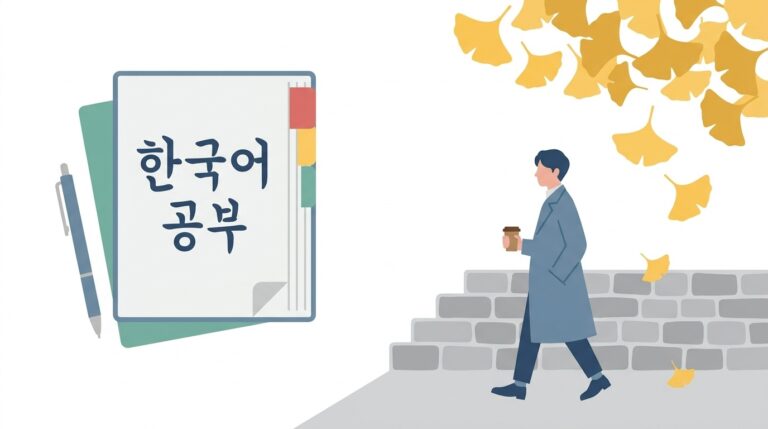
Picture this: You are sitting at a cozy café in Samcheong-dong in mid-October. Golden ginkgo leaves are floating past the glass window. Across from you sits your normally energetic Korean guy friend, Min-su. Today, though, he is wearing a beige trench coat, silently staring into his steaming Americano with an expression of existential melancholy. When you ask him if something is wrong, he stares off toward the stonewall walkway, lets out a dramatic sigh, and mutters: “가을 타나 봐…” (Gaeul tana bwa).
If your first thought was, “Wait, why is he talking about riding autumn like a bus?”—you are definitely not alone! This is one of the most relatable cultural puzzles foreigners encounter every year between September and November. In Korea, people frequently say that men “ride the autumn” (가을을 탄다), meaning they become emotionally sensitive, wistful, and reflective as the weather turns crisp.
Mastering this single cultural phrase does so much more than just widen your vocabulary: it gives you an instant key to decode the subtle emotional rhythms of Korean social life, bond with your friends on a deeper emotional wavelength, and understand countless K-drama tropes. Based on hundreds of real coaching sessions with learners tackling intermediate Korean, here is your definitive, friendly field guide to navigating autumn blues like a true local!
Phase 2: Core Expressions Deep Dive (핵심 표현 3선)
1. 가을 타요 (Gaeul tayeo)
- Pronunciation: [Gae-ul ta-yo] (Sounds like “GAY-ool tah-yo”, rhyming softly with “taco” without the ‘c’)
- Meaning: Literally “I ride autumn” vs. Natural nuance: “I have caught the autumn blues” or “I am feeling wistfully sentimental because of the fall season.”
- K-Culture Moment: Think of Gong Yoo in Guardian: The Lonely and Great God (도깨비) strolling across a field of buckwheat in a sweeping wool coat, brooding in silence while the wind blows his hair.
- Editor’s Insight: The verb 타다 (tada) usually means “to ride” or “to burn,” but when paired with seasons or emotions, it describes how your body and mind are deeply swept along by the seasonal atmosphere.
- Situation Spectrum: Casual: ✅ | Semi-formal: ✅ | Formal: ⚠️ (Better to use 계절의 변화를 느낍니다 in stiff corporate settings)
- 🤔 Think About It: In English, we often pathologize changes in weather as “Seasonal Affective Disorder” or just say “I’m down.” Why do you think Korean embraces this melancholy with the dynamic image of “riding” the season?
2. 마음이 쓸쓸해요 (Maeumi sseulsseulhaeyo)
- Pronunciation: [Ma-eum-i sseul-sseul-hae-yo] (The double ‘ss’ is tense like the hiss of steam: “sseul-sseul”)
- Meaning: Literally “My heart is chilly/lonely” vs. Natural nuance: “I feel a cold, empty loneliness inside.”
- K-Culture Moment: An indie acoustic ballad playing softly inside an orange pojangmacha (street tent stall) while a lone character sips a glass of soju.
- Editor’s Insight: Unlike 외롭다 (oeropda), which means you feel lonely because you are socially isolated or lacking a partner, 쓸쓸하다 (sseulsseulhada) describes a poetic emptiness triggered by the scenery, the biting wind, or the passage of time.
- Situation Spectrum: Casual: ✅ | Semi-formal: ✅ | Formal: ✅
- 🤔 Think About It: Notice how Korean splits loneliness into social absence (외로움) versus environmental/poetic solitude (쓸쓸함). Does your native language make this distinction?
3. 분위기 잡지 마 (Bunwigi japji ma)
- Pronunciation: [Bun-wi-gi jap-ji ma] (Sounds like “Boon-wee-ghee jahp-jee mah”)
- Meaning: Literally “Don’t catch the atmosphere” vs. Natural nuance: “Stop trying to look all brooding and dramatic!” / “Quit acting like you’re in an indie movie!”
- K-Culture Moment: In a variety show like Running Man, whenever a member stands on a bridge pretending to be a tragic hero, another member instantly snaps them back to reality with this line.
- Editor’s Insight: Koreans love atmosphere, but friends will tease you ruthlessly if you try too hard to be aesthetically sad. Use this playfully with close friends!
- Situation Spectrum: Casual: ✅ | Semi-formal: 🚫 | Formal: 🚫
- 🤔 Think About It: Teasing someone out of self-indulgent melancholy shows how Korean friendships balance sweet empathy with humorous reality checks.
Phase 3: Textbook Korean vs. Real Korean (교과서 한국어 vs. 진짜 한국어)
Situation 1: Explaining why you feel a bit quiet today
- 📖 교과서 한국어: 저는 가을이 되어서 기분이 매우 우울합니다.
(Jeoneun gaeuri doeeoseo gibuni maeu u-ulhamnida. / “Because autumn has arrived, my mood is extremely depressed.”) - 🗣️ 진짜 한국어: 요즘 날씨가 쌀쌀해지니까 괜히 센치해지네.
(Yojeum nalssiga ssalssalhaejinikka gwaenhi senchihaejine. / “Now that the weather is getting chilly, I’m getting all sentimental for no reason.”) - 💡 왜 다를까? The textbook phrase sounds like a medical diagnosis. Native speakers prefer colloquial words like 쌀쌀하다 (brisk/chilly) and 센치하다 (derived from “sentimental”) combined with 괜히 (“for no particular reason”).
Situation 2: Checking on a friend who is staring blankly out the window
- 📖 교과서 한국어: 당신은 지금 왜 슬픈 표정을 짓고 있습니까?
(Dangsineun jigeum wae seulpeun pyojeongeul jitgo isseumnikka? / “Why are you making a sad facial expression right now?”) - 🗣️ 진짜 한국어: 너 왜 그래? 벌써 가을 타냐?
(Neo wae geurae? Beolsseo gaeul tanya? / “What’s with you? Catching the autumn blues already?”) - 💡 왜 다를까? Calling someone “sad” can feel overly dramatic and intrusive. Teasing them about “riding autumn” (가을 타냐?) allows them to share their vulnerability while keeping the conversation light.
Phase 4: K-Culture Deep Dive & Non-Verbal Manners
4-1. 눈치 (Nunchi) & Gestures
When someone says they are “riding autumn,” how you react matters:
* The Stare & Space: If your Korean friend leans against a bench in Marronnier Park, hands buried deep in their coat pockets, staring into the middle distance, do not immediately barrage them with “Why are you quiet? Are you mad at me?”
* The Beverage Gesture: Hand them a warm canned coffee (like a hot Let’s Be or warm milk tea from a convenience store heater rack). Simply tapping the warm can against their palm says: “I see your mood, and you’re allowed to feel it.”
* Facial Tone: Maintain a soft, amused smile. Acknowledge their mood without blowing it out of proportion.
4-2. Cultural Code: The Legend of “Men in Autumn, Women in Spring”
There is an ancient Korean saying: “남자는 가을을 타고, 여자는 봄을 탄다” (Men ride autumn; women ride spring). Traditional agricultural lore attributed this to Yin and Yang shifts—as the bright Yang of summer fades into the cold Yin of winter, men were thought to experience a sudden deflation of vitality.
In modern pop culture, this manifests in the timeless trope of the “Trench Coat Brooder.” Every October, fashion retailers launch massive trench coat campaigns, cafés put bittersweet jazz on their playlists, and K-Dramas inevitably feature an emotional stroll along the Deoksugung Stonewall Walkway (덕수궁 돌담길). Melancholy in Korean autumn is not viewed as a flaw; it is an aesthetic privilege.
Phase 5: Real-Life Roleplay Scenario
Setting: A quiet second-floor café in Ikseon-dong. Yellow ginkgo leaves rest on the rooftop tiles outside. Min-su is looking out the window while holding a lukewarm americano.
- You: 민수야, 커피 다 식겠다. 무슨 생각해?
(Minsu-ya, keopi da sikgetda. Museun saenggakhae?)
(Min-su, your coffee’s getting cold. What are you thinking about?)
🎭 Gently tap the edge of his table. -
Min-su: 어? 아… 미안. 그냥 은행잎 떨어지는 거 보고 있었어.
(Eo? A… mian. Geunyang eunhaeng-ip tteoreojineun geo bogo isseosseo.)
(Huh? Ah… sorry. I was just watching the ginkgo leaves fall.)
🎭 Blinks slowly, snapping back to reality. -
You: 평소의 민수답지 않은데? 어디 아파?
(Pyeongso-ui Minsudapji aneunde? Eodi apa?)
(That doesn’t sound like the usual Min-su. Are you feeling sick?)
🎭 Tilt your head with a warm, caring grin. -
Min-su: 아픈 건 아니고… 찬 바람 부니까 마음이 좀 쓸쓸하네.
(Apeun geon agigo… chan baram bunikka maeumi jom sseulsseulhane.)
(I’m not sick… It’s just that the cold wind makes my heart feel empty.)
🎭 Sighs softly while clutching his coat collar. -
You: 풋, 뭐야. 너 지금 가을 타는 거야?
(Put, mwoya. Neo jigeum gaeul taneun geoya?)
(Pfft, what is this? Are you catching the autumn blues right now?)
🎭 Tease him with raised eyebrows. -
Min-su: 놀리지 마. 남자는 가을의 동물이라고 하잖아.
(Nol-li-ji ma. Namjaneun gaeurui dongmurirago hajanna.)
(Don’t tease me. You know they say men are creatures of autumn.)
🎭 Tries to suppress a shy smile. -
You: 아주 영화 한 편 찍으시네! 분위기 그만 잡고 떡볶이나 먹으러 가자.
(Aju yeonghwa han pyeon jjigeusine! Bunwigi geuman japgo tteokbokkina meogeureo gaja.)
(You’re practically shooting a movie here! Stop brooding and let’s go get spicy tteokbokki.)
🎭 Pack up your bag and point playfully toward the door. -
Min-su: 그래, 매운 거 먹으면 좀 풀리겠다. 가자!
(Geurae, maeun geo meogeumyeon jom pulligetda. Gaja!)
(Yeah, eating something spicy will snap me out of it. Let’s go!)
🎭 Brightens up and gets out of his seat.
🔀 Interactive Branch Point: How do you respond to Min-su’s mood?
- Option A: “민수야, 힘내! 우울해할 필요 전혀 없어!” (Cheer up! There’s no reason to be depressed!)
- Feedback (Bad): Too dismissive. In Korean culture, dismissing someone’s seasonal contemplation as mere “depression” makes you seem lacking in poetic empathy.
- Option B: “가을 타나 보네? 그럼 오늘 맛있는 거 내가 쏠게!” (Catching the autumn blues, huh? Let me treat you to a nice meal today!)
- Feedback (Best!): Perfect balance of acknowledging the mood (가을 타다) and offering comfort through food and friendship.
- Option C: “그런 건 비과학적이야. 호르몬 문제야.” (That’s unscientific. It’s just a hormonal shift.)
- Feedback (Risk): While biologically true, saying this out loud ruins the romantic, sentimental autumn mood (분위기 깬다).
Phase 6: 10-Second Emotion Shadowing Drill
Practice matching both the rhythm and the heart of these phrases. Pause briefly at every / mark!
[🍂 센치하고 쓸쓸하게 / Sentimental & wistful]
“찬 바람이 부니까… / 마음이 좀 / 쓸쓸하네.”
(Chan barami bunikka… / maeumi jom / sseulsseulhane.)
Intonation guide: Let your voice drop softly on ‘쓸쓸하네’ like a falling leaf.-
[😏 장난스럽고 다정하게 / Playful & teasing]
“너 / 트렌치코트까지 입고… / 분위기 잡는 거야?”
(Neo / teurenchiko-teukkaji ipgo… / bunwigi jamneun geoya?)
Intonation guide: Raise the pitch slightly at ‘입고’ and end with an amused lilt on ‘거야?’. -
[☕ 따뜻하고 털털하게 / Warm & comforting]
“가을 타지 말고, / 우리 / 따뜻한 라떼 한잔 마시자!”
(Gaeul taji malgo, / uri / ttatteut-han ratte hanjan masija!)
Intonation guide: Energetic, friendly upswing on ‘라떼 한잔’ and a reassuring finish on ‘마시자!’.
Phase 7: K-Culture Mini Dictionary (핵심 키워드 4선)
-
가을 타다 (Gaeul tada)
Translation: To catch the autumn blues; to feel seasonal melancholy.
Usage: Used when someone becomes unusually quiet, introspective, or romantic as the leaves change color. Can be used for anyone, though traditionally associated with men. -
센치하다 (Senchihada)
Translation: To feel sentimental; moody in an artistic way.
Usage: A Konglish term adapted from “sentimental.” Koreans say “나 오늘 좀 센치해” when listening to soft acoustic tracks on a rainy or chilly evening. -
트렌치코트 (Teurenchiko-teu)
Translation: Trench coat.
Usage: The undisputed uniform of Korean autumn. Spotting the first trench coats on the streets of Gangnam or Hongdae is the unofficial official sign that fall has arrived. -
낙엽 (Nagyeop)
Translation: Fallen dry leaves.
Usage: Symbolizes impermanence and reflection. You will frequently hear phrases like “낙엽 밟는 소리가 좋다” (I love the crunching sound of stepping on dry leaves).
Phase 8: Survival Kit for Travelers
Top 3 Survival Phrases
-
“가을 풍경이 참 예쁘네요.” (Gaeul punggyeongi cham yeppeuneyo.)
Translation: “The autumn scenery is truly lovely.”
Pro Tip: Use this with elderly hikers on mountain trails or taxi drivers. It creates instant warmth! -
“따뜻한 아메리카노 한잔 주세요.” (Ttatteut-han amerikano hanjan juseyo.)
Translation: “One hot Americano, please.”
Pro Tip: Koreans drink iced coffee all year (“얼죽아” – iced even if I freeze to death), but autumn is when hot coffee finally makes its seasonal comeback. -
“단풍 구경 가기 좋은 곳이 어디예요?” (Danpung gugyeong gagi joeun gosi eodiyeyo?)
Translation: “Where is a good place to go see the autumn foliage?”
Pro Tip: Locals will passionately list parks from Namsan to Bukhansan.
Editor’s Travel Note
- Navigation Tip: Always rely on local mapping tools rather than global ones. You should download the Naver Map application to search for scenic spots like “정동전망대” (Jeongdong Observatory) or “덕수궁 돌담길” (Deoksugung Stonewall Pathway) for the ultimate golden-leaf walk.
- Packing Tip: Korean autumn is infamous for its daily temperature swings (일교차). It can be sunny and 20°C at 2 PM, then drop sharply to 7°C by 7 PM. Always carry a lightweight layer or scarf.
Phase 9: “한 발 더 깊이” (Reflective Mini-Essay)
In many Western cultures, emotional shifts toward melancholy are treated as problems to fix or symptoms to brush aside. But Korean culture treats 가을 타다 as a celebrated collective aesthetic. By sharing this feeling aloud, Korean men are permitted a rare window of vulnerability in an otherwise intense, fast-paced society. It is a moment where taking a pause, sighing, and looking at the falling foliage is not perceived as slacking off—it is honored as being human.
💬 Your Turn: Does your culture have a specific season where people are expected to become romantic or sentimental? Drop your story in the comments below!
Phase 10: FAQ & Common Mistakes
Q: Can women use the phrase ‘가을 타다’?
A: Absolutely! While the traditional proverb highlights men (남자는 가을을 탄다), anyone of any gender can say “나 요즘 가을 타나 봐” (I guess I’m catching the autumn blues).
Q: Is ‘가을 타다’ considered an illness or depression?
A: No, it is fundamentally distinct from clinical depression (우울증). It describes a light, poetic, transient melancholy brought on by the season’s aesthetics and weather changes.
Q: What is the opposite expression for spring?
A: The spring equivalent is 봄을 타다 (Bomeul tada), which means to become restless, romantic, or fluttery-hearted as the flowers bloom.
🚨 Common Mistakes Alert (흔한 실수 TOP 3)
- Translating ‘타다’ literally: Don’t say “I am riding the autumn” in English, and don’t assume the speaker is talking about transportation!
Correct Action: Treat 가을 타다 as an idiomatic unit meaning “feeling seasonal melancholy.” - Confusing ‘쓸쓸하다’ with ‘심심하다’: Learners often mix up 쓸쓸하다 (lonely/wistful) with 심심하다 (bored). Saying “가을이라 심심해요” just means you have nothing to do!
Correct Action: Use 쓸쓸해요 when you want to describe emotional chilliness. - Being overly grave when someone mentions it: If a coworker says “가을 타요,” don’t offer counseling contact cards.
Correct Action: Offer a coffee, tease them gently about their outfit, or suggest taking a walk during lunch break.
Phase 11: Action Mission & Engagement
- 🥉 Bronze Mission (Solo Practice): Look out your window today, take a deep breath, and say out loud with feeling: “날씨가 쌀쌀하니까 마음이 좀 쓸쓸하네.”
- 🥈 Silver Mission (Social Share): Snap a photo of autumn leaves or a warm warm drink on Instagram or X, and caption it with: #가을타나봐 #DailyHangul.
- 🥇 Gold Mission (Real Life): When you chat with your Korean language partner or friend this week, ask them: “요즘 가을 안 타요?” (Aren’t you catching the autumn blues lately?) and see their delighted reaction!
- 🎮 K-Culture Mission: Watch any classic autumn K-drama episode (e.g., Goblin or Autumn in My Heart) and spot a character wearing a trench coat standing alone. Shout: “분위기 잡지 마!”
Phase 12: Interactive Quiz Challenge
Test your knowledge before you hit the streets this autumn!
1. Situation Challenge
Your Korean coworker Jun-ho is staring at a falling leaf during break time with a solemn expression. What is the most natural and culturally appropriate response?
* (A) “준호 씨, 병원에 가보셔야겠어요.” (Jun-ho, you should go to the hospital.)
* (B) “준호 씨, 지금 가을 타시는 거예요?” (Jun-ho, are you catching the autumn blues?)
* (C) “준호 씨, 왜 그렇게 심심하세요?” (Jun-ho, why are you so bored?)
2. Fill-in-the-Blank
Complete the natural real-world sentence:
“바람이 불어서 괜히 마음이 [ ].” (Hint: Cold, solitary loneliness)
3. True or False?
In traditional Korean culture, women are said to catch the autumn blues (가을), while men catch the spring fever (봄). [True / False]
👉 Click here to reveal the answers and explanations!
-
Answer: (B)
Explanation: Asking if they are “riding autumn” (가을 타시는 거예요?) acknowledges their poetic mood with friendly warmth. (A) is way too alarming, and (C) confuses 심심하다 (bored) with loneliness. -
Answer: 쓸쓸해요 (or 쓸쓸하다)
Explanation: 쓸쓸하다 captures that unique feeling of a heart made lonely by autumn winds. -
Answer: False
Explanation: The historic saying is reversed: 남자는 가을을 타고, 여자는 봄을 탄다 (Men ride autumn; women ride spring)!







