

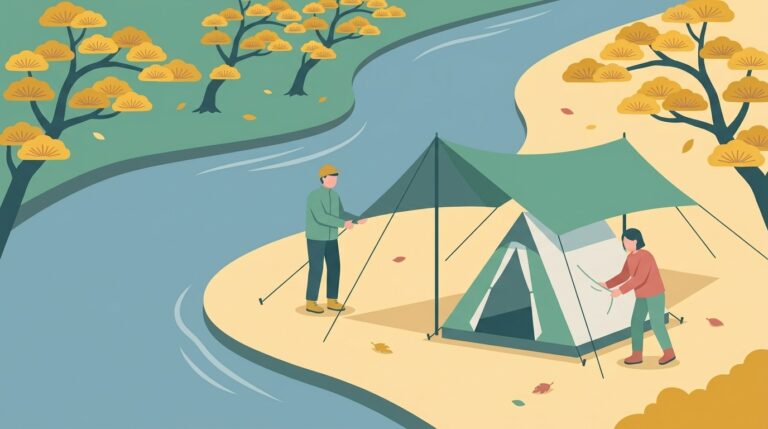
Master Korean Camping: Essential Lingo for Pitching Tents and Tarps
Phase 1: Empathy (Story-immersive Opening)
안녕하세요! 매일한글 에디터입니다. (Hello! This is your Daily Hangul editor.)
Picture this: You have finally arrived at an idyllic campsite along the Bukhan River in Gapyeong. The autumn mountain breeze is crisp, the aroma of charcoal hangs in the air, and your Korean friends are unloading what looks like twenty bags of heavy-duty outdoor gear. Someone shouts, “Let’s set up the living-shell tent first and peg down the tarp before the wind kicks up!” Suddenly, you are handed a heavy metal mallet and an unspooled guyline. Your textbook taught you terms like “텐트를 칩니다” (I pitch a tent), but your campmates are trading rapid-fire slang: “각 살려라” (sharpen the angle), “똥바람 분다” (ferocious wind is coming), and “스트링 바짝 땡겨” (pull the string taut).
You freeze, wondering which cord connects to which pole, worried that one misstep will send the rainfly flying toward someone else’s barbecue grill. Don’t sweat it! Pitching a tent in Korea is far more than shelter building—it is a sacred communal ritual of seamless teamwork, precision, and aesthetic pride (감성 캠핑). Based on feedback from our advanced C1 learners who felt lost in high-context outdoor scenarios, this masterclass equips you with fluent, native-level expressions to command the campsite like a seasoned Korean outdoorsman.
Phase 2: Deep Dive into 3 Core Expressions
1. 팩다운 제대로 안 하면 바람에 훅 날아가요 (Paek-daun jedeolo an hamyeon balame huk nal-agayo)
- Pronunciation: [Paek-da-un je-deo-ro an ha-myeon ba-ram-e hook nal-la-ga-yo] (Think of ‘hook’ like the sudden swoosh of a gust sweeping a hat off your head!)
- Meaning: Literal: If you don’t do the peg-down properly, it will fly away in the wind with a whoosh. / Nuance: “Make sure those stakes are driven deep into the ground at a proper angle, or this entire canopy is airborne.”
- K-Culture Moment: Seen frequently on variety programs like House on Wheels (바퀴 달린 집), where veteran cast members urgently secure shelter poles when sudden coastal gusts threaten their outdoor kitchen.
- Editor’s Insight: 팩다운 (peg-down) combines the English loanword “peg” with “down.” In natural C1 Korean, we pair this with the evocative onomatopoeia 훅 (suddenly, in one swoosh) to vividly warn team members of structural risk without sounding overly bossy.
- Situation Spectrum: Casual ✅ | Semi-formal ✅ | Formal ⚠️
- 🤔 Think About It: Notice how Koreans use evocative sound-symbolic adverbs (훅, 확) to describe physical dynamics. How does your language encapsulate physical consequences with sensory words?
2. 타프 각 좀 살려서 스트링 바짝 당겨주세요 (Tapeu gak jom sallyeoseo seuteuring bajjak dang-gyeojuseyo)
- Pronunciation: [Ta-peu gak jom sal-lyeo-seo seu-teu-ring ba-jjak dang-gyeo-ju-se-yo] (The word ‘gak’ snaps crisply like cracking a twig, while ‘bajjak’ has the crisp double-consonant snap of tight tension.)
- Meaning: Literal: Please revive the tarp’s angle and pull the string tightly. / Nuance: “Let’s get this tarp taut and wrinkle-free so it has that sleek, professional silhouette.”
- K-Culture Moment: On camp shows like Camping Club (캠핑클럽), members obsess over whether the tarp’s ridgeline has a crisp aesthetic angle (각) before snapping Instagram photos.
- Editor’s Insight: 각(角) literally means an angle or corner. To 각을 살리다 (bring an angle to life) is ubiquitous in Korean culture—from folding military bedsheets to crisp suits, and crucially, eliminating any sagging wrinkles on outdoor shelters. 바짝 emphasizes tension without slack.
- Situation Spectrum: Casual ✅ | Semi-formal ✅ | Formal 🚫
- 🤔 Think About It: Why is aesthetic symmetry and tautness (각) considered a measure of competence and respect for the group in Korean outdoor culture?
3. 이건 리빙쉘이라 이너텐트 먼저 치고 플라이 씌워야 돼요 (Igeon ribingsyel-ira ineotenteu meonjeo chigo peullai ssuiwoya dwaeyo)
- Pronunciation: [I-geon ri-bing-syel-i-ra i-neo-ten-teu meon-jeo chi-go pleu-lla-i ssui-wo-ya dwae-yo] (Pronounce ‘ssuiwoya’ smoothly like sweeping a blanket over a mattress.)
- Meaning: Literal: Since this is a living shell, we need to pitch the inner tent first and cover it with the fly. / Nuance: “This is an all-in-one tunnel tent, so our sequence matters: pitch the sleeping cabin inside, then drape the protective fly over the frame.”
- K-Culture Moment: Frequently heard during winter camping trips (동계 캠핑) when Korean campers explain why they prefer spacious 리빙쉘 (living shells) to escape the sub-zero chill.
- Editor’s Insight: Korean campers distinguish strictly between a 돔텐트 (compact dome tent) and a 거실형 텐트 / 리빙쉘 (two-room tunnel tent that combines a bedroom with an enclosed dining hall). Explaining structural order smoothly signals high outdoor literacy.
- Situation Spectrum: Casual ✅ | Semi-formal ✅ | Formal ✅
- 🤔 Think About It: How do shelter terms reflect local climate? In Korea, distinct four-season camping requires modular shelter architecture.
Phase 3: Textbook Korean vs. Real Korean
Situation 1: Tightening the Tarp Guylines
- 📖 Textbook Korean: 타프의 줄을 단단히 고정해 주십시오. (Tapeu-ui jul-eul dandanhi gojeonghae jusipsio. – Please fasten the tarp’s ropes securely.)
- 🗣️ Real Korean: 각이 안 나오니까 스트링 좀 더 짱짱하게 땡겨봐! (Gak-i an na-o-nikka seuteuring jom deo jjang-jjang-ha-ge ddaeng-gyeo-bwa! – It’s sagging and looks sloppy, pull that guyline rock-solid!)
- 💡 Why It Differs: Textbook phrasing sounds like an industrial safety manual. Native campers use expressive sensory terms like 짱짱하다 (taut, robust, zero slack) and the colloquial 땡기다 (pull) to communicate fast on windy pitches.
Situation 2: Choosing Shelter for Heavy Wind
- 📖 Textbook Korean: 바람이 많이 부니 돔 텐트를 설치하는 것이 좋겠습니다. (Baram-i mani buni dom tenteu-reul seolchihaneun geos-i jokessseumnida. – Since it is windy, installing a dome tent would be advisable.)
- 🗣️ Real Korean: 오늘 똥바람 터질 것 같은데, 리빙쉘 말고 돔에 윈드스크린 조합으로 가자. (Oneul ttong-baram teojil geot gateunde, ribingsyel malgo dom-e windeuseukeurin johab-euro gaja. – We’re in for insane gale-force gusts today; let’s ditch the bulky living shell and run a low dome tent paired with a windscreen.)
- 💡 Why It Differs: In actual outdoor circles, 똥바람 (literally ‘poop wind’) is genuine camper slang for brutal, erratic gusts. Real conversations discuss gear combinations (조합) rather than individual isolated components.
Phase 4: K-Culture Deep Dive & Non-Verbal Manners
4-1. 눈치 (Nunchi) & Field Etiquette
When pitching a tarp, words should be minimal; physical 눈치 (situational instinct) does the talking:
* The Foot-on-Peg Anchor: While your partner swings the peg mallet (망치질), never stand idle. Step forward and lightly anchor the head of the peg or the base of the pole with the thick sole of your hiking boot (발로 지그시 밟아주기). It prevents the metal stake from snapping back and shows elite teamwork.
* The 45-Degree Eye Alignment: Korean campers follow the structural golden rule: pegs must be hammered at a 45-degree angle opposite the pulling tension of the guyline. Before hammering, make brief eye contact and ask with an eyebrow raise: “이 각도 맞지?” (This angle looks right, yeah?).
4-2. Cultural Code: 감성 캠핑 (Aesthetic Camping) and 불멍 (Bulmeong)
To modern Koreans, camping is not survivalism; it is high-aesthetic curation (감성). Equipment is chosen in matched earth or ivory tones, and string lights (알전구) are strung along the tarp ridgeline. Once the grueling setup is complete, the entire campsite settles into 불멍—staring blankly into the flickering campfire flames to decompress from high-stress urban life.
Phase 5: Real-world Roleplay Scenario
Setting: Jara Island Campsite (자라섬 캠핑장) in Gapyeong. Dusk is falling, clouds are gathering, and wind is whipping off the river.
Characters:
* Min-woo (민우): Your outdoor-obsessed Korean friend who brings precision military specs to camping.
* You: Advanced international camper ready to pitch like a pro.
Min-woo: 해 지기 전에 타프부터 치자. 저쪽 메인 폴대 좀 잡아줄래?
(Hae jigi jeone tapeu-buteo chija. Jeojjok mein pol-dae jom jab-a-jul-lae?)
“Let’s get the tarp up before sunset. Could you hold up that main center pole for me?”
🎭 He hands you a heavy aluminum pole while unrolling the heavy ripstop fabric.
You: 응, 잡았어. 스트링은 삼각 스토퍼로 조절하면 되지?
(Eung, jab-ass-eo. Seuteuring-eun samgak seutopeo-ro jojeolhamyeon doeji?)
“Got it. I should adjust the guyline tension with this triangular stopper, right?”
🎭 You take a firm stance against the wind, holding the pole perpendicular.
Min-woo: 어, 팽팽하게 당겨줘. 팩다운은 바람 반대 방향으로 비스듬히 박아야 돼.
(Eo, paeng-paeng-hage dang-gyeo-jwo. Paek-da-un-eun baram bandae banghyang-euro biseudeumhi bag-a-ya dwae.)
“Yeah, pull it tight. Hammer the pegs diagonally against the wind direction.”
You: 알겠어. 45도 각도로 깊게 박을게. 이 정도 텐션이면 돼?
(Algess-eo. Sasib-o-do gakdo-ro gipge bag-eulge. I jeongdo tensyeon-imyeon dwae?)
“Understood. I’ll drive it deep at a 45-degree angle. Is this amount of tension good?”
🎭 You strike the forged iron peg rhythmically until only two fingers of clearance remain.
Min-woo: 오, 각 제대로 나오는데? 이제 서브 폴대 세우고 윙 타프 날개 벌리자.
(O, gak jedeolo na-o-neunde? Ije seobeu pol-dae se-u-go wing tapeu nalgae beol-li-ja.)
“Whoa, that angle looks razor-sharp! Now let’s raise the side sub-poles and flare out the wing flaps.”
You: 비 올 것 같으니까 빗물 고이지 않게 중앙 스트링 좀 낮출까?
(Bi ol geot gat-eunikka bin-mul go-iji ankke jung-ang seuteuring jom najchul-kka?)
“Looks like rain; should we lower the center side guyline so water doesn’t pool on top?”
Min-woo: 대박! 완전 캠핑 고수네. 물길 안 만들어두면 타프 무너지거든.
(Daebak! Wanjeon kaemping gosu-ne. Mul-gil an mandeul-eo-dumyeon tapeu muneojigeodeun.)
“Awesome call! You’re a legit camping master. If we don’t make a drainage path, the tarp will collapse.”
🎭 He gives you an impressed high-five as the tarp ridgeline snaps perfectly taut.
You: 이제 텐트 이너 걸고 바로 불멍 준비하자!
(Ije tenteu ineogol-go baro bulmeong junbihaja!)
“Now let’s clip in the inner tent and prep the campfire for some serious fire-staring!”
🔀 Interactive Decision Point
The wind suddenly gusts violently and the corner of the tarp begins to flap erratically. How do you respond to Min-woo?
- Option A: “야, 날아가겠다! 내가 폴대 잡고 있을 테니까 네가 스트링 더 조여!”
(Ya, nal-agagetda! Naega pol-dae japgo isseul tenikka nega seuteuring deo joyeo! – “Hey, it’s gonna blow! I’ll secure this pole; you tighten the guyline!”)
👉 Feedback [Best Choice]: Exceptional C1 real-time leadership! Clear, split-second task division showing total situational control under pressure. - Option B: “바람이 부는데 텐트 안으로 그냥 들어갈까요?”
(Baram-i buneunde tenteu an-euro geunyang deul-eogalkkayo? – “It’s windy, should we just go inside the tent?”)
👉 Feedback [Bad Choice]: Abandoning an unsecured tarp during high wind will wreck the gear and potentially damage neighboring campers’ sites. - Option C: “제가 망치 들고 아무 데나 팩 하나 더 박아볼게요.”
(Jega mangchi deulgo amu de-na paek hana deo bag-a-bolgeyo. – “I’ll take the mallet and just hammer another peg down anywhere.”)
👉 Feedback [Risk Choice]: Hammering pegs haphazardly without calculating the tension vector can warp the poles or rip the fabric seams.
Phase 6: 10-Second Emotion Shadowing Drill
Practice matching these real camping intonations. Slash marks (/) indicate breath pauses:
- [🔥 Urgent & Focused – Catching a loose pole]
“거기 잡지 말고 / 메인 폴대 밑동부터 꽉 잡아줘!”
(Geogi japji malgo / mein pol-dae mit-dong-buteo kkwak jab-a-jwo!)
“Don’t grab there / hold tight onto the base of the main pole first!” -
[😎 Confident & Satisfied – Admiring the clean setup]
“스트링 짱짱하게 당겼더니 / 주름 하나 없이 각 예술이다!”
(Seuteuring jjang-jjang-hage dang-gyeot-deoni / jureum hana eopsi gak ye-sul-ida!)
“Now that we pulled the guylines taut / not a single wrinkle, the angle is pure art!” -
[🌧️ Proactive & Cautious – Prepping for a storm]
“오늘 밤에 비 예보 있으니까 / 타프 중앙에 물길 터놓자.”
(Oneul bam-e bi yebo isseunikka / tapeu jung-ang-e mul-gil teo-noh-ja.)
“There’s rain forecast tonight / let’s slope the center of the tarp so water drains off.”
Phase 7: K-Culture Mini Dictionary
-
각 잡다 (Gak japda) [Slang/Idiom]
Literal translation: To catch the angle.
Real-world usage: Used when perfecting the structure of outdoor gear, squaring military uniform corners, or styling crisp streetwear. In camping, 각이 살아있다 means your shelter setup looks razor-sharp, symmetric, and showroom-ready. -
불멍 (Bulmeong) [Compound Noun: 불 (Fire) + 멍때리다 (Spaced out)]
Literal translation: Fire-daze.
Real-world usage: The therapeutic practice of sitting silently in front of a fire pit. Variations include 물멍 (staring at water/river) and 풀멍 (staring at trees/grass). It is considered the ultimate emotional climax of Korean camping. -
우중캠 (Ujung-kaem) [Abbreviation: 우중 (In the rain) + 캠핑 (Camping)]
Literal translation: Rainy camping.
Real-world usage: Many Korean campers deliberately head out during rainfall to enjoy the sound of raindrops hitting the taut tarp roof (타프에 떨어지는 빗소리) over a bowl of hot ramyeon or fresh scallion pancakes (파전). -
팩다운 (Paek-daun) [Konglish Technical Term]
Literal translation: Peg down.
Real-world usage: The foundational action of driving metal stakes into gravel, dirt, or wooden camp decks. Campers often discuss whether they need 단조팩 (heavy forged steel pegs) or 데크팩 (anchor pegs for wooden platforms).
Phase 8: Traveler’s Survival Kit
Top 3 Native Survival Phrases
- “여기 파쇄석인가요, 아니면 데크 사이트인가요?”
(Yeogi pasweseok-in-ga-yo, animyeon de-keu sa-i-teu-in-ga-yo?)
Pro Tip: Campsites are divided into crushed stone gravel (파쇄석), grass (잔디), or wooden platforms (데크). Asking this determines whether you need long 30cm steel pegs or anchor deck screws. - “릴선 연결해야 하는데 분전함이 어디에 있어요?”
(Ril-seon yeon-gyeol-hae-ya haneunde bun-jeon-ham-i eodi-e iss-eo-yo?)
Pro Tip: Essential for running electricity into your tent for heaters or mood lighting. A 릴선 is an extension cord reel; 분전함 is the electrical breaker box. - “매너타임 몇 시부터 적용되나요?”
(Maeneo-ta-im myeot si-buteo jeok-yong-doenayo?)
Pro Tip: Quiet hours at Korean campsites are strictly regulated under the name 매너타임 (Manner Time), usually beginning between 10:00 PM and 11:00 PM.
Editor’s Field Guide
- Camp Reservation Apps: Camping in Korea is wildly competitive. Download the Camfit Campsite Booking App or search reserved public national park pitches on the National Park Service Camping Reservation Portal three weeks ahead.
- Power Limits: Korean campsites strictly limit electrical draw to 600W per pitch. High-wattage home hair dryers or electric cookers will trip the local breaker (차단기 내려가요).
Phase 9: “One Step Deeper” (Sociocultural Reflection)
Korean outdoor culture provides a fascinating lens into modern societal dynamics. At first glance, the obsessive pursuit of the perfect tarp angle (각) and matched aesthetic gear (감성 장비) might appear hyper-materialistic. However, beneath the surface lies Korea’s deep communal tradition of 품앗이 (mutual cooperative labor) modernized for leisure. Pitching a 7-meter living-shell tent under adverse weather cannot be done alone; it requires synchronized collaboration, empathetic non-verbal cues, and shared physical exertion. The shared trial of pitching shelter transforms acquaintances into tight-knit comrades within hours—an outdoor antidote to the hyper-individualistic grind of Seoul city life.
💬 Your Turn: Have you ever experienced outdoor culture where group synchronization was more prized than individual comfort? Share your camp stories or favorite tent disasters in the comments below!
Phase 10: FAQ & Common Pitfalls
Q: What is the main difference between a 타프 (Tarp) and a 플라이 (Fly)?
A: A 타프 (tarp) is a standalone fabric canopy suspended on independent poles to create an open-air shaded living and cooking pavilion. A 플라이 (fly / rainfly) is the form-fitted waterproof outer skin laid directly over an inner tent structure to block rain and condensation.
Q: What does someone mean when they say “스트링 스토퍼를 밀어올리세요”?
A: The 스토퍼 (guyline runner/stopper) is the metal or plastic piece threaded along the guyline. Sliding it upward increases cord tension; sliding it downward releases slack.
Q: Can I build an open campfire directly on the ground in Korea?
A: Absolutely not. In Korea, ground fires (맨땅에 불피우기) are strictly prohibited at almost all official campgrounds and national parks due to forest fire regulations. You must bring a dedicated fire pit / brazier (화로대) and dispose of cool ashes in marked charcoal barrels (재 버리는 곳).
🚨 Common Mistakes Alert
- Mistake: Hammering pegs perpendicular (90°) to the ground.
Correct Action: Always drive pegs at a 45° angle leaning away from the direction the tension cord pulls. - Mistake: Pitching a giant tarp solo in high wind without anchoring the leeward side first.
Correct Action: Always peg the main windward anchors (바람 부는 쪽 팩) into the earth before raising vertical poles. - Mistake: Leaving guylines loose before going to sleep.
Correct Action: Dew (이슬) and night winds loosen fabric; do a quick round of 스트링 조이기 (tightening guylines) right before 매너타임.
Phase 11: Action Missions
- 🥉 Bronze Mission (Solo Practice): Stand in your room and say aloud three times with dramatic urgency: “각 안 나오니까 스트링 좀 더 짱짱하게 땡겨줘!”
- 🥈 Silver Mission (Social Media): Find a camping reel on Instagram or TikTok and leave a Korean comment evaluating their setup: “와, 텐트 각 예술이네요! 불멍하기 딱 좋은 날씨예요.”
- 🥇 Gold Mission (Real-World Application): On your next outdoor trip or visit to an outdoor gear shop in Seoul (like Decathlon or Snow Peak in Gangnam), talk to staff in Korean: “초보자가 치기 쉬운 돔텐트나 원터치 텐트 추천해 주실 수 있나요?”
🎮 K-Culture Mission: Watch an episode of tvN’s House on Wheels (바퀴 달린 집) or MBC’s I Live Alone (나 혼자 산다 camping specials) and note down every time the cast mentions 팩, 타프, or 불멍!
Phase 12: Interactive Quiz Challenge
1. Situation Judgment: You are pitching a tarp and notice water gathering heavily in the middle during a downpour. What should you immediately do?
* (A) 메인 폴대를 더 높인다. (Raise the center main poles higher.)
* (B) 사이드 스트링을 아래로 당겨 물길을 터준다. (Pull down a side guyline to create a water runoff channel.)
* (C) 타프를 즉시 철거하고 차로 대피한다. (Dismantle the tarp immediately and flee to the car.)
2. Fill-in-the-blank: Complete the common camper phrase:
“바람에 안 날아가려면 45도 각도로 ( )을 단단히 박아야 돼.”
3. True or False: In Korea, pitch setups with zero wrinkles and sharp silhouettes are colloquially praised as “각이 살아있다”.
👉 Click here to check the answers and explanations!
Answer Key:
1. (B) Creating a designated runoff channel (물길) prevents catastrophic pooled water weight (물고임) from snapping poles.
2. 팩 (or 팩다운) – Peg / Peg-down.
3. True! 각이 살아있다 (the angle is alive) is the highest aesthetic compliment at a Korean campsite.







