

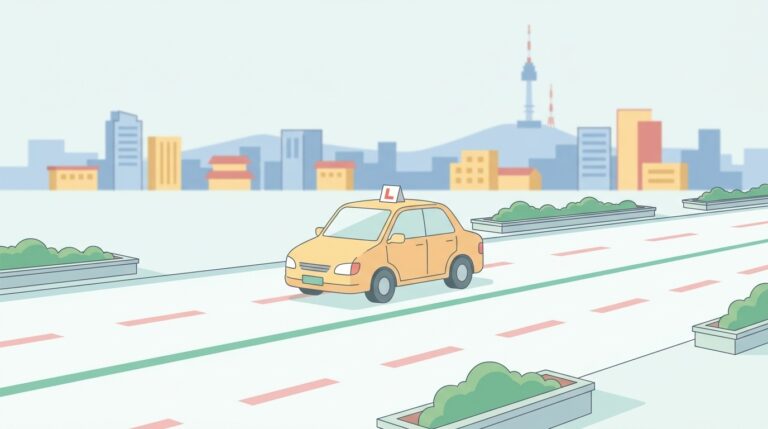
Conquering the Korean Road Test: From Academy Jitters to Confident Cruising
Phase 1: Empathy (Story-Immersive Opening)
안녕하세요! 매일한글 에디터입니다. (Hello! It’s your Daily Hangul editor.)
Picture this: You are sitting behind the wheel of a bright yellow compact car—the unmistakable symbol of a Korean driving academy (운전전문학원). Sitting right beside you is an evaluator holding a digital scoring tablet, his face an unreadable poker face straight out of a suspenseful thriller. Your palms are sweating against the faux-leather steering wheel. You pull up to a busy intersection in Gangnam or Mapo, and suddenly the traffic light switches to green, but there is no dedicated left-turn arrow—only a blue sign that reads 비보호 (Bi-bo-ho). Cars behind you start inching forward, delivery scooters buzz past your side mirrors like angry bees, and you wonder: Do I go now? Do I wait? What if I fail right here?
If you have ever felt your pulse race just watching driving test scenes in K-dramas—where the protagonist inevitably stalls the engine on an uphill slope while the examiner sighs dramatically—you are not alone. Taking the Korean driver’s license exam (운전면허시험) or driving on the bustling roads of Korea as a foreigner can feel like an overwhelming rite of passage. Between rapid-fire automated GPS voice instructions and the unique unwritten codes of Korean traffic etiquette, standard textbook phrases simply won’t cut it.
This guide is crafted from years of field observations, authentic test-center debriefs, and real feedback from intermediate (B2) learners who transitioned from terrified test-takers to calm, licensed drivers. By the end of this journey, you won’t just memorize traffic terms; you will decode the psychological rhythm of Korean driving, know exactly how to interpret the examiner’s subtle cues, and pass your road test (도로주행) with poise.
Phase 2: Core Expressions Deep Dive
Let’s break down the three most critical expressions you will encounter during test day and daily driving.
1. 비보호 좌회전 (Bi-bo-ho jwa-hoe-jeon)
- Pronunciation: [Bi-bo-ho jwa-hwe-jeon] (Phonetic cue: “Bee-bo-ho”, rhythmic like a calm warning chime, followed by “Jwa-hwe-jeon”, where ‘jwa’ sounds like ‘j-wah’ and rhymes with ‘spa’.)
- Meaning: Literal: “Unprotected left turn” | Nuance: “Turn left only on a green straight light when oncoming traffic is completely clear—if you turn on red, it is an automatic test failure.”
- K-Culture Moment: Seen in comedy-dramas when a panicked new driver stops at a green light under a “비보호” sign, paralyzing an entire line of honking taxis during rush hour.
- Editor’s Insight: Many Western drivers assume “unprotected” means you can turn on a red signal if the road is clear (like a right turn). In Korea, entering the intersection on a red light under a 비보호 sign is treated as a major traffic violation (신호위반) and results in instant disqualification on your road test.
- Situation Spectrum: Casual: ⚠️ | Semi-formal: ✅ | Formal: ✅ (Official road term used universally).
- 🤔 Think About It: How does the word “protection (보호)” in traffic language reflect the Korean legal system’s emphasis on strictly designated state safeguards versus individual discretion?
2. 깜빡이를 켜다 (Kkam-ppak-i-reul kyeo-da)
- Pronunciation: [Kkam-ppa-gi-reul kyeo-da] (Phonetic cue: “Kkam-ppak” sounds just like the on-and-off clicking rhythm of a turn indicator or the blink of an eye.)
- Meaning: Literal: “To turn on the blinker” | Nuance: “Signal your intention early and decisively to prevent accidents.”
- K-Culture Moment: You will hear an exasperated passenger in a variety show yell, “깜빡이 좀 켜고 들어와요!” (At least put your turn signal on before cutting in!)
- Editor’s Insight: While the formal term is 방향지시등 (direction indicator light), nobody calls it that inside the car. During the road test, forgetting to flick your 깜빡이 at least 30 meters prior to changing lanes costs you 7 points every single time.
- Situation Spectrum: Casual: ✅ | Semi-formal: ✅ | Formal: ⚠️ (In an official written report, write 방향지시등).
- 🤔 Think About It: Notice how onomatopoeic words (깜빡깜빡 = blinking) seamlessly integrate into technical everyday tasks in Korean. What does this reveal about the visual and emotional nature of Korean verbs?
3. 급제동 금지 (Geup-je-dong geum-ji)
- Pronunciation: [Geup-je-dong geum-ji] (Phonetic cue: “Geup” snaps short like an abrupt stop; “je-dong” flows smoothly, similar to ‘jay-dong’.)
- Meaning: Literal: “Sudden braking prohibited” | Nuance: “Maintain smooth, calculated deceleration to ensure rear-vehicle safety.”
- K-Culture Moment: The dreaded electronic tablet carried by the test proctor announces: “급제동 감점입니다” (Points deducted for abrupt braking), causing the driver’s heart to sink into their stomach.
- Editor’s Insight: Korean driving evaluations place immense weight on “승차감” (ride comfort). Jerking the car or braking abruptly without an emergency cause triggers automatic sensor deductions on the tablet.
- Situation Spectrum: Casual: 🚫 | Semi-formal: ✅ | Formal: ✅
- 🤔 Think About It: Why does Korean road testing penalize sudden stops so heavily compared to some Western tests that prioritize only stopping before the white line?
Phase 3: Textbook Korean vs. Real-World Korean
Situation 1: Letting someone merge or thanking a driver
- 📖 교과서 한국어 (Textbook Korean):
양보해 주셔서 대단히 감사합니다. (Yang-bo-hae ju-syeo-seo dae-dan-hi gam-sa-hap-ni-da.)
“Thank you very much for yielding to me.” - 🗣️ 진짜 한국어 (Real Korean):
비상등 두세 번 켜 드려. (Bi-sang-deung du-se beon kyeo deu-ryeo.)
“Flash the hazard lights two or three times for them.” - 💡 왜 다를까? (Why the difference?): You cannot hold a verbal conversation between moving vehicles traveling at 60 km/h. In Korea, the hazard light (비상등) is a universal, non-verbal dialect meaning both “Thank you for letting me in” and “Sorry for cutting close.”
Situation 2: Alerting your passenger/co-driver about speed enforcement
- 📖 교과서 한국어 (Textbook Korean):
전방에 과속 단속 카메라가 있으니 감속하십시오. (Jeon-bang-e gwa-sok dan-sok ka-me-ra-ga it-seu-ni gam-sok-ha-sip-si-o.)
“There is a speed camera ahead, please decelerate.” - 🗣️ 진짜 한국어 (Real Korean):
앞에 카메라 있어, 속도 줄여. (Ap-e ka-me-ra it-seo, sok-do jul-yeo.)
“Camera ahead, drop your speed.” - 💡 왜 다를까? (Why the difference?): Real-world road conversations value immediate conciseness. Dropping Sino-Korean compound nouns like 과속 단속 (speeding enforcement) in favor of the colloquial 카메라 (camera) allows split-second reaction.
Phase 4: K-Culture Deep Dive & Non-Verbal Road Etiquette
4-1. 눈치 (Nunchi) Behind the Wheel: The Art of Silent Coordination
Driving in Korea is one of the ultimate tests of practical 눈치 (Nunchi – social situational awareness).
- The 3-Blink Hazard Courtesy: When someone slows down to let you merge into heavy traffic on the Olympic Expressway (올림픽대로), tap your emergency hazard button immediately and let it blink three times. Failing to do this isn’t illegal, but it is considered the road equivalent of someone holding the door open for you and having you walk through without acknowledging them.
- Exaggerated Head Movements on the Test: The evaluator sitting beside you cannot read your peripheral vision. When checking your rear-view and side mirrors during the road test, move your entire chin and head deliberately, not just your eyes. Many learners lose 5 to 10 points simply because the examiner didn’t notice their subtle eye shifts.
4-2. Cultural Code: The 노란 차 (Yellow Academy Car) Phenomenon
In Korea, almost everyone recognizes the cheerful yellow Hyundai Avante or Accent bearing the roof sign “도로주행시험” (Road Driving Exam). Regular drivers treat these vehicles with an amusing mix of wide-berth dread and deep personal empathy. Most drivers recall their own agonizing 4-hour practice sessions before the test and will deliberately leave extra braking room—provided you signal your intentions clearly.
Phase 5: Real-World Roleplay Scenario
Setting: Inside the evaluation vehicle outside Gangnam Driving Examination Center (강남운전면허시험장). Evaluator Park (박 감독관), a veteran with a notoriously neutral expression, sits in the passenger seat clutching a digital scoring tablet.
Characters:
* Evaluator Park (박 감독관): Efficient, strict, but fundamentally fair.
* Alex (알렉스): An intermediate Korean learner taking their Category 2 Regular (2종 보통) road test.
박 감독관: 알렉스 씨, 준비되셨으면 시동 걸고 출발하세요.
(Alex-ssi, jun-bi-doe-syeot-seu-myeon si-dong geol-go chul-bal-ha-se-yo.)
“Mr. Alex, if you are ready, please start the engine and set off.”
🎭 Looks down at tablet, finger poised over the digital scoring screen.
알렉스: 네, 안전벨트 착용 확인했고 사이드브레이크 해제했습니다. 출발하겠습니다!
(Ne, an-jeon-bel-teu chak-yong hwag-in-haet-go sa-i-deu-beu-re-i-keu hae-je-haet-seum-ni-da. Chul-bal-ha-get-seum-ni-da!)
“Yes, seatbelt confirmed fastened and parking brake disengaged. Departing now!”
🎭 Exaggeratedly adjusts rear-view mirror, turns on left blinker, checks blind spot over shoulder.
박 감독관: 전방 300미터 앞 우회전입니다. 차선 변경 신경 쓰세요.
(Jeon-bang sam-baek-mi-teo ap u-hoe-jeon-im-ni-da. Cha-seon byeon-gyeong sin-gyeong sseu-se-yo.)
“Right turn 300 meters ahead. Pay close attention to lane changes.”
🎭 Glances sideways at Alex's hand positioning on the wheel.
알렉스: 알겠습니다. 우측 깜빡이 미리 켜고 진입하겠습니다.
(Al-get-seum-ni-da. U-cheuk kkam-ppak-i mi-ri kyeo-go jin-ip-ha-get-seum-ni-da.)
“Understood. Turning on the right blinker in advance before merging.”
🎭 Smoothly accelerates while checking right side mirror.
박 감독관: (끄덕이며) 횡단보도 보행자 신호 주의하시고요.
((Kkeu-deog-i-myeo) Hoeng-dan-bo-do bo-haeng-ja sin-ho ju-ui-ha-si-go-yo.)
“(Nodding slightly) Watch out for the pedestrian light at the crosswalk.”
🎭 Taps his pen rhythmically against the tablet casing.
알렉스: 보행자 신호 적색 확인했습니다. 서행하면서 우회전 진행하겠습니다.
(Bo-haeng-ja sin-ho jeok-saek hwag-in-haet-seum-ni-da. Seo-haeng-ha-myeon-seo u-hoe-jeon jin-haeng-ha-get-seum-ni-da.)
“Pedestrian signal confirmed red. Proceeding with right turn at reduced speed.”
🎭 Eases foot smoothly onto the brake pedal to maintain crawl speed.
박 감독관: 네, 침착하게 잘하고 있어요. 계속 직진하세요.
(Ne, chim-chak-ha-ge jal-ha-go it-eo-yo. Gye-sok jik-jin-ha-se-yo.)
“Yes, you’re doing well and staying calm. Continue going straight.”
🎭 Relaxes his grip on the emergency passenger brake pedal.
알렉스: 감사합니다. 규정 속도 50킬로미터 유지하겠습니다.
(Gam-sa-hap-ni-da. Gyu-jeong sok-do o-sip-kil-ro-mi-teo yu-ji-ha-get-seum-ni-da.)
“Thank you. Maintaining the legal speed limit of 50 km/h.”
🎭 Keeps both hands firmly at the 9 and 3 o'clock positions.
🔀 Interactive Decision Point
You are approaching an intersection at 48 km/h. The distance to the white stop line is roughly 15 meters. Suddenly, the signal turns from Green to Yellow (황색불). What do you do?
- Option A: Slam hard on the brakes immediately to make sure the front bumper does not cross the white line.
- Option B: Check that the intersection is clear and smoothly accelerate through without hesitating.
- Option C: Put your foot lightly on the brake, hesitate halfway into the crosswalk, and stop dead across the pedestrian crossing.
🔎 Reveal Feedback for Options A, B, and C
- Option A (Risk / Deduction): You stopped before the line, but you triggered an abrupt stop (급제동 감점, -7 to -10 points). If a car was tailgating you, this could cause a collision.
- Option B (Best Choice): This is the classic Dilemma Zone (딜레마 존). Under Korean road guidelines, if an abrupt stop would cause you to skid or get rear-ended, crossing safely through the intersection before the signal turns solid red is considered safe driving. You pass cleanly!
- Option C (Bad / Immediate Failure): Stopping halfway over a pedestrian crosswalk constitutes signal/pedestrian obstruction (보행자 보호 위반 or 교차로 통행방법 위반), resulting in severe point loss or an instant disqualification fail (실격).
Phase 6: 10-Second Emotion Shadowing Drill
Repeat these lines out loud, mimicking the rhythm pauses (/) and capturing the situational emotion:
[😰 긴장하며 조심스럽게 / Tense and cautious]
“보행자 신호 / 빨간불인 거 확인했고요, / 서행하면서 / 천천히 지나가겠습니다.”
(Bo-haeng-ja sin-ho / ppal-gan-bul-in geo hwag-in-haet-go-yo, / seo-haeng-ha-myeon-seo / cheon-cheon-hi ji-na-ga-get-seum-ni-da.)-
[😤 단호하고 침착하게 / Firm and composed]
“무리하게 끼어들지 말고, / 비상등 켜면서 / 차선 천천히 바꿀게요.”
(Mu-ri-ha-ge kki-eo-deul-ji mal-go, / bi-sang-deung kyeo-myeon-seo / cha-seon cheon-cheon-hi ba-kkul-ge-yo.) -
[🙏 미안하고 고마운 뉘앙스로 / Apologetic yet thankful]
“먼저 가시라고 / 양보해 주셔서 감사합니다, / 비상등 세 번 깜빡!”
(Meon-jeo ga-si-ra-go / yang-bo-hae ju-syeo-seo gam-sa-hap-ni-da, / bi-sang-deung se beon kkam-ppak!)
Phase 7: K-Culture Mini Dictionary
-
장롱면허 (Jang-nong-myeon-heo)
- Translation: Closet license.
- Usage: Refers to someone who passed the driving test, put their driver’s license inside their wardrobe (장롱), and hasn’t driven a car since. A frequent punchline when someone admits: “저 운전면허는 있는데 장롱면허예요.” (I have a license, but it’s a closet license).
- 딜레마 존 (Dil-le-ma Jon)
- Translation: Dilemma Zone.
- Usage: The critical zone approaching an intersection where a driver is neither able to stop comfortably before the stop line nor clear the intersection before the light turns red.
- 비보호 (Bi-bo-ho)
- Translation: Unprotected (traffic status).
- Usage: Signifies that turns are permitted at your own risk without dedicated signal priority. Never execute a 비보호 turn on red!
- 칼치기 (Kal-chi-gi)
- Translation: Knife-blade lane cutting / reckless aggressive weaving.
- Usage: Used widely on the news and dashcam review channels (like Han Moon-chul TV) to describe drivers who aggressively weave through traffic without signaling.
Phase 8: Traveler & Expat Survival Kit
Top 3 On-the-Road Survival Expressions
- 네비 따라 우측 첫 번째 차선으로 갈게요. (Ne-bi tta-ra u-cheuk cheot beon-jjae cha-seon-eu-ro gal-ge-yo.)
Romanization: [Ne-bi tta-ra u-cheuk cheot beon-jjae cha-seon-eu-ro gal-ge-yo.]
Pro Tip: Tell this to your examiner or cab driver so they know you are deliberately following GPS lane guidance. - 여기 주차해도 되는 구역인가요? (Yeo-gi ju-cha-hae-do doe-neun gu-yeog-in-ga-yo?)
Romanization: [Yeo-gi ju-cha-hae-do doe-neun gu-yeo-gin-ga-yo?]
Pro Tip: Illegal parking enforcement in Korean metropolitan areas is automated and merciless. Always double-check. - 시동이 꺼졌어요, 다시 걸겠습니다. (Si-dong-i kkeo-jeot-eo-yo, da-si geol-get-seum-ni-da.)
Romanization: [Si-dong-i kkeo-jyeot-eo-yo, da-si geol-get-seum-ni-da.]
Pro Tip: If taking a manual (1종 보통) test and you stall, verbally announce this clearly to stay composed and avoid rushing.
Editor’s Travel & Road Note
Before heading onto Korean asphalt, download the Naver Map navigation app download or KakaoMap navigation app download. Unlike Google Maps, which lacks car turn-by-turn routing in Korea due to local spatial data security regulations, these domestic navigation apps offer real-time speed camera alerts, lane guidance color-coded directly matching the street paint (pink/green lanes), and toll-booth lane suggestions.
If you need to reserve your official road test or convert your overseas license, visit the Korea Road Traffic Authority reservation portal to book your appointment in advance.
Phase 9: A Step Deeper (한 발 더 깊이)
Korean driving culture sits at a fascinating intersection between the famous 빨리빨리 (Ppal-li-ppal-li: fast-paced urgency) mindset and an exceptionally high-tech collective safety infrastructure. With the introduction of the nationwide “Safe Speed 5030” policy (restricting urban speeds to 50 km/h and residential zones to 30 km/h), Korean streets have evolved from cutthroat racing tracks into strictly monitored, synchronized networks. The ubiquitous non-verbal gesture of tapping emergency flashers reminds us that despite fast tempos, mutual respect remains the bedrock of Korean public etiquette.
💬 Your Turn: In your home country, how do drivers silently say “Thank you” or “Sorry” on the road? Have you ever witnessed or tried the Korean hazard light courtesy? Share your driving stories in the comments below!
Phase 10: FAQ & Avoiding Misunderstandings
Q: Can I turn right on a red light during the Korean driving test?
A: You must come to a complete stop (일시정지) before turning right if the pedestrian light facing you or the vehicle signal is red. If the pedestrian crosswalk has pedestrians crossing or waiting to cross, you must remain stopped until they have completely stepped onto the sidewalk. Moving while someone is crossing is an immediate disqualification on the driving test.
Q: Can I take the Korean driver’s license written exam in English?
A: Yes! The Academic Test (학과시험, 40 multiple-choice questions) is available in English, Chinese, and Vietnamese at all official Driver’s License Examination Centers nationwide. However, the automated voice prompts during the Road Test (도로주행) are primarily in Korean, so memorizing auditory cues like “300미터 앞 우회전” (Right turn 300m ahead) is essential.
Q: What does the pink or green stripe painted on Korean highways mean?
A: These are called 주행유도선 (Visual Guiding Lines). They are designed to guide drivers through complicated junctions and highway splits. If your navigation voice announces “분홍색 유도선을 따라 주행하세요” (Follow the pink guiding line), simply align your car with that colored lane.
🚨 Common Mistakes Board (외국인 학습자 흔한 실수 TOP 3)
- Treating “비보호” like a Western Red-Turn:
Mistake: Turning left on a red light because no cars are approaching.
Correct Action: Wait until the signal turns green, yield to oncoming cars, then make your turn. - Insufficiently Stopping at Crosswalks When Turning Right:
Mistake: Rolling through the crosswalk at 5 km/h while checking for pedestrians.
Correct Action: Bring the speedometer to an absolute 0 km/h for at least 3 seconds, look left and right, and only proceed when completely clear. - Forgetting to Neutralize the Gear at Stoplights:
Mistake: Keeping the automatic gear in Drive (D) while stopped for longer than 10 seconds.
Correct Action: Shift the gear lever to Neutral (N) whenever you are waiting at a traffic light. The test tablet deducts 5 points every time you idle in D without moving!
Phase 11: Action Missions & Cultural Engagement
- 🥉 Bronze Level (Solo Drill): Look out the window at a Korean intersection or watch a Seoul walking/driving stream. Every time you see a car prepare to turn, say aloud in Korean: “우측 깜빡이 켰어요” (They turned on the right blinker) or “비상등 켰어요” (They flashed their hazard lights).
- 🥈 Silver Level (Community Share): Take a screenshot of a Korean colored road guide (주행유도선) or a 비보호 sign from a drama or map app. Post it on your social media or study journal with the correct Romanization and explanation.
- 🥇 Gold Level (Real-World Application): When riding a taxi or traveling with a Korean friend, actively listen for navigation app prompts. See if you can identify three spoken commands (e.g., 과속 단속, 서행, 경로 이탈) before the driver executes them!
🎮 K-Culture Media Mission: Watch the YouTube series 한문철 TV (Han Moon-chul TV)—Korea’s most famous traffic attorney dashcam review channel. Notice how often netizen commenters use terms like 칼치기, 급제동, and 비보호. Pick one real case video and write down two driving terms used by the attorney!
Phase 12: Interactive Quiz Challenge
Test your knowledge before you get behind the wheel!
1. Real-World Judgment Question
You are in the middle of your road test. You need to change lanes to make a left turn. The traffic behind you is tight. What sequence of actions guarantees you will not lose points?
- (A) Turn the wheel first, quickly flick the blinker, and speed up.
- (B) Check your mirrors, flick your blinker at least 30 meters in advance, confirm your blind spot by turning your head, and smoothly enter the lane.
- (C) Honk your horn to warn the rear car, move over immediately, and turn on the hazard lights.
2. Fill-in-the-Blank
운전면허증은 있지만 오랫동안 운전하지 않아서 차고에 모셔둔 면허를 속어로 [ ]면허라고 부릅니다.
(A driver’s license that is rarely used and kept stored away in a wardrobe is colloquially called a [ ] license.)
3. Cultural True or False
True or False: In Korea, flashing your emergency hazard lights (비상등) is exclusively reserved for car breakdowns and mechanical emergencies.
👉 Click here to check the Quiz Answers & Explanations!
- Answer: (B)
Explanation: Korean road tests penalize lane changes without advance signaling (-7 points) and failure to check blind spots (-10 points). Turn on the 깜빡이 at least 30 meters ahead and turn your head to check mirrors! - Answer: 장롱 (Jang-nong)
Explanation: The term is 장롱면허 (Closet license), meaning a licensed driver who lacks real driving practice. - Answer: False
Explanation: Hazard lights double as social currency on Korean roads! They are constantly used to say “Thank you for letting me merge” and “Sorry for the sudden braking.”







