

Phase 1: 공감 (Story Immersion Opening)
안녕하세요! 매일한글 에디터입니다.
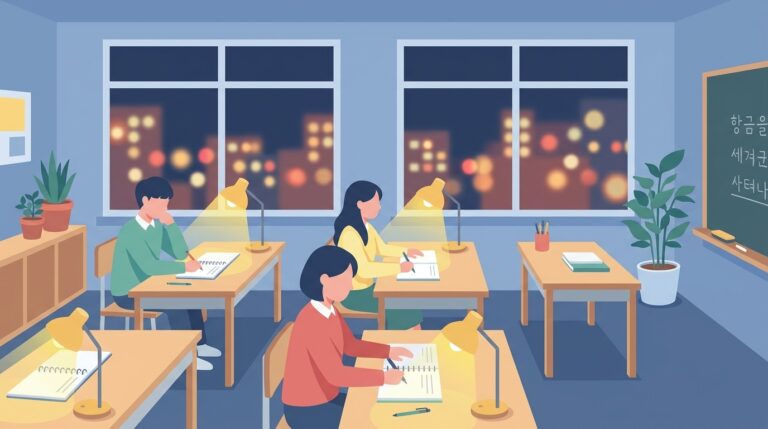
Have you ever watched a classic school K-Drama like True Beauty or Reply 1997 and wondered why students are still sitting at their classroom desks long after the sun has set? The corridors are dimly lit, quiet shadows stretch across the campus, but inside the classrooms, fluorescent lights hum as students battle their drooping eyelids over towering stacks of workbooks. This is Korea’s legendary night self-study, affectionately known as 야자 (Yaja).
Many Korean language learners tell us, “I want to ask my Korean friends about their high school memories, but textbook phrases sound like a formal news broadcast!” Sticking to literal translations like “I study late at night” completely misses the emotional flavor of school camaraderie, secret midnight snacks, and dodging teachers in the hallway. Based on real classroom coaching and daily feedback from elementary learners, this guide will show you the exact phrases, cultural non-verbal codes, and lively slang needed to discuss Korea’s unique education fever naturally. Let’s dive in!
Phase 2: 핵심 표현 3선 심층 분석 (Top 3 Essential Expressions)
1. 오늘 야자 해요 (Oneul yaja haeyo)
- Pronunciation: [O-neul ya-ja hae-yo] (Sounds like: Oh-nul ya-jah hae-yo)
- Meaning: Literal: “Today I do night self-study” vs. Real Nuance: “I have evening study hall at school tonight, so I cannot hang out.”
- K-Culture Moment: Seen in almost every teen drama when a friend invites someone out for tteokbokki after school, and the character sighs while pointing back toward the classroom.
- Editor’s Insight: 야자 (Yaja) is a contraction of 야간 자율 학습 (Yagan jayul hakseup). While “자율” literally means “voluntary,” historically it was practically mandatory! Using this abbreviation instantly signals that you understand Korean youth slang.
- Situation Spectrum: Casual ✅ | Semi-formal ✅ | Formal ⚠️
- 🤔 Think About It: In your home country, do students stay at school after 6 PM? How does staying together until 10 PM change how friendships are formed?
2. 졸려 죽겠어요 (Jollyeo jukgesseoyo)
- Pronunciation: [Jol-lyeo juk-get-seo-yo] (Sounds like: Jol-lyuh jook-get-suh-yo)
- Meaning: Literal: “I am sleepy to death” vs. Real Nuance: “I am dying of sleepiness / My eyes are shutting down.”
- K-Culture Moment: Whispered between deskmates right around 8:30 PM when the classroom turns dead silent and the air gets heavy.
- Editor’s Insight: The pattern ~죽겠다 (~jukgetda) is attached to adjectives to express extreme sensations (배고파 죽겠어요 = starving to death, 추워 죽겠어요 = freezing to death). At the A2 level, this dramatic exaggeration is your golden ticket to sounding like a native friend rather than a textbook.
- Situation Spectrum: Casual ✅ | Semi-formal ✅ | Formal 🚫
- 🤔 Think About It: Many languages use hyperbolic death metaphors for tiredness. What sounds more dramatic in your mother tongue?
3. 땡땡이 치고 싶어요 (Ttaengttaengi chigo sipeoyo)
- Pronunciation: [Ttaeng-ttaeng-i chi-go sip-eo-yo] (Sounds like: Taeng-taeng-ee chee-goh sheep-uh-yo)
- Meaning: Literal: “I want to ring the bell” vs. Real Nuance: “I really want to ditch / cut class / skip night study.”
- K-Culture Moment: When high school characters plot a daring escape over the back gate of the school just to go to an internet cafe (PC방) or eat ramyeon.
- Editor’s Insight: “땡땡이 (Ttaengttaengi)” comes from an onomatopoeia for ringing a bell to signal time, which later evolved into secretly running away before the bell. Use this phrase when venting about exhausting study sessions, but be careful using it around strict superiors!
- Situation Spectrum: Casual ✅ | Semi-formal ⚠️ | Formal 🚫
- 🤔 Think About It: Is cutting study hall seen as harmless rebellion or serious trouble in your home culture?
Phase 3: 교과서 한국어 vs 진짜 한국어 (Textbook vs. Real-World Korean)
Situation 1: Telling someone you are staying late to study
- 📖 교과서 한국어: 저는 오늘 밤에 학교에서 스스로 공부합니다. (Jeoneun oneul bame hakgyo-eseo seuseuro gongbuhamnida. / “I study by myself at school tonight.”)
- 🗣️ 진짜 한국어: 저 오늘 야자 해요. (Jeo oneul yaja haeyo. / “I have night study today.”)
- 💡 왜 다를까? Koreans love efficiency. The formal 6-syllable institutional phrase “야간 자율 학습” is virtually never spoken by teens or young adults. It is collapsed into “야자”, paired simply with “해요”.
Situation 2: Expressing low energy during study hours
- 📖 교과서 한국어: 저는 공부를 많이 해서 매우 피곤합니다. (Jeoneun gongbureul mani haeseo maeu pigonhamnida. / “I am very fatigued because I studied a lot.”)
- 🗣️ 진짜 한국어: 졸려 죽겠어요. 당 떨어졌어요! (Jollyeo jukgesseoyo. Dang tteoreojyeosseoyo! / “I am dying of sleepiness. My blood sugar crashed!”)
- 💡 왜 다를까? In conversational Korean, expressing physical fatigue is tied directly to fun somatic phrases like “당 떨어지다” (blood sugar drop, craving sweets). It sounds relatable and invites the other person to share a candy!
Phase 4: K-Culture 딥다이브 & 비언어적 매너 (Culture Deep Dive & Non-Verbal Manners)
4-1. 눈치 (Nunchi) & Gestures
During evening self-study, the golden rule is 눈치 (quick situational awareness). The teacher supervising study hall (일직 선생님) walks the hallway with soft footsteps.
* The Textbook Shield: If you are snacking or nodding off, keep your thick textbook propped up vertically on your desk.
* The Cup-Hand Whisper: When asking your deskmate for a correction pen or chewing gum, place your palm right beside your mouth (손으로 입 가리기) and tilt your head sideways. Speaking out loud breaks the sacred silence of the room and triggers a reprimand from the monitor.
4-2. 문화 코드 분석: The Post-Yaja Snack Run
Why do Koreans look back on such grueling study routines with fond nostalgia? The secret lies in 야식 (Late-Night Food). Exactly at 10:00 PM, when the bell chimes the end of Yaja, dozens of students flood out into the night air and gather at the nearest convenience store or snack cart (bunsik). Sharing piping-hot cup ramyeon, triangle kimbap, and sweet banana milk right outside the school gates turns exhausting academic pressure into unforgettable friendship bonding.
Phase 5: 실전 롤플레이 시나리오 (Interactive Roleplay Scenario)
Setting: It is 9:15 PM in a high school classroom in Seoul. Fluorescent lights buzz faintly. You are seated next to Minho (민호), a cheerful classmate who is fighting to stay awake.
- 민호: 저기, 혹시 지금 몇 시야? (Jeogi, hoksi jigeum myeot siya? / “Hey, what time is it right now?”)
🎭 Minho whispers while resting his chin flat on an open workbook. - 나: 지금 아홉 시 십오 분이야. (Jigeum ahop si sibo buniya. / “It’s 9:15 PM right now.”)
🎭 You glance down at your wrist watch under the desk. - 민호: 진짜? 아직 사십오 분이나 남았어? (Jinja? Ajik sasibo bun-ina namasseo? / “Really? There’s still 45 minutes left?”)
🎭 Minho groans softly and covers his face with both hands. - 나: 졸려 죽겠지? 나도 눈이 감겨. (Jollyeo jukgetji? Nado nuni gamgyeo. / “Dying of sleepiness, right? My eyes are closing too.”)
🎭 You rub your eyes and offer an understanding nod. - 민호: 우리 땡땡이 치고 편의점 갈까? (Uri ttaengttaengi chigo pyeon-uijeom galkka? / “Should we sneak out and hit the convenience store?”)
🎭 Minho leans in with eyes sparkling with temptation. - 나: 안 돼! 선생님 복도 지나가신다. (An dwae! Seonsaengnim bokdo jinagasinda. / “No way! The teacher is walking down the hall.”)
🎭 You tap Minho’s arm and point your eyes toward the door glass. - 민호: 헉, 들킬 뻔했다. 공부하는 척하자. (Heok, deulkil ppeonhaetda. Gongbuhaneun cheokhaja. / “Gasp, that was close. Let’s pretend to study.”)
🎭 Minho quickly straightens his spine and grips a highlighter pen. - 나: 야자 끝나고 내가 맛있는 거 사 줄게. (Yaja kkeutnago naega masinneun geo sa julge. / “Once night study is over, I’ll buy you a tasty treat.”)
🎭 You smile warmly and return to your notes.
🔀 인터랙티브 분기점: How do you answer Minho’s snack proposal?
- Option A: “야자 끝나고 떡볶이 먹으러 가자!” (Yaja kkeutnago tteokbokki meogeureo gaja! – Let’s eat tteokbokki after Yaja!)
👉 [Best Choice]: Patient, positive, and culturally spot-on! You respect the rules while securing a fun late-night food date. - Option B: “지금 도망치자! 선생님 안 보셔.” (Jigeum domangchija! Seonsaengnim an bosyeo. – Let’s run away now! The teacher isn’t looking.)
👉 [Risk Choice]: Thrilling K-drama protagonist move, but if caught by the discipline monitor, you’ll be writing reflection letters (banseongmun) until midnight! - Option C: “조용히 해. 나 공부해야 하니까 말 걸지 마.” (Joyonghi hae. Na gongbuhaeya hanikka mal geolji ma. – Be quiet. Don’t talk to me because I need to study.)
👉 [Bad Choice]: Too cold and blunt. It destroys the warm camaraderie that Koreans value during late-night study hours.
Phase 6: 10초 감정 섀도잉 드릴 (10-Second Emotional Shadowing Drill)
Practice matching the rhythm and emotional pauses marked by /.
[😴 지치고 졸린 목소리로]
아… / 졸려 죽겠어요. / 커피 마시고 싶어요.
(A… / Jollyeo jukgesseoyo. / Keopi masigo sipeoyo.)
“Ah… / I am dying of sleepiness. / I want to drink coffee.”-
[🤫 선생님 눈치 보며 긴장된 속삭임]
쉿, / 조용히 해! / 선생님 오신다.
(Swit, / joyonghi hae! / Seonsaengnim osinda.)
“Shh, / quiet down! / The teacher is coming.” -
[😋 야식 생각에 눈을 반짝이며]
야자 끝나면 / 편의점 가서 / 바나나 우유 마시자!
(Yaja kkeutnamyeon / pyeon-uijeom gaseo / banana uyu masija!)
“When night study ends / let’s go to the convenience store / and drink banana milk!”
Phase 7: K-Culture 미니 사전 (Mini Dictionary)
- 야자 (Yaja) | Noun | Evening self-study session held at Korean middle or high schools until 9:00~10:00 PM.
- 독서실 (Dokseosil) | Noun | Traditional quiet partitioned study library; used by students preparing for university entrance exams (수능).
- 야식 (Yasik) | Noun | Late-night meals eaten after 9 PM, commonly tteokbokki, fried chicken, or ramyeon, crucial for recharging energy.
- 땡땡이 (Ttaengttaengi) | Noun | Playful slang for skipping an obligation, ditching class, or cutting study hall.
Phase 8: 여행자를 위한 생존 키트 (Traveler’s Survival Kit)
Even as a traveler, you will encounter Korea’s late-night study buzz in modern “Study Cafes” (스터디 카페) and 24-hour libraries.
Survival Expressions TOP 3:
- 이 근처에 스터디 카페 있어요? (I geuncheoe seuteodi kape isseoyo?)
Pronunciation: [I geun-cheo-e seu-teo-di ka-pe it-seo-yo?]
Pro Tip: If you need a quiet desk with high-speed Wi-Fi to work on your laptop, ask this at your hotel front desk. - 조용히 해 주세요. (Joyonghi hae juseyo.)
Pronunciation: [Jo-yong-hi hae ju-se-yo.]
Pro Tip: A polite way to ask someone in a quiet study zone or reading lounge to keep their voice down. - 물 좀 마시고 올게요. (Mul jom masigo olgeyo.)
Pronunciation: [Mul jom ma-si-go ol-ge-yo.]
Pro Tip: Tell this to your study buddy or deskmate before stepping away so they know you haven’t abandoned your seat.
Editor’s Travel Note:
Want to experience the real modern Korean study vibe? Download the local map application via the 카카오맵 공식 웹사이트 및 앱 다운로드 to locate 24-hour unstaffed study cafes (무인 스터디 카페) in student hubs like Sinchon (신촌) or Anam (안암). You can purchase a 2-hour day pass right at the digital kiosk, grab free iced tea, and enjoy pristine air conditioning alongside dedicated Korean college students!
Phase 9: “한 발 더 깊이” (A Step Deeper)
Korea’s intense study routine can look intimidating from the outside, but it also reflects a profound cultural concept: 동병상련 (Dong-byeong-sang-ryeon), which means “sharing mutual empathy through shared hardship.” When Korean teenagers survive cold winter nights and grueling mock exams together under the same flickering lights, they form lifelong bonds. The struggle is communal, not solitary; they lean on each other, split snacks, and celebrate every small victory as a team.
💬 Your Turn: Did your high school have evening study sessions or late-night clubs? What snack kept you going when you had to study late? Tell us in the comments below!
Phase 10: FAQ & 오해 방지 (FAQ Schema)
Q: Is 야자 (Yaja) still mandatory for all Korean high school students today?
A: No. In the past, almost all academic high schools required students to participate. Today, most Korean public and private schools make evening self-study optional, giving students the freedom to attend private academies (학원) or study in quiet local cafes.
Q: Can I use “야자” when talking about my own adult self-study at home?
A: Not quite. “야자” specifically refers to the formal institutional night self-study program organized by middle or high schools. If you are studying late at home or in a cafe as an adult, say “밤늦게까지 혼자 공부했어요” (I studied alone until late at night) or “야근했어요” (if working overtime).
Q: Is “졸려 죽겠어요” considered rude or offensive because it mentions death (죽다)?
A: Not at all! In colloquial Korean, “~죽겠다” is an everyday emotional amplifier similar to the English idiom “I’m dying of laughter” or “I’m dying of thirst.” However, avoid using it in ultra-formal business presentations or when greeting senior elders for the first time.
🚨 흔한 실수 (Common Mistakes) 경고판:
- ❌ Mistake 1: Saying “저는 밤 공부를 해요” (Literal translation of I do night study).
✔️ Correct Action: Say “오늘 야자 해요” (if in school) or “밤에 공부해요”. - ❌ Mistake 2: Using “땡땡이 치다” with your school teacher or boss.
✔️ Correct Action: This is casual slang! Keep it strictly between friends and peers. - ❌ Mistake 3: Confusing “야식” (night snack) with “야간” (night time).
✔️ Correct Action: Remember that “식 (Sik)” means food/meal (음식), while “간 (Gan)” relates to time (시간)!
Phase 11: 액션 미션 & 참여 유도 (Action Missions)
- 🥉 Bronze Mission (Self-Practice): Look into your mirror and say
졸려 죽겠어요!three times, making an exaggerated sleepy facial expression. - 🥈 Silver Mission (Social Media): Post a photo of your Korean study notebook on Instagram or Threads with the caption:
오늘도 열공! 야자 느낌이에요 📖. - 🥇 Gold Mission (Real-world Chat): Next time your Korean tutor or language exchange partner asks what you are doing tonight, reply:
오늘 밤에 한국어 공부해요. 야자 하는 기분이에요! - 🎮 K-Culture Mission: Watch Episode 1 of Twenty-Five Twenty-One or Reply 1997 and spot the moment the characters mention study hall or run out of the school gates!
Phase 12: 인터랙티브 퀴즈 챌린지 (Interactive Quiz)
1. 상황 판단 (Situational Judgment)
Your Korean friend looks exhausted at 9 PM and groans, “눈이 감겨요…” What is the most natural sympathetic response?
* A) 축하합니다! (Chukahamnida!)
* B) 졸려 죽겠죠? 잠깐 쉴까요? (Jollyeo jukgetjyo? Jamkkan swilkkayo?)
* C) 실례지만 누구세요? (Sillyejiman nuguseyo?)
👉 Click to reveal Answer & Explanation
Correct Answer: B
Explanation: “졸려 죽겠죠? 잠깐 쉴까요?” means “You’re dying of sleepiness, right? Shall we take a short break?” It shows warmth, empathy, and uses natural conversational Korean!
2. 빈칸 채우기 (Fill in the Blank)
Complete the sentence using the popular abbreviation for night self-study:
오늘 학교 끝나고 ( ) 해요. 집에 늦게 가요.
Today after school, I have evening study hall. I’m going home late.
👉 Click to reveal Answer & Explanation
Correct Answer: 야자 (Yaja)
Explanation: 야자 is the beloved short term for 야간 자율 학습.
3. True / False 문화 퀴즈 (True or False)
In Korea, eating late-night snacks like tteokbokki after 10 PM study sessions is called “야식 (Yasik)”.
* (True / False)
👉 Click to reveal Answer & Explanation
Correct Answer: True
Explanation: Yes! “야식” (夜食) literally translates to late-night food, a cherished ritual for students and night owls across Korea.







