

안녕하세요! 매일한글 에디터입니다.
Imagine this classic K-drama scenario: You just finished a delicious dinner at a cozy Hongdae pocha with friends. Everyone decides to split the bill via bank transfer—the standard, lightning-fast Korean way. You whip out your phone, tap your banking app with supreme confidence, type in the digits, and hit ‘Send.’
A second later, a cold chill runs down your spine. The name that popped up on the confirmation screen wasn’t your friend Min-jun… it was a complete stranger named ‘Kim Cheol-su’!
Your heart drops into your stomach. Panic sets in. Did I just lose my money forever? How do I even explain this in Korean?!
Take a deep breath! You are definitely not the first person to experience this ‘split-second nightmare.’ In fact, countless international residents and travelers make this exact mistake when navigating Korea’s ultra-fast cashless banking ecosystem. Over my 10 years guiding Korean language learners, I have held the hands of dozens of panicked students through this exact hurdle.
The good news? Korean financial systems have clear, supportive safety nets for accidental transfers, and all it takes to get help are a few ultra-simple A1-level phrases. Today, we’re going to transform your financial panic into crystal-clear confidence!
Phase 2: Core 3 Expressions
Here are the three magic expressions you need when a bank transfer goes wrong.
1. 돈을 잘못 보냈어요 (Don-eul jal-mot bo-nae-sseo-yo)
- Pronunciation: [Don-eul jal-mot bo-nae-sseo-yo] (Sound analogy: Think “Dawn-ool jahl-mote bo-neh-ssuh-yo”. Say ‘jal-mot’ quickly like the English word ‘jolt’)
- Meaning: Literal: “I sent money wrongly.” / Actual Nuance: “I accidentally transferred money to the wrong person/account.”
- K-Culture Moment: You’ll hear this in slice-of-life dramas whenever a character frantically calls customer support after typing one wrong digit while paying rent.
- Editor’s Insight: ‘잘못’ (jal-mot) means ‘wrongly’ or ‘by mistake.’ Placing it right before ‘보냈어요’ (sent) instantly signals to any Korean speaker that this was an unintentional accident, not a dispute!
- Situation Spectrum: Casual: ⚠️ (Use ‘돈 잘못 보냈어’) | Semi-formal: ✅ (돈 잘못 보냈어요) | Formal: ✅ (돈을 잘못 보냈습니다)
- 🤔 Think About It: In English, we often say “I wired to the wrong person,” focusing on the recipient. Korean focuses on the action itself (“I sent it mistakenly”). Why do you think Korean emphasizes the unintended mistake first?
2. 취소할 수 있어요? (Chwi-so-hal su i-sseo-yo?)
- Pronunciation: [Chwi-so-hal su i-sseo-yo?] (Sound analogy: Think “Chee-so-hahl soo ee-ssuh-yo?” Pronounce ‘Chwi’ by rounding your lips like you’re blowing a soft whistle)
- Meaning: Literal: “Can [I] do cancellation?” / Actual Nuance: “Can I cancel this transfer?”
- K-Culture Moment: Essential in any retail, booking, or banking context across Korea—from canceling a train ticket on the Korail app to halting an erroneous transaction.
- Editor’s Insight: The pattern ‘~ㄹ 수 있어요?’ is your best friend in beginner Korean. It simply means “Can I…?” or “Is it possible to…?”
- Situation Spectrum: Casual: ⚠️ | Semi-formal: ✅ | Formal: ✅
- 🤔 Think About It: Notice there is no “I” (나/저) in this sentence. Korean often drops pronouns when the context is obvious. How does dropping “I” make your request sound softer and less demanding?
3. 도와주세요 (Do-wa-ju-se-yo)
- Pronunciation: [Do-wa-ju-se-yo] (Sound analogy: “Doh-wah-joo-seh-yo”. Smooth, gentle, and melodic)
- Meaning: Literal: “Please give help.” / Actual Nuance: “Please help me!”
- K-Culture Moment: The universal distress signal used by beloved drama heroines and real-life travelers alike whenever things get overwhelming.
- Editor’s Insight: When your mind goes completely blank from stress, this single word acts as an instant bridge. Any bank clerk, security guard, or bystander will immediately pay attention.
- Situation Spectrum: Casual: ⚠️ (도와줘) | Semi-formal: ✅ (도와주세요) | Formal: ✅ (도와주시겠어요?)
- 🤔 Think About It: ‘주세요’ comes from the verb ‘to give’ (주다). You are literally asking someone to ‘gift’ you their assistance. Beautiful, isn’t it?
Phase 3: Textbook Korean vs Real-Life Korean
Let’s upgrade your language from robotic textbook phrases to how real Koreans actually speak when flustered!
Situation 1: Explaining the wrong transfer
- 📖 교과서 한국어 (Textbook): 착오 송금하여 반환을 요청합니다. (Chago songgeumhayeo banhwaneul yocheonghamnida. / “I made an erroneous remittance and request restitution.”)
- 🗣️ 진짜 한국어 (Real-Life): 어떡해요, 돈을 잘못 보냈어요! (Eotteokhaeyo, doneul jalmot bonaesseoyo! / “Oh no, what do I do? I sent the money by mistake!”)
- 💡 왜 다를까? (Why is it different?): Textbook phrases sound like an official legal contract! Real Koreans express natural human emotion first with “어떡해요!” (What should I do!) before explaining the issue.
Situation 2: Asking the teller what to do next
- 📖 교과서 한국어 (Textbook): 다음 절차를 설명해 주십시오. (Daeum jeolchareul seolmyeonghae jusipsio. / “Please explain the subsequent procedure.”)
- 🗣️ 진짜 한국어 (Real-Life): 이제 어떻게 해야 돼요? (Ije eotteoke haeya dwaeyo? / “What should I do now?”)
- 💡 왜 다를까? (Why is it different?): Beginner learners often memorize stiff military-style endings (-십시오). In real bank branches, polite conversational endings (-해야 돼요?) make you sound approachable and natural.
Phase 4: K-Culture Deep Dive & Non-Verbal Manners
4-1. 눈치 (Nunchi) & Body Language
When asking for help after a banking mistake in Korea, your physical attitude speaks louder than words:
* Two-Handed Phone Delivery: Never point your phone at the bank teller with one hand. Hold your phone with both hands when showing the transfer receipt screen. It signals deep respect and sincerity.
* The Humble Micro-Bow: As you say “도와주세요”, tilt your upper body forward by about 15 degrees. This humble posture activates the teller’s protective instinct, making them go the extra mile for you.
* Maintain Gentle Eye Contact: Avoid staring aggressively while they type. Look down politely at the counter when they are working on the keyboard, then look up when they speak.
4-2. Cultural Code: The ‘Palli-Palli’ Banking Phenomenon
Korea boasts the fastest real-time interbank transfer system in the world. Services like KakaoPay and Toss allow funds to settle in under 1.5 seconds! But the flip side of ‘빨리빨리’ (Palli-Palli / fast-fast) culture is that once you press confirm, the money is literally gone. You cannot simply hit an “undo” button. However, Korean culture values social fairness, which is why Korea created the 착오송금 반환지원제도 (Wrongful Remittance Return Support System), legally obligating accidental recipients to return funds.
Phase 5: Real-World Roleplay Scenario
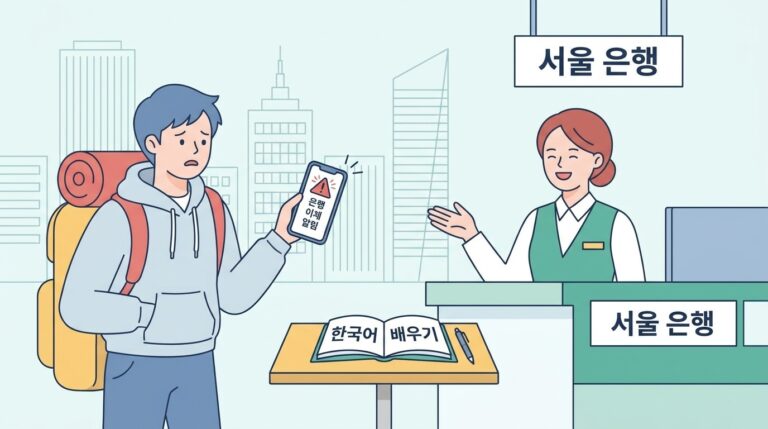
Setting: You are standing in front of Teller Min-ji at a bustling bank branch in Sinchon, clutching your smartphone with a pale face.
- Turn 1 (You): 저기요, 도와주세요! (Jeogiyo, dowajuseyo! / “Excuse me, please help me!”)
🎭 Panting slightly with wide eyes, holding your phone with both hands - Turn 2 (Min-ji): 네, 고객님! 진정하시고 무슨 일이세요? (Ne, gogaeknim! Jinjeonghasigo museun iriseyo? / “Yes, valued customer! Please calm down, what happened?”)
🎭 Leaning forward with warm, attentive eyes - Turn 3 (You): 돈을 잘못 보냈어요. (Doneul jalmot bonaesseoyo. / “I sent money by mistake.”)
🎭 Showing the app confirmation screen with trembling hands - Turn 4 (Min-ji): 아이고, 계좌번호를 잘못 입력하셨군요. (Aigo, gyejwabeonhoreul jalmot imnyeokhayeotgunyo. / “Oh dear, you typed the account number incorrectly.”)
🎭 Nodding sympathetically and pulling up a search window - Turn 5 (You): 취소할 수 있어요? (Chwisohal su isseoyo? / “Can I cancel it?”)
🎭 Clasping hands together in earnest hope - Turn 6 (Min-ji): 바로 취소는 어렵지만, 반환 신청 접수해 드릴게요! (Baro chwisoneun eoryeopjiman, banhwan sincheong jeopsuhae deurilgeyo! / “Immediate cancellation isn’t possible, but I will file a return request for you!”)
🎭 Typing rapidly on the computer - Turn 7 (You): 정말 감사합니다! (Jeongmal gamsahamnida! / “Thank you so very much!”)
🎭 Bowing deeply twice with a huge sigh of relief - Turn 8 (Min-ji): 상대방 은행에 연락해 볼 테니 조금만 기다려 주세요. (Sangdaebang eunhaenge yeollakhae bol teni jogeumman gidaryeo juseyo. / “I’ll contact the recipient’s bank, so please wait just a moment.”)
🎭 Handing you a paper cup of warm green tea with a friendly smile
🔀 Interactive Choice Point
What do you say if Min-ji asks: “언제 보내셨어요?” (When did you send it?)
- Option A: 방금 보냈어요! (Bang-geum bo-nae-sseo-yo! / “I sent it just now!”)
- Option B: 몰라요, 취소해 줘. (Mol-la-yo, chwi-so-hae jwo. / “Don’t know, cancel it.”)
- Option C: 내일 보냈어요! (Nae-il bo-nae-sseo-yo! / “I sent it tomorrow!”)
Choice Feedback:
* Option A [BEST]: Perfect! ‘방금’ means ‘just a moment ago.’ It helps the teller trace the exact transaction code immediately.
* Option B [BAD]: Rude alert! ‘취소해 줘’ is informal talk (반말) and will make the clerk feel disrespected. Always use ‘-주세요’!
* Option C [RISK]: Grammatical slip-up! ‘내일’ means tomorrow, which confuses the timeline of an event that already happened.
Phase 6: 10-Second Emotion Shadowing Drill
Repeat after me! Pay attention to the pauses marked with / and mimic the emotion!
[🥺 Flustered and urgent]
저기요… / 돈을 / 잘못 보냈어요!
(Jeo-gi-yo… / don-eul / jal-mot bo-nae-sseo-yo!)-
[🙏 Earnest and polite]
혹시… / 취소할 수 있어요? / 도와주세요.
(Hok-si… / chwi-so-hal su i-sseo-yo? / do-wa-ju-se-yo.) -
[😮💨 Relieved and grateful]
휴… / 정말 / 감사합니다!
(Hyu… / jeong-mal / gam-sa-ham-ni-da!)
Phase 7: K-Culture Mini Dictionary
- 계좌번호 (Gye-jwa-beon-ho) | Account Number | The string of 11–14 digits identifying a bank account. Always verify the last 3 digits before hitting send!
- 착오송금 (Chak-o-song-geum) | Erroneous Remittance | The official financial/legal term for sending money to the wrong account. Knowing this word makes bank staff treat your case with top priority.
- 이체 (I-che) | Transfer/Remittance | The button you click inside banking apps (계좌이체 = Account Transfer).
- 은행 (Eun-haeng) | Bank | Physical commercial branches like KB국민, 신한, 우리, or 하나.
Phase 8: Traveler’s Survival Kit
Survival Expressions TOP 3
- 영수증 있어요 (Yeong-su-jeung i-sseo-yo / I have the receipt)
- Pro Tip: Showing the digital transaction confirmation on your screen is 10 times faster than spelling out Korean numbers.
- 외국인이에요 (Wae-guk-in-i-e-yo / I am a foreigner)
- Pro Tip: Signals to the staff to speak slowly or use translation devices.
- 적어 주세요 (Jeo-geo ju-se-yo / Please write it down)
- Pro Tip: If the teller gives you complex instructions, ask them to write it on paper.
Editor’s Travel Note
- App Support Guides: If you use mobile banking, check the [토스 간편 송금 반환 신청 가이드] inside the Toss app or visit the nearest branch with your passport and Alien Registration Card (ARC).
- Emergency Call: You can dial 1345 (Korea Immigration Contact Center) for three-way interpretation between you and the Korean bank clerk!
Phase 9: “One Step Deeper” (Reflective Essay)
In many countries, sending money to the wrong account means entering an endless civil lawsuit with slim hopes of recovery. But Korea’s banking system operates on an intriguing mix of hyper-efficiency and mutual societal trust. Through Korea’s Deposit Insurance Corporation (KDIC), the government actively mediates wrongful transfers so citizens aren’t left stranded. The law considers holding onto mistakenly received funds as ‘unjust enrichment’ (부당이득). When you apologize and say “도와주세요,” the system doesn’t punish your mistake; it rallies to correct it.
💬 Your Turn: Have you ever transferred money or sent a message to the wrong person? How does your home country handle accidental bank transfers? Share your story in the comments below!
Phase 10: FAQ & Common Mistakes
Q: Can the bank immediately pull the money back out of the stranger’s account?
A: No. Legally, the bank cannot touch someone’s account without their explicit consent. The bank will contact the recipient on your behalf and request them to return the funds.
Q: What if the recipient refuses to return the money?
A: Don’t panic. Under Korean law, keeping that money constitutes embezzlement (횡령죄). The government’s KDIC return support program will assist you in recovering it legally.
Q: Does this work the same way on KakaoPay or Toss?
A: Yes! Both apps feature a dedicated ‘착오송금 반환 신청’ (Return Request for Mistaken Transfer) button directly under transaction details.
🚨 Common Mistakes Warning Board
- Mistake: Shouting in English out of panic.
- Correct Action: Calmly say “도와주세요” (Dowajuseyo) first, then show your screen.
- Mistake: Closing the app transaction page immediately.
- Correct Action: Take an instant screenshot of the transaction ID, date, time, and recipient name.
- Mistake: Waiting days before reporting because of language shyness.
- Correct Action: Report within the first hour! Fast reporting prevents the recipient from accidentally spending or moving the balance.
Phase 11: Action Mission & Community Challenge
- 🥉 Bronze Mission (Solo Drill): Look in the mirror, bow slightly, and practice saying “돈을 잘못 보냈어요. 도와주세요!” 5 times smoothly.
- 🥈 Silver Mission (Social Drill): Leave a comment below using the phrase “취소할 수 있어요?” in a complete sentence.
- 🥇 Gold Mission (Real Simulation): Open your banking app, locate where the transaction history (거래내역) and customer center (고객센터) buttons are, and note their Korean labels!
- 🎮 K-Culture Mission: Watch an episode of a modern K-drama (like Start-Up or Work Later, Drink Now) and spot whenever characters use mobile transfer apps!
Phase 12: Interactive Quiz Challenge
Test your knowledge before you hit the streets of Seoul!
- Situational Check: You just sent 50,000 KRW to the wrong account at a convenience store ATM. What is the most appropriate first sentence to say to the staff?
- A) 돈 내놔! (Give me the money!)
- B) 돈을 잘못 보냈어요. 도와주세요. (Doneul jalmot bonaesseoyo. Dowajuseyo.)
- C) 계좌번호 몰라요. (I don’t know the account number.)
- Fill in the Blank: “너무 떨려요… 이 이체 [ _____ ] 수 있어요?” (I’m so nervous… Can I cancel this transfer?)
- Hint: It means ‘cancel.’
- True / False Culture Quiz: In Korea, if you accidentally receive money from a stranger, you can legally keep it as a lucky gift. (True / False)
👉 Click here to reveal answers and explanations!
- Answer: B. Always explain the mistake politely with “돈을 잘못 보냈어요. 도와주세요.” Option A is extremely rude slang!
- Answer: 취소할 (Chwi-so-hal). The full sentence is “이체 취소할 수 있어요?”
- Answer: False! Keeping mistakenly transferred money is considered unlawful enrichment and can lead to legal penalties under Korean law.







