

Phase 1: Empathy (Story Opening)
안녕하세요! 매일한글 에디터입니다. (Hello! I’m your Daily Hangul editor.)
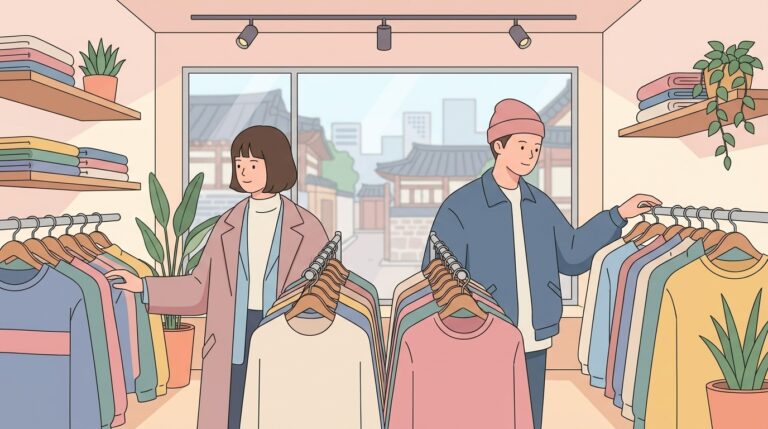
Have you ever walked down the trendy red-brick streets of Seongsu-dong or the buzzing alleys of Hongdae, completely mesmerized by the sleek, effortlessly cool outfits around you? You see an oversized blazer cut just right, cargo pants styled like an idol’s dance rehearsal fit, and minimalist silver accessories that scream K-aesthetic. You step into a boutique with lo-fi beats playing in the background. A stylish clerk approaches you with a polite nod, and your mind suddenly goes blank. You want to ask, “Is this what everyone is wearing right now?” or “Does this fit the current trend?” but all you can recall is textbook Korean like “이 옷은 유행입니까?” which sounds like a 1980s documentary narrator!
You are not alone. So many of our intermediate (B1) learners tell us: “I know grammar, but inside a Seoul clothing boutique, I freeze because I don’t want to sound robotic or awkwardly out-of-touch.” Korean fashion moves at lightning speed—what was viral last month might already be replaced by a fresh micro-trend today. Learning how to navigate trendy fashion conversations isn’t just about buying clothes; it’s about connecting with contemporary Korean youth culture. This guide is crafted directly from our classroom feedback and on-the-ground shopping experiences to give you the exact phrases, nuances, and social etiquette you need to talk fashion like a chic Seoul insider.
Phase 2: Deep Dive into 3 Core Expressions
1. 요즘 이게 유행이에요? (Yojeum ige yuhaeng-ieyo?)
- Pronunciation: [Yo-jeum i-ge yu-haeng-i-e-yo] (Sounds like: “Yo” as in yo-yo + “jeum” like “gem” + “ee-geh” + “you-hang-ee-eh-yo”)
- Meaning: Literal: “These days, is this popularity?” | Real Nuance: “Is this what’s trending right now? / Are people wearing this a lot these days?”
- K-Culture Moment: Seen frequently in K-drama shopping scenes where characters browse flagship concept stores in Hannam-dong or Apgujeong Rodeo, checking what the latest seasonal must-have is.
- Editor’s Insight: Starting your question with 요즘 (yojeum – these days) naturally softens your sentence and frames your curiosity around the current cultural vibe rather than sounding demanding.
- Situation Spectrum: Casual: ✅ | Semi-formal: ✅ | Formal: ⚠️ (Use ‘유행입니까?’ in business retail presentations)
- 🤔 Think About It: In many Western cultures, asking a clerk “Is this trendy?” might feel like admitting you lack personal style. In Korea, asking about trends reflects cultural awareness and a desire for shared aesthetic harmony. How does your native culture view trend-following versus individuality?
2. 저한테 잘 어울려요? (Jeohante jal eoullyeoyo?)
- Pronunciation: [Jeo-han-te jal eo-ul-lyeo-yo] (Sounds like: “Juh-hahn-teh” + “jahl” + “uh-wool-lyuh-yo”)
- Meaning: Literal: “Toward me, does it harmonize well?” | Real Nuance: “Does this look good on me? / Does it suit my vibe?”
- K-Culture Moment: Best friends holding up cardigans against each other in front of full-length boutique mirrors before taking an Instagram story mirror selfie.
- Editor’s Insight: While textbook Korean focuses on ‘맞다’ (to fit sizing), native speakers focus on 어울리다 (to harmonize/suit). Fashion in Korea is about overall harmony—your skin tone, proportions, and presence matching the piece.
- Situation Spectrum: Casual: ✅ | Semi-formal: ✅ | Formal: 🚫
- 🤔 Think About It: Notice that Korean uses the concept of “harmonizing together” (어울림) rather than simply “looking pretty” (예쁘다). What does this reveal about the value placed on balance and contextual aesthetics in Korean society?
3. 추천 좀 해 주세요 (Chucheon jom hae juseyo)
- Pronunciation: [Chu-cheon jom hae ju-se-yo] (Sounds like: “Choo-chun” like a toy train + “jom” like “jump” without the ‘p’ + “heh joo-seh-yo”)
- Meaning: Literal: “Please give a little recommendation.” | Real Nuance: “Could you pick out a couple of popular or flattering pieces for me?”
- K-Culture Moment: When shopping in bustling subterranean markets like Express Bus Terminal (Goto Mall) or indie boutiques where racks are overflowing and you want the shopkeeper’s expert pick.
- Editor’s Insight: The secret weapon here is 좀 (jom – a little). Dropping ‘좀’ into requests instantly transforms a blunt command into an endearing, polite request. It shows respect for the clerk’s time and expertise.
- Situation Spectrum: Casual: ✅ | Semi-formal: ✅ | Formal: ✅
- 🤔 Think About It: Why does adding a diminutive word like “a little” (좀) convey politeness in Korean, whereas in English saying “Recommend a little” might sound vague or awkward?
Phase 3: Textbook Korean vs. Real Korean
Situation 1: Asking if an outfit looks stylish and modern
- 📖 교과서 한국어 (Textbook): 이 옷은 현대적이고 유행에 맞습니까? (I oseun hyeondaejeog-igo yuhaeng-e matseumnikka? / “Is this clothing modern and suitable for the trend?”)
- 🗣️ 진짜 한국어 (Real-Life): 이거 요즘 스타일이에요? (Igeo yojeum seutail-ieyo? / “Is this the vibe nowadays?”) or 완전 힙한데요! (Wanjeon hiphandeyo! / “This is super hip!”)
- 💡 왜 다를까? (Why the difference?): Young Koreans rarely use heavy Sino-Korean phrasing like ‘현대적’ (modern) when browsing racks. Instead, they seamlessly weave loanwords like 스타일 (style) or vibrant slang like 힙하다 (to be hip/trendy) into everyday speech.
Situation 2: Complimenting someone whose outfit matches them flawlessly
- 📖 교과서 한국어 (Textbook): 당신에게 이 옷이 아주 잘 맞습니다. (Dangsin-ege i osi aju jal matseumnida. / “This garment fits you very well.”)
- 🗣️ 진짜 한국어 (Real-Life): 와, 완전 찰떡이에요! (Wa, wanjeon chaltteog-ieyo! / “Wow, that’s completely your look! / It suits you like sticky rice cake!”)
- 💡 왜 다를까? (Why the difference?): Addressing someone as 당신 (dangsin) in real conversation feels uncomfortably formal, stiff, or even confrontational like in a drama dispute! Furthermore, native speakers love culinary metaphors: 찰떡 (chal-tteok – glutinous rice cake) evokes something sticking seamlessly together, making it the ultimate compliment for an outfit that fits your personality like a glove.
Phase 4: K-Culture Deep Dive & Non-Verbal Manners
4-1. 눈치 (Nunchi) & Body Language in Fitting Rooms
Shopping in South Korea has its own subtle choreography of respect and awareness:
1. The Fitting Room Eye Contact & Removal: Many boutique staff will offer a face cover (페이스 커버) before you try on tops to prevent makeup smudges on collars. Always accept it with two hands and a brief bow: “감사합니다! (Gamsahamnida!)”.
2. The Mirror Posture: When asking an attendant or friend “저한테 잘 어울려요?”, step out of the booth, turn halfway toward the full mirror, lightly touch the hemline or lapel, and tilt your head slightly. This non-verbal cue signals that you are genuinely evaluating the silhouette and receptive to their styling advice.
3. Card Exchange Manners: When paying or handing back garments you decided not to purchase, hold the item or your card with both hands (or place your left hand under your right wrist/forearm). Simply say, “다음에 다시 올게요 (Daeume dasi olgeyo – I’ll come by again next time)” with a light nod.
4-2. Cultural Code: ‘꾸안꾸’ (Kku-an-kku) & The Streetwear Boom
If there is one phrase that defines contemporary K-fashion philosophy, it is 꾸안꾸 (Kku-an-kku)—short for 꾸민 듯 안 꾸민 듯 (looking like you put effort in, yet didn’t).
Koreans spend significant time curating outfits that look completely effortless: an oversized crisp shirt worn over wide-leg vintage slacks, clean white sneakers, and an unpretentious canvas tote bag. Unlike red carpet glam, Seoul street style celebrates high-low mixing (luxury accessories paired with affordable local indie labels). When you shop in hubs like Seongsu, Musinsa Standard, or Yeonnam-dong, clerks respect shoppers who appreciate this nuanced balance between comfort and trendiness.
Phase 5: Real-Life Roleplay Scenario
- Setting: A sunlit, concrete-aesthetic boutique in Seongsu-dong. Indie tracks play softly, and racks of monochrome oversized knits and wide-leg trousers line the room.
- Characters:
- You (A curious fashion adventurer looking for a signature Seoul piece)
- 민지 (Minji, a friendly 20-something boutique curator wearing stylish clear glasses and a cropped cardigan)
[Dialogue]
1. 민지: 🎭 (Smiling warmly, stepping out from behind the counter) 안녕하세요! 천천히 둘러보세요. (Annyeonghaseyo! Cheoncheonhi dulleoboseyo. / “Hello! Feel free to take your time looking around.”)
2. You: 🎭 (Smiling back, pointing toward a rack of wide-leg utility trousers) 저기요, 이거 요즘 유행이에요? (Jeogiyo, igeo yojeum yuhaeng-ieyo? / “Excuse me, is this style trending these days?”)
3. 민지: 🎭 (Nodding enthusiastically, holding up a pair to show the silhouette) 네! 요즘 이런 와이드 카고 팬츠가 진짜 인기 많아요. (Ne! Yojeum ireon waideu kago paencheuga jinjja ingi manayo. / “Yes! Wide cargo pants like these are really popular these days.”)
4. You: 🎭 (Holding the fabric, slightly hesitant) 제가 입어봐도 돼요? (Jega ibeobwado dwaeyo? / “May I try this on?”)
5. 민지: 🎭 (Gesturing politely toward the fitting booth) 네, 저쪽 피팅룸 이용하시면 돼요. 페이스 커버 챙겨드릴게요! (Ne, jeojjjok pitingnum iyonghasimyeon dwaeyo. Peiseu keobeo chaenggyeodeurilgeyo! / “Yes, you can use the fitting room over there. I’ll get you a face cover!”)
6. You: 🎭 (Stepping out of the fitting room, checking the mirror) 사이즈는 맞는 것 같은데… 저한테 잘 어울려요? (Saijeuneun manneun geot gateunde… jeohante jal eoullyeoyo? / “The size seems right, but… does it suit me well?”)
7. 민지: 🎭 (Clapping hands gently together with sparkling eyes) 와, 핏이 너무 예뻐요! 고객님 분위기랑 완전 찰떡이에요. (Wa, pisi neomu yeppeoyo! Gogaengnim bunwigirang wanjeon chaltteog-ieyo. / “Wow, the silhouette is gorgeous! It matches your vibe completely like sticky rice cake.”)
8. You: 🎭 (Beaming with satisfaction) 마음에 들어요. 이걸로 할게요! (Maeume deureoyo. Igeollo halgeyo! / “I love it. I’ll take this one!”)
🔀 Interactive Choice Point
Imagine Minji now offers to show you an oversized structured blazer to layer over the pants. How do you respond?
- Option A: “와, 좋아요! 이거랑 같이 입을 만한 거 추천 좀 해 주세요.” (Wa, joayo! Igeorang gachi ibeul manhan geo chucheon jom hae juseyo. / “Wow, great! Could you recommend something to wear with this?”)
- Outcome (Best): 🌟 Excellent! You politely leverage ‘추천 좀 해 주세요’, opening the door for personalized styling tips while keeping the vibe fun and friendly.
- Option B: “아니요, 난 내 스타일이 있으니까 보지 않겠습니다.” (Aniyo, nan nae seutairi isseunikka boji anketseumnida. / “No, I have my own style so I will not look.”)
- Outcome (Bad): 🛑 Ouch! Using ‘난’ (informal) combined with blunt negative phrasing sounds aggressive and dismissive to a shop associate who was merely trying to help.
- Option C: “이거 너무 비싸 보여서 그냥 됐어요.” (Igeo neomu bissa boyeoseo geunyang dwaesseoyo. / “This looks too expensive so forget it.”)
- Outcome (Risk): ⚠️ While honest, saying it looks “too expensive so forget it” in this abrupt manner can create minor awkwardness. A smoother refusal would be: “아, 오늘은 바지만 먼저 볼게요! 감사합니다.” (Ah, I’ll just look at the pants today! Thank you.)
Phase 6: 10-Second Emotional Shadowing Drill
Practice these lines out loud! The slashes (/) indicate natural breath pauses, and the brackets set your emotional tone:
- [😊 Curious & Trend-Savvy]
저기요, / 이거 / 요즘 제일 잘나가는 스타일이에요?
(Jeogiyo, / igeo / yojeum jeil jalnaganeun seutail-ieyo?)
“Excuse me, / is this / the hottest selling style these days?” -
[🥺 Slightly Shy but Eager for Validation]
핏은 괜찮은 것 같은데… / 저한테 / 잘 어울려요?
(Piseun gwaenchaneun geot gateunde… / jeohante / jal eoullyeoyo?)
“The fit feels fine, but… / on me, / does it look flattering?” -
[✨ Delighted & Enthusiastic Compliment]
대박! / 네 스타일이랑 / 완전 찰떡이다!
(Daebak! / ne seutairirang / wanjeon chaltteog-ida!)
“Incredible! / With your unique style, / it’s an absolute match!”
Phase 7: K-Culture Mini Dictionary (4 Key Fashion Terms)
-
꾸안꾸 (Kku-an-kku)
Meaning: Effortlessly chic; “Dressed up yet looking like you didn’t try too hard.”
Daily Usage: Used everywhere from Instagram fashion reels to real-life shopping: “이 재킷 하나만 걸치면 완전 꾸안꾸 룩 완성이에요.” (Just throwing on this one jacket completes the effortless chic look.) -
힙하다 (Hip-ha-da)
Meaning: Super cool, trendy, aesthetic, street-smart.
Daily Usage: Created by combining English “hip” with Korean “하다” (to do/be). Commonly said of indie brands, quirky cafes, and stylish outfits: “성수동에는 힙한 옷가게가 진짜 많아요.” (There are so many hip clothing stores in Seongsu.) -
찰떡 (Chal-tteok)
Meaning: A perfect match / Made for each other (literally: sticky rice cake).
Daily Usage: In fashion and beauty, when a color or fit suits someone impeccably: “이 립스틱 색깔, 너랑 완전 찰떡이다!” (This lipstick shade is totally made for you!) -
착장 (Chak-jang)
Meaning: Full outfit / “Fit” / OOTD (outfit of the day).
Daily Usage: Widely used on Korean fashion forums and social media: “오늘 아이돌 공항 착장 봤어?” (Did you see that idol’s airport outfit today?)
Phase 8: Survival Kit for Fashion Explorers in Korea
🌟 Top 3 Survival Phrases
- 입어봐도 돼요? (Ibeobwado dwaeyo?)
“Can I try this on?”
💡 Pro Tip: Always ask before stepping into a fitting room, especially with white tops, knitwear, or delicate silks. - 다른 색상도 있어요? (Dareun saeksangdo isseoyo?)
“Do you have this in other colors?”
💡 Pro Tip: Korean displays often show just one colorway per rack. The staff can easily check backstock for charcoal, cream, or beige. - 새 상품으로 있나요? (Sae sangpumeuro innayo?)
“Do you have a fresh, unopened one?”
💡 Pro Tip: At small boutiques, display items (디스플레이 상품) might have been handled by dozens of people. Asking for a new item ensures you get pristine packaging.
🧭 Editor’s Travel Note
- Must-Have Navigation: Download the 네이버 지도 앱 (Naver Map App) to search for curated showroom clusters around Seongsu (성수), Hannam (한남), and Dosan Park (도산공원). Google Maps often lacks updated footpaths in boutique alleyways!
- Sizing Awareness: Many Korean indie labels sell in Free Size (프리사이즈), which roughly translates to a Western US 2–6 or S/M with an oversized drape. Don’t be afraid to check shoulder widths and sleeve lengths before purchasing.
- Tax Refund Ease: Look out for the “Tax Free” logo on boutique windows. Keep your passport handy in your day bag; flagship stores can process instant tax deductions right at checkout!
Phase 9: “A Step Deeper” (Cultural Reflection)
In Korean society, the word 유행 (yuhaeng – trend) carries immense cultural gravity. South Korea’s rapid urbanization and high digital connectivity gave rise to a collective spirit where trends sweep across the country with breathtaking speed. Yet modern Korean youth do not simply copy trends blindly; they reinterpret them through micro-details—custom keychain charms on bags, mismatched vintage accessories, or unique color accents. Understanding K-fashion means observing this delicate dynamic between belonging to a collective aesthetic wave while retaining individual artistic flair.
💬 Your Turn: How quickly do fashion trends change in your home city compared to Korea? Do people prefer standing out with unconventional outfits, or fitting seamlessly into the collective aesthetic? Share your thoughts in the comments below!
Phase 10: FAQ & Avoiding Misunderstandings
Q: Can I haggle (bargain for discounts) in Korean clothing stores?
A: In modern department stores, multi-brand flagship stores (like Musinsa, Gentle Monster, or Ader Error), and Seongsu boutiques, prices are strictly fixed (정찰제). Asking for a discount there will cause awkwardness! However, at traditional open-air markets like Dongdaemun Night Market or Goto Mall subway shops, paying in cash (현금) might occasionally save you 1,000 to 2,000 KRW if you politely ask: “현금으로 하면 조금 깎아주실 수 있나요?”
Q: What should I do if a top doesn’t fit my shoulders or chest in the fitting room?
A: Simply step out and hand it back with a pleasant face, saying: “사이즈가 저한테 조금 안 맞는 것 같아요. 감사합니다! (The size doesn’t seem to fit me quite right. Thank you!)” The staff will never be offended. Korean retail culture places zero pressure on you to buy every item you try on.
Q: Is asking “저한테 잘 어울려요?” to a male or female store clerk considered flirting?
A: Not at all! In Korea, asking a sales associate if an outfit suits you is viewed as trusting their aesthetic eye. Shop curators take pride in helping customers look their best, so treat it as a collaborative fashion moment rather than anything overly personal.
🚨 Common Mistakes Alert Board
- ❌ Mistake 1: Using 당신 (dangsin) to say “you” to the clerk (“당신 생각은 어때요?”).
- ✔️ Correct Action: Omit the pronoun completely! Say: “어떤 게 더 나아요?” (Which one looks better?).
- ❌ Mistake 2: Stepping into the fitting room wearing shoes when there is a raised wooden step or carpet mat.
- ✔️ Correct Action: Look at the floor. If there’s a mat or raised platform, slip off your shoes before stepping inside.
- ❌ Mistake 3: Confusing 맞다 (matda – fits mechanically/size-wise) with 어울리다 (eoullyeoda – looks flattering/suits you).
- ✔️ Correct Action: If the shirt zips up, it 맞아요. But if it makes you look radiant and stylish, it 잘 어울려요!
Phase 11: Action Mission & Community Challenge
- 🥉 Bronze Mission: Stand in front of your bedroom mirror wearing your favorite daily outfit and practice saying clearly 3 times: “와, 오늘 내 착장 완전 찰떡이다!”
- 🥈 Silver Mission: Browse a Korean fashion e-commerce site or idol Instagram account, screenshot one trendy piece, and post a photo in the comments or on your socials with the caption: “이거 요즘 유행이에요? 완전 힙해요!”
- 🥇 Gold Mission: Next time you enter a clothing store (or visit Korea), ask the clerk in natural Korean: “요즘 제일 인기 있는 스타일 추천 좀 해 주세요!” and observe their recommendation.
🎮 K-Culture Bonus Quest: Put on the latest episode of a popular K-drama or an airport vlog of your favorite K-Pop group. Listen carefully: Can you spot the word 스타일, 핏 (fit), or 어울려요 within the first 20 minutes? When you hear it, jot down the full sentence!
Phase 12: Interactive Quiz Challenge
Test your knowledge with these 3 quick practical challenges!
1. Situation Judgment
You are trying on an autumn trench coat in a Hongdae shop. You want to ask your friend if this coat matches your personal aura and color tone. Which sentence is the most natural?
* (A) 이 옷이 내 몸의 치수에 맞습니까?
* (B) 저한테 이거 잘 어울려요?
* (C) 이 코트는 유행에 복종합니까?
2. Fill-in-the-Blank
Complete the natural boutique request using the magic politeness word:
“저기요, 요즘 인기 있는 카디건 _________ 좀 해 주세요.”
(Hint: The word for ‘recommendation’ is 2 syllables!)
3. True or False Culture Check
In Seoul street style, the term ‘꾸안꾸’ (Kku-an-kku) means dressing up in ultra-formal, flashy banquet wear with lots of glitter and heavy evening makeup.
(True / False)
👉 Click here to reveal the answers and explanations!
-
Answer: (B) 저한테 이거 잘 어울려요?
Explanation: (A) sounds like an engineering manual measuring dimensions, and (C) is absurdly translated (“does it obey the trend?”). (B) is the textbook-perfect, natural way to ask if an outfit flatters your vibe! -
Answer: 추천 (Chucheon)
Explanation: The complete natural phrase is: “저기요, 요즘 인기 있는 카디건 추천 좀 해 주세요.” (Excuse me, please give me a recommendation for a popular cardigan these days.) -
Answer: False
Explanation: ‘꾸안꾸’ stands for 꾸민 듯 안 꾸민 듯, meaning an effortlessly chic, natural daily look that looks stylish without seeming like you tried too hard!







