

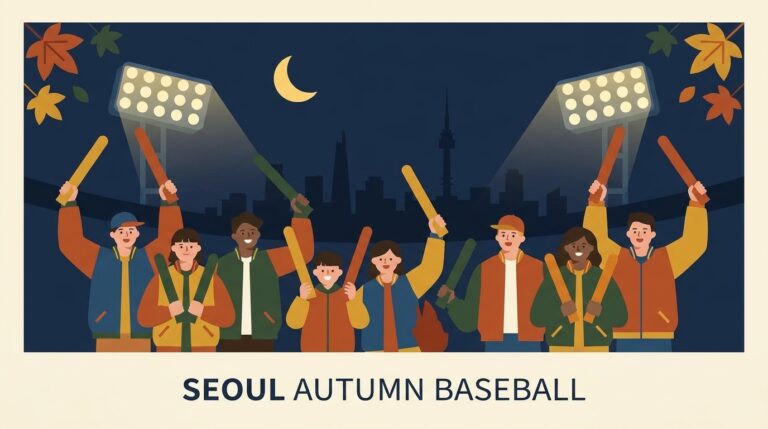
Phase 1: Empathy (Story-Driven Opening)
안녕하세요! 매일한글 에디터입니다.
Imagine this: It is early October in Seoul. The scorching summer heat has given way to crisp autumn breezes, and golden ginkgo leaves flutter down near Jamsil Baseball Stadium. You are surrounded by thousands of ecstatic fans wearing shiny satin varsity jackets. Suddenly, the stadium erupts into deafening unison: “우리 가을 야구 간다!” (We are going to fall baseball!). If you only studied standard textbook Korean, you might scratch your head: Fall baseball? Aren’t they just playing regular postseason playoffs?
Many intermediate Korean learners hit an invisible wall right here. You know the vocabulary words for “playoffs” and “qualifying,” yet real K-baseball culture operates on a completely different emotional frequency. Based on real feedback from our Daily Hangul learners who froze up when invited to a postseason match, mastering postseason baseball expressions isn’t just about sports—it is your VIP backstage pass to modern Korean collective culture, camaraderie, and slang. Let’s make sure you never miss a beat in the bleachers.
Phase 2: Core Expressions Deep Dive
1. 가을 야구 가자! (Gaeul yagu gaja!)
- Pronunciation: [Gae-ul ya-gu ga-ja!] (Think of “Gae-ul” like “gale” with an open ‘ul’ sound, and “ga-ja” like the energetic Italian ‘ragazzo’ without the ‘ra’.)
- Meaning: Literal: “Let’s go to autumn baseball!” | Nuance: “We clinched a playoff berth! / Let’s make it to the postseason!”
- K-Culture Moment: Seen on banners, team Instagrams, and shouted by K-pop idols during ceremonial first pitches when their hometown club is on a late-season winning streak.
- Editor’s Insight: In Korea, baseball ends in autumn, so 가을 야구 is the ultimate holy grail for fans. If your team has suffered a 5-year playoff drought, shouting this carries genuine tears of relief, not just casual excitement.
- Situation Spectrum:
- Casual (Friends/Stadium): ✅
- Semi-formal (Coworkers who are fans): ⚠️ (Use: “가을 야구 꼭 가면 좋겠어요.”)
- Formal (Business meeting): 🚫
- 🤔 Think About It: Why does Korean baseball link emotional longing with seasonal imagery (autumn) rather than a corporate term like “playoff bracket”?
2. 기적이 일어났다! (Gijeogi ireonatta!)
- Pronunciation: [Gi-jeo-gi i-reo-nat-ta!] (Sounds similar to “Gee-jugg-ee” followed by a fast “e-run-at-ta”.)
- Meaning: Literal: “A miracle has occurred!” | Nuance: “Against all odds, we pulled off an unbelievable comeback/clinch!”
- K-Culture Moment: The iconic commentator voiceover in sports documentaries when an underdog 8th-place team sweeps their final series to sneak into the wild card slot.
- Editor’s Insight: While textbook Korean treats 기적 (miracle) as a solemn, rare noun, sports fans toss it out with explosive drama the moment a 9th-inning, two-out home run seals the postseason ticket.
- Situation Spectrum:
- Casual: ✅
- Semi-formal: ✅ (Use: “정말 기적이 일어났네요!”)
- Formal: ⚠️
- 🤔 Think About It: How does hyperbole in Korean sports commentary reflect the broader Korean dynamic of passionate collective catharsis (흥 and 한)?
3. 피켓팅 성공했어! (Piketing seonggonghaesseo!)
- Pronunciation: [Pi-ke-tting seong-gong-haet-seo!] (Like “blood” = 피 (pi) mashed with English “ticketing”, ending in “seong-gong”.)
- Meaning: Literal: “Blood-ticketing succeeded!” | Nuance: “I survived the brutal online ticket war and secured my seat!”
- K-Culture Moment: Flooding your KakaoTalk group chat with a screenshot of your reserved seat ticket 30 seconds after sales opened for the Korean Series.
- Editor’s Insight: Korean ticketing is famous worldwide thanks to K-Pop concert wars. Postseason baseball is equally cutthroat. Combining 피 (blood) and 티켓팅 (ticketing), this compound slang signals triumph in a merciless digital battle.
- Situation Spectrum:
- Casual: ✅
- Semi-formal: ⚠️ (Use: “피켓팅 성공했습니다!”)
- Formal: 🚫
- 🤔 Think About It: What does the birth of terms like 피켓팅 reveal about Korea’s high-speed digital infrastructure and hyper-competitive ticketing ecosystem?
Phase 3: Textbook Korean vs. Real Korean
Situation 1: Celebrating your team’s playoff qualification
- 📖 교과서 한국어 (Textbook): 우리 팀이 포스트시즌 진출을 확정 지었습니다. (Uri tim-i poseuteusijeun jincheul-eul hwakjeong jieotseumnida. – Our team has confirmed its postseason advancement.)
- 🗣️ 진짜 한국어 (Real-Life): 우리 드디어 가을 야구 냄새 맡는다! (Uri deudieo gaeul yagu naemsae manneunda! – We finally smell autumn baseball!)
- 💡 왜 다를까?: Textbook Korean relies on rigid Sino-Korean loanwords. Real Korean baseball fans use sensory metaphors like “smelling autumn baseball” (가을 야구 냄새를 맡다) to convey tactile anticipation.
Situation 2: Asking if someone managed to book a sold-out game
- 📖 교과서 한국어 (Textbook): 입장권을 예매하는 데 성공하셨습니까? (Ipjanggwon-eul yemaehaneun de seonggonghasyeotseumnikka? – Were you successful in booking an admission ticket?)
- 🗣️ 진짜 한국어 (Real-Life): 예매 몇 초 만에 털렸어? (Yemae myeot cho mane teollyeosseo? – How many seconds did it take for the seats to get wiped out?)
- 💡 왜 다를까?: Native speakers rarely say 입장권. They refer directly to the server warfare using 털리다 (to be robbed/wiped clean), highlighting how fast the servers crashed.
Phase 4: K-Culture Deep Dive & Non-Verbal Manners
4-1. 눈치 (Nunchi) & Stadium Gestures
Postseason baseball is not a seated spectatorship; it is an organized, standing musical performance. When your team scores the clinching run:
* The High-Five Chain: Do not hesitate when strangers around you reach out their hands. Clasp both palms with fellow fans, jump on the spot, and match their gaze.
* The Towel Twist: Postseason games feature team-branded rally towels. Fold yours in half and spin it above your head in tight, clockwise circles.
* Rival Respect Nunchi: If your team eliminates the host team on their home turf, celebrate passionately in your designated cheer section (응원석), but never provoke the home crowd exit paths. Transition your cheers to respect chants immediately after the final out.
4-2. Culture Code Analysis: “유광점퍼” & Fall Chimaek
In autumn, Korean stadiums become fashion runways of club pride. The most legendary symbol is the LG Twins’ 유광점퍼 (glossy satin varsity jacket). Wearing this glossy jacket means your team survived into chilly October. It pairs with the autumn ritual of eating 순살치킨 (boneless fried chicken) with warm canned beer or warm tteokbokki broth directly in the stands to fight off the autumn night chill.
Phase 5: Real-Life Roleplay Scenario
Setting: A cozy pub near Jamsil Stadium. Minho (민호), an intense lifelong baseball fan, is refreshing his phone frantically alongside you as the final regular season out is recorded.
- 민호: 야, 9회 말 2아웃이야. 스트라이크 하나만 더 잡으면 끝난다… 제발! 🎭 (손을 모아 기도하며 화면을 응시한다)
(Ya, gu-hoe mal i-aus-i-ya. Seuteuraikeu hana-man deo jabeumyeon kkeutnanda… Jebal! / Hey, bottom of the 9th, two outs. Just one more strike and it’s over… Please!) - 나 (Learner): 떨린다… 투수 던졌어! 🎭 (화면을 가리키며)
(Tteollinda… Tusu deonjyeosseo! / My heart is racing… The pitcher threw!) - 민호: 삼진 아웃!! 와, 진짜 해냈다!! 🎭 (테이블을 치고 벌떡 일어나 환호한다)
(Samjin aut!! Wa, jinjja haenaetta!! / Strikeout!! Wow, they really did it!!) - 나 (Learner): 기적이 일어났다! 우리 드디어 가을 야구 간다! 🎭 (민호와 양손 하이파이브를 힘차게 친다)
(Gijeogi ireonatta! Uri deudieo gaeul yagu ganda! / A miracle happened! We’re finally going to fall baseball!) - 민호: 나 눈물 날 것 같아… 5년 만에 포스트시즌이야! 🎭 (눈가를 훔치며 웃는다)
(Na nunmul nal geot gata… O-nyeon mane poseuteusijeun-iya! / I feel like crying… It’s our first postseason in five years!) - 나 (Learner): 다음 주 1차전 꼭 보러 가자. 내가 무조건 갈게! 🎭 (주먹을 쥐어 보이며)
(Daeum ju il-chajeon kkok boreo gaja. Naega mujogeon galge! / Let’s definitely go watch Game 1 next week. Count me in!) - 민호: 근데 문제는 티켓이야. 가을 야구는 예매 완전 헬(Hell)이잖아. 🎭 (머리를 긁적이며 걱정스런 표정을 짓는다)
(Geunde munjeneun tiketiya. Gaeul yagu-neun yemae wanjeon hel-ijana. / But the problem is tickets. Postseason ticketing is pure hell.) - 나 (Learner): 걱정 마, 내 광클 실력 보여줄게. 피켓팅 성공하고 만다! 🎭 (휴대폰을 비장하게 꺼내 탭 화면을 켠다)
(Geokjeong ma, nae gwangkeul sillyeok boyeojulge. Piketing seonggonghago manda! / Don’t worry, I’ll show you my crazy-clicking skills. I will conquer this blood ticketing!)
🔀 Interactive Decision Point
Minho turns to you and asks: “야! 티켓팅 서버 2시 오픈인데 PC방 갈래, 폰으로 할래?” (Ticketing opens at 2 PM, should we hit a PC Bang or use mobile?)
- Option A: “그냥 천천히 편하게 예매 사이트 접속합시다.” (Geunyang cheoncheonhi pyeonhage yemae saiteu jeopsokhopsida.)
Feedback (Bad): Instant ticket loss! Postseason tickets sell out in under 15 seconds. Acting relaxed will shock and frustrate your Korean friend. - Option B: “당연히 PC방 가야지! 5G도 불안해, 무조건 1초 컷 노린다.” (Dangyeonhi PC-bang gayaji! 5G-do buranhae, mujogeon il-cho keot norinda.)
Feedback (Best!): Shows true mastery of Korean gaming and booking culture. Minho will treat you like a trusted comrade. - Option C: “표 없으면 암표상한테 웃돈 주고 사면 되지.” (Pyo eopseumyeon ampyosanghante utdon jugo samyeon doeji.)
Feedback (Risk): Scalping (암표) is illegal and heavily condemned by true baseball fandoms. Avoid proposing illegal resales.
Phase 6: 10-Second Emotion Shadowing Drill
Read these out loud, observing the slash marks (/) for breath pauses:
[🔥 벅차오르는 흥분감]
“말도 안 돼… / 우리 드디어 / 가을 야구 간다!”
(Maldo an dwae… / uri deudieo / gaeul yagu ganda!)
Unbelievable… / We are finally / going to fall baseball!-
[😤 비장한 결의]
“이번 피켓팅은 / 무조건 / 성공하고 만다!”
(Ibeon piketing-eun / mujogeon / seonggonghago manda!)
This blood-ticketing / no matter what / I will conquer it! -
[ 감격스러운 안도]
“9회 말 투아웃 역전이라니, / 완전 기적이야!”
(Gu-hoe mal tu-aut yeokjeon-irani, / wanjeon gijeok-iya!)
A walk-off comeback in the bottom of the 9th, / it’s an absolute miracle!
Phase 7: K-Culture Mini Dictionary
-
직관 (Jikgwan)
Translation: In-person spectating (Literal: Direct viewing).
Usage: Used whenever watching live games at the stadium rather than on TV (집관 – home viewing). Example: “오늘 직관 승률 100%야!” (My live stadium win rate is 100% today!). -
떼창 (Ttechang)
Translation: Group singing in unison.
Usage: The signature feature of KBO baseball where 25,000 people sing tailored player entrance songs with synchronized arm dances without stopping for 3 hours. -
광클 (Gwangkeul)
Translation: Mad clicking (Crazy-fast clicking).
Usage: Essential technique during ticket booking. Clicking the mouse repeatedly at millisecond speed to defeat queue bots. -
유광점퍼 (Yugwang jeompeo)
Translation: Glossy satin baseball varsity jacket.
Usage: Symbol of late-autumn postseason eligibility. Pulling this out of your wardrobe is the ultimate boast for Seoul baseball fans in October.
Phase 8: Traveler’s Survival Kit
Survival Expressions TOP 3
-
“응원석으로 예매해 주세요.” (Eungwonseog-euro yemaehae juseyo.)
Translation: Please book me in the cheering section.
Pro Tip: The cheering section (usually 1B or 3B infield lower deck) requires standing the whole game. If you want a relaxed beer-drinking vibe, ask for 외야석 (outfield seats). -
“응원 타월 어디서 팔아요?” (Eungwon taweol eodiseo parayo?)
Translation: Where do you sell the cheering rally towels?
Pro Tip: Merch shops get congested 2 hours before game time. Visit the merchandise trailer outside right when gates open. -
“오늘 선발 투수 누구예요?” (Oneul seonbal tusu nuguyeyo?)
Translation: Who is the starting pitcher today?
Pro Tip: A natural conversation starter with Korean fans seated next to you on the subway ride to the stadium.
Editor’s Travel Note
Booking postseason tickets as an international traveler can be tricky because official platforms like 인터파크 티켓 공식 예매처 or 티켓링크 야구 예매 시스템 frequently require Korean identity verification (본인인증). If you do not possess a domestic resident card, check the platform’s Global English Booking portal, or visit the stadium box office (현장 매표소) at least 3 hours before game time on weekdays for released remaining tickets.
Phase 9: “One Step Deeper” (Reflective Thought)
In many Western sports leagues, fandom can be a solitary, analytical pastime focused on stats, fantasy leagues, and quiet observation. In Korea, baseball is an open-air cathartic celebration. When fans chant “우리 가을 야구 간다,” the plural pronoun 우리 (we/our) dissolves individual social stress, workplace hierarchy, and everyday loneliness into one collective heartbeat under the stadium lights.
💬 Your Turn: Does your home country have a sporting event where strangers hug and sing together like family? What seasonal phrase compares to “가을 야구”? Share your story in the comments below!
Phase 10: FAQ & Avoiding Misunderstandings
Q: Why do Koreans say ‘Fall Baseball’ when regular season games also happen in September?
A: In Korea, the regular season typically wraps up by late September or early October. Only the top five teams survive to play in the postseason tournaments (Wild Card, Semi-Playoff, Playoff, and the Korean Series) held through October and November. Thus, true “Autumn Baseball” is an exclusive badge of honor reserved for playoff contenders.
Q: Can I wear clothing supporting a team while sitting in the opposing team’s cheer block?
A: It is considered poor etiquette and may lead to awkward confrontations. The infield is strictly split: 1st Base side is generally Home (except at Samsung Lions Park and Gwangju Champions Field where 3rd Base is Home), and 3rd Base is Away. Always double-check team side allocations before sitting in team gear.
Q: Is food from outside allowed into Korean baseball stadiums?
A: Yes! Unlike many venues worldwide that confiscate outside snacks, KBO stadiums welcome outside food. You can order takeout chicken, kimbap, and pizzas from vendors directly outside the concourse. Just ensure canned or bottled beverages adhere to stadium safety limits (cans/PET bottles under 1 liter; hard liquor is prohibited).
🚨 Common Mistakes TOP 3
- Saying “플레이오프 가자” instead of “가을 야구 가자”: While understood, it sounds like an excerpt from a translated sports textbook. Native fans almost exclusively say 가을 야구.
- Confusing ‘예매’ (Yemae) with ‘예약’ (Yeyak): In baseball ticketing, reserving and paying for a seat online is always 예매 (advance purchase). 예약 is used for restaurants or clinic appointments.
- Leaving during the 7th inning stretch: In the KBO postseason, the 7th to 9th innings feature special synchronized light-stick and smartphone flashlight singing events (e.g., “Bravo My Life”). Leaving early misses the most emotional part of the night.
Phase 11: Action Mission & Community Engagement
- 🥉 Bronze Level: Practice saying “가을 야구 가자!” out loud three times with your hands clenched in determination.
- 🥈 Silver Level: Find a KBO postseason cheer clip on YouTube or Instagram and leave a supportive comment using: “올해는 꼭 가을 야구 가자! 응원합니다!”
- 🥇 Gold Level: Visit a local Korean chimaek pub during October, identify fellow fans watching the postseason broadcast on the TV screen, and toast with them saying: “기적이 일어났네요!”
🎮 K-Culture Mission: Watch an episode of the Korean variety show 최강야구 (A Clean Sweep) or baseball drama 스토브리그 (Stove League). Listen closely and spot the exact minute a character utters 가을 야구!
Phase 12: Interactive Quiz Challenge
1. Situational Judgment
Your friend’s favorite baseball team was stuck in 9th place all season but miraculously won 7 consecutive games to secure the 5th playoff seed. What is the most natural congratulatory phrase?
* (A) 좌절하지 마세요, 내년이 있습니다.
* (B) 진짜 기적이 일어났다! 드디어 가을 야구 가네!
* (C) 경기 관람 티켓을 취소해야겠어요.
2. Fill-in-the-Blank
“이번 포스트시즌 경기 예매는 완전 ( )이라서 1초 만에 매진됐어!”
* Hint: A compound word combining ‘blood’ and ‘ticketing’.
3. True / False Culture Check
- Statement: In Korea, the term 가을 야구 refers strictly to games played during daytime hours in autumn.
- [ True / False ]
👉 Click here for Answers & Explanations
-
Answer: (B)
Explanation: (B) accurately captures the excitement and utilizes the core expressions 기적이 일어났다 and 가을 야구. (A) is a consolation for losers, and (C) means canceling tickets. -
Answer: 피켓팅 (Piketing)
Explanation: Combining 피 (blood) and 티켓팅 (ticketing) describes the ferocious competition of securing seats. -
Answer: False
Explanation: 가을 야구 has nothing to do with day or night; it specifically refers to postseason qualifying games played in the autumn months.







