

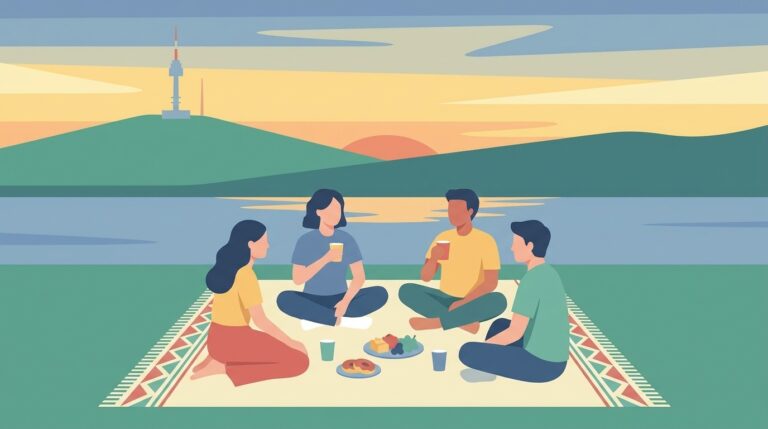
Chill Like a Local: How to Rent and Lay Out a Picnic Mat at Han River
Phase 1: Empathy (Welcome to Seoul’s Living Room!)
안녕하세요! 매일한글 에디터입니다. (Hello! It’s your Daily Hangul editor.)
Picture this: It’s 5:30 PM on a breezy Friday in Seoul. You’ve walked out of Yeouinaru Station onto the rolling green lawns of Yeouido Han River Park. The golden hour light is dancing on the river, acoustic buskers are playing in the distance, and the irresistible scent of fried chicken and bubbling instant ramyeon fills the air. You see hundreds of Seoulites lounging effortlessly on colorful picnic mats, laughing with friends.
You have your snacks in hand, your stomach is rumbling, but suddenly panic hits: you don’t have a mat to sit on! You spot vendor stalls under subway exits overflowing with silver mats and picnic wagons, but your mind goes blank. How do you ask for one? Can you just spread a mat anywhere on the grass? What if you’re encroaching on someone else’s territory?
Don’t worry, my friend. We’ve all been there! Han River picnicking is practically an art form in Korea, but it only takes three simple A1 phrases to navigate it like an absolute native. This guide is built directly from our real beginner students’ Han River adventures, tested and proven to get you seated, relaxed, and snacking without breaking a sweat.
Phase 2: Core 3 Expressions Deep Dive
Here are the top three magic phrases you need to set up your dream picnic.
1. 돗자리 있어요? (Dotjari isseoyo?)
- Pronunciation: Dot-jah-ree ee-ssuh-yo? (Think: the word dot + a jar + the letter E, followed by “is saw yo?”)
- Meaning: “Do you have a picnic mat?”
- Literal vs. Real Nuance: Literally “Picnic mat exists?”, but in context, it’s the natural Korean way to ask “Do you sell/rent picnic mats here?”
- K-Culture Moment: Remember in K-dramas when the lead characters spontaneously run to the Han River at dusk and buy a shiny silver mat from a tent stall? This is the exact phrase they mutter!
- Editor’s Insight: In Korean service encounters, asking “Do you have [X]?” (X 있어요?) is much friendlier and softer than commanding “Sell me [X]!”
- Situation Spectrum:
- Casual with close friends: 돗자리 있어? (Dotjari isseo?) ✅
- Semi-formal / Polite with shopkeeper: 돗자리 있어요? (Dotjari isseoyo?) ✅ (Recommended!)
- Formal business: 돗자리 있습니까? (Dotjari itseumnikka?) ⚠️ (Too stiff for a picnic stall!)
- 🤔 Think About It: In English, we focus on action (“Do you carry/sell mats?”), whereas Korean naturally inquires about state/presence (“Does a mat exist here?”). Isn’t that an interesting peek into how Korean grammar centers around the environment?
2. 여기 앉아도 돼요? (Yeogi anjado dwaeyo?)
- Pronunciation: Yuh-gee ahn-jah-doh dway-yo? (Think: Yuh–gee + ahn as in ‘on’ + jah + dough + dway–yo)
- Meaning: “Can I sit here?”
- Literal vs. Real Nuance: “Even if I sit here, is it okay?”
- K-Culture Moment: You arrive at Banpo Han River Park during the Rainbow Moonlight Fountain show. Every square inch of grass looks taken, but there’s an awkward gap near another group. You make gentle eye contact and ask this question politely.
- Editor’s Insight: The pattern
-도 돼요?(-do dwaeyo?) is your universal beginner key for asking permission for anything in Korea.- Situation Spectrum:
- Casual (peers): 여기 앉아도 돼? (Yeogi anjado dwae?) ✅
- Polite (strangers/public): 여기 앉아도 돼요? (Yeogi anjado dwaeyo?) ✅
- Formal: 여기 앉아도 됩니까? (Yeogi anjado doemnikka?) ⚠️ (Sounds like a military inspection)
- 🤔 Think About It: Seoul is one of the most densely populated cities on earth, so asking permission before claiming personal space is a cornerstone of daily social peace.
3. 돗자리 빌려주세요 (Dotjari billyeojuseyo)
- Pronunciation: Dot-jah-ree beel-lyuh-joo-seh-yo (Sounds like dot–jar–ee + bill + your + juice–say–yo)
- Meaning: “Please lend / rent me a picnic mat.”
- Literal vs. Real Nuance: “Please lend a picnic mat to me.” In Korean, rental stalls use the verb 빌리다 (billida, to borrow/lend) rather than ‘rent’.
- K-Culture Moment: Stepping up to those mega-popular picnic package rental shops near subway exit 2 where you get a cart, a mat, LED mood lights, and mini tables for 15,000 KRW.
- Editor’s Insight: Whenever you want someone to do a helpful action for you, attach
-아/어 주세요(-a/eo juseyo) at the end. It’s polite and warm!- Situation Spectrum:
- Casual: 돗자리 빌려줘 (Dotjari billyeojwo) 🚫 (Rude to strangers!)
- Polite: 돗자리 빌려주세요 (Dotjari billyeojuseyo) ✅
- Formal: 돗자리 대여 부탁드립니다 (Dotjari daeyeo butakdeurimnida) ⚠️ (Sounds like drafting a contract)
- 🤔 Think About It: Combining the request for an item with “give” (주세요) shows gratitude built directly into the grammar itself.
Phase 3: Textbook Korean vs. Real Street Korean
Let’s compare stiff textbook robotic phrasing with what you will actually hear on the banks of the Han River!
Situation 1: Renting a mat at a street tent
- 📖 교과서 한국어 (Textbook): 돗자리를 대여하고 싶습니다. (Dotjarireul daeyeohago sipseumnida. – “I desire to lease a picnic mat.”)
- 🗣️ 진짜 한국어 (Real-Life): 돗자리 대여 돼요? (Dotjari daeyeo dwaeyo? – “Can I rent a mat?”) or simply 돗자리 있어요? (Dotjari isseoyo? – “Do you have mats?”)
- 💡 Why is it different?: Real Koreans avoid ultra-formal grammar like
-고 싶습니다when buying street snacks or renting park gear. Keeping it short and conversational with돼요?(Is it possible?) is far more natural.
Situation 2: Checking if a patch of grass is available
- 📖 교과서 한국어 (Textbook): 이곳에 착석해도 괜찮습니까? (Igose chakseokhaedo gwaenchansseumnikka? – “Is it acceptable if I seat myself in this spot?”)
- 🗣️ 진짜 한국어 (Real-Life): 여기 자리 있어요? (Yeogi jari isseoyo? – “Is this spot taken?”)
- 💡 Why is it different?: Nobody says ‘착석’ (seated) outside of airline flights or solemn graduation ceremonies! In real life, asking if there is a ‘seat’ (자리, jari) is fast, clear, and friendly.
Phase 4: K-Culture Deep Dive & Non-Verbal Manners
4-1. 눈치 (Nunchi) & Gestures on the Mat
- The Golden Rule of Shoes: The moment your mat touches the grass, it transforms into an indoor Korean living room floor! Never step on the picnic mat with your sneakers on. Kick them off at the edge of the mat, keeping your soles turned away from where people are sitting.
- The Space Buffer: When rolling out your mat, give neighboring groups at least 1 meter of breathing space if available. A tiny 15-degree bow with a friendly smile signals: “I see you, I respect your chill time, and we’re sharing this breeze together!”
4-2. The Holy Trinity: Chimaek, Ramyeon & Sunset
Picnicking at Han River isn’t just about sitting—it’s a cultural ritual known as “Hangang Healing” (한강 힐링).
* Koreans combine Chimaek (치맥, fried chicken + draft beer) delivered straight to the park’s designated delivery zones with Hangang Ramyeon (foil containers cooked on high-tech induction machines inside convenience stores).
* A picnic mat (돗자리) is the centerpiece of this entire lifestyle. Without it, you’re merely visiting; with it, you’re living like a local!
Phase 5: Real-Life Roleplay Scenario
Setting: Yeouinaru Station Exit 2, Han River Park entrance. Bright 20-something stall owner Minho is managing a mountain of picnic mats, wagons, and mini folding tables.
- Alex: 저기요! 돗자리 있어요? (Jeogiyo! Dotjari isseoyo?)
🎭 (Timidly steps up to the stall and points at the stacked mats)
“Excuse me! Do you have picnic mats?” - Minho: 네, 있어요! 대여하실 거예요, 사실 거예요? (Ne, isseoyo! Daeyeohasil geoyeyo, sasil geoyeyo?)
🎭 (Smiles warmly, holding up a sleek checkered mat and a silver mat)
“Yes, we do! Are you going to rent or buy?” - Alex: 빌려주세요! 얼마예요? (Billyeojuseyo! Eolmayeyo?)
🎭 (Smiles back with renewed confidence)
“Please rent it to me! How much is it?” - Minho: 4시간에 5천 원이에요. 담요도 필요하세요? (Neshigane ocheon-wonieyo. Dam-yodo piryohaseyo?)
🎭 (Taps the rental sign gently)
“It’s 5,000 won for 4 hours. Do you need a blanket too?” - Alex: 아니요, 괜찮아요. 돗자리만 주세요! (Aniyo, gwaenchanayo. Dotjariman juseyo!)
🎭 (Waving hand slightly with a polite head tilt)
“No, I’m okay. Just the picnic mat, please!” - Minho: 네! 여기 있습니다. 반납은 9시까지예요! (Ne! Yeogi itsseumnida. Bannabeun ahopssikkajiyeyo!)
🎭 (Hands over the mat in a tidy shoulder bag strap)
“Here you go! Return is by 9 PM!” - Alex: 감사합니다! 좋은 하루 보내세요! (Gamsahamnida! Joeun haru bonaeseyo!)
🎭 (Receives the mat with both hands and bows slightly)
“Thank you! Have a great day!” - Minho: 재미있게 놀다 가세요! (Jaemi-itge nolda gaseyo!)
🎭 (Waves cheerfully)
“Have lots of fun!”
🔀 Interactive Branching Choice
You walk down to the grass. You find a shaded spot under a willow tree, but a pair of sandals is sitting right on the edge of the patch. What do you do?
- Option A: Approach the nearby group, point softly, and ask: “저기요, 여기 자리 있어요?” (Jeogiyo, yeogi jari isseoyo?)
- 👉 Feedback [BEST]: Perfect! They will likely say “아니요, 앉으세요!” (No, please sit!) and move their sandals. Polite, natural, 100% native style.
- Option B: Don’t say anything and just snap your mat open right over their sandals.
- 👉 Feedback [RISK]: Major breach of Korean public etiquette! You will get silent side-eyes (눈총, nunchong) and awkward tension for the rest of your picnic.
- Option C: Yell across the lawn: “돗자리 비켜!” (Dotjari bikyeo! – “Mat move!”)
- 👉 Feedback [BAD]: Yikes! This is extremely rude panmal (informal speech). You might end up featured on Korean social media as the day’s rudest tourist!
Phase 6: 10-Second Emotion Shadowing Drill
Practice reading these out loud with rhythm and native feeling. Pause at the slash marks (/)!
[😊 Cheerful & Curious]
저기요! / 돗자리 / 있어요?
(Jeogiyo! / Dotjari / isseoyo?)-
[🤔 Polite & Respectful]
실례지만, / 여기 / 앉아도 돼요?
(Sillyejiman, / yeogi / anjado dwaeyo?) -
[🙏 Grateful & Sweet]
돗자리 / 하나만 / 빌려주세요!
(Dotjari / hanaman / billyeojuseyo!)
Phase 7: K-Culture Mini Dictionary
-
돗자리 (Dotjari)
Literal: Picnic mat / Floor mat.
Real Use: The quintessential outdoor accessory in Korea. Comes in traditional foil-silver or trendy Instagrammable pastel gingham checks. -
한강공원 (Hangang gong-won)
Literal: Han River Park.
Real Use: The vast string of riverside parks stretching across Seoul (Yeouido, Banpo, Ttukseom, Mangwon). The ultimate casual weekend destination for dates, family outings, and group gatherings. -
배달존 (Baedal-jon)
Literal: Delivery Zone.
Real Use: Specific numbered meeting points in the park where motorcycle couriers deliver fried chicken, tteokbokki, and pizza directly to picnic-goers. -
물티슈 (Mulsiti-syu)
Literal: Wet tissue / Wet wipes.
Real Use: An absolute lifesaver. Keep a pack in your bag to wipe your mat before packing up and clean your hands after tearing into crunchy fried chicken.
Phase 8: Survival Kit for Travelers
Top 3 Survival Phrases
- 얼마예요? (Eolmayeyo?) — “How much is it?”
Pro Tip: Always clarify rental price vs. purchase price when dealing with street carts. - 여기서 먹어도 돼요? (Yeogiseo meogeodo dwaeyo?) — “Can I eat here?”
Pro Tip: Useful if you’re close to historical landmarks or flowerbeds where food might be restricted. - 쓰레기통 어디 있어요? (Sseuregitong eodi isseoyo?) — “Where is the trash can?”
Pro Tip: Littering at Han River incurs hefty fines. Korean parks have distinct recycling stations!
Editor’s Travel Note
- Must-have Navigation App: Google Maps doesn’t provide walking routes accurately in Korea. Make sure you complete your Naver Map app download before heading to the river so you can find exact rental stalls and delivery zones.
- Renting a City Bike: Combine your picnic with a scenic riverside ride! Check out our Seoul Bike Ddareungi Guide to unlock 1,000 KRW hourly bike rentals straight from your phone.
Phase 9: “One Step Deeper” (Editor’s Cultural Essay)
In modern, high-speed Seoul—where apartments are small and workspaces demand endless hustle—the Han River serves as Korea’s communal open-air living room. Spreading a picnic mat (돗자리) isn’t just about avoiding dirt on your jeans; it’s a symbolic claiming of your personal sanctuary under the open sky. Yet, this personal space thrives on profound mutual respect: nobody plays blaring speakers, shoes never touch the mat surface, and everyone painstakingly sorts their trash before leaving. It is a harmonious dance between extreme density and shared mindfulness.
💬 Your Turn: What is your favorite public picnic spot in your home country, and what is one unspoken rule visitors should know? Share with us in the comments below!
Phase 10: FAQ & Common Mistakes
Q: Can I pitch a camping tent instead of a picnic mat?
A: Only in designated seasonal “Tent Zones” (그늘막 텐트 구역) and only with at least two sides completely unzipped and open! Pitching unauthorized tents or fully closed tents outside these areas can result in fines up to 1,000,000 KRW.
Q: What time do picnic mat rental shops close?
A: Most rental shops near Yeouinaru and Banpo close around 10:00 PM to 11:00 PM. Make sure to note your return deadline (반납 시간, bannap sigan) when paying your rental deposit.
Q: Can I drink alcohol on my picnic mat at Han River?
A: Yes! Moderate alcohol consumption (like a cold can of beer with chicken) is legal and very common at Han River Park, as long as you maintain public decorum and dispose of your cans responsibly.
🚨 Common Mistakes Alert!
- Stepping on the mat with shoes: Always slip shoes off at the rim. Stepping on a mat with sneakers is considered just as shocking as walking onto a clean bed with muddy boots!
- Leaving trash behind: Han River maintains clean eco-parks. Sort into general trash (일반쓰레기), food waste (음식물쓰레기), and recyclables (재활용).
- Mixing up ‘Rent’ and ‘Buy’: A silver mat costs around 3,000–5,000 KRW to buy outright at a convenience store, while full rental sets (with wagon, lamps, mat) cost 10,000–20,000 KRW for a 4-hour slot. Check before paying!
Phase 11: Action Missions
- 🥉 Bronze Mission (Solo Practice): Stand in front of your mirror and say: “저기요, 돗자리 있어요?” 5 times with a bright, welcoming smile.
- 🥈 Silver Mission (Social Share): Snap a picture of your favorite park or cozy rug at home, post it to Instagram Stories, and caption it with: 돗자리 펴기 완료! (Dotjari pyeogi wanryo! – Picnic mat spread complete!) tagging @DailyHangul.
- 🥇 Gold Mission (Real Life Action): Head down to any park in Korea (or a Korean market near you), find a vendor, and rent or buy your mat 100% in Korean!
🎮 K-Culture Watcher Mission: Watch an episode of Hospital Playlist or any Seoul-based slice-of-life K-drama. Spot a scene featuring the Han River and notice whether the characters take their shoes off before stepping onto their mats!
Phase 12: Interactive Quiz Challenge
Test your new Han River park superpowers!
1. Situational Judgment: You walk up to a convenience store near Yeouido Han River Park and want to know if they sell picnic mats. Which phrase do you use?
* A) 돗자리 비켜요? (Dotjari bikyeoyo?)
* B) 돗자리 있어요? (Dotjari isseoyo?)
* C) 돗자리 나빠요? (Dotjari nappayo?)
2. Fill-in-the-Blank: When politely asking a group if an empty patch of grass is taken, you say:
“여기 ________ 돼요?” (Can I sit here?)
* A) 가도 (gado – go)
* B) 먹어도 (meogeodo – eat)
* C) 앉아도 (anjado – sit)
3. True or False Culture Check: At Han River Park, it is completely acceptable and clean to walk across a picnic mat with your running shoes on.
* A) True
* B) False
👉 Click here to reveal the answers and explanations!
-
Answer: B) 돗자리 있어요?
Explanation: “있어요?” asks if they have mats in stock. Option A means “get out of the way”, and Option C means “are mats bad?” -
Answer: C) 앉아도
Explanation: 앉다 means ‘to sit’. “앉아도 돼요?” translates to “Is it okay if I sit?” -
Answer: B) False
Explanation: Absolutely false! Picnic mats are treated like domestic floors. Always take your shoes off at the border of the mat!







