

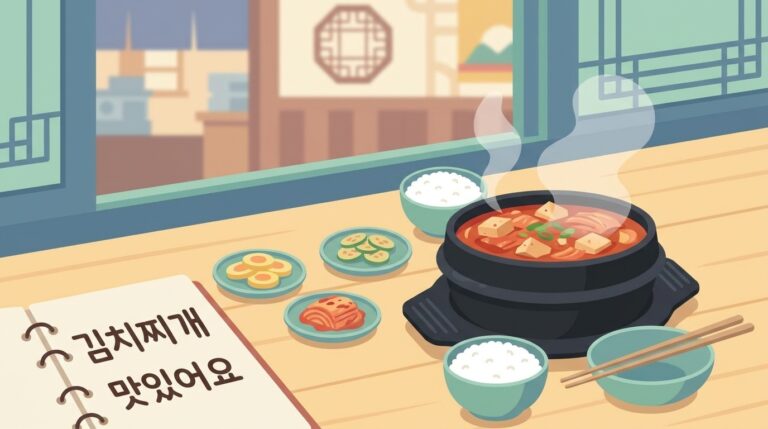
Order Kimchi Jjigae Like a True Seoul Local Without Any Fear
Phase 1: Empathy (A Story-Driven Diner Opening)
안녕하세요! 매일한글 에디터입니다. (Hello! I’m your Daily Hangul editor.)
Picture this: It’s a brisk evening in Seoul. You follow a narrow alleyway behind Euljiro’s vintage neon signs and slip through the sliding glass doors of a bustling neighborhood diner. The room hits you with the mouthwatering, intoxicating scent of caramelized garlic, sour fermented cabbage, and rich pork broth simmering over open flames. Every little table is crowded with happy diners spooning deep-red, bubbling soup from sizzling black earthenware pots over bowls of fluffy white rice.
You want nothing more than to dive into a bowl of Kimchi Jjigae (김치찌개)—Korea’s undisputed number-one soul food. But as the busy restaurant auntie (이모님) strides briskly toward your table holding a metallic order pad, sudden panic sets in: How do I order just one portion? Is it going to be way too spicy for me? Do I have to pay extra for rice?
Take a deep breath! You are not alone. Thousands of our beginner students have frozen up in this exact moment. Today, we are turning you from a nervous tourist into an insider who orders with calm, effortless confidence. Let’s master the magic words of Korean diner culture together!
Phase 2: Core Expressions (3 Essential Keys)
1. 김치찌개 하나 주세요 (Kimchi-jjigae hana juseyo)
- Pronunciation: [Gim-chi-jji-gae ha-na joo-seh-yo] (Sounds like: “Kim-chee” + snappy “gee-geh” + “hah-nah” + “joo-say-yo”)
- Meaning: Literal: “Kimchi stew one give please” | Real Nuance: “One Kimchi stew, please!”
- K-Culture Moment: In slice-of-life K-Dramas like Hospital Playlist or Reply 1988, whenever tired characters sit down at a humble restaurant after an exhausting day, this single sentence is ordered almost like a reflex.
- Editor’s Insight: “하나 (hana)” is the native Korean word for “one.” Paired with the golden polite phrase “주세요 (juseyo – please give),” this sentence acts as your master key to order virtually anything anywhere in Korea.
- Situation Spectrum: Casual ⚠️ | Semi-formal ✅ | Formal ✅
- 🤔 Think About It: In English, you typically ask “Can I get…?” focusing on your act of receiving. In Korean, “주세요 (please give)” centers politely on the server’s generosity. How does this shift your connection with the restaurant staff?
2. 덜 맵게 해주세요 (Deol maepge hae-juseyo)
- Pronunciation: [Deol maep-gae hae-joo-seh-yo] (Sounds like: “Dull” + “map” with a soft “g” + “heh-joo-say-yo”)
- Meaning: Literal: “Less spicy make please” | Real Nuance: “Could you make it less spicy, please?”
- K-Culture Moment: On variety shows like Running Man, whenever cast members who cannot handle spicy food (affectionately called 맵찔이, mapjjiri) face a fiery red dish, they frantically chant this phrase to survive!
- Editor’s Insight: Authentic Kimchi Jjigae uses long-fermented aged kimchi (mugeunji), which can carry quite a spicy and tangy punch. Asking for “덜 맵게 (deol maepge)” ensures the chef eases up on the extra chili powder without sacrificing that deep, savory broth flavor.
- Situation Spectrum: Casual ⚠️ | Semi-formal ✅ | Formal ✅
- 🤔 Think About It: Notice Koreans rarely ask for Kimchi Jjigae “안 맵게 (not spicy at all)”—because spicy kimchi is the core DNA of the dish. Instead, they soften the intensity with “덜 (less).” Isn’t it fascinating how language mirrors culinary identity?
3. 공깃밥 추가해 주세요 (Gong-git-bap chugahae juseyo)
- Pronunciation: [Gong-git-bap choo-gah-hae joo-seh-yo] (Sounds like: “Gong” + “geet” + “bop” like pop music + “choo-gah-heh joo-say-yo”)
- Meaning: Literal: “Bowl of rice add please” | Real Nuance: “I’d like an extra bowl of rice, please!”
- K-Culture Moment: In any legendary Korean Mukbang (eating show), finishing only one bowl of rice with Kimchi Jjigae is practically considered a crime. Taking down a second bowl is the ultimate badge of appreciation.
- Editor’s Insight: The individual stainless-steel bowl filled with warm steamed rice is called “공깃밥 (gong-git-bap).” Knowing how to request an extra one when your spicy soup outlasts your carb supply will earn you fond nods from the kitchen!
- Situation Spectrum: Casual ⚠️ | Semi-formal ✅ | Formal ✅
- 🤔 Think About It: In Western dining, soups are often appetizers. In Korea, the stew exists to elevate the rice. In your culture, is grain the humble sidekick or the true star of the meal?
Phase 3: Textbook Korean vs. Real Korean
Situation 1: Calling the Server in a Crowded Diner
- 📖 교과서 한국어 (Textbook): 저기 실례합니다, 이리 와 주시겠어요? (Jeogi sillyehamnida, iri wa jusigesseoyo? – Excuse me, could you please come here?)
- 🗣️ 진짜 한국어 (Real-Life): 사장님, 여기요! (Sajangnim, yeogiyo! – Boss, over here please!) or 이모님, 주문할게요! (Imo-nim, jumunhalgeyo! – Auntie, we are ready to order!)
- 💡 왜 다를까?: Textbook phrasing is too long and awkward for a noisy eatery. In real Korean dining, addressing servers warmly as “사장님 (Sajangnim – Boss)” or “이모님 (Imo-nim – Auntie)” treats them like extended family, getting you faster service and extra friendly smiles!
Situation 2: Asking if Rice is Included with the Stew
- 📖 교과서 한국어 (Textbook): 이 찌개에 밥이 포함되어 있습니까? (I jjigaee babi pohamdoe-eo itsseumnikka? – Is rice included in this stew?)
- 🗣️ 진짜 한국어 (Real-Life): 밥 같이 나와요? (Bap gachi nawayo? – Does rice come together with it?)
- 💡 왜 다를까?: Everyday Korean drops stuffy Sino-Korean nouns like “포함 (inclusion)” in favor of the lively verb “나오다 (to come out).” It sounds breezy, friendly, and 100% natural.
Phase 4: K-Culture Deep Dive & Non-verbal Manners
4-1. 눈치 (Nunchi) & Dining Gestures
- The Gentle Hand Raise: Never snap your fingers, wave both arms, or whistle. Simply raise one hand gently to shoulder height, make warm eye contact, and say “사장님~ (Sajangnim~)” with a friendly upward pitch.
- Two Hands for Safety and Respect: Kimchi stew arrives piping hot in a thick ceramic stone bowl. When the server sets it down, do not touch the pot with bare hands. When handed your metal bowl of rice or side dishes, receive them using both hands as a sign of polite gratitude.
- The Napkin Setup: Before the food lands on your table, lay down a clean paper napkin and place your metal spoon and chopsticks side by side on top of it. Doing this shows great dining etiquette (nunchi) in casual eateries!
4-2. Culture Code: The Soul Food Chemistry
Why does Kimchi Jjigae rule Korean tables? The magic lies in 묵은지 (mugeunji)—kimchi that has fermented slowly over months. As the acidic, pungent aged cabbage cooks down with juicy pork belly (samgyeopsal) or canned tuna (chamchi), the broth turns velvety, savory, and rich. In Korean cinema and K-Dramas, coming home to a warm bowl of Kimchi Jjigae symbolizes healing and unconditional love after life’s hardest battles.
Phase 5: Real-Life Roleplay Scenario
- Location: “Halmeoni’s Ttukbaegi” (Grandma’s Earthenware Stew) in a lively alley near Jongno, Seoul.
- Character: Imo-nim (이모님), a cheerful, warm 50-something restaurant owner in a floral apron holding an order pad.
[Scene Start]

1. 이모님 (Imo-nim): 어서 오세요! 몇 분이세요?
   (Eoseo oseyo! Myeot bun-iseyo?)
   "Welcome! How many people?"
   🎭 Wiping down a clean table with a broad, welcoming smile.

2. Learner: 한 명이에요!
   (Han myeong-ieyo!)
   "Just one person!"
   🎭 Holding up one index finger gently while smiling back.

3. 이모님 (Imo-nim): 편한 데 앉아요. 뭐 줄까?
   (Pyeonhan de anjayo. Mwo julkka?)
   "Sit anywhere you like, dear. What can I get ya?"
   🎭 Placing down a chilled metal bottle of water and a cup.

4. Learner: 김치찌개 하나 주세요!
   (Kimchi-jjigae hana juseyo!)
   "One Kimchi stew, please!"
   🎭 Pointing politely toward the wooden wall menu.

5. 이모님 (Imo-nim): 매운 거 잘 먹어요? 보통도 칼칼한데.
   (Maeun geo jal meogeoyo? Botongdo kalkalhande.)
   "Can you handle spicy food? Our regular version has a spicy kick."
   🎭 Tilting her head with caring concern.

6. Learner: 덜 맵게 해주세요!
   (Deol maepge hae-juseyo!)
   "Please make it less spicy!"
   🎭 Placing palms lightly together with a modest, grateful grin.

7. 이모님 (Imo-nim): 알겠어! 맛있게 끓여줄게!
   (Algesseo! Mas-itge kkeullyeojulge!)
   "Got it! I will boil it up delicious for you!"
   🎭 Tucking her pen behind her ear and calling out the order to the kitchen.

8. Learner: 네, 감사합니다!
   (Ne, gamsahamnida!)
   "Yes, thank you so much!"
   🎭 Nodding head in a short, polite bow.

[Scene End]
🔀 Interactive Branching Point
The fiery stew is bubbling in front of you, but you realize you want more delicious seasoned bean sprouts (kongnamul):
* Option A: Call out politely: “사장님, 반찬 좀 더 주세요!” (Sajangnim, banchan jom deo juseyo! – Boss, could we get a little more side dishes please?)
* 👉 Feedback [Best]: Spot on! Friendly, natural, and polite. In Korea, side dishes are complimentary, and asking like this will delight the staff.
* Option B: Shouting across the room: “야! 여기 반찬 더 가져와!” (Ya! Yeogi banchan deo gajyeowa! – Hey! Bring more side dishes here!)
* 👉 Feedback [Bad]: Major red alert! Using informal speech (banmal) and demanding tone to restaurant elders will shock everyone in the room.
* Option C: Silently walking into the back kitchen pantry area to grab side dishes yourself.
* 👉 Feedback [Risk]: Dangerous! Stepping into the busy kitchen can cause accidents with boiling broths. Check first if there is a marked “셀프 코너 (Self-Service Corner)” outside the kitchen before getting up.
Phase 6: 10-Second Emotion Shadowing Drill
Practice matching the emotional melody of native speakers! Pay attention to the pauses marked with /:
- [😊 Bright & Energetic – Ordering with cheer]
김치찌개 / 하나 / 주세요!
(Kimchi-jjigae / hana / juseyo!) -
[🥺 Cautious & Hopeful – Requesting mild spice]
조금 / 덜 맵게 / 해주세요.
(Jogeum / deol maepge / hae-juseyo.) -
[😋 Delighted & Hungry – Craving more rice]
공깃밥 / 하나 더 / 주세요!
(Gong-git-bap / hana deo / juseyo!)
Phase 7: K-Culture Mini Dictionary
- 뚝배기 (Ttukbaegi) | Noun
- Translation: Korean earthenware pot.
- Everyday Usage: Thick ceramic stoneware that retains intense heat, keeping your Kimchi Jjigae simmering vigorously even after it sits on your table.
- 묵은지 (Mugeunji) | Noun
- Translation: Long-aged fermented kimchi.
- Everyday Usage: Kimchi fermented for months or years under cold temperatures, celebrated for its deep tang and essential role in creating authentic stew broth.
- 사리 (Sari) | Noun
- Translation: Soup noodle or rice-cake add-in.
- Everyday Usage: When you want instant ramen noodles boiled right inside your stew, ask for “라면 사리 (ramyeon sari)”.
- 반찬 (Banchan) | Noun
- Translation: Side dishes.
- Everyday Usage: The rainbow of complimentary small plates (rolled omelets, kimchi, pickled radish, stir-fried fish cakes) that accompany every Korean meal.
Phase 8: Traveler’s Survival Kit
Survival Expressions TOP 3
- 라면 사리 추가해 주세요 (Ramyeon sari chugahae juseyo) – Please add ramen noodles!
- Pro Tip: Order this right when your stew starts boiling so the dry noodles soak up the rich, savory broth.
- 물 셀프예요? (Mul selpeu-yeyo?) – Is water self-service?
- Pro Tip: If you don’t see a water bottle brought to your table, spot the water dispenser nearby, grab a metal cup, and pour your own water.
- 계산해 주세요 (Gyesanhae juseyo) – Check, please / I’d like to pay.
- Pro Tip: Bring the paper order slip resting on your table up to the counter near the front door to complete payment.
Editor’s Travel Note
Before heading out, perform a [Naver Map app download for English navigation] to easily locate highly rated neighborhood stew spots labeled “백반 (Baekban – home-style meals).” Remember: Some specialty restaurants require a minimum of two orders (2인분 이상) for stews cooked at the table. If you are solo, look for places welcoming single diners with “1인 식사 가능 (Single diner welcome).”
Phase 9: Going Deeper (Humanities Essay)
In Korean society, food is far more than physical fuel; it is the ultimate emotional currency. Koreans rarely greet close friends with a simple “How are you?”; instead, they ask, “밥 먹었어요? (Did you eat rice?)”. Gathering around a steaming hot pot of Kimchi Jjigae, sharing the warmth, and dipping spoons together breaks down formalities and cultivates 정 (Jeong)—a profound, unspoken bond of affection and community.
💬 Your Turn: Have you ever tasted real Korean Kimchi Jjigae? Do you like it super fiery, or are you on team “덜 맵게 (less spicy)” like many of our fellow learners? Tell us your favorite comfort food story in the comments below!
Phase 10: FAQ & Common Mistakes
Q: Is Kimchi Jjigae always cooked with pork?
A: Pork belly (dwaejigogi) is the most classic restaurant standard, but tuna (chamchi) and canned ham or sausage (budae-style) are also wildly popular. If you do not eat pork, you can ask before ordering: “돼지고기 들어가요? (Does it contain pork?)”.
Q: What is the main difference between Kimchi Jjigae and Kimchi Guk?
A: Kimchi Jjigae (찌개) is a concentrated, thick, pungent stew loaded with solid ingredients and meant to be eaten alongside rice. Kimchi Guk (국) is a much lighter, clear soup with higher water content served in an individual bowl.
Q: Do I have to pay extra money to refill my side dishes (banchan)?
A: Almost never! In standard Korean restaurants, banchan refills are completely free. Simply take your empty dish to the self-serve bar or politely ask: “반찬 더 주세요 (Please give more side dishes).”
🚨 흔한 실수 (Common Mistakes) Warning Board
- Mistake: Calling the restaurant staff “웨이터 (Waiter)” or “아가씨 (Agassi – young lady)”.
- Correct Action: Always call them “사장님 (Sajangnim)” or “이모님 (Imo-nim)” to stay warm and polite.
- Mistake: Leaving your metal spoon standing upright stuck inside the earthenware pot.
- Correct Action: The metal spoon absorbs heat rapidly from the boiling ceramic bowl and will burn your lips! Always rest your spoon on your napkin or side plate between bites.
- Mistake: Blowing your nose loudly at the dining table because the hot stew made it runny.
- Correct Action: Blowing your nose at the table is considered unhygienic in Korea. Excuse yourself to the restroom or dab gently with a napkin.
Phase 11: Action Mission & Engagement
- 🥉 Bronze Mission (Solo Practice): Stand in front of your mirror and repeat “김치찌개 하나 주세요, 덜 맵게 해주세요!” 3 times with a bright, friendly smile.
- 🥈 Silver Mission (Social Share): Snap a photo of your next meal or spicy dish and post it on your social media with the phrase
#김치찌개 #DailyHangul! - 🥇 Gold Mission (Real-Life Action): Visit a local Korean restaurant or grocery food court this weekend and place your order entirely in Korean!
- 🎮 K-Culture Mission: Watch any episode of a food-centered K-Drama (like Let’s Eat) and count how many times characters say “맛있겠다! (Looks delicious!)” before eating stew.
Phase 12: Interactive Quiz Challenge
1. Situational Judgment Quiz
You want to order Kimchi Jjigae, but your spice tolerance is low. What do you say to the server?
* A) 김치찌개 많이 주세요 (Kimchi-jjigae mani juseyo)
* B) 김치찌개 덜 맵게 해주세요 (Kimchi-jjigae deol maepge hae-juseyo)
* C) 김치찌개 없어요? (Kimchi-jjigae eopseoyo?)
2. Fill-in-the-Blank Quiz
You finished your rice, but your stew is still half full! Complete the sentence:
“사장님, ________ 추가해 주세요!” (Bowl of rice)
3. True or False Culture Quiz
True or False: In a traditional Korean restaurant, you must pay extra for every small plate of side dishes (banchan) you refill.
👉 Click here to reveal the answers and explanations!
- 1. Answer: B (덜 맵게 해주세요 means “Please make it less spicy.” Option A asks for a large portion, and Option C asks if they don’t have it!)
- 2. Answer: 공깃밥 (Gong-git-bap) (“공깃밥 추가해 주세요!” means “Please add an extra bowl of rice!”)
- 3. Answer: False (Banchan refills are complimentary in virtually all Korean diners! Feel free to enjoy them!)







