

Phase 1: Empathy & Story Opening
안녕하세요! 매일한글 에디터입니다. (Hello! I’m your Daily Hangul editor.)
Imagine this: You have just landed at Incheon Airport after an exhausting overnight flight. Your shoulders ache, your feet are heavy, and all you want is to sink into the restorative, steaming herbal baths of a legendary Korean bathhouse—the iconic 찜질방 (Jjimjilbang). You excitedly head inside, pay your admission at the counter, and receive a set of soft cotton pajamas and a small numbered wristband.
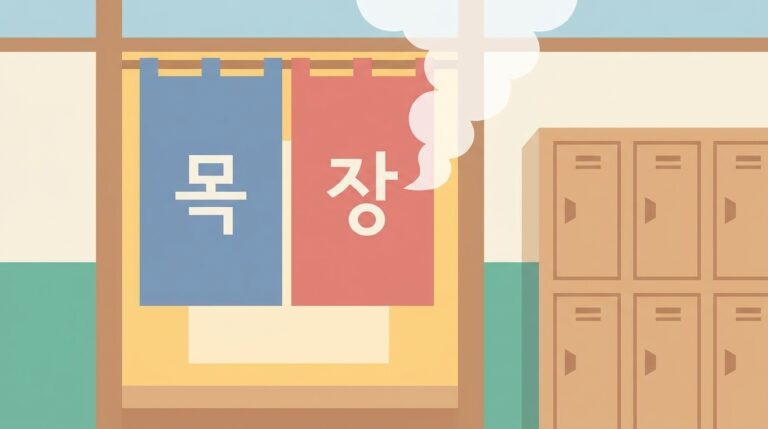
Then, suddenly, you freeze. Ahead of you are two distinct corridors: one draped with a blue curtain labeled 남 (Nam), the other with a red curtain labeled 여 (Yeo). People are slipping off their shoes at lightning speed, electronic lockers are chiming, and the counter auntie (아줌마) is rattling off rapid-fire Korean instructions about towel rules and shoe lockers. Your heart races—Which curtain is mine? What do I do with my shoes? Does this tiny key open everything?
If that sudden wave of bathhouse culture shock sounds familiar, take a deep breath! Every single international traveler and Korean learner encounters this exact moment of hesitation. In this guide, distilled from hundreds of real classroom discussions and student travel feedback, we are going to unlock the exact survival phrases, locker room customs, and unspoken etiquette you need to step through those bathhouse doors with total confidence.
Phase 2: Top 3 Core Expressions Deep-Dive
1. 남탕은 / 여탕은 몇 층이에요? (Nam-tang-eun / Yeo-tang-eun myeot cheung-i-e-yo?)
- Pronunciation: [Nam-tang-eun / Yeo-tang-eun myut cheung-ee-yeo] (Nam rhymes with “calm”, Yeo sounds like “yuh”, myeot sounds like “myut”, and cheung rhymes with “sung”.)
- Meaning: “Which floor is the men’s / women’s bath?” (Literal: Men’s bath / Women’s bath which floor is it?)
- K-Culture Moment: You’ll see this all the time in Korean variety shows and travel vlogs when celebrities visit multi-level mega-spas in Busan or Seoul and end up wandering onto the wrong floor.
- Editor’s Insight: Urban Korean bathhouses often span three or four floors. Typically, the women’s facility (여탕) is on one floor (for privacy, often lower or higher), the men’s facility (남탕) on another, and the shared lounge (찜질방) in the middle. Asking this right at check-in saves you from awkward elevator rides in your socks.
- Situation Spectrum: Casual ⚠️ | Semi-formal ✅ | Formal ✅
- 🤔 Think About It: In English, we usually ask for “the men’s locker room.” Korean uses the concise root 탕 (Tang – hot water tub/bath). How does naming a room after “water” rather than “lockers” change how we view the primary purpose of the space?
2. 수건 더 받을 수 있어요? (Su-geon deo ba-deul su iss-eo-yo?)
- Pronunciation: [Su-gun duh bah-deul soo ee-ssuh-yo?] (Su-geon sounds like “sue-gun”, badeul like “bah-dull”.)
- Meaning: “Could I get extra towels?” (Literal: Towel more can receive?)
- K-Culture Moment: A classic recurring topic on Korean talk shows is the humorous “towel inequality” debate. In the women’s bath (여탕), you are handed exactly two small towels at the front desk due to historic towel loss rates, whereas in the men’s bath (남탕), stacks of hundreds of towels sit freely inside!
- Editor’s Insight: If you are heading into 여탕 and have long hair, two small face-sized towels might not feel like enough. Do not hesitate to ask the counter staff for one more right at the entrance using this phrase before you walk inside.
- Situation Spectrum: Casual ⚠️ | Semi-formal ✅ | Formal ✅
- 🤔 Think About It: Why do you think Korean public baths use small hand towels (페이스타월) rather than giant Western bath towels? (Hint: Small towels dry quickly on heated floors and don’t drag across wet bath tiles!)
3. 신발장 키랑 옷장 키 같아요? (Sin-bal-jang ki-rang ot-jang ki gat-a-yo?)
- Pronunciation: [Shin-bal-jang kee-rang oht-jang kee gah-tah-yo?] (Shin-bal sounds like “shin-ball”, ot-jang sounds like “oat-jahng”.)
- Meaning: “Is the shoe locker key the same as the clothes locker key?”
- K-Culture Moment: You will often see nervous newcomers wandering around with shoes in their hands looking puzzled until a local points to their electronic wristband and chuckles reassuringly.
- Editor’s Insight: At 95% of modern Korean bathhouses, your shoe cubby number at the entrance matches your tall locker number inside the changing area. You place your street shoes into the cubby, take the wristband, and that single key handles everything.
- Situation Spectrum: Casual ⚠️ | Semi-formal ✅ | Formal ✅
- 🤔 Think About It: In many Western gyms, everyone brings their own metal padlock. What does Korea’s unified electronic wristband system tell you about societal trust and technological convenience?
Phase 3: Textbook Korean vs. Real Korean
Situation 1: Asking where your gender’s bath area is located
- 📖 교과서 한국어 (Textbook): 여성 전용 목욕탕은 어디에 위치합니까? (Yeo-seong jeon-yong mog-yog-tang-eun eo-di-e wi-chi-ham-ni-kka? – Where is the female-only bathhouse located?)
- 🗣️ 진짜 한국어 (Real-Life): 여탕 어디로 가요? (Yeo-tang eo-di-ro ga-yo? – Where do I go for the women’s bath?) or 남탕 몇 층이에요? (Nam-tang myeot cheung-i-e-yo? – What floor is the men’s bath?)
- 💡 왜 다를까? (Why is it different?): Textbook phrasing relies heavily on stiff, administrative Chinese-character loanwords like ‘전용’ (exclusive) and ‘위치합니까’ (is situated). Real Koreans prefer short, functional vocabulary: ‘남탕’ (men’s) or ‘여탕’ (women’s) paired with active destination verbs.
Situation 2: Asking if you can pay for snacks with your key wristband
- 📖 교과서 한국어 (Textbook): 이 전자 팔찌로 내부 결제가 가능합니까? (I jeon-ja pal-jji-ro nae-bu gyeol-je-ga ga-neung-ham-ni-kka? – Is internal payment possible with this electronic bracelet?)
- 🗣️ 진짜 한국어 (Real-Life): 이거 키로 찍으면 돼요? (I-geo ki-ro jji-geu-myeon dwae-yo? – Can I just tap this key?)
- 💡 왜 다를까? (Why is it different?): Native speakers use concrete onomatopoeic and sensory verbs. ‘찍다’ (to stamp / to tap an RFID chip) replaces lengthy conceptual phrases like ‘결제가 가능합니까’ (is payment possible).
Phase 4: K-Culture Deep Dive & Non-Verbal Manners
4-1. 눈치 (Nunchi) & Entry Gestures
- The Threshold Line (Shoes Off Immediately!): The very first unspoken rule occurs the millisecond you cross the counter. You will see a raised step or a transition from outdoor tile to indoor flooring. Never step onto the clean indoor floor with shoes on! Remove your footwear immediately, hold them in your hand, and place them directly into your assigned 신발장 (shoe locker).
- Gaze & Eye Contact: Inside the entry and changing area, everyone is at various stages of undress. Maintain a friendly, direct gaze when talking to counter staff. Once you step beyond the curtain into the locker room, however, practice respectful Nunchi: keep your gaze neutral and relaxed at eye or floor level. Do not stare or scan the room curiously.
- Two-Handed Reception: When the desk clerk hands you your folded uniform (찜질복) and key band, receive them using both hands, or support your right wrist lightly with your left hand. This effortless body language instantly conveys respect.
4-2. Cultural Code Analysis: The Bathhouse as Community Healing
In K-dramas (like Reply 1988 or Legend of the Blue Sea), the Jjimjilbang is depicted as far more than a place to wash. It is a social community hub where entire families sleep side-by-side on heated ondol floors, break warm roasted eggs (맥반석 계란) against their foreheads, and sip sweet chilled rice punch (식혜). Entering the separate 남탕 or 여탕 is the essential ritual purifying step before entering this shared paradise.
Phase 5: Real-Life Roleplay Scenario
- Setting: 11:30 PM at a bustling, warm 24-hour Jjimjilbang in Mapo, Seoul.
- Characters:
- Alex: A weary foreign traveler carrying a small daypack, eager to rest.
- Auntie Staff (아주머니): A brisk, kind front-desk manager sporting a visor and arm warmers.
- Turn 1 (Alex): 안녕하세요! 성인 한 명이에요. (Annyeonghaseyo! Seong-in han myeong-ieyo. / Hello! One adult, please.) 🎭 [Hands over a payment card with two hands politely]
- Turn 2 (Staff): 네, 찜질복 포함해서 만 오천 원이에요. 여기 키랑 옷 받아요. (Ne, jjimjilbok pohamhaeseo man o-cheon won-ieyo. Yeogi ki-rang ot bad-ayo. / Yes, 15,000 won including the sauna clothing. Here is your key and uniform.) 🎭 [Slides wristband #54 and a neatly folded t-shirt set across the counter]
- Turn 3 (Alex): 감사합니다! 그런데 남탕은 몇 층이에요? (Gamsahamnida! Geureonde nam-tang-eun myeot cheung-i-e-yo? / Thank you! But which floor is the men’s bath?) 🎭 [Glances around at the various staircases and elevators]
- Turn 4 (Staff): 남탕은 지하 일 층이고, 여탕은 삼 층이에요. (Nam-tang-eun ji-ha il cheung-i-go, yeo-tang-eun sam cheung-ieyo. / Men’s is basement 1, women’s is the 3rd floor.) 🎭 [Points toward the stairwell to the left]
- Turn 5 (Alex): 신발 먼저 넣고 내려가면 돼요? (Sin-bal meon-jeo neo-ko nae-ryeo-ga-myeon dwae-yo? / Do I put my shoes in first and then head down?) 🎭 [Points toward the numbered wooden shoe lockers behind the desk]
- Turn 6 (Staff): 맞아요. 저기 54번에 넣고, 그 키로 아래 옷장 열면 돼요. (Maj-ayo. Jeo-gi o-sip-sa-beon-e neo-ko, geu ki-ro a-rae ot-jang yeol-myeon dwae-yo. / Exactly. Put them in locker 54 over there, and use that same key to open your locker downstairs.) 🎭 [Nods with an approving smile]
- Turn 7 (Alex): 아, 신발장이랑 옷장 번호가 같군요! 수건은 아래에 있나요? (A, sin-bal-jang-i-rang ot-jang beon-ho-ga gat-gun-yo! Su-geon-eun a-rae-e in-na-yo? / Ah, the shoe locker and clothing locker numbers are identical! Are towels downstairs?) 🎭 [Pats the wristband with a smile of relief]
- Turn 8 (Staff): 네, 남탕 안에 넉넉히 쌓여 있어요. 푹 쉬고 가요! (Ne, nam-tang an-e neok-neok-hi ssay-eo iss-eo-yo. Puk swi-go ga-yo! / Yes, they are piled up generously inside the men’s bath. Get some good rest!) 🎭 [Waves warmly as Alex heads to the shoe cubby]
🔀 Interactive Decision Point
You enter your gender’s locker room. You open your locker (#54), take off your clothes, and see other guests heading toward the glass doors leading to the hot tubs and showers.
- Choice A: Put on your cotton 찜질복 (T-shirt and shorts) right now and walk directly into the hot bath water wearing them.
- Choice B: Strip completely naked, grab a small hand towel to cover your front respectfully, and head to the shower stalls first to wash before bathing.
- Choice C: Leave your street shoes on while opening your clothes locker because the locker room floor looks clean enough.
Feedback:
* Choice A (Risk / Major Faux Pas): 🚫 Stop! The cotton uniform is exclusively for the co-ed dry saunas and sleeping halls upstairs. Wearing clothes into the bath water (탕) is strictly prohibited for hygiene reasons. Pools are 100% nude!
* Choice B (Best Practice): ✅ Perfect! Everyone bathes completely naked in Korean bathhouses. Walking to the shower first to thoroughly wash before entering the pools is the golden rule of bathhouse etiquette.
* Choice C (Bad): 🚫 Never wear outdoor shoes into the locker area! Outdoor shoes belong solely in the shoe cubby at the front desk. Walking on the locker room floor with shoes contaminates the bare-foot floor.
Phase 6: 10-Second Emotion Shadowing Drill
Practice these lines out loud with your voice matching the indicated emotional tones and natural breath pauses (/).
- [😊 밝고 정중하게 – Bright & Inquiring]
“남탕은 / 몇 층이에요?” (Nam-tang-eun / myeot cheung-i-e-yo?)
“여탕은 / 몇 층이에요?” (Yeo-tang-eun / myeot cheung-i-e-yo?) -
[🤔 확인하듯이 – Checking & Clarifying]
“이 키 번호로 / 옷장도 열려요?” (I ki beon-ho-ro / ot-jang-do yeol-lyeo-yo?) -
[😄 안도하며 경쾌하게 – Relieved & Cheerful]
“아, / 신발장 번호랑 / 똑같네요!” (A, / sin-bal-jang beon-ho-rang / ttok-gat-nae-yo!)
Phase 7: K-Culture Mini Dictionary
- 남탕 / 여탕 (Nam-tang / Yeo-tang) | Men’s Bath / Women’s Bath
The two most critical signs at any sauna entrance. Look for blue signs/curtains (남 – Men) and red/pink signs/curtains (여 – Women). - 찜질복 (Jjim-jil-bok) | Bathhouse Uniform / Spa Loungewear
The loose, ultra-comfy matching cotton short-sleeve shirt and shorts provided at check-in, worn in all co-ed common spaces. - 신발장 (Sin-bal-jang) | Shoe Locker
The wall of miniature locking cubbies near the front counter where outdoor shoes must be secured prior to stepping on the floor. - 전자키 (Jeon-ja-ki) | Electronic Key Band / RFID Wristband
Your lifeline in the facility. It unlocks your shoe cubby, your locker, and functions as a digital tab to charge snacks and drinks.
Phase 8: Survival Kit for Travelers
Top 3 Survival Phrases
- 수건 더 주세요. (Su-geon deo ju-se-yo.) – “More towels, please.”
Pro Tip: In 여탕 (women’s bath), if you need an extra towel for long hair, say this with a polite smile at the counter before heading in. - 키가 안 돼요. (Ki-ga an dwae-yo.) – “The key isn’t working.”
Pro Tip: Modern RFID bands require you to press the flat chip flush against the door sensor until it chimes twice. - 샴푸 있어요? (Syam-pu iss-eo-yo?) – “Do you have shampoo?”
Pro Tip: Korean public baths provide free shared hard bars of soap, but shampoo and body wash are rarely free. You can buy mini single-use packets at the desk for 500–1,000 KRW.
Editor’s Travel Note
- Find Open Spas: Use the Naver Map app on your phone and search for
24시 찜질방(24-hour Jjimjilbang) to find authenticated facilities near major subway stations. - Cashless System: Never carry paper money or credit cards in your bath shorts! Simply tap your wristband at the snack bar for your boiled eggs and Sikhye, then settle the full bill when returning your key at checkout.
Phase 9: A Step Deeper (Reflection)
In Western society, nudity is heavily individualized and strictly private. In Korea, communal bathing represents an ancient cultural leveler. Inside the hot waters of the bathhouse, fancy designer clothes, business titles, and social hierarchies are stripped away; billionaire and student sit side-by-side on modest plastic stools scrubbing their backs. It reflects an endearing concept called 정 (Jeong)—a deep, unspoken communal bond built on shared vulnerability and shared relaxation.
💬 Your Turn: Have you ever visited a traditional public bathhouse, or would entering a Korean Jjimjilbang be your very first time stepping out of your comfort zone? Share your thoughts and questions below!
Phase 10: FAQ & Common Mistakes
Q: Are visible tattoos allowed inside Korean bathhouses?
A: Generally, yes! Unlike traditional Japanese onsens where tattoos are frequently banned, modern Korean Jjimjilbangs do not legally ban tattoos. Smaller artistic or travel tattoos are completely accepted. However, older patrons at small neighborhood neighborhood baths might cast a curious glance at large, full-body mob-style ink.
Q: What should I do if I accidentally lose my key wristband?
A: Inform the front desk staff immediately with the phrase “키를 잃어버렸어요 (Ki-reul il-eo-beo-ryeoss-eo-yo).” Because the electronic key can be used to charge unlimited food and drinks, facilities have strict lost-key policies and usually charge a replacement fee of 10,000 to 20,000 KRW.
Q: Can families or couples stay together in the Jjimjilbang?
A: Yes, but only in the common area! You separate by gender at the entrance into 남탕 (men’s) and 여탕 (women’s) to wash and soak naked. Afterward, you put on your matching 찜질복 uniform and meet up in the mixed central lounge.
🚨 Common Mistakes TOP 3
- Mistake: Walking onto the indoor floor with street sneakers on.
Correct Action: Slip off your shoes at the welcome mat and put them immediately into your assigned 신발장. - Mistake: Dipping into the hot pools before taking a seated shower.
Correct Action: Never enter communal pool water unwashed. Always sit at a washing station and scrub down thoroughly first. - Mistake: Submerging your bath towel or hair into the hot tub water.
Correct Action: Balance your folded towel on your head (or tie it into sheep horns – 양머리!) to keep it completely dry and clean.
Phase 11: Action Missions
- 🥉 Bronze Mission (Solo Practice): Stand before a mirror and practice asking where the bath is located: “남탕은 몇 층이에요?” or “여탕은 몇 층이에요?” in under 3 seconds.
- 🥈 Silver Mission (Social Share): Save the 3 core phrases from this guide to your phone notes and tag a friend who is planning a trip to Korea!
- 🥇 Gold Mission (Real-Life Test): Walk into a real Korean bathhouse, greet the desk staff with “안녕하세요!”, ask for your floor in Korean, and successfully navigate to your locker with zero English!
- 🎮 K-Culture Mission: Search YouTube for “Korean sheep head towel folding” (양머리 접는 법) and make one using a hand towel at home!
Phase 12: Interactive Quiz Challenge
1. Situational Judgment: You are a female traveler with thick hair at the check-in desk. The staff hands you two small towels, but you know you need one more. What do you say?
* A) 키 바꿔 주세요. (Ki ba-kkwo ju-se-yo.)
* B) 수건 더 받을 수 있어요? (Su-geon deo ba-deul su iss-eo-yo?)
* C) 신발장 어디예요? (Sin-bal-jang eo-di-yeo-yo?)
2. Fill in the Blank:
“남탕은 지하 1층이고, _________은 2층이에요.” (Men’s bath is basement 1, and women’s bath is on the 2nd floor.)
3. True or False:
“In a Korean bathhouse, your outdoor shoe locker number and your indoor clothes locker number are almost always completely different, requiring two separate keys.”
👉 Click to reveal Answer & Explanations
- Answer: B (
수건 더 받을 수 있어요?politely requests an extra towel at the counter before entering the women’s area). - Answer: 여탕 (Yeo-tang) (The female bathhouse section).
- Answer: False! In modern Jjimjilbangs, your shoe locker number matches your clothes locker number, and one single wristband key unlocks both!







