

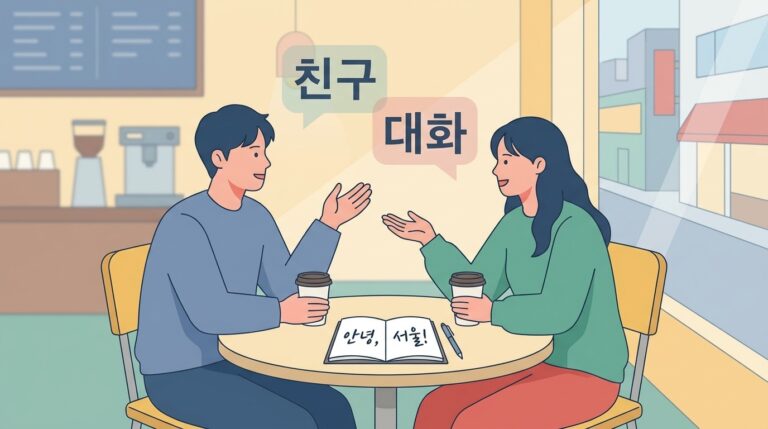
The MBTI Craze: Decoding Korea’s Quest for Belonging
Phase 1: Empathy (Story-Immersive Opening)
안녕하세요! 매일한글 에디터입니다. (Annyeonghaseyo! It is your Daily Hangul editor.)
Picture this: You are sitting in a dimly lit, industrial-chic natural wine bar in Euljiro, surrounded by lively chatter and the clinking of glasses. You have just been introduced to a group of sophisticated Korean professionals in their late twenties and early thirties. You exchange polite introductions, take a sip of your drink, and before you can even delve into your career or artistic pursuits, someone leans forward with intense, glittering curiosity and asks: “혹시… MBTI가 어떻게 되세요?” (Hoksi… MBTI-ga eotteoke doeseyo? / “By any chance… what is your MBTI?”)
If you come from a culture where Myers-Briggs typologies are relegated to forgotten corporate seminars or mid-2000s internet forums, this ubiquitous line might feel surprisingly invasive—or even juvenile. Yet in modern South Korea, MBTI is neither a trivial parlor game nor mere pseudoscience; it is a hyper-efficient socio-psychological framework. It operates as an existential shorthand in a hyper-dense, high-context society where people crave psychological safety, instant communal alignment, and an excuse to reveal their true vulnerabilities without violating strict social hierarchies (nunchi).
As advanced C2 learners, mastering conversational Korean requires venturing past sterile syntactic precision. You must decipher the implicit subtext of human relationships (ingwan-gwangye). Drawing from over a decade of fieldwork and direct pedagogical insights from advanced international learners in Seoul, this guide unpacks the psychological machinery behind Korea’s typology craze. By internalizing these idiomatic blueprints, you will navigate social gatherings with profound cultural literacy, effortlessly decoding boundaries, belonging, and emotional wavelengths.
Phase 2: Core Expressions (Deep Dive)
1. 결이 맞다 (Gyeori matda)
- Pronunciation: [Gyeo-ri mat-da] (Think of gyeol like the soft ‘curl’ of natural wood grain, followed by mat-da, similar to ‘mot-dah’).
- Meaning: Literally “the grain aligns”; nuance: to share an innate psychological, emotional, or philosophical wavelength.
- K-Culture Moment: Frequently heard on thoughtful observational reality series like Heart Signal (하트시그널) or Transit Love (환승연애), when participants explain why they felt an instinctive, unforced intimacy with someone.
- Editor’s Insight: While textbook Korean encourages phrases like “성격이 비슷하다” (Seonggyeogi biseuthada / “Our personalities are similar”), native speakers at a C2 level use gyeol. It borrows from woodworking: when two pieces of timber share identical grain (gyeol), they can be joined seamlessly without sanding or resistance. In Korean MBTI discourse, people often say, “우린 MBTI는 정반대인데, 은근히 결이 맞아” (Urin MBTI-neun jeongbandae-inde, eungeunhi gyeori maja / “Our MBTIs are total opposites, yet our underlying emotional textures align effortlessly”).
- Situation Spectrum: Casual ✅ | Semi-formal ✅ | Formal ⚠️
- 🤔 Think About It: Does your native tongue distinguish between superficial behavioral similarity and deep, aesthetic/emotional harmony like the concept of gyeol?
2. 선을 긋다 (Seoneul geutda)
- Pronunciation: [Seo-neul geut-da] (Pronounce seon like ‘sun’ in sunlight, and geut-da like ‘good-tah’ with an unreleased ‘t’).
- Meaning: Literally “to draw a line”; nuance: to delineate an emotional boundary or keep someone at a psychological distance.
- K-Culture Moment: In the hit drama My Liberation Notes (나의 해방일지), characters constantly struggle with invisible societal thresholds and the psychological strain of maintaining polite boundaries against workplace intrusions.
- Editor’s Insight: In South Korea’s hyper-relational ecosystem, stating “I need space” can sound aggressive or socially disruptive. Typology categories like “극 I” (extreme Introvert) or “T 성향” (analytical Thinking type) serve as polite armor. Instead of bluntly rejecting someone, people weaponize typology to rationalize boundary-drawing without causing interpersonal rupture: “제가 극 I라서 선을 긋는 게 아니라, 에너지가 방전돼서 그래요” (Jega geuk I-raseo seoneul geunneun ge anira, eneojiga bangjeondwaeseo geuraeyo / “It’s not that I’m drawing a boundary; my battery is just drained”).
- Situation Spectrum: Casual ✅ | Semi-formal ✅ | Formal 🚫
- 🤔 Think About It: How does utilizing personality typology mitigate the tension between individual autonomy and communal obligations in your own culture?
3. 과몰입하다 (Gwamoriphada)
- Pronunciation: [Gwa-mo-rip-ha-da] (Blend gwa like ‘gua-camole’, mo-rip like ‘more-leap’, and ha-da).
- Meaning: Literally “to hyper-immerse”; nuance: to be obsessively invested or reading too deeply into a conceptual framework.
- K-Culture Moment: Widely utilized in YouTube variety content featuring groups like BTS or SEVENTEEN, where members jokingly mock themselves for dissecting everyday interpersonal conflicts entirely through the lens of cognitive functions.
- Editor’s Insight: While morip (immersion) carries a positive connotation in art or study, adding the prefix gwa- (hyper-/over-) brings a self-deprecating self-awareness. When Koreans analyze someone’s romantic failures or communication blocks using MBTI for two hours straight, someone inevitably chuckles: “우리 너무 과몰입하는 거 아니야?” (Uri neomu gwamoriphaneun geo aniya? / “Aren’t we getting way too overly invested in this?”). It provides psychological relief by acknowledging the absurdity of labeling human complexity.
- Situation Spectrum: Casual ✅ | Semi-formal ✅ | Formal 🚫
- 🤔 Think About It: What mechanisms does your culture use to laugh at its own societal trends before they turn dogmatic?
Phase 3: Textbook Korean vs. Real Korean
Situation 1: Analyzing an acquaintance’s detached interpersonal behavior
- 📖 교과서 한국어 (Textbook): “그 사람은 감정 공감 능력이 부족하고 지나치게 이성적입니다.” (Geu sarameun gamjeong gonggam neungryeogi bujokhago jinachige iseongjeogimnida. / “That person lacks emotional empathy and is excessively rational.”)
- 🗣️ 진짜 한국어 (Real-World C2): “그 친구 완전 극 T 성향이라, 상황을 너무 인과관계로만 풀어내더라고요.” (Geu chingu wanjeon geuk T seonghyang-ira, sanghwangeul neomu ingwagwangyero-man pureonaedeoragoyo. / “He is an extreme T-type; he deconstructs emotional situations purely through cold cause-and-effect.”)
- 💡 왜 다를까? (Cultural Mechanics): Declaring someone emotionally deficient (gonggam neungryeok bujok) is a harsh interpersonal indictment in Korea. Framing analytical detachment through “T 성향” (Thinking trait) softens the judgment into an innate cognitive style rather than a character flaw.
Situation 2: Expressing mutual synergy with a collaborator
- 📖 교과서 한국어 (Textbook): “우리는 상호 보완적인 성격을 가지고 있어서 협력이 잘 됩니다.” (Urineun sangho bowanjeogin seonggyeogeul gajigo isseoseo hyeomnyeogi jal doemnida. / “We have complementary personalities, so our cooperation goes well.”)
- 🗣️ 진짜 한국어 (Real-World C2): “우리 둘이 티키타카도 잘 맞고, 업무 스타일에서 상호보완적 시너지가 확실해요.” (Uri duri tiki-takado jal matgo, eonmu seutail-eseo sanghobowanjeok sineojiga hwaksilhaeyo. / “Our conversational rapid-fire banter clicks, and there is unmistakable complementary synergy in our workflow.”)
- 💡 왜 다를까? (Cultural Mechanics): Modern conversational Korean integrates kinetic loanwords like tiki-taka (rapid, rhythmic dialogue) to describe dynamic interpersonal cadence, elevating functional business relationships into personal rapport.
Phase 4: K-Culture Deep Dive & Non-Verbal Manners
4-1. 눈치 (Nunchi) & Gestural Dynamics: The Subconscious Scan
When MBTI is broached at a Korean dinner table, the non-verbal dialogue is far more intense than the spoken words. Notice the micro-movements: Koreans rarely proclaim their MBTI with rigid, boastful posture. Instead, they slightly tilt their head, offer an ambiguous smile, and modulate their tone downward with modest hesitation: “저… 사실 INFP인데, 의외라고들 하세요” (Jeo… sasil INFP-inde, uioeragodeul haseyo / “I am actually an INFP, though people often say it’s unexpected”).
This humility test prevents appearing self-absorbed. If someone guesses your type correctly, the culturally appropriate response is not a dry confirmation, but an energetic, hand-covering-mouth gesture of astonishment accompanied by: “소름 돋았어요! 어떻게 아셨어요?” (Soreum dodasseoyo! Eotteoke asyeosseoyo? / “I got goosebumps! How did you know?”). The physical act of leaning slightly inward signals shared membership in the cognitive tribe.
4-2. Cultural Code Analysis: From Blood Types to Cognitive Tribes
In the early 2000s, Korean interpersonal taxonomy was dominated by the four ABO blood groups (hyeol-aek-hyeong). Type B men were branded as emotionally volatile charmers, while Type A individuals were stereotyped as cautious and timid. MBTI is the intellectualized, democratic successor to this phenomenon.
In a hyper-compressed, competitive society where youth face demanding corporate tracks and social fragmentation, MBTI serves as an antidote to existential alienation. It allows Koreans to find their 소속감 (sosokgam / sense of belonging) within 16 universally recognized archetypes. It legitimizes eccentricities: one is not socially dysfunctional; one is simply an “INTP operating in a high-density sensory environment.” It creates an instant relational bridge where shared traits override hierarchical barriers of age (na-i) and academic background (hakbeol).
Phase 5: Real-World Roleplay Scenario
Setting: A hip rooftop bar overlooking the urban skyline of Seongsu-dong. After completing a demanding cross-departmental brand campaign, Min-woo (a sharp, data-driven Product Lead) and Hye-jin (a vibrant, intuitive Creative Director) unwind with craft beer.
- 민우: 혜진 님, 이번 캠페인 론칭하느라 진짜 고생 많으셨어요. (Hyejin nim, ibeon kaempein ronchinghaneura jinjja gosaeng maneusyeosseoyo. / “Hye-jin, you truly went through so much launching this campaign.”)
🎭 [맥주잔을 부딪히며 피로가 풀린 듯 엷은 미소를 띤다 / Clinks beer glasses, smiling faintly with palpable relief] - 혜진: 민우 님이 데이터 트래킹을 빈틈없이 잡아주신 덕분이죠! 역시 완벽주의 J 성향 다우세요. (Min-woo nimi de-iteo teuraekingeul binteumeopsi jabajusin deokbun-ijyo! Yeoksi wanbyeokjuui J seonghyang dauseyo. / “It is entirely thanks to your flawless data tracking, Min-woo! Truly characteristic of a perfectionist J-type.”)
🎭 [눈을 반짝이며 두 손으로 잔을 모아 쥐며 화답한다 / Eyes sparkling, cupping her glass with both hands in warmth] - 민우: 하하, 그런가요? 근데 저 사실 일할 때만 계획적이지, 사생활은 거의 무체계에 가까워요. (Haha, geureongayo? Geunde jeo sasil ilhal ttaeman gyehoekjeogiji, sasaenghwareun geoui muchegye-e gakkawoyo. / “Haha, is that so? Honestly, I am only planned at work; my personal life verges on utter chaos.”)
🎭 [머리를 긁적이며 멋쩍은 듯 안경을 고쳐 쓴다 / Scratches head, readjusting his glasses with self-deprecating bashfulness] - 혜진: 맞아요, MBTI로 사람을 다 규정할 순 없죠. 그래도 민우 님이랑 일하면 감정 소모가 없어서 편해요. (Majayo, MBTI-ro sarameul da gyujeonghal sun eopjyo. Geuraedo Min-woo nim-irang ilhamyeon gamjeong somoga eopseoseo pyeonhaeyo. / “Indeed, we can’t define someone entirely by MBTI. Still, working with you is peaceful because there is zero emotional friction.”)
🎭 [진지한 눈빛으로 민우를 응시하며 가볍게 턱을 괸다 / Rests her chin on her hand, gazing with sincere professional regard] - 민우: 다행이네요. 가끔 제 피드백이 너무 직설적이라 상대방이 선을 긋는 느낌을 받을까 봐 신경 쓰이거든요. (Dahaeng-ineyyo. Gakkeum je pideubaegi neomu jikseoljeog-ira sangdaebangi seoneul geunneun neukkimeul badeulkka bwa singyeong sseuigeodeunyo. / “What a relief. Sometimes I worry my feedback is too direct, making people feel the urge to draw a boundary with me.”)
🎭 [조심스러운 어조로 말끝을 흐리며 상대의 반응을 살핀다 / Softens his tone carefully, observing her reaction through subtle nunchi] - 혜진: 전혀요! 오히려 명확해서 좋아요. 우리 비록 성격 코드는 달라도, 본질적인 결은 통하잖아요. (Jeonhyeoyo! Ohiryeo myeonghwakhaeseo joayo. Uri birok seonggyeok kodeuneun dallado, bonjiljeogin gyeoreun tonghajanayo. / “Not at all! Its clarity is refreshing. Even if our personality codes differ, our fundamental wavelengths align.”)
🎭 [손사래를 치며 민우의 염려를 경쾌하게 불식시킨다 / Waves her hand dismissively, cheerily clearing his lingering anxiety] - 민우: 그렇게 말씀해 주시니 든든합니다. 다음 프로젝트 때도 우리 합을 믿고 가시죠. (Geureoke malsseumhae jusini deundeunhamnida. Daeum peurojekteu ttaedo uri habeul mitgo gasijo. / “Hearing you say that is deeply reassuring. Let’s trust our synergy for the next project as well.”)
🎭 [한결 편안해진 표정으로 맥주를 시원하게 들이켠다 / Takes a refreshing sip of beer, his posture completely relaxed] - 혜진: 당연하죠! 오늘은 과몰입 토크 접고, 성수동 야경이나 제대로 즐겨요! (Dang-yeonhajo! Oneureun gwamorip tokeu jeopgo, Seongsu-dong yagyeong-ina jedaero jeulgyeoyo! / “Without question! Let’s shelve this over-analytical talk tonight and appreciate the Seongsu skyline!”)
🎭 [테라스 밖 도심 야경을 활짝 가리키며 밝게 웃는다 / Laughs brightly, gesturing toward the gleaming city lights beyond the terrace]
🔀 Interactive Branching Choice
How would you step into this conversation if Hye-jin turned to you and asked how you balance analytical feedback and interpersonal harmony?
- Choice A (Best): “저도 예전엔 직설 화법 때문에 오해를 샀는데, 요즘은 상대방의 결을 먼저 파악하려고 노력해요.” (Jeodo yejeonen jikseol hwabeop ttaemune ohaereul sanneunde, yojeumeun sangdaebang-ui gyeoreul meonjeo pa-akharyeogo noryeokhaeyo. / “I used to cause misunderstandings with blunt speech, but nowadays I make an effort to gauge the other person’s wavelength first.”)
Feedback: Exceptional. Uses idiomatic C2 phrasing (gyeoreul pa-akhada) while demonstrating emotional intelligence, blending self-reflection with Korean relational nuance. - Choice B (Bad): “MBTI는 비과학적인 유사과학이니까 직관보다는 통계에 기반한 평가 툴을 써야 합니다.” (MBTI-neun bigwahakjeogin yusagwahag-inikka jikgwanbodaneun tonggye-e gibanhan pyeongga tureul sseoya hamnida. / “Since MBTI is unscientific pseudoscience, we must use statistical evaluation tools rather than intuition.”)
Feedback: Relational Suicide. Extremely rigid and tactless. It halts the emotional flow (heureum) and creates severe friction in a relaxed social setting. - Choice C (Risk): “저는 T 성향 사람들과는 사적으로 절대 안 맞아서, 일할 때만 선을 긋고 대화해요.” (Jeoneun T seonghyang saramdeulgwaneun sajeogeuro jeoldae an majaseo, ilhal ttaeman seoneul geutgo daehwahaeyo. / “I personally never click with T-types, so I consciously draw a boundary and speak only about work.”)
Feedback: High Risk. While culturally fluent in slang, it sounds overtly exclusionary and directly invalidates Min-woo, who just identified as a T-type.
Phase 6: 10-Second Emotion Shadowing Drill
Internalize native cadence by shadowing these emotional inflection points. Focus on the pitch drop after pauses (/).
[😌 깊은 안도와 잔잔한 공감을 담아 / With profound relief and gentle empathy]
“우리 비록 / 성격 코드는 달라도, / 본질적인 결은 / 통하잖아요.”
(Uri birok / seonggyeok kodeuneun dallado, / bonjiljeogin gyeoreun / tonghajanayo.)-
[😂 능청스럽고 장난기 어린 자조를 섞어 / With mischievous, playful self-deprecation]
“우리 지금 / 아무 의미 없는 알파벳 네 글자에 / 너무 과몰입하는 거 / 아니에요?”
(Uri jigeum / amu uimi eomneun alpabet ne geulja-e / neomu gwamoriphaneun geo / anieyo?) -
[🤔 조심스러우면서도 배려심 깊은 태도로 / With cautious, considerate contemplation]
“혹시 제 피드백 때문에 / 마음속으로 / 선을 긋고 계셨던 건 / 아니죠?”
(Hoksi je pideubaek ttaemune / ma-eumsogeuro / seoneul geutgo gyesyeotdeon geon / anijyo?)
Phase 7: K-Culture Mini Dictionary
- 과몰입 (Gwamorip) | Hyper-Fixation / Over-Immersion
Originally referring to deep absorption in dramatic plotlines, it now designates anyone who analyzes daily interactions or relationships through a singular conceptual lens (e.g., “MBTI 과몰입러”). - 결 (Gyeol) | Relational Texture / Innate Wavelength
The intrinsic pattern of wood, water, or fabric. In psychological contexts, it denotes unquantifiable compatibility where two individuals coexist without relational friction. - T발 너 C야? (T-bal neo C-ya?) | Are you crazy insensitive? (Playful Wordplay)
A viral Korean internet portmanteau blending the MBTI trait “T” (analytical/rational) with a Korean expletive, humorously softened into “C” (sounding like “see”). Used among close peers when someone gives an overly analytical, heartless response to emotional distress. - 인싸 vs. 아싸 (Inssa vs. Assa) | Insider (Extrovert) vs. Outsider (Introvert)
Truncations of “Insider” and “Outsider.” In typology discourse, this binary categorizes how people recharge energy in community environments, often paired with the MBTI letters E and I.
Phase 8: Survival Kit for Travelers
Top 3 Social Survival Expressions
- “제가 낯을 좀 가려서 그런데, 기분 나빠하지 마세요.”
Pronunciation: [Jega nacheul jom garyeoseo geureonde, gibun nappa-haji maseyo.]
Pro Tip: Perfect for introverts entering a new group. It signals shyness rather than cold aloofness, disarming the room instantly. - “우리는 성향이 정반대라 오히려 더 잘 맞는 것 같아요.”
Pronunciation: [Urineun seonghyang-i jeongbandaera ohiryeo deo jal manneun geot gatayo.]
Pro Tip: Use this to charm conversation partners when your typologies directly clash. - “그건 성격 탓이 아니라, 누구나 그 상황이면 그랬을 거예요.”
Pronunciation: [Geugeon seonggyeok tasi anira, nuguna geu sanghwang-imyeon geuraesseul geoyeyo.]
Pro Tip: The ultimate empathetic compliment (gonggam), removing blame from typology and normalizing their reaction.
Editor’s Travel Note: Navigating Social Seoul
Before diving into Seoul’s bustling social landscape, install the essential local apps. International Google Maps lacks walking route accuracy; secure the Naver Map App Download to find hidden speakeasies in Euljiro or Seongsu-dong effortlessly. For local restaurant reservations, check out the CatchTable Dining Reservation Portal to book social hotspots where young Seoulites congregate. T-Money transit cards remain essential for seamless transit across Seoul’s subway and buses; grab one at any convenience store upon landing at Incheon International Airport.
Phase 9: A Step Deeper (Sociological Reflection)
In an ultra-modern society characterized by blistering structural speed and hyper-dense urban environments, loneliness often disguises itself as social efficiency. The South Korean obsession with MBTI is fundamentally an architectural blueprint for psychological safety. In traditional communal Korea, belonging was geographically and familial-bound through jeong (정); in the contemporary metropolis, it has transformed into cognitive self-sorting. By displaying our cognitive letters like social nametags, we implicitly tell strangers: “Here is my operating manual; handle my boundaries with care, and grant me grace within our shared space.”
💬 Your Turn: Does your home society have an equivalent taxonomy for belonging, or do you view social profiling as a hindrance to true intimacy? Share your reflections in the comments below!
Phase 10: FAQ & Common Mistakes
Q: Why do Korean recruiters and dating app profiles ask for MBTI?
A: In corporate and romantic contexts, MBTI functions as an immediate behavioral heuristic. While controversial, recruiters seek insight into organizational communication styles (e.g., leadership versus execution focus), while daters use it to avoid predictable interpersonal friction before investing emotional labor.
Q: Is it considered rude to refuse to disclose my MBTI in Korea?
A: Refusing bluntly can appear standoffish. Instead of stating “I do not believe in it,” playfully deflect: “검사할 때마다 바뀌어서 저도 제 유형을 잘 모르겠어요!” (Geomsahal ttaemada bakkwieoseo jeodo je yuhyeongeul jal moreugesseoyo! / “It changes every time I take it, so I barely know my own type!”).
Q: How did MBTI replace the older blood type personality trend?
A: Blood types offered only four fatalistic, biologically deterministic boxes. MBTI’s 16-point matrix offers an illusion of nuanced scientific rigor and individual agency, satisfying both the collectivist desire for grouping and the modern individual’s thirst for self-expression.
🚨 Common Mistakes Warning Board
- Mistake 1: Treating MBTI as definitive rather than conversational.
Incorrect: “당신은 F 유형이니까 비판적 사고를 못 하시네요.” (Telling someone they lack critical thinking because they are an ‘F’.)
Correct Action: Use typology strictly as playful social currency, never as an intellectual evaluation. - Mistake 2: Confusing ‘선 긋기’ (drawing boundaries) with open hostility.
Incorrect: Confronting someone aggressively when they seek personal space.
Correct Action: Recognize it as self-preservation in a high-contact culture. Respect the boundary gracefully. - Mistake 3: Stiff literal translations of empathy.
Incorrect: Translating “I understand your pain” into archaic, literary terms like “당신의 고통을 이해합니다.”
Correct Action: Use natural, conversational validation: “완전 마음고생 심하셨겠어요” (Wanjeon ma-eumgosaeng simhasyeokgesseoyo / “Your heart must have suffered so much”).
Phase 11: Action Missions
- 🥉 Bronze Mission (Solo Shadowing): Stand before a mirror and practice the 3 expressions from Phase 6, mirroring the facial micro-expressions and tonal drops. Record your voice on your phone to confirm your pitch contour.
- 🥈 Silver Mission (Social Exploration): Go to a Korean social media account (Instagram, Threads, or YouTube) of your favorite celebrity. Search the comments for terms like “과몰입”, “극 I”, or “결이 맞다” and observe how native speakers deploy them contextually.
- 🥇 Gold Mission (Live Interaction): At your next language exchange or dinner with Korean friends, introduce the phrase “우리 은근히 결이 잘 맞는 것 같아요” (Uri eungeunhi gyeori jal manneun geot gatayo) after a shared moment of laughter. Observe how their demeanor shifts.
🎮 K-Culture Mission: Watch an episode of a modern dating reality show like Transit Love (환승연애) or a talk show like IU’s Palette (아이유의 팔레트). Count how many times MBTI terminology is used as a linguistic catalyst to build rapport.
Phase 12: Interactive Quiz Challenge
Test your situational mastery and cultural intuition below.
1. Situational Judgment
A colleague appears exhausted after an all-company workshop and sits alone by the window. You want to validate their emotional state without pressuring them to socialize. Which statement demonstrates superior cultural nuance?
* (A) “왜 혼자 계세요? 팀워크를 위해 어서 들어오세요.” (Wae honja gyeseyo? Timeowokeureul wihae eoseo deureo-oseyo.)
* (B) “에너지 방전되셨죠? 극 I 성향 존중하니까 편하게 쉬세요.” (Eneoji bangjeondoesyeotjyo? Geuk I seonghyang jonjunghanikka pyeonhage swiseyo.)
* (C) “MBTI 성격 검사를 다시 해보시면 사회성이 개선될 거예요.” (MBTI seonggyeok geomsareul dasi haebosimyeon sahoeseong-i gaeseondoel geoyeyo.)
2. Fill-in-the-Blank
Complete the sentence to express deep intuitive alignment beyond personality categorization:
“우리는 성격 유형은 정반대이지만, 대화를 나눌수록 내면의 ( )이/가 통한다는 걸 느껴요.”
3. Cultural True or False
True or False: In Korea, referring to someone as a “T-type” in response to personal sorrow implies they gave a wonderfully compassionate, comforting answer.
Click here for answers & detailed explanations
-
Correct Answer: (B)
Explanation: Option B uses the typology framework compassionately (“극 I 성향 존중”) to grant psychological permission to rest. Option A exerts forceful collectivist pressure, while Option C is insulting. -
Correct Answer: 결 (Gyeol)
Explanation: Gyeol denotes intrinsic texture and mutual emotional harmony that transcends superficial categorization. -
Correct Answer: False
Explanation: Highlighting someone as “T” (Thinking) suggests their response was overly logical, pragmatic, or dryly analytical rather than offering the expected emotional empathy (F / Feeling).







