

Phase 1: Empathy (Welcome to Your First Korean Lease!)
안녕하세요! 매일한글 에디터입니다. (Hello! It’s your Daily Hangul editor here!)
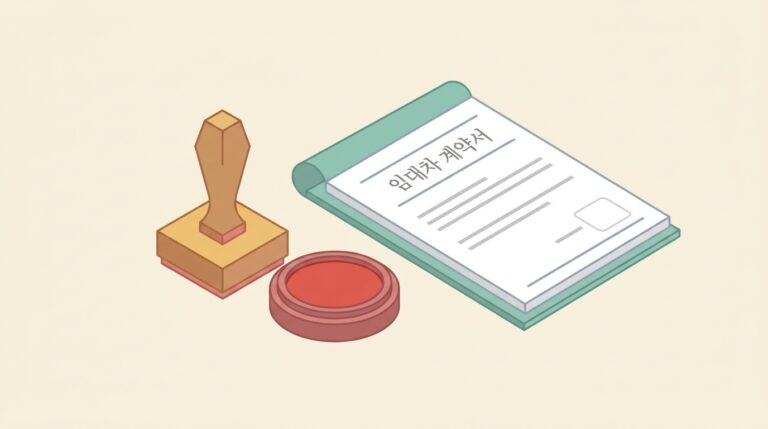
Imagine this classic K-Drama scene: You have finally found the perfect cozy rooftop apartment in Seoul—just like the ones you see in your favorite romance dramas. You are sitting at a low wooden desk in a local real estate office (부동산), sipping a warm paper cup of sweet Maxim instant coffee provided by a cheerful neighborhood realtor. Everything feels magical until the realtor pulls out a crisp, two-page lease agreement, taps a round red box on the desk, and turns to you expecting a 도장 (dojang – personal seal/stamp).
Suddenly, your mind goes blank. Wait, do I need an official wooden stamp to rent a room? Can I just use a ballpoint pen? What if I press it upside down?
Don’t worry! In over a decade of guiding newcomers through Korean culture, this exact moment is where 90% of beginners freeze up. Today, we will break down the essential words, physical etiquette, and simple survival phrases so you can seal your Korean contract with 100% confidence.
Phase 2: Core 3 Expressions Deep-Dive
1. 여기에 도장 찍어 주세요. (Yeogie dojang jjigeo juseyo.)
- Pronunciation: [Yeo-gi-e do-jang jji-geo ju-se-yo] (Pronunciation tip: “jji-geo” sounds like firmly dipping a chip into salsa with a punchy ‘double-j’ sound!)
- Meaning: “Please stamp your seal here.” (Literal: In this place / seal / press / please give)
- K-Culture Moment: You will hear this exact sentence in every moving-in episode of Korean slice-of-life dramas when the main character signs their very first studio lease.
- Editor’s Insight: The verb 찍다 (jjikda) means to stamp, print, or even snap a picture. In contract settings, it always refers to putting red ink to paper with a seal.
- Situation Spectrum:
- Casual: 🚫
- Semi-formal (Polite): ✅
- Formal (Business/Legal): ✅
- 🤔 Think About It: In many Western countries, a handwritten signature is the ultimate proof of identity. Why do you think physical carved seals are still so deeply cherished in Korea?
2. 도장이 없어요. (Dojangi eopseoyo.)
- Pronunciation: [Do-jang-i eop-seo-yo] (Pronunciation tip: “eop-seo-yo” sounds like ‘up-saw-yo’ spoken quickly and smoothly!)
- Meaning: “I don’t have a stamp.” (Literal: Stamp / does not exist)
- K-Culture Moment: When an exchange student visits a bank or real estate agency for the first time and nervously pats their empty pockets.
- Editor’s Insight: Don’t panic when saying this! Real estate agents hear this from foreigners every single week. Saying it calmly and clearly prompts the agent to offer the signature alternative right away.
- Situation Spectrum:
- Casual: ⚠️ (Only with friends)
- Semi-formal (Polite): ✅
- Formal: ✅
- 🤔 Think About It: How do you usually express that you lack a formal tool in your home country? Notice how Korean simply states existence or non-existence (있어요 / 없어요).
3. 싸인해도 돼요? (Ssain-haedo dwaeyo?)
- Pronunciation: [Ssain-hae-do dwae-yo?] (Pronunciation tip: “Ssain” sounds just like the English word ‘sign’, and “dwae-yo” rhymes with ‘way-yo’.)
- Meaning: “May I sign instead?” (Literal: Even if I sign, is it okay?)
- K-Culture Moment: A busy freelancer sitting across an office desk asking if a quick pen signature will suffice instead of digging through their bag for a seal.
- Editor’s Insight: The word 싸인 (ssain) is a classic Korean loanword. While the pure Korean word for signature is 서명 (seomyeong), almost everyone uses 싸인 in spoken conversation.
- Situation Spectrum:
- Casual: ⚠️
- Semi-formal (Polite): ✅
- Formal: ✅
- 🤔 Think About It: Korean often uses “~해도 돼요?” (May I do ~?) to politely ask permission. How does this compare to asking “Can I…?” in English?
Phase 3: Textbook Korean vs. Real Korean
Situation 1: Asking where to stamp
- 📖 교과서 한국어 (Textbook Korean): 계약서의 어느 란에 날인해야 합니까? (Gyeyakseoui eoneu rane narinhaeya hamnikka? – “On which column of the contract should I affix my seal?”)
- 🗣️ 진짜 한국어 (Real Korean): 어디에 찍어요? (Eodie jjigeoyo? – “Where do I stamp it?”)
- 💡 Why the difference?: The legal textbook term 날인 (narin) is rarely spoken aloud by regular people. Native speakers simply point and use the basic question word 어디 (where) + 찍어요 (stamp).
Situation 2: Confirming if a signature works
- 📖 교과서 한국어 (Textbook Korean): 서명으로 대체할 수 있습니까? (Seomyeongeuro daechehal su itseumnikka? – “Is it permissible to substitute with a signature?”)
- 🗣️ 진짜 한국어 (Real Korean): 그냥 싸인해도 돼요? (Geunyang ssain-haedo dwaeyo? – “Can I just sign?”)
- 💡 Why the difference?: Adding 그냥 (geunyang – just / simply) softens your speech instantly, turning a stiff legal inquiry into a natural, friendly question.
Phase 4: K-Culture Deep Dive & Non-Verbal Manners
4-1. 눈치 (Nunchi) & Physical Etiquette
- The Two-Hand Rule: When the agent hands you the ink pad (인주) or the paper, always receive it with both hands or with your left hand supporting your right wrist. This shows respect.
- Checking the Orientation: Korean stamps have a small groove or a dot indicating the “top.” Always feel for the notch before inking! Stamping someone’s name upside down on an official contract is considered bad luck and careless.
- The Steady Press: Do not smash the stamp down. Gently tap it on the red ink pad 2–3 times, align it neatly next to your printed name, and press straight down firmly using both index fingers for 2 seconds. No wiggling, or the ink will blur!
4-2. Cultural Insight: The Weight of Red Ink
In historical K-dramas (사극), the king’s royal seal (옥새, oksae) carried absolute power. Even today, Koreans treat the physical seal as a symbol of personal accountability. While ordinary rental contracts (임대차 계약) legally permit signatures (서명), many traditional landlords still feel safer seeing red ink on the paper. Making your own custom wooden seal at an artisan shop in Insadong is both a fun cultural souvenir and a practical tool for living in Korea!
Phase 5: Real-Life Roleplay Scenario
- Setting: Inside “Haengbok Real Estate” (행복부동산) near Sinchon Station.
- Characters:
- Realtor Park (공인중개사 박 사장님): A warm, middle-aged agent wearing reading glasses, holding a green ballpoint pen.
- You: A foreign resident finalizing your one-room studio lease.
- Realtor Park: 자, 여기가 계약서예요. (Ja, yeogiga gyeyakseoyeyo.)
🎭 Action: Slides the final contract across the desk and points at the bottom row.
*Translation: “Well, here is the contract.” -
You: 네, 확인했어요. (Ne, hwaginhaesseoyo.)
🎭 Action: Nods politely while scanning your name and deposit amount.
*Translation: “Yes, I checked it.” -
Realtor Park: 여기에 도장 찍어 주세요. (Yeogie dojang jjigeo juseyo.)
🎭 Action: Opens a small red ink pad and taps the spot marked (인).
*Translation: “Please stamp your seal right here.” -
You: 저… 도장이 없어요. (Jeo… dojangi eopseoyo.)
🎭 Action: Apologetically shows empty hands with a soft smile.
*Translation: “Um… I don’t have a stamp.” -
Realtor Park: 아, 도장 없으세요? 괜찮아요! (A, dojang eopseuseyo? Gwaenchanhayo!)
🎭 Action: Chuckles warmly and clicks his ballpoint pen.
*Translation: “Ah, you don’t have one? That is totally okay!” -
You: 싸인해도 돼요? (Ssain-haedo dwaeyo?)
🎭 Action: Gestures a writing motion politely.
*Translation: “May I sign instead?” -
Realtor Park: 네, 여기에 정자로 이름 쓰시고 싸인하세요. (Ne, yeogie jeongjaro ireum sseusigo ssainhaseyo.)
🎭 Action: Hands over the pen with two hands.
*Translation: “Yes, write your full name clearly here and add your signature.” -
You: 감사합니다! 여기에 쓸게요. (Gamsahamnida! Yeogie sseulgeyo.)
🎭 Action: Carefully prints name and signs with two hands steadying the paper.
*Translation: “Thank you! I will write it here.”
🔀 Interactive Decision Point
The realtor asks you to stamp, but you don’t have a seal. What do you do?
- Option A: Wave your hands, say “No stamp!” in English, and pull out your passport.
- Feedback (Bad): The agent might get confused about what you are trying to verify. Stick to simple Korean!
- Option B: Calmly say, “도장이 없어요. 싸인해도 돼요?” (Dojangi eopseoyo. Ssainhaedo dwaeyo?)
- Feedback (Best): Natural, polite, and directly solves the issue in seconds. The agent will gladly hand you a pen.
- Option C: Just scribble your signature right over the red stamp box without saying anything.
- Feedback (Risk): Rushing without asking permission can look abrupt or smudge legal lines where your printed legal name is required.
Phase 6: 10-Second Emotion Shadowing Drill
Repeat these 3 lines out loud using the emotional guidance and rhythm marks (/ = pause):
[🥺 Slightly shy & apologetic]
저… / 도장이 / 없어요.
(Jeo… / do-jang-i / eop-seo-yo.)-
[🤔 Polite & inquiring]
혹시 / 싸인해도 / 돼요?
(Hok-si / ssain-hae-do / dwae-yo?) -
[😊 Bright & confident]
네! / 여기에 / 찍을게요.
(Ne! / yeo-gi-e / jji-geul-ge-yo. – “Yes! I will stamp it here.”)
Phase 7: K-Culture Mini Dictionary
- 도장 (Dojang): A personal name seal carved from wood, stone, or acrylic. Essential for contracts, traditional banking, and legal documents.
- 인주 (Inju): The thick, bright crimson-red ink paste kept in small round containers specifically used for seals.
- 싸인 (Ssain): The colloquial loanword for a signature. In formal paperwork, you may also see the pure Korean word 서명 (Seomyeong).
- 부동산 (Bhudongsan): A licensed real estate agency in Korea, as well as the industry term for property and real estate.
Phase 8: Traveler & Expat Survival Kit
Top 3 Real Estate Survival Phrases
- 어디에 써요? (Eodie sseoyo?) – “Where do I write?”
Pro Tip: Perfect when you have the pen in hand and need the agent to point to the exact blank box. - 한 번 더 찍을게요. (Han beon deo jjigeulgeyo.) – “I will stamp it one more time.”
Pro Tip: Use this if your first stamp impression was too faint or missed a corner. - 계약서 복사본 주세요. (Gyeyakseo boksabon juseyo.) – “Please give me a copy of the contract.”
Pro Tip: Always keep a physical paper copy or clear smartphone photo for your residence registration.
Editor’s Practical Note
When navigating Korean neighborhoods to find rental agencies, foreign mapping services often lack up-to-date storefront data. Make sure to complete your Naver Map app download before apartment hunting, and type in 부동산 to find highly-rated local agencies right around your target subway station.
Phase 9: “One Step Deeper” (Cultural Reflection)
In our modern digital world of DocuSign and touchscreens, holding a physical stamp dipped in crimson paste feels like stepping back in time. In Korean society, the 도장 carries personal integrity; pressing your name into paper symbolizes taking complete, unshakeable responsibility for the agreement. It bridges centuries of communal trust with modern metropolitan living. When you press a seal onto your Korean lease, you aren’t just signing paperwork—you are literally stamping your presence into the fabric of Korean daily life.
💬 Your Turn: Does your home country still use personal seals or stamps for legal matters, or is everything digital now? Share your experience in the comments below!
Phase 10: FAQ & Common Mistakes
Q: Do foreign residents legally need a custom seal (도장) to rent an apartment in Korea?
A: No! Under current Korean housing law, a handwritten signature (서명) is 100% legally binding on standard residential lease contracts. However, telling the agent in advance helps avoid surprise.
Q: What is the difference between 막도장 (mak-dojang) and 인감도장 (ingam-dojang)?
A: A 막도장 is a cheap, casual everyday wooden stamp made in 5 minutes at any key/stamp shop. An 인감도장 is a registered legal seal certified at the local community center (주민센터) for major asset sales like buying a building or car.
Q: Can I use colored ink other than red for contracts?
A: Never. Official Korean seals must exclusively use traditional red stamp paste (인주). Black, blue, or green ink pads are only used for office work or play stamps.
🚨 Common Mistakes Warning Board
- Mistake: Stamping upside down.
Correct Action: Look for the small carved notch or small jewel on the side of the seal. That notch always faces UP. - Mistake: Twisting the stamp while pressing.
Correct Action: Press straight down like an elevator; twisting will smudge the delicate Chinese characters or Korean letters. - Mistake: Writing your signature across the agent’s name.
Correct Action: Always look for the character (인) or (서명) next to 임차인 (Tenant) before signing.
Phase 11: Action Missions
- 🥉 Bronze Mission: Stand in front of a mirror and practice saying: 도장이 없어요. 싸인해도 돼요? three times smoothly in under 10 seconds.
- 🥈 Silver Mission: Visit a stationary store or neighborhood market and spot a red 인주 container or a display of custom seals.
- 🥇 Gold Mission: Make your own personalized Hangul seal (도장) at an Insadong craft boutique and use it in your Korean notebook or real contract!
- 🎮 K-Culture Mission: Watch an episode of a Korean workplace or romance drama (like Because This Is My First Life) and spot the exact scene where the characters stamp their rental agreement!
Phase 12: Interactive Quiz Challenge
1. You are sitting at the real estate office and don’t have a personal seal. What is the most natural thing to say?
a) 도장 싫어요. (Dojang sileoyo.)
b) 도장이 없어요. 싸인해도 돼요? (Dojangi eopseoyo. Ssainhaedo dwaeyo?)
c) 종이 주세요. (Jongi juseyo.)
👉 Click to reveal Answer & Explanation
Answer: b)
도장이 없어요. 싸인해도 돼요? politely informs the agent that you don’t possess a stamp and requests permission to use a handwritten signature instead. Option a means “I hate stamps!” which would sound rude!
2. Fill in the blank:
여기에 도장 ________ 주세요. (Please stamp your seal here.)
a) 써 (sseo)
b) 찍어 (jjigeo)
c) 봐 (bwa)
👉 Click to reveal Answer & Explanation
Answer: b) 찍어 (jjigeo)
The verb for stamping a seal or pressing ink is 찍다 (jjikda), making the polite imperative form 찍어 주세요 (jjigeo juseyo).
3. True or False:
In Korea, it is legally mandatory for international tenants to carve a traditional stone seal to sign an apartment lease. (True / False)
👉 Click to reveal Answer & Explanation
Answer: False!
While seals are traditional and widely appreciated, handwritten signatures (서명/싸인) are completely legal for standard residential lease agreements.







