

The Ultimate Guide to Watching a Korean Wedding ‘Pyebaek’ Ceremony
Phase 1: Empathy (Story Immersion Opening)
안녕하세요! 매일한글 에디터입니다. (Hello! I’m your Daily Hangul editor.)
Picture this: You are dressed up at a sleek, ultra-modern wedding hall in Seoul. The western-style ceremony wraps up in just 30 whirlwind minutes, and everyone heads toward the buffet. But suddenly, your Korean friend leans in and whispers, “Hey, the bride and groom are heading to the Pyebaek room. Want to come sneak a peek?”
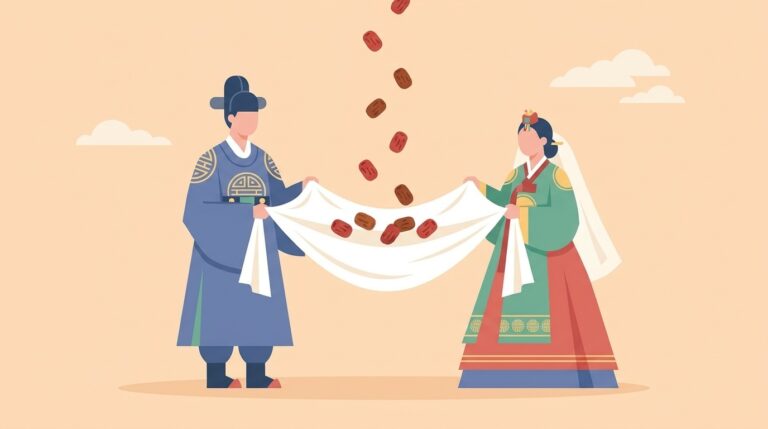
You walk into a quiet room tucked behind the banquet hall, and the atmosphere completely transforms. The modern white dress and tuxedo are gone. The couple is now wearing vibrant Joseon-dynasty royal garments (hwarot and gwanbok). Suddenly, the groom’s parents toss handfuls of red dates and chestnuts straight across a low table into a white silk cloth held by the newlyweds! You want to know what on earth is happening, ask polite questions, and compliment the couple without feeling like an awkward intruder.
Don’t worry—you are not alone. As an editor who has guided hundreds of intermediate learners through real-life cultural milestones, I’ve compiled this practical B1-level guide. By the end of this post, you’ll know exactly what to say, how to behave with impeccable nunchi (cultural tact), and how to enjoy this beautiful tradition with total confidence.
Phase 2: Core Expressions 3 Deep-Dive
1. 폐백 구경해도 돼요? (Pyebaek gugyeonghaedo dwaeyo?)
- Pronunciation: [Pye-baek goo-gyeong-hae-do dway-yo?] (Think of ‘Pye’ like ‘pie-eh’, and ‘dwaeyo’ like ‘dway-yo’.)
- Meaning: Literal: “Is it okay if I watch Pyebaek?” / Real Nuance: “May I respectfully observe the traditional ceremony from the back?”
- K-Culture Moment: Seen in classic K-dramas when foreign friends or close colleagues follow the family to the traditional ceremonial chamber after the main banquet.
- Editor’s Insight: The verb 구경하다 (gugyeonghada) means to watch or sightsee. Adding
-해도 돼요?softens the request into a polite, respectful inquiry suitable for guests who are not direct family members. - Situation Spectrum: Casual: ⚠️ | Semi-formal: ✅ | Formal: ✅
- 🤔 Think About It: In many Western weddings, private family traditions happen strictly behind closed doors. Why do you think Korean weddings often welcome friends to quietly observe the Pyebaek from the doorway?
2. 밤이랑 대추를 왜 던져요? (Bamirang daechureul wae deonjyeoyo?)
- Pronunciation: [Bahm-ee-rahng dae-choo-reul weh deon-jyeo-yo?]
- Meaning: Literal: “Why do you throw chestnuts and dates?” / Real Nuance: “What is the meaning behind throwing the chestnuts and jujubes?”
- K-Culture Moment: The iconic climax of the ceremony where the groom’s parents throw dates and chestnuts while the bride and groom catch them in the bride’s wide apron.
- Editor’s Insight: Dates (daechu) represent sons, while chestnuts (bam) symbolize daughters (and defense against evil). It’s a joyful, symbolic blessing for fertility and prosperity.
- Situation Spectrum: Casual: ✅ | Semi-formal: ✅ | Formal: ⚠️
- 🤔 Think About It: What symbolic foods or items are used in wedding rituals in your home country to wish fertility or wealth for the new couple?
3. 두 분 한복이 진짜 잘 어울려요! (Du bun hanbogi jinjja jal eoullyeoyo!)
- Pronunciation: [Doo boon han-bo-gee jeen-jja jal uh-ool-lyuh-yo!]
- Meaning: Literal: “The Hanbok really suits both of you!” / Real Nuance: “You two look stunning in your traditional Hanbok!”
- K-Culture Moment: The heartfelt compliment every Korean bride and groom loves to hear when they step out after changing into intricate traditional royal attire.
- Editor’s Insight: Du bun (두 분) is the honorific form of ‘two people’ (du saram). Using honorific pronouns when praising the couple shows high linguistic refinement at the B1 level.
- Situation Spectrum: Casual: ⚠️ | Semi-formal: ✅ | Formal: ✅
- 🤔 Think About It: How does switching to honorific nouns like bun (분) instead of myeong/saram alter the emotional warmth and respect in Korean culture?
Phase 3: Textbook Korean vs. Real Korean
Situation 1: Asking if you can stand by the door to watch
- 📖 교과서 한국어 (Textbook): “폐백 의식을 참관해도 되겠습니까?” (Pyoebaek uisigeul chamgwanhaedo doegesseumnikka? – May I participate as an observer in the Pyebaek ritual?)
- 🗣️ 진짜 한국어 (Real-Life): “저 혹시 뒤에서 살짝 구경해도 괜찮아요?” (Jeo hoksi dwieseo saljjak gugyeonghaedo gwaenchannayo? – Excuse me, is it okay if I just quietly watch from the back?)
- 💡 Why the difference? Words like 참관 (chamgwan – official observation) sound like a government audit! Natural spoken Korean uses friendly softeners like hoksi (by any chance) and saljjak (lightly/briefly).
Situation 2: Wishing them a happy family life
- 📖 교과서 한국어 (Textbook): “자손이 번창하시기를 진심으로 기원합니다.” (Jasoni beonchanghasigireul jinsimeuro giwonhamnida? – I sincerely pray for the prosperity of your descendants.)
- 🗣️ 진짜 한국어 (Real-Life): “대추 많이 받으셨네요! 행복하게 잘 사세요!” (Daechu mani badeusyeotneyo! Haengbokhage jal saseyo! – You caught so many dates! Wishing you a lifetime of happiness!)
- 💡 Why the difference? Archaic Confucian phrases sound distant. Modern guests celebrate the playful outcome of the date-tossing ritual and offer warm, genuine wishes.
Phase 4: K-Culture Deep Dive & Non-Verbal Manners
4-1. 눈치 (Nunchi) & Etiquette in the Pyebaek Room
- Mind the Threshold: Pyebaek rooms have tatami or silk-matted floors. Always take your shoes off at the entrance if you step inside, or remain standing quietly just outside the doorway sliding frame.
- Camera Etiquette: The professional wedding photographer has priority. Avoid stepping into their frame or holding your phone right in front of the parents. Keep your phone on silent!
- Quiet Appreciation: When the parents toss the chestnuts and dates, it’s customary to gasp and cheer softly (“와아~! 축하해요!”), matching the family’s laughter.
4-2. Cultural Code: The Royal Transformation
Originally, Pyebaek was an intimate Confucian ritual where the bride paid formal respects to the groom’s parents after moving into their household. In contemporary Korea, it has evolved into a fun, inclusive photo celebration honoring both sets of parents. The couple wears Hwarot (traditional bridal robe embroidered with peonies and phoenixes) and Gwanbok (official court attire for the groom)—symbolizing that for their wedding day, they are treated as nobility.
Phase 5: Real-Life Roleplay Scenario
Setting: Outside the traditional Pyebaek room at a modern wedding venue in Gangnam. Minji (the bride’s sister) notices you looking curious.
- Minji: “여기 폐백실이에요! 들어와서 구경해도 돼요.”
(Yeogi pyebaek-sil-ie-yo! Deureowaseo gugyeonghaedo dwaeyo.)
🎭 Smiling warmly and gesturing toward the room.
“This is the Pyebaek room! You can come in and watch.” -
You: “정말요? 제가 방해되는 건 아니죠?”
(Jeongmallyo? Jega banghaedoeneun geon anijyo?)
🎭 Stepping forward carefully with hands clasped politely.
“Really? I won’t be in the way, right?” -
Minji: “전혀요! 뒤쪽에 편하게 서서 보시면 돼요.”
(Jeonhyeoyo! Dwijjoge pyeonhage seoseo bosimyeon dwaeyo.)
🎭 Whispering softly as the ceremony begins.
“Not at all! You can stand comfortably in the back and watch.” -
You: “와, 신부님이랑 신랑님 한복 진짜 화려하네요!”
(Wa, sinbunimirang sillangnim hanbok jinjja hwaryeohaneyo!)
🎭 Looking in awe at the intricate silk robes.
“Wow, the bride and groom’s Hanboks are truly gorgeous!” -
Minji: “지금 시부모님이 대추랑 밤 던지실 거예요. 잘 보세요!”
(Jigeum sibumonimi daechurang bam deonjisil geoyeyo. Jal boseyo!)
🎭 Pointing excitedly toward the central low table.
“The parents are about to throw the dates and chestnuts now. Watch closely!” -
You: “우와, 엄청 많이 받으셨어요! 대추가 아들이죠?”
(Uwa, eomcheong mani badeusyeosseoyo! Daechuga adeul-ijyo?)
🎭 Clapping quietly with an excited smile.
“Whoa, they caught so many! The dates mean sons, right?” -
Minji: “맞아요! 한국 문화 완전 잘 아시네요!”
(Majayo! Hanguk munhwa wanjeon jal asinoyo!)
🎭 Looking pleasantly surprised and giving a thumbs up.
“That’s right! You really know Korean culture well!” -
You: “두 분 다 너무 행복해 보여서 보기 좋아요.”
(Du bun da neomu haengbokhae boyeoseo bogi joayo.)
🎭 Smiling toward the bowing couple.
“They both look so happy, it’s wonderful to see.”
🔀 Interactive Choice Point
The groom’s mother spots you standing at the back and makes eye contact with a warm smile. What do you do?
- Option A: Bow your head politely at 30 degrees, smile, and say “축하드립니다, 어머님!” (Chukhadeurimnida, eomeonim! – Congratulations, mother!)
- Option B: Walk directly onto the silk mat to ask the photographer for a selfie with the couple.
- Option C: Wave frantically across the room and shout “대박!” (Daebak!).
Feedback:
* Option A (Best): Perfect! A polite bow combined with respectful congratulations creates an unforgettable, heartwarming impression.
* Option B (Bad): Stepping onto the ceremonial mat with shoes or interrupting the sacred ritual breaks solemn wedding etiquette.
* Option C (Risk): Too loud for a traditional ceremony where elderly relatives are holding formal bows.
Phase 6: 10-Second Emotional Shadowing Drill
Practice reading these sentences aloud with natural pacing. Follow the / pause marks and emotional prompts:
[😊 조심스럽고 공손하게 - Polite & Gentle]
“저 혹시 / 뒤에서 / 잠깐 구경해도 괜찮을까요?”
(Jeo hoksi / dwieseo / jamkkan gugyeonghaedo gwaenchaneulkkayo?)-
[🎉 감탄하며 밝게 - Amazed & Delighted]
“우와, / 두 분 다 / 한복이 정말 잘 어울리세요!”
(Uwa, / du bun da / hanbogi jeongmal jal eoulliseyo!) -
[💖 진심 어린 축하 - Warm & Sincere]
“대추 많이 받으신 만큼 / 예쁘고 행복하게 사세요!”
(Daechu mani badeusin mankeum / yeppeugo haengbokhage saseyo!)
Phase 7: K-Culture Mini Dictionary
- 폐백 (Pyebaek): The traditional post-wedding ceremony where the bride pays respects to the groom’s family and receives blessings for fertility and prosperity.
- 활옷 & 관복 (Hwarot & Gwanbok): Traditional Joseon-era royal ceremonial garments worn exclusively by the bride and groom during Pyebaek.
- 대추와 밤 (Daechu-wa Bam): Jujubes (dates) representing boys/vigor and chestnuts representing girls/wisdom, thrown into the bride’s apron by parents.
- 절값 (Jeol-gap): Monetary gift envelopes presented by the parents to the newlyweds after receiving their formal deep bows (jeol).
Phase 8: Traveler’s Survival Kit
Survival Expressions TOP 3
- “사진 한 장 찍어도 될까요?” (Sajin han jang jjigeodo doelkkayo?)
Pro Tip: Use this before snapping close-up photos of the ceremonial spread. - “먼저 들어가세요!” (Meonjeo deureogaseyo!)
Pro Tip: Great phrase to politely yield space to elderly relatives approaching the doorway. - “결혼 진심으로 축하드려요!” (Gyeolhon jinsimeuro chukhadeuryeoyo!)
Pro Tip: The golden standard congratulatory sentence to say to the couple when they finish.
Editor’s Travel Note
- Navigation: Wedding halls in Seoul can be massive multi-story complexes. Use the Naver Map Navigation App to locate the exact floor and banquet hall without getting lost.
- Footwear Check: Make sure to wear clean, matching socks! If an elder invites you inside the matted Pyebaek area, you must take off your shoes.
Phase 9: “One Step Deeper” (Reflective Mini-Essay)
While modern Korean weddings are fast-paced and heavily influenced by western trends, the Pyebaek serves as an emotional bridge anchoring the celebration back to ancestral roots. It shifts the spotlight from modern consumerist spectacle back to filial gratitude, generational continuity, and playful familial bonding. It reminds us that no matter how rapidly society modernizes, taking a moment to bow before our elders and laugh together over falling chestnuts remains the heartbeat of Korean family life.
💬 Your Turn: Does your culture have a special post-wedding ritual that bridges ancient traditions with modern ceremonies? Share your stories in the comments below!
Phase 10: FAQ & Common Mistakes
Q: Can non-family guests watch the Pyebaek ceremony?
A: Yes! While only immediate family participate in the actual bowing and drinking of cheongju, guests and friends are usually welcome to watch quietly from behind the photographer.
Q: Do I need to give an additional money gift during Pyebaek?
A: No. Your main wedding gift envelope (chuk-ui-geum) handed at the front reception desk covers your wedding gift. The money given in the Pyebaek room (jeol-gap) is exclusively between parents and the couple.
Q: What should I wear if I attend a Korean wedding?
A: Dress in neat, semi-formal or business-casual attire. Avoid wearing solid white dresses (reserved for the bride) or overly flashy neon colors.
🚨 Common Mistakes Alert
- Mistake: Stepping onto the Pyebaek silk mat with shoes on.
Correct Action: Always slip off your shoes at the wooden boundary threshold. - Mistake: Blocking the official camera crew while taking smartphone videos.
Correct Action: Stand to the side or behind the secondary videographer. - Mistake: Greeting the couple loudly while they are performing their deep bows.
Correct Action: Wait until the parents finish their words of wisdom before congratulating them.
Phase 11: Action Mission & Engagement
- 🥉 Bronze Mission: Practice saying “폐백 구경해도 돼요?” 3 times out loud using the shadowing pause marks.
- 🥈 Silver Mission: Write a sentence in the comments congratulating an imaginary Korean couple on catching 5 dates and 3 chestnuts.
- 🥇 Gold Mission: Spot a Pyebaek scene in a K-drama (like Because This Is My First Life or Go Back Couple) and identify the hwarot and date-throwing moment!
🎮 K-Culture Challenge: Next time you hear a traditional instrument soundtrack in a K-drama wedding, listen closely for the phrase “잘 살아라!” (Live well/happily!) shouted by the elders.
Phase 12: Interactive Quiz Challenge
Q1. What do the dates (daechu) and chestnuts (bam) symbolize during the Pyebaek ritual?
A) Wealth and academic success
B) Sons and daughters (fertility and health)
C) Long life and good cooking skills
Q2. Fill in the blank with the appropriate polite phrase:
“두 분 다 한복이 정말 _______!”
A) 잘 어울려요 (jal eoullyeoyo)
B) 맛없어요 (maseopseoyo)
C) 비싸요 (bissayo)
Q3. [True / False] Pyebaek requires all wedding guests to take off their shoes and perform a deep bow to the groom’s parents.
🔍 Click here to reveal the answers & explanations!
- Q1 Answer: B) Sons and daughters. Dates traditionally symbolize sons and chestnuts symbolize daughters, wishing the couple a thriving family.
- Q2 Answer: A) 잘 어울려요. Jal eoullyeoyo means “it suits you wonderfully”.
- Q3 Answer: False. Only the newlyweds bow to the parents; regular guests simply observe respectfully from the back.







