

안녕하세요! 매일한글 에디터입니다. (Hello! I’m your Daily Hangul editor!)
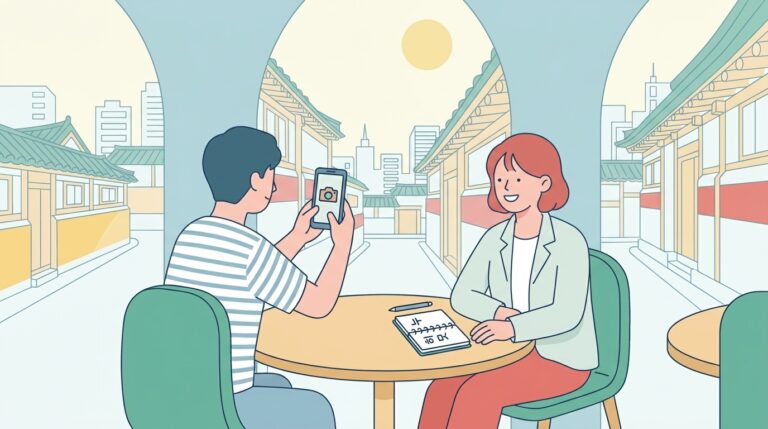
Picture this: You are relaxing at a sunlit aesthetic cafe in Ikseon-dong, enjoying a slice of matcha cake. Suddenly, the Korean traveler at the next table turns to you with an apologetic smile, holds up their smartphone, and asks, “저기요… 사진 한 번만 찍어주실 수 있으세요?” (Excuse me… could you take a photo for me?).
Your heart skips a beat. You genuinely want to help, but your brain freezes. Do you bark “알겠습니다!” (Understood!) like a stern soldier reporting for duty? Or do you mutter “네…” so quietly that you sound annoyed?
Accepting favors—부탁 들어주기—is one of the most heartwarming moments in everyday Korean life. It is the secret doorway to making Korean friends, building Jeong (emotional connection), and showing true warmth. Over the past 10 years of mentoring Korean language learners, I have seen so many beginners stumble not because they don’t want to help, but because textbooks teach stiff, wooden translations. In this guide, tailored specifically for A2 learners, we will transform your awkward nods into smooth, warm, and natural Korean responses. Let’s dive right in!
Phase 2: 3 Core Expressions for Accepting Favors
Here are the top three natural phrases you can rely on whenever someone asks you for a favor in Korea.
1. 그럼요, 도와드릴게요! (Geureomyo, dowadeurilgeyo!)
- Pronunciation: Geu-reom-yo, do-wa-deu-ril-ge-yo! (Sounds like: Guh-rum-yo, doh-wah-duh-ril-geh-yo)
- Meaning: Literal: “Of course, I will give you help!” | Real Nuance: “Of course, I’d be happy to help!”
- K-Culture Moment: Think of that warm, supportive colleague in a workplace K-Drama who steps in with a smile when someone drops a stack of paperwork.
- Editor’s Insight: Starting your sentence with 그럼요 (Of course) instantly relieves the other person’s hesitation. The verb 도와드리다 uses the humble auxiliary verb 드리다 (to give respectfully), which shows beautiful Korean politeness without sounding overly stiff.
- Situation Spectrum:
- Casual (Close friends): ⚠️ (Use “당연하지, 도와줄게!” instead)
- Semi-formal (Polite everyday / Cafes / Classmates): ✅
- Formal (Business / Elders): ✅
- 🤔 Think About It: In English, we often say “No problem!” (focusing on the lack of trouble), but Korean defaults to proactive positivity like 그럼요 (Of course!). How does this change the emotional warmth of the interaction?
2. 제가 해 드릴게요 (Jega hae deurilgeyo)
- Pronunciation: Je-ga hae deu-ril-ge-yo (Sounds like: Jay-gah heh-duh-ril-geh-yo)
- Meaning: Literal: “I will do [it] for you.” | Real Nuance: “Leave it to me! / I’ll take care of it for you.”
- K-Culture Moment: An attentive friend stepping forward to carry a heavy suitcase up the subway stairs at Hongdae station.
- Editor’s Insight: Use this when someone asks you to perform a specific action (e.g., taking a photo, opening a door, or editing a sentence). It sounds decisive, reassuring, and extremely kind.
- Situation Spectrum:
- Casual: ⚠️ (Use “내가 해줄게!”)
- Semi-formal: ✅
- Formal: ✅
- 🤔 Think About It: Notice the particle 제가 (Je-ga = “I”). Emphasizing 제 shows personal responsibility and care for the person asking.
3. 네, 좋아요! (Ne, joayo!)
- Pronunciation: Ne, jo-a-yo! (Sounds like: Neh, joh-ah-yoh)
- Meaning: Literal: “Yes, it is good!” | Real Nuance: “Sure, sounds great! / Happy to!”
- K-Culture Moment: Agreeing when a buddy asks, “Can you check this text message before I send it?”
- Editor’s Insight: This is the ultimate “Swiss Army Knife” of A2 Korean. It is bright, effortless to pronounce, and immediately sets a friendly tone.
- Situation Spectrum:
- Casual: ⚠️ (Use “응, 좋아!”)
- Semi-formal: ✅
- Formal: ⚠️ (In very formal business, use “네, 알겠습니다”)
- 🤔 Think About It: Why does adding a cheerful musical pitch to -요 convey more sincerity in Korean than complex vocabulary?
Phase 3: Textbook Korean vs. Real Korean
Let’s see how textbook phrases compare to what real Koreans say on the streets of Seoul.
Situation 1: Agreeing to help carry groceries or items
- 📖 교과서 한국어 (Textbook): “네, 당신의 부탁을 들어주겠습니다.” (Ne, dangsin-ui butak-eul deureojugessseumnida. – Yes, I shall grant your favor.)
- 🗣️ 진짜 한국어 (Real Life): “네, 좋아요! 제가 도와드릴게요.” (Ne, joayo! Jega dowadeurilgeyo. – Sure, I’d love to help!)
- 💡 왜 다를까? (Why is it different?): The word 당신 (you) and the formal phrase 부탁을 들어주다 sound like a legal contract! Real native speakers use natural, friendly action verbs.
Situation 2: Responding when someone says “Sorry to bother you”
- 📖 교과서 한국어 (Textbook): “그것은 저에게 문제가 되지 않습니다.” (Geugeoseun jeo-ege munje-ga doeji anseumnida. – That does not become a problem for me.)
- 🗣️ 진짜 한국어 (Real Life): “그럼요! 얼마든지요.” (Geureomyo! Eolmadeunjiyo. – Of course! Anytime / As much as you need!)
- 💡 왜 다를까? (Why is it different?): Literal negations like “no problem” can feel cold or translated from English. Koreans prefer enthusiastic reassurance like 얼마든지요 (Anytime / Gladly).
Phase 4: K-Culture Deep Dive & Non-Verbal Manners
4-1. 눈치 (Nunchi) & Polite Gestures
When someone hands you their smartphone to take their photo:
* Two Hands (두 손): Always receive their phone lightly with both hands. It shows respect and care for their personal belongings.
* Eye Contact & Slight Bow: Give a warm smile and a slight 15-degree head nod as you say “그럼요!”.
* Vocal Brightness: Slightly raise your vocal pitch on the last syllable (-요↗). A flat, low pitch can accidentally sound like you are annoyed by the chore.
4-2. The Cultural Phenomenon: 인생샷 (Insaeng-syat)
In Korea, agreeing to take someone’s photo is a sacred social contract! When you accept a photo favor, Koreans don’t expect just one click. The unspoken etiquette is to take 5 to 10 shots in both portrait and landscape orientation, crouching down slightly to make their legs look longer. When you hand the phone back saying, “확인해 보세요!” (Please check them out!), you will instantly be crowned a local hero.
Phase 5: Real-Life Roleplay Scenario
Setting: A trendy cafe in Seongsu-dong. You and Minji, your Korean study buddy, are sitting with your drinks. Minji looks a little nervous before asking for a quick favor.
- Turn 1 (Minji): 저기… 혹시 시간 괜찮으면 이것 좀 봐줄 수 있어요? (Jeogi… hoksi sigan gwaenchanheumyeon igeot jom bwajul su isseoyo?)
🎭 (Looks slightly hesitant, tapping her laptop screen)
“Um… if you have time, could you take a quick look at this?” - Turn 2 (You): 그럼요! 무슨 일이에요? (Geureomyo! Museun il-ieyo?)
🎭 (Smiles warmly and leans in)
“Of course! What’s going on?” - Turn 3 (Minji): 영어 발표 슬라이드인데, 어색한 문장 있는지 봐줄래요? (Yeongeo balpyo seullaideu-inde, eosaekan munjang inneunji bwajullaeyo?)
🎭 (Turns the laptop toward you with an apologetic grin)
“It’s my English presentation slide, could you see if there are any awkward sentences?” - Turn 4 (You): 네, 좋아요! 제가 해 드릴게요. (Ne, joayo! Jega hae deurilgeyo.)
🎭 (Nods reassuringly and adjusts glasses)
“Yes, sure! I’ll do it for you.” - Turn 5 (Minji): 정말요? 바쁠 텐데 너무 고마워요! (Jeongmalyo? Bappeul tende neomu gomawoyo!)
🎭 (Claps hands together in relief)
“Really? You must be busy, thank you so much!” - Turn 6 (You): 아니에요, 전혀 안 바빠요. 같이 봐요! (Anieyo, jeonhyeo an bappayo. Gati bwayo!)
🎭 (Waves hand gently to ease her mind)
“Not at all, I’m not busy. Let’s look together!” - Turn 7 (Minji): 덕분에 마음이 놓여요. 끝나고 맛있는 디저트 살게요! (Deokbune maeumi noyeoyo. Kkeun-nago masinneun dijeoteu salgeyo!)
🎭 (Beams happily)
“Thanks to you, I feel so relieved. I’ll buy delicious dessert after this!” - Turn 8 (You): 와, 기대할게요! 얼른 끝내봐요. (Wa, gidaehalgeyo! Eolleun kkeun-naebwayo.)
🎭 (Chuckles and points at the screen enthusiastically)
“Wow, I’ll look forward to it! Let’s finish it quickly.”
🔀 Interactive Decision Branch
What would you say if someone asks you for a favor on the street?
* Option A: “네, 좋아요! 제가 도와드릴게요.”
👉 [Best]: Warm, polite, and reassuring. The perfect response!
* Option B: “알겠습니다. 하십시오.”
👉 [Bad]: Sounds like a robotic military officer. Creates an awkward distance.
* Option C: “응, 그래.”
👉 [Risk]: Banmal (informal). Only safe with your closest same-age friends; rude to acquaintances or strangers.
Phase 6: 10-Second Emotion Shadowing Drill
Practice reading these out loud, pausing at the / marks and channeling the indicated mood!
[😊 기쁘고 활기차게 / Cheerful & Energetic]
그럼요! / 제가 / 도와드릴게요!
(Geureomyo! / Jega / dowadeurilgeyo!)-
[🤝 믿음직하고 따뜻하게 / Reliable & Warm]
네, 좋아요! / 같이 / 봐요.
(Ne, joayo! / Gati / bwayo.) -
[👋 부담을 덜어주며 / Relaxed & Reassuring]
아니에요, / 전혀 / 안 바빠요!
(Anieyo, / jeonhyeo / an bappayo!)
Phase 7: K-Culture Mini Dictionary
- 품앗이 (Pum-asi)
Literal: Traditional mutual labor exchange | Modern Usage: The cultural habit of exchanging favors warmly without keeping strict transactional score. - 인생샷 (Insaeng-syat)
Literal: Life shot | Modern Usage: A once-in-a-lifetime photo. The #1 reason Koreans ask strangers for favors at tourist spots. - 부탁 (Butak)
Literal: Request / Favor | Modern Usage: Used in expressions like 부탁해요 (Please take care of it) or 부탁 하나만 들어줘 (Do me a favor). - 매너 (Maeneo)
Literal: Manners / Etiquette | Modern Usage: Being attentive (센스, 눈치) to make the favor-asker feel comfortable.
Phase 8: Survival Kit for Travelers
Top 3 Survival Expressions for Travelers
- 사진 찍어드릴까요? (Sajin jjigeodeurilkkayo?)
“Shall I take a photo for you?”
💡 Pro Tip: Offer this to Koreans trying to take group selfies at Gyeongbokgung Palace. Instant smiles guaranteed! - 제가 도와드릴까요? (Jega dowadeurilkkayo?)
“May I help you?”
💡 Pro Tip: Perfect when you see someone struggling with a heavy cart on subway stairs. - 네, 여기 있어요! (Ne, yeogi isseoyo!)
“Yes, here you go!”
💡 Pro Tip: Use when handing back someone’s camera or passing a requested napkin.
🗺️ Editor’s Travel Note
When hunting for photogenic cafes, check our Naver Map app download guide to save your favorite spots in Seongsu and Yeonnam-dong. If you need help with directions, locals are extraordinarily kind—just remember to accept their help with a bright “감사합니다!”.
Phase 9: “한 발 더 깊이” (Deeper Reflection)
In Korean society, asking for and accepting favors is not viewed as an annoying imposition; rather, it is a vital vehicle for 정 (Jeong)—the warm, affectionate bond that ties community members together. When you gladly say “그럼요!”, you are opening the door to reciprocal hospitality. In Korea, favors rarely go unrewarded: don’t be surprised if your helpful gesture earns you a free coffee, a piece of candy, or a lifelong friend.
💬 Your Turn: Have you ever helped someone or received help while traveling in Korea? What phrase did you use? Share your experience in the comments below!
Phase 10: FAQ & Avoiding Common Mistakes
Q: Can I just say “네 (Ne)” when accepting a favor?
A: While “네” is polite, saying only “네” with a flat intonation can sound passive or reluctant. Adding “좋아요!” (네, 좋아요!) or “도와드릴게요!” makes your willingness sound genuine.
Q: What is the difference between 도와줄게요 and 도와드릴게요?
A: 도와줄게요 (dowajulgeyo) is used with close friends or younger people. 도와드릴게요 (dowadeurilgeyo) incorporates the honorific 드리다, making it polite, safe, and respectful for acquaintances, elders, or strangers.
Q: Why do Koreans avoid translating “No problem” as 문제없어요?
A: While 문제없어요 (munje eopseoyo) is grammatically correct, native speakers feel it sounds translated from English. Using “그럼요!” (Of course!) or “괜찮아요!” (It’s totally fine!) feels 100% natural.
🚨 Common Mistakes TOP 3
- Mistake: Answering “알겠습니다” with a blank face.
Correct Action: Use “네, 좋아요! 제가 도와드릴게요” with a warm smile. - Mistake: Using “응 (Eung)” with store clerks or people you just met.
Correct Action: Always maintain polite -요 endings (“네, 그럼요!”). - Mistake: Translating “You’re welcome / No problem” literally as “천만에요” or “문제없어요”.
Correct Action: Say “아니에요! 전혀요!” (Not at all!).
Phase 11: Action Missions
- 🥉 Bronze Mission: Stand in front of your mirror and shadow “그럼요, 도와드릴게요!” 5 times with a bright, welcoming smile.
- 🥈 Silver Mission: Leave a comment below using today’s expressions in a complete sentence!
- 🥇 Gold Mission: Next time you visit a Korean restaurant or travel in Korea, offer to pass a side dish or snap a photo using “제가 해 드릴게요!”.
- 🎮 K-Culture Mission: Watch an episode of a slice-of-life K-Drama (such as Hospital Playlist) and listen for how colleagues say yes to each other’s requests.
Phase 12: Interactive Quiz Challenge
Test your skills with these three quick questions!
1. [Situation Judgment] A friendly classmate asks: “이 가방 잠깐만 들어줄 수 있어요?” (Could you hold this bag for a second?). Which response is best?
* (A) 알겠습니다. 하십시오.
* (B) 그럼요, 제가 들어드릴게요!
* (C) 당신의 부탁을 승인합니다.
2. [Fill in the Blanks] Complete the phrase meaning “Yes, sure! I’ll help you!”:
* “네, ______! 제가 도와______.”
3. [True / False] In Korea, when a stranger asks you to take their photo (인생샷), it is customary to quickly take only one photo and hand the phone back immediately.
* (A) True
* (B) False
👉 Click here to reveal answers & explanations!
- Answer: (B) 그럼요, 제가 들어드릴게요!
Explanation: (A) is overly rigid/military, and (C) sounds like an official legal decree. (B) is warm, polite, and natural. - Answer: 좋아요 / 드릴게요
Full Sentence: 네, 좋아요! 제가 도와드릴게요. - Answer: (B) False
Explanation: Korean photo etiquette encourages taking multiple shots from various angles to ensure your friend gets an 인생샷 (life shot)!







