

Phase 1: Empathy & Storytelling Opening
안녕하세요! 매일한글 (Daily Hangul) 에디터입니다.
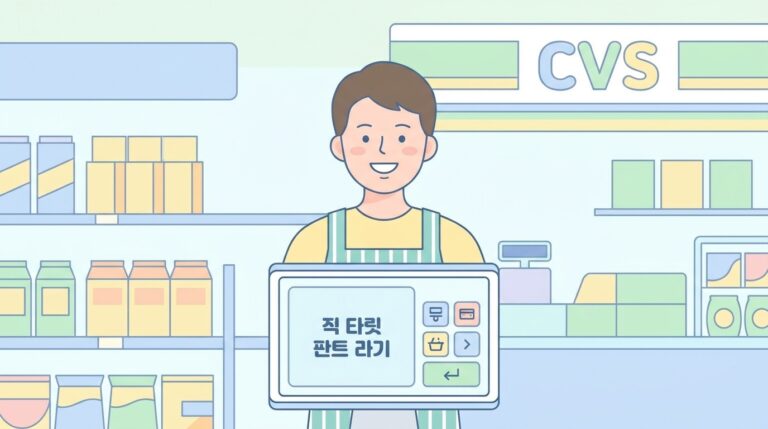
Picture this: It is your very first day working a part-time job (alba) at a bustling convenience store right outside Hongik University Station. The lunch rush hits. A customer in chic sunglasses slaps an iced Americano and a triangle gimbap on the counter, holding out a sleek metal card. Your heart pounds. You stare down at the glowing screen of the POS machine—a labyrinth of flashing neon buttons with labels like ‘카드결제’ (Card Payment), ‘현금영수증’ (Cash Receipt), and ‘적립/할인’ (Points/Discount).
Every foreign resident or student in Korea has felt that split-second panic when standing behind a Korean register. You want to be polite, fast, and confident, but your tongue feels tied. What if I press the wrong button? What do I ask first?
Don’t worry! Operating a POS machine (포스기) in Korea isn’t about memorizing fifty complex textbook dialogues. In fact, real convenience store and cafe counters run on just three to four core building-block phrases. Based on real-world training sessions with hundreds of beginner learners working in Seoul, this guide will transform your register anxiety into total professional confidence.
Phase 2: Core Expressions In-Depth Analysis
1. 봉투 필요하세요? (Bongtu piryohaseyo?)
- Pronunciation: [Bong-too pee-ryo-ha-seh-yo?] (Think of ‘bong’ like a soft chime, and ‘too’ like the number two: Bong-too!)
- Meaning: Literal: “Is a bag necessary?” | Real-life nuance: “Would you like a plastic bag / shopping bag?”
- K-Culture Moment: Just like in the K-drama Work Later, Drink Now when the characters stumble into a late-night convenience store, the cashier’s instinctual first question before scanning items is always this exact line.
- Editor’s Insight: Due to eco-friendly retail laws in Korea, single-use plastic bags cost 50 to 100 KRW and are never given automatically. Asking this right away saves you from having to re-scan or charge separately later.
- Situation Spectrum: Casual ⚠️ | Semi-formal ✅ | Formal ✅
- 🤔 Think About It: In many Western supermarkets, cashiers automatically pack your groceries into bags. Why do you think Korean stores emphasize asking before offering a bag?
2. 카드로 결제 도와드릴게요. (Kadeuro gyeolje dowadeurilgeyo.)
- Pronunciation: [Kah-deu-ro gyul-jeh do-wah-deu-ril-geh-yo.] (The word ‘gyeolje’ sounds like ‘guhl-jeh’—crisp and smooth.)
- Meaning: Literal: “I will help you with card payment.” | Real-life nuance: “I’ll process your card payment now / Please tap or insert your card here.”
- K-Culture Moment: Seen frequently in cafe scenes in Itaewon Class, where staff warmly guide customers toward the card reader terminal while taking an order.
- Editor’s Insight: Korean service speech loves using the verb ‘돕다’ (dopda – to help) to make standard business transactions sound caring and cooperative rather than purely transactional.
- Situation Spectrum: Casual 🚫 | Semi-formal ✅ | Formal ✅
- 🤔 Think About It: Notice how Korean customer service frames payment as helping the customer rather than demanding money. How does this compare to customer service in your home country?
3. 영수증 버려드릴까요? (Yeongsujeung beoryeodeurilkkayo?)
- Pronunciation: [Young-soo-jeung buh-ryuh-deu-ril-kka-yo?] (Imagine saying ‘young’ + ‘sue’ + ‘jeung’.)
- Meaning: Literal: “Shall I throw away the receipt for you?” | Real-life nuance: “Would you like me to discard your receipt, or do you need it?”
- K-Culture Moment: In countless Korean YouTube vlogs (Alba Vlogs), convenience store workers ask this with their hand already gently hovering over the small receipt trash bin beneath the counter!
- Editor’s Insight: Most Korean customers pay by smartphone app or card and rarely keep paper receipts. Saying this phrase proactively is considered peak efficiency (빨리빨리, ppalli-ppalli) service etiquette.
- Situation Spectrum: Casual ⚠️ | Semi-formal ✅ | Formal ✅
- 🤔 Think About It: Rather than asking “Do you want a receipt?”, Koreans often ask “Should I throw it away for you?”. What does this reveal about Korea’s fast-paced digital payment culture?
Phase 3: Textbook Korean vs. Real Korean
Situation 1: Asking about receipts
- 📖 교과서 한국어 (Textbook): 영수증을 받으시겠습니까? (Yeongsujeungeul badeusigesseumnikka? – Would you like to receive your receipt?)
- 🗣️ 진짜 한국어 (Real-life): 영수증 버려드릴까요? (Yeongsujeung beoryeodeurilkkayo? – Shall I throw the receipt away for you?)
- 💡 왜 다를까? (Why is it different?): Textbook phrases are ultra-formal and assume paper record keeping. In contemporary cashless Korea, 90% of customers discard paper receipts, so cashiers offer the proactive favor of tossing it immediately.
Situation 2: Asking for payment method
- 📖 교과서 한국어 (Textbook): 어떻게 지불하시겠습니까? (Eotteoke jibulhasigesseumnikka? – How would you like to disburse payment?)
- 🗣️ 진짜 한국어 (Real-life): 결제 어떻게 도와드릴까요? (Gyeolje eotteoke dowadeurilkkayo? – How can I help you pay?)
- 💡 왜 다를까? (Why is it different?): The textbook term 지불 (jibul) sounds like a legal accounting term! Real retail staff use 결제 (gyeolje – settlement/payment) coupled with polite helper verbs.
Phase 4: K-Culture Deep Dive & Non-Verbal Manners
4-1. 눈치 (Nunchi) & Counter Body Language
- The Two-Handed Handover: When receiving or returning a customer’s credit card or cash, always hold the card with both hands or support your right forearm with your left hand. Passing a card with one hand while looking away is considered blunt or dismissive.
- Screen Pointing Gesture: Korean IC chip readers can sometimes be tricky to spot. Politely point with an open palm (never a single index finger) toward the IC slot while saying “여기에 꽂아주세요” (Yeogie kkojajuseyo – Please insert it here).
4-2. Culture Code Analysis: Convenience Stores (Pyeon-ui-jeom)
Korean convenience stores are cultural community hubs open 24/7. Promotional tags like 1+1 (One-Plus-One) and 2+1 dominate the shelves. As a cashier, customers often grab only one item, not knowing it’s on a 2+1 promotion. Having the nunchi to alert them—”이거 2+1 행사 상품이에요!” (Igeo two-plus-one haengsa sangpum-ieyo!)—is the hallmark of a beloved, top-tier part-timer.
Phase 5: Real-Life Roleplay Scenario
- Setting: A bright, lively CU convenience store in Mapo-gu during the 8:30 AM morning rush.
- Character: Min-jun (a 20-something office worker holding a banana milk, a sandwich, and his phone ready for mobile pay).
[1] Min-jun: 안녕하세요! (Annyeonghaseyo!)
    🎭 [Rushes to the counter and places items down with a warm smile]

[2] You (Cashier): 안녕하세요! 봉투 필요하세요? (Annyeonghaseyo! Bongtu piryohaseyo?)
    🎭 [Scans the barcode with the scanner beep and looks up kindly]

[3] Min-jun: 아니요, 괜찮아요. 그냥 들고 갈게요. (Aniyo, gwaenchanayo. Geunyang deulgo galgeyo.)
    🎭 [Shakes his hand lightly to decline the bag]

[4] You (Cashier): 네, 총 4,500원입니다. 포인트 적립 있으세요? (Ne, chong sacheon-obaeg-won-imnida. Pointeu jeongnip isseuseyo?)
    🎭 [Checks the POS screen total and points politely toward the keypad]

[5] Min-jun: 없어요. 카카오페이로 결제할게요. (Eopseoyo. Kakaopeiro gyeoljehalgeyo.)
    🎭 [Shows the QR code barcode on his smartphone screen]

[6] You (Cashier): 네, 바코드 찍어드릴게요. (Ne, bakodeu jjigeodeurilgeyo.)
    🎭 [Beeps the phone screen smoothly with the scanner gun]

[7] You (Cashier): 결제되셨습니다. 영수증 버려드릴까요? (Gyeoljedoesyeosseumnida. Yeongsujeung beoryeodeurilkkayo?)
    🎭 [Tears the receipt halfway and tilts head pleasantly]

[8] Min-jun: 네, 버려주세요. 수고하세요! (Ne, beoryeojuseyo. Sugohaseyo!)
    🎭 [Grabs his food and gives a polite nod as the automatic door opens]
🔀 Interactive Decision Point
The customer brings a can of coffee that has a bright yellow ‘1+1’ tag on the shelf, but he only brought one can to the counter. What do you do?
- Option A: Say nothing, scan it, and let him pay for just one.
👉 Feedback [Bad]: The customer might realize outside, feel disappointed that he missed a free drink, and come back for a refund during a rush! - Option B: Loudly shout: “손님! 왜 하나만 가져왔어요?” (Customer! Why did you only bring one?)
👉 Feedback [Risk]: Too direct and informal. It may startle or embarrass the customer. - Option C: Politely say: “손님, 이거 1+1 상품인데 하나 더 가져오시겠어요?” (Customer, this is a 1+1 item; would you like to bring one more?)
👉 Feedback [Best ⭐]: Exemplary service! The customer will be super grateful for your quick thinking and kindness.
Phase 6: 10-Second Emotion Shadowing Drill
Practice reading these rhythmically! The / indicates a brief natural pause.
[😊 밝고 친절하게 (Bright & Friendly)]
안녕하세요! / 봉투 / 필요하세요?
(Annyeonghaseyo! / Bongtu / piryohaseyo?)-
[⚡ 신속하고 차분하게 (Fast & Composed)]
네, / 총 오천 원입니다. / 카드로 / 결제 도와드릴게요.
(Ne, / chong ocheon-won-imnida. / Kadeuro / gyeolje dowadeurilgeyo.) -
[🤝 배려 넘치고 경쾌하게 (Caring & Breezy)]
결제 완료되셨습니다. / 영수증 / 버려드릴까요?
(Gyeolje wanryodoesyeosseumnida. / Yeongsujeung / beoryeodeurilkkayo?)
Phase 7: K-Culture Mini Dictionary
- 알바 (Alba) | Part-time Job
Short for the German-loan word Arbeit. In Korea, working a part-time job at a convenience store, cafe, or restaurant is affectionately referred to as doing alba (알바하다). - 포스기 (Poseugi) | POS Machine / Checkout Register
The touchscreen cash register terminal found in all Korean stores. Key buttons include 객층키 (Customer demographic button) and 현금/카드 (Cash/Card). - 바코드 (Bakodeu) | Barcode
Used when scanning merchandise. When scanning a phone screen coupon or payment app, cashiers say “바코드 찍을게요” (I’ll scan the barcode). - 적립 (Jeongnip) | Points Accumulation / Loyalty Points
Koreans love reward points (CJ ONE, Shinsegae Point, Happy Point). Asking “적립 있으세요?” (Do you have membership points?) is standard procedure.
Phase 8: Survival Kit for Part-Timers & Travelers
- Top 1: 여기에 카드 꽂아주세요. (Yeogie kadeu kkojajuseyo. – Please insert your card right here.)
Pro Tip: Use this when foreigners or elderly customers are searching for where to tap or insert their credit card. - Top 2: 카카오페이나 제로페이 되세요. (Kakaopeina Jeropei doeseyo. – Kakao Pay and Zero Pay are accepted.)
Pro Tip: Great when mobile-first shoppers ask if smartphone QR payment is supported. - Top 3: 교환이나 환불은 영수증 가져오셔야 해요. (Gyohwan-ina hwanbureun yeongsujeung gajyeoosyeoya haeyo. – For exchanges or refunds, you must bring the receipt.)
Pro Tip: Crucial for preventing future misunderstandings.
📱 Editor’s Travel & Work Note:
If you are looking for part-time work in Korea, check out the Albamon Job Search Portal for Foreigners and keep payment apps updated. When navigating local store shifts, knowing how public transit cards like T-money are reloaded (교통카드 충전) on the POS screen will make you the manager’s favorite hire!
Phase 9: “One Step Deeper” (Cultural Reflection)
In Korean retail and service interactions, language acts as a delicate social bridge. Notice how honorific endings like -세요 (-seyo) and helper verbs like 도와드리다 (to assist/help) soften what would otherwise be a cold commercial command. Operating a register is not merely pressing buttons; it is participating in Korea’s mutual respect dynamic. Even during a busy 10-second interaction, both customer and worker acknowledge each other’s effort through tiny linguistic courtesies.
💬 Your Turn: Have you ever felt nervous when paying at a foreign register? What is the most surprising difference between Korean convenience stores and stores in your home country? Drop your story in the comments below!
Phase 10: FAQ & Avoiding Misunderstandings
Q: What is the demographic button (객층키) on the POS screen that beeps before scanning?
A: Most Korean convenience store POS machines require the cashier to press a quick demographic estimate button (e.g., ‘남 20’ for male in his 20s, or ‘여 30’ for female in her 30s) before opening the scan transaction. It is purely for marketing analytics, so don’t stress over getting the exact age right—just tap the closest button!
Q: What should I say if a customer’s card gets declined?
A: Never say “돈이 없어요” (You have no money)! Politely say: “한도 초과 / 카드 오류로 나오는데, 다른 카드 있으실까요?” (Hando chogwa / kadeu oryuro naoneunde, dareun kadeu isseusilkkayo? – It is showing a limit reached / card error; do you happen to have another card?)
Q: How do I ask if someone wants to split the bill (Dutch Pay)?
A: You can ask: “따로 결제해 드릴까요?” (Ttaro gyeoljehae deurilkkayo? – Would you like me to split/process the payments separately?)
🚨 COMMON MISTAKES WARNING BOARD
--------------------------------------------------------------
1. [WRONG] "봉투 줄까?" (Bongtu julkka? - Casual talk to strangers)
   -> [CORRECT] "봉투 필요하세요?" (Always use polite 존댓말 at work!)

2. [WRONG] Handing back credit cards with only one thumb and index finger.
   -> [CORRECT] Hand back cards using both hands with a slight head nod.

3. [WRONG] Throwing away receipts without asking first.
   -> [CORRECT] Always ask: "영수증 버려드릴까요?" before crumpling it!
--------------------------------------------------------------
Phase 11: Action Missions & Engagement
- 🥉 Bronze Mission (Solo Practice): Stand in front of your mirror and practice saying “봉투 필요하세요?” and “영수증 버려드릴까요?” 5 times with a warm smile.
- 🥈 Silver Mission (Observation): Visit a local Korean mart, cafe, or K-food grocery store, listen carefully to the cashier, and spot which of today’s 3 phrases they use first!
- 🥇 Gold Mission (Real-World Test): Next time you buy something at a Korean store, reply to the cashier before they finish asking: “영수증은 버려주세요, 감사합니다!”
🎮 K-Culture Mission: Watch an episode of a Korean drama featuring a convenience store (like Backstreet Rookie), and count how many times the POS machine beep coincides with a greeting!
Phase 12: Interactive Quiz Challenge
1. Situation Challenge: A customer arrives with their hands overflowing with 5 drink cans and snacks. Which phrase should you say first?
– (A) 영수증 버려드릴까요?
– (B) 봉투 필요하세요?
– (C) 포인트 없으세요?
2. Fill-in-the-Blank: Complete the polite cashier sentence:
“카드로 결제 ________드릴게요.”
– (A) 도와
– (B) 버려
– (C) 찍어
3. True or False: In Korea, cashiers must provide single-use plastic bags for free whenever requested.
– (True / False)
👉 Click here to reveal answers & explanations!
-
Answer: (B) 봉투 필요하세요?
Explanation: Since the customer is carrying too many items, offering a shopping bag immediately is the most helpful and practical step. -
Answer: (A) 도와
Explanation: 도와드릴게요 (dowadeurilgeyo) means “I will help you with…”. The full phrase means “I’ll help you pay with card.” -
Answer: False
Explanation: Under Korean environmental regulations, plastic bags must be charged separately (usually 50~100 KRW) and cannot be given out for free.







